Positive Behaviour Support (PBS) can support both children and adults living with disability, but what that support looks like can change significantly across different stages of life.
The core principles of positive behaviour support for children and adults remain consistent: understand why behaviour is happening, identify the person’s needs, build useful skills and create environments that support participation and quality of life.
However, a child attending school and living with family may have very different goals, routines and environments from an adult who is working, building relationships, participating in the community or living more independently.
That is why PBS for children vs adults should not be viewed as two completely different approaches. Instead, Positive Behaviour Support should adapt to the person’s age, communication preferences, individual circumstances, support needs and goals.
What Is Positive Behaviour Support?
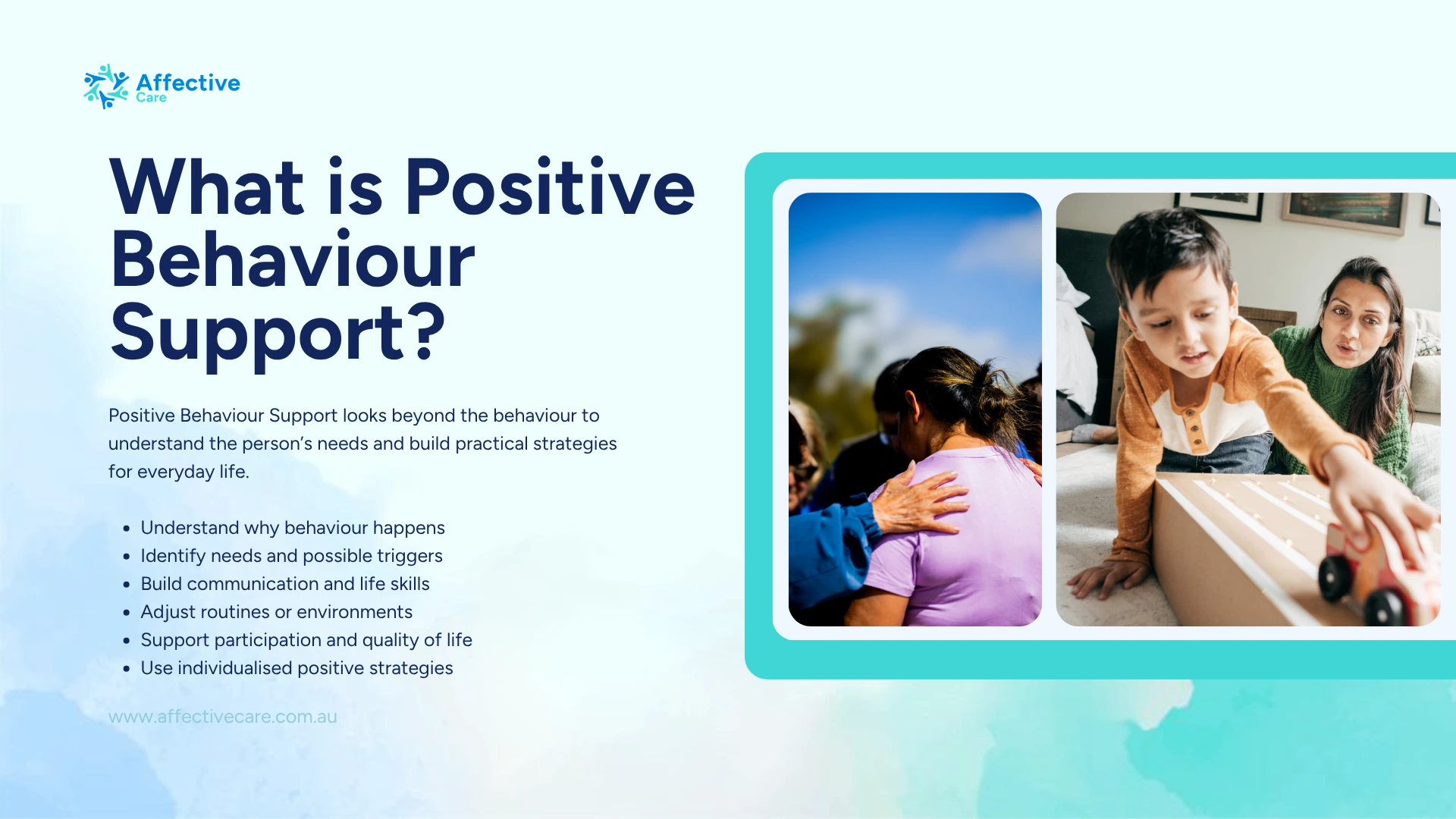
Positive Behaviour Support is an evidence-informed approach that seeks to understand the reasons behind behaviours of concern rather than focusing only on stopping the behaviour.
Under current NDIS guidance, behaviour support can include strategies designed to understand why behaviours of concern occur, meet individual needs, improve quality of life and reduce or manage behaviours of concern over time.
Positive behaviour support strategies may include skill development, environmental changes and guidance for the people providing everyday support.
For example, instead of simply asking, “How do we stop this behaviour?”, PBS may explore questions such as:
- What is the person trying to communicate?
- What tends to happen before the behaviour?
- Are certain environments, activities or transitions difficult?
- Does the person need another way to communicate their needs?
- Could changes to routines or the environment help?
- What new skills could make everyday situations easier?
This means positive behaviour support for children and adults should always be individualised rather than applying the same strategy to everyone.
Is PBS Different for Children and Adults?
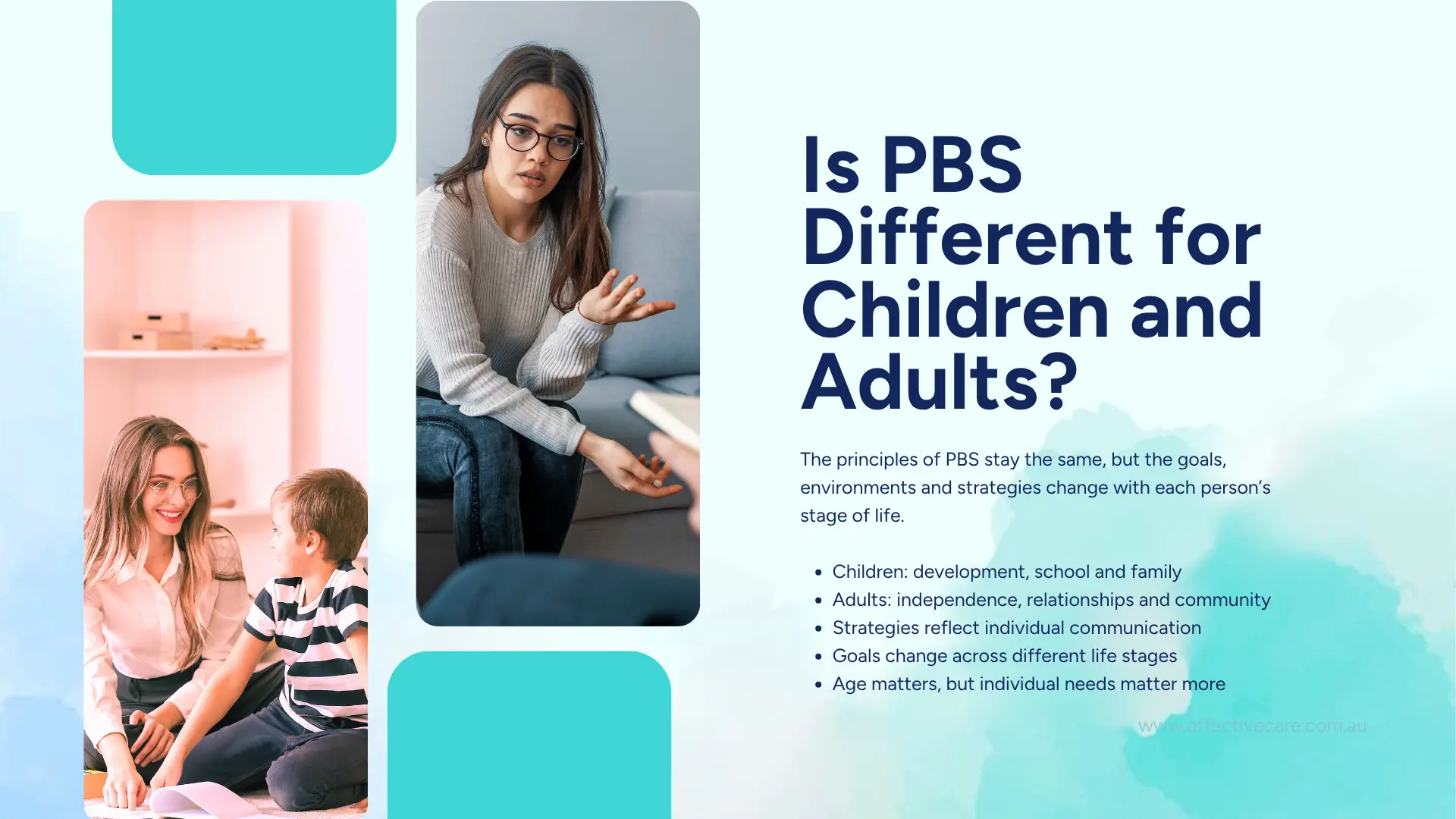
The principles are similar, but how they are applied can be different.
A child’s life may centre around family, school, play, learning, communication development and everyday routines.
An adult’s priorities may include independence, relationships, employment, community participation, home life, self-advocacy and having greater control over everyday decisions.
This means PBS for children might place greater emphasis on developmental needs, family routines and participation at school, while PBS for adults may place stronger emphasis on personal goals, autonomy and participation in adult life.
The person's disability, communication style and individual needs are still more important than age alone.
PBS for Children vs Adults at a Glance
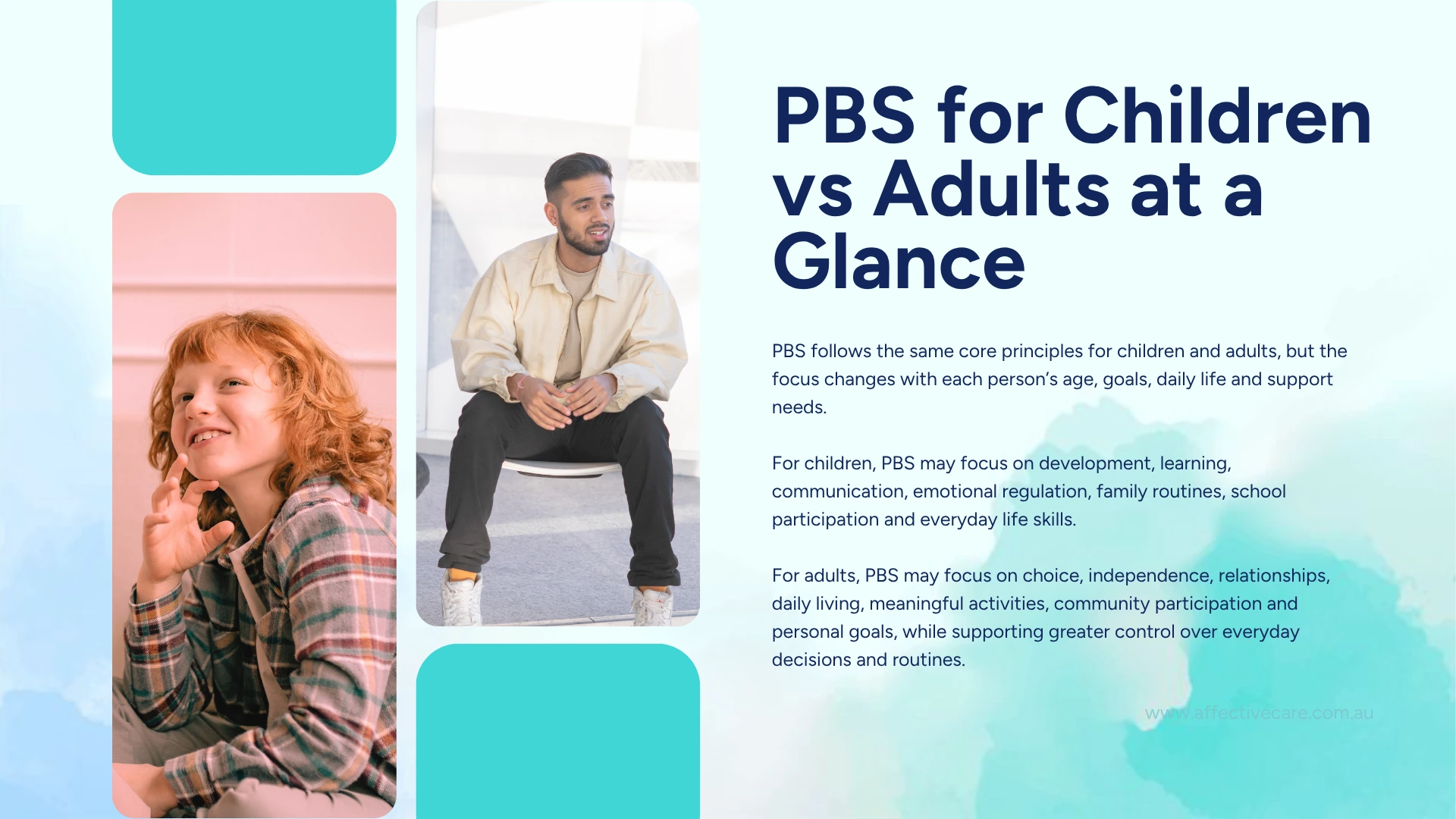
| Area | PBS for Children | PBS for Adults |
| Main focus | Development, communication, participation and skill building | Choice, independence, relationships, participation and quality of life |
| Common environments | Home, school, childcare and community | Home, work, community and supported living environments |
| People involved | Child, parents, carers, teachers and therapists | Participant, family where appropriate, support workers and other professionals |
| Goals | Communication, routines, emotional regulation, participation and learning | Independent living, communication, relationships, work and community participation |
| Strategies | Adapted to developmental needs and everyday childhood environments | Adapted to individual preferences, responsibilities and adult life |
| Decision-making | Child's rights, voice and preferences are considered with appropriate support | Strong emphasis on the participant's choices, will, preferences and supported decision-making |
These are general differences rather than fixed rules. Every positive behaviour support plan should respond to the individual person.
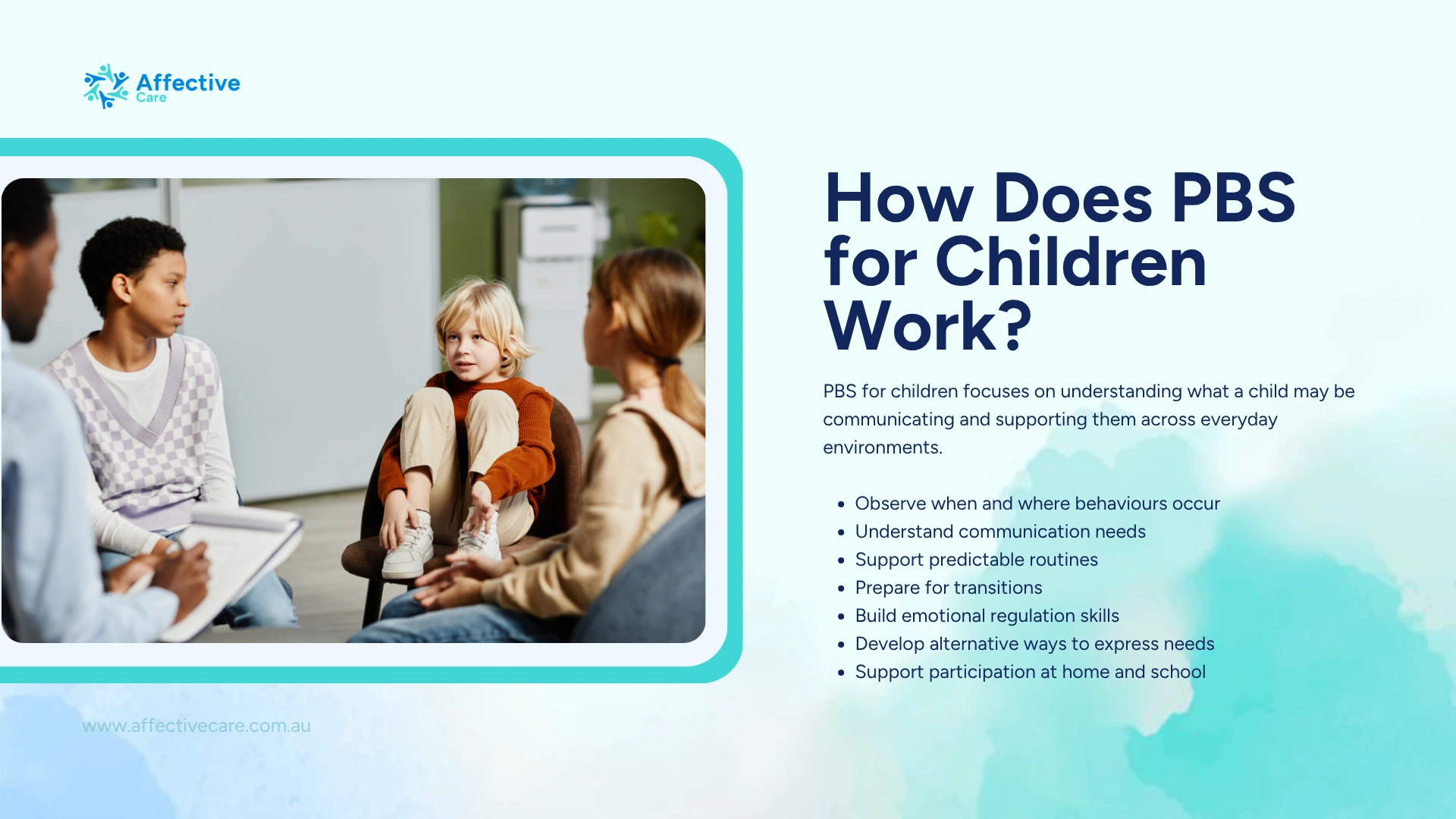
How Does PBS for Children Work?
Positive behaviour support for children begins with understanding the child rather than making assumptions about the behaviour.
A Behaviour Support Practitioner may look at where and when behaviours occur, what happens beforehand, how others respond and what the child may be communicating through their behaviour.
For younger children, everyday environments are particularly important.
The current NDIS early childhood approach emphasises participation in natural environments such as the child's home, childcare, playgroup and community. It also recognises the important role families and other adults have in supporting a child's development and participation.
PBS Strategies for Children
Depending on an individual assessment, PBS strategies for children might include:
- Developing communication skills
- Making routines easier to understand
- Preparing for transitions
- Adjusting environmental factors
- Providing choices in an age-appropriate way
- Teaching alternative ways to express needs
- Supporting emotional regulation
- Building social or everyday living skills
- Helping adults respond more consistently
For example, if a child finds an unexpected change in routine difficult, simply telling them to “behave” does not explain what is causing the difficulty.
A PBS approach may investigate whether additional preparation, visual information, communication support or a more predictable transition could help.
The goal is not to make every child behave in the same way. It is to understand their needs and support meaningful participation in everyday life.
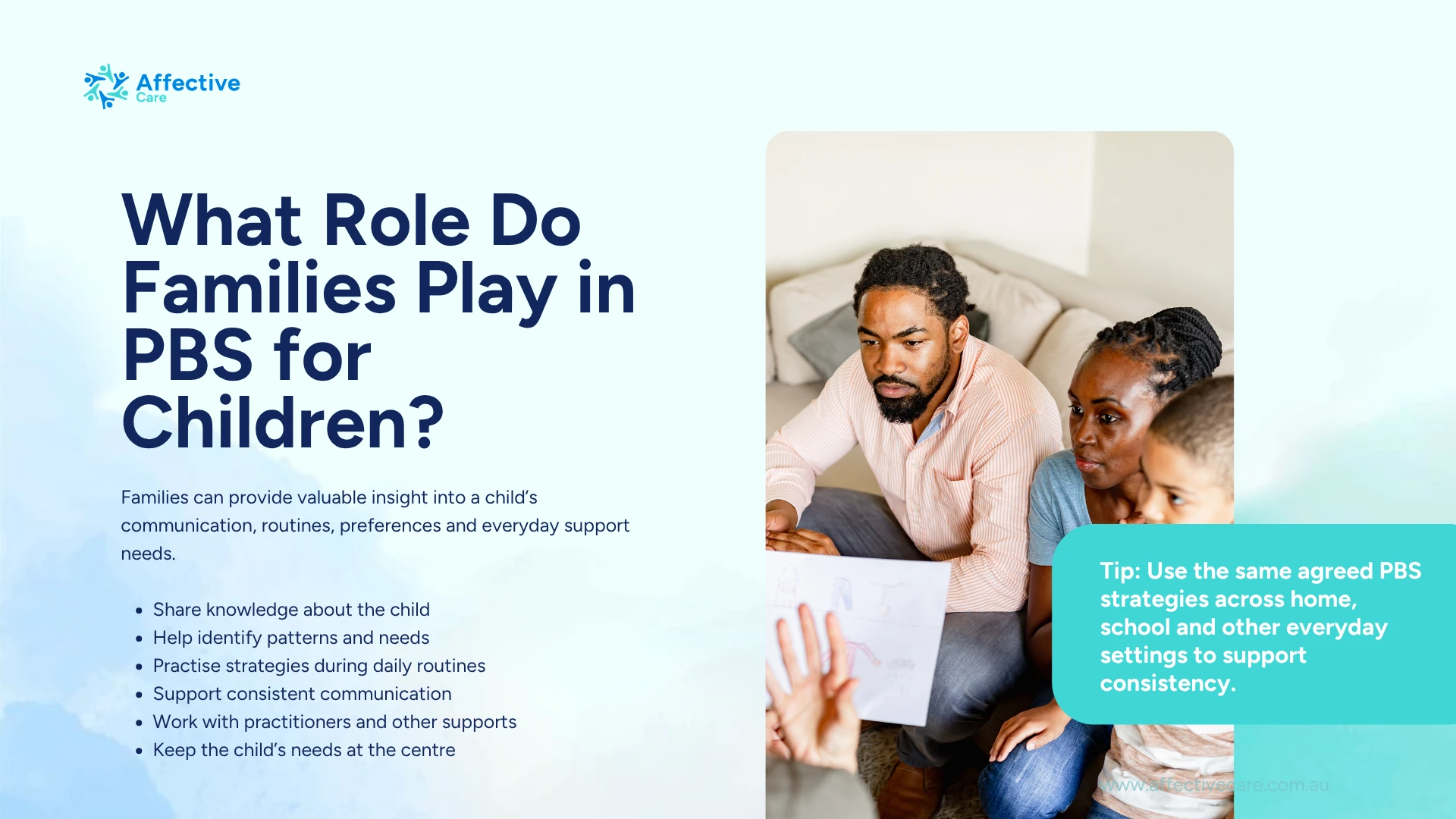
What Role Do Families Play in PBS for Children?
Families often play an important role in behaviour support for children because they know the child's routines, communication and preferences.
A Behaviour Support Practitioner may therefore collaborate with parents, carers and other important people to understand what is happening across different environments.
Schools, educators, therapists and support workers may also contribute useful information where appropriate and with relevant consent.
Consistency can be particularly important.
If a child is learning a new communication strategy, for example, it may be more useful when the important people around them understand how and when to support it.
PBS should also avoid treating parents as responsible for “fixing” behaviour.
The focus is on understanding the child, identifying practical supports and helping the people around them respond in ways that support their needs.
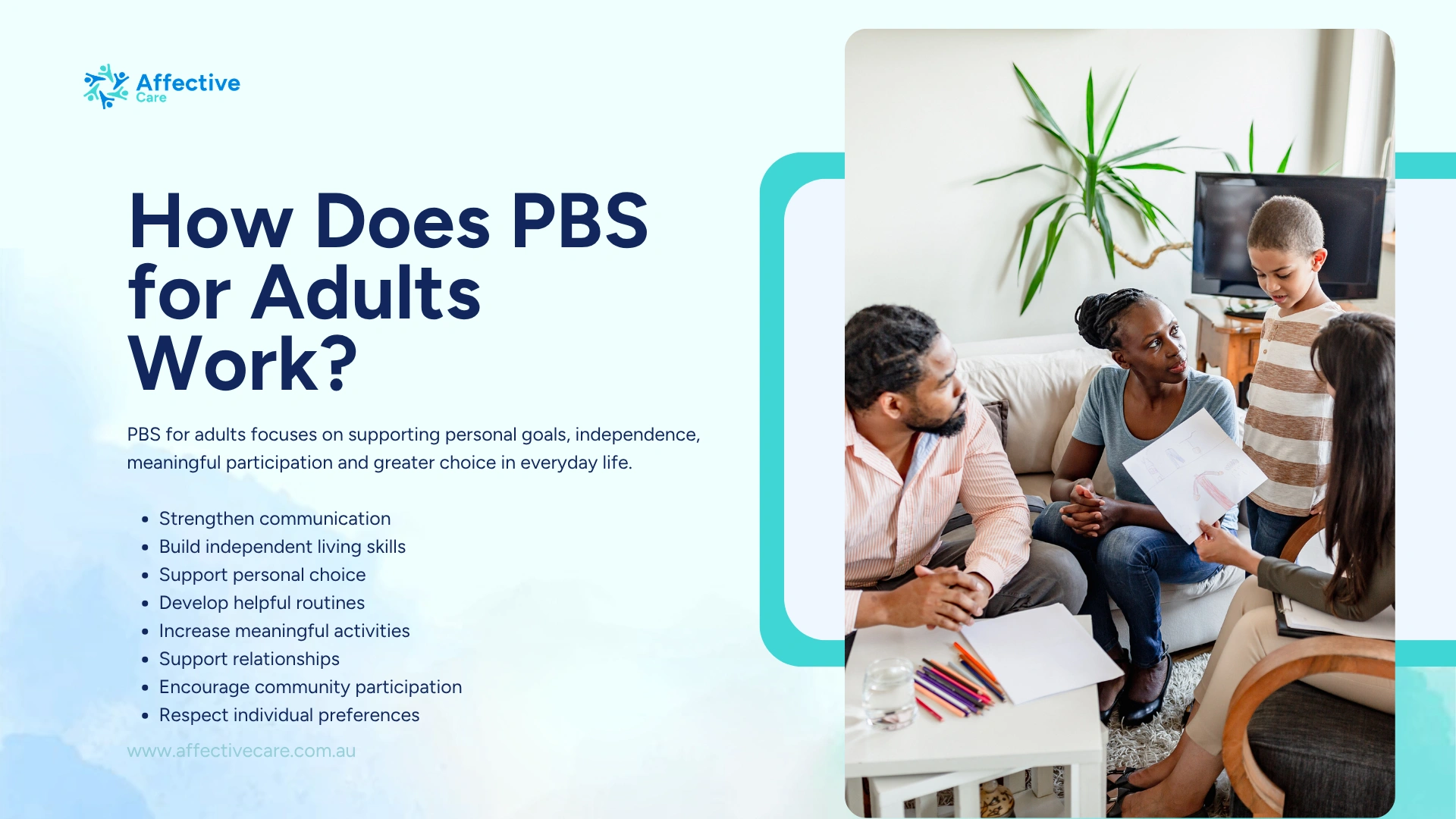
How Does PBS for Adults Work?
Positive behaviour support for adults follows the same underlying principles but needs to reflect adult life.
An adult participant may have goals related to living more independently, developing relationships, participating in community activities, employment, communication, daily routines or having greater control over their own support.
PBS should therefore be centred on the participant's own goals, preferences and quality of life.
PBS Strategies for Adults
Depending on the person's circumstances and assessment, PBS strategies for adults may include:
- Developing communication strategies
- Adjusting environmental factors
- Building independent living skills
- Supporting predictable routines
- Increasing access to meaningful activities
- Developing coping or self-regulation skills
- Improving consistency between support workers
- Strengthening social and community participationSupporting personal choice
An important principle in adult support is ensuring that assistance does not unnecessarily replace the person's own decision-making.
For example, current NDIS Commission supported decision-making standards for SIL emphasise helping participants understand their options and make decisions themselves based on their individual needs, skills and communication preferences.
While those specific standards apply to SIL providers, the underlying focus on respecting participant choice provides useful context when considering adult supports.
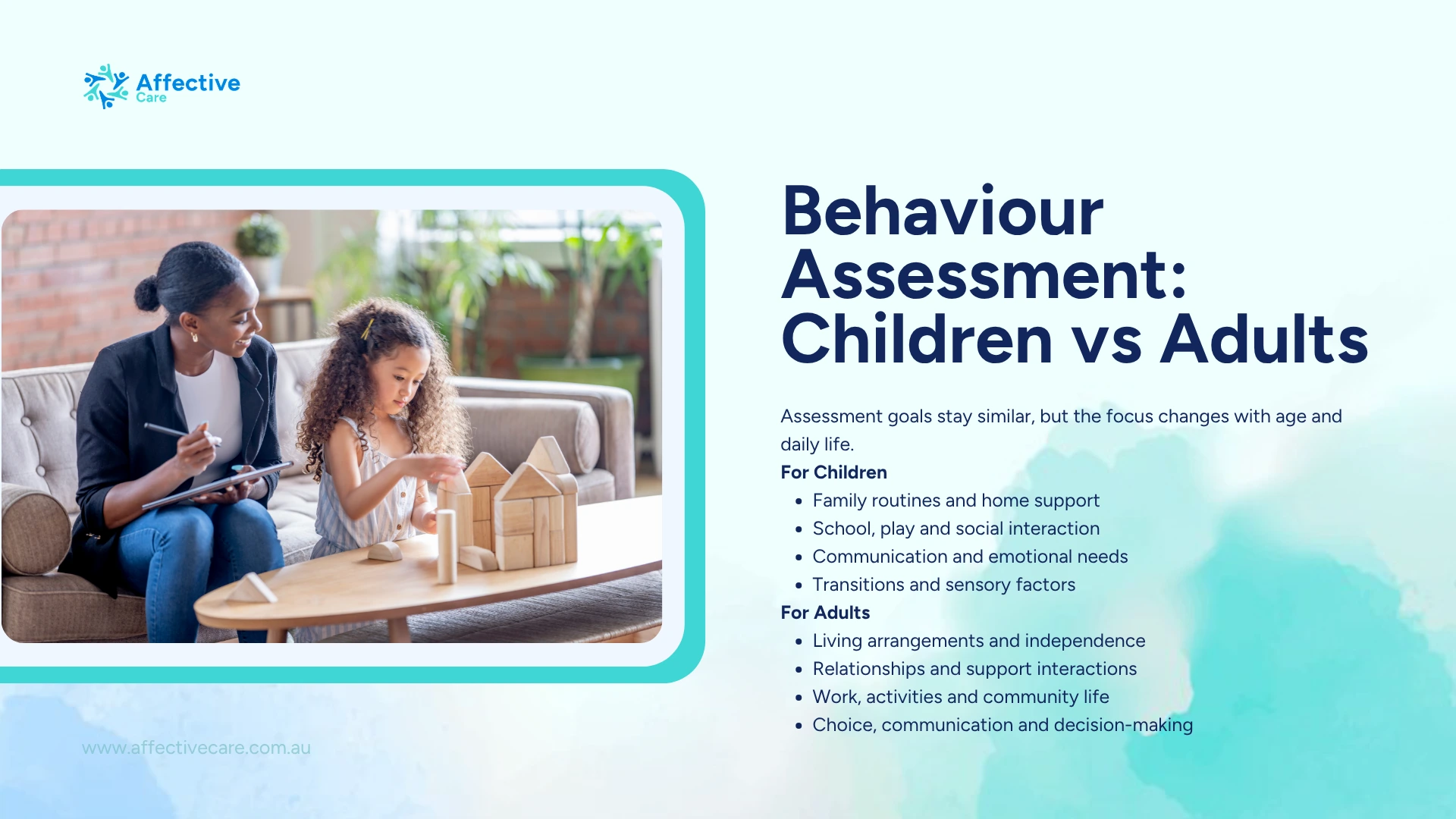
Does the Behaviour Assessment Change for Children and Adults?
The purpose of a behaviour assessment remains similar: gather information that helps explain the behaviour and identify appropriate supports.
An assessment should not assume that a particular behaviour has the same purpose for every person.
For a child, assessment might consider:
- family routines
- school environments
- play
- communication development
- sensory environments
- transitions
- interaction with parents, carers and educators.
For an adult, assessment might consider:
- living arrangements
- communication
- relationships
- employment or day activities
- community environments
- support worker interactions
- daily routines
- opportunities for choice and independence.
Current NDIS guidance recognises behaviour support assessments as one type of behaviour support that may meet the applicable NDIS funding criteria.
A functional behaviour assessment may also form part of specialist behaviour support where appropriate.
The important point is that assessment needs to look at the whole person and their environment rather than treating behaviour as an isolated problem.
Behaviour Support Plans for Children vs Adults
A positive behaviour support plan documents strategies designed around the individual participant.
The NDIS Quality and Safeguards Commission states that behaviour support plans should be developed in consultation with the person living with disability and relevant family members, carers or other support people.
For a child, a plan might place greater emphasis on:
- communication
- family routines
- transitions
- school participation
- emotional regulation
- developmental skills
- strategies for parents, carers or educators.
For an adult, the plan may focus more heavily on:
- individual preferences
- independence
- relationships
- home routines
- employment or meaningful activities
- community participation
- communication
- consistency across support teams.
A Behaviour Support Plan should not remain unchanged simply because it worked at one point in the person's life.
Needs, environments, relationships and goals can change. PBS should be reviewed accordingly so that the support remains relevant to the person's current life.
Positive Behaviour Support Across Different Life Stages
One of the biggest differences between PBS for children vs adults is that goals naturally evolve across the lifespan.
A child may initially work on communicating needs, managing transitions or participating in school.
During adolescence, priorities may start changing towards greater independence, social relationships, community participation and preparing for adult life.
As an adult, the person may want to focus on employment, relationships, living arrangements, independent decision-making or participating more freely in their community.
Good positive behaviour support for children and adults therefore grows with the person.
The focus should not simply be:
“How can we reduce this behaviour?”
A more useful question may be:
“What does this person need to participate more fully in the life they want?”
That broader perspective helps keep PBS focused on quality of life rather than behaviour alone.
Positive Behaviour Support and the NDIS
Behaviour support is identified within current NDIS guidance as a therapeutic support that can be included as an NDIS support where the relevant requirements are met.
However, having an NDIS plan does not automatically mean every participant will have behaviour support included.
The NDIS states that behaviour support must meet applicable funding criteria.
Supports that may be considered include behaviour support assessments, Behaviour Support Plans, staff training and monitoring, positive behaviour support training for family members, friends or carers, and interim Behaviour Support Plans.
Where behaviour support is provided as an NDIS support, current guidance also states that it must be delivered through appropriately registered providers and professionals with specialist behaviour support skills.
The NDIS Quality and Safeguards Commission's Positive Behaviour Support Capability Framework sets expectations around the knowledge and capabilities of NDIS Behaviour Support Practitioners and supports safeguards for people receiving specialist behaviour support.
Participants and families should therefore check their individual plan, circumstances and current NDIS requirements rather than assuming PBS will automatically be included.
How to Choose a Behaviour Support Practitioner
Whether you are seeking PBS for children or PBS for adults, the practitioner should understand that behaviour support needs to fit the individual person.
Useful questions to ask include:
- What experience do you have supporting people of a similar age?
- How will you involve the participant in decision-making?
- How will you understand their communication preferences?
- How will you identify why behaviours may be occurring?
- How will family or carers be involved where appropriate?
- Can you collaborate with schools, therapists or support workers?
- How will progress be reviewed?
- How will strategies support quality of life?
- How will the Behaviour Support Plan change if circumstances change?
The goal is not simply to find someone who can produce a plan. Look for an approach that takes time to understand the participant, their environment and what matters to them.
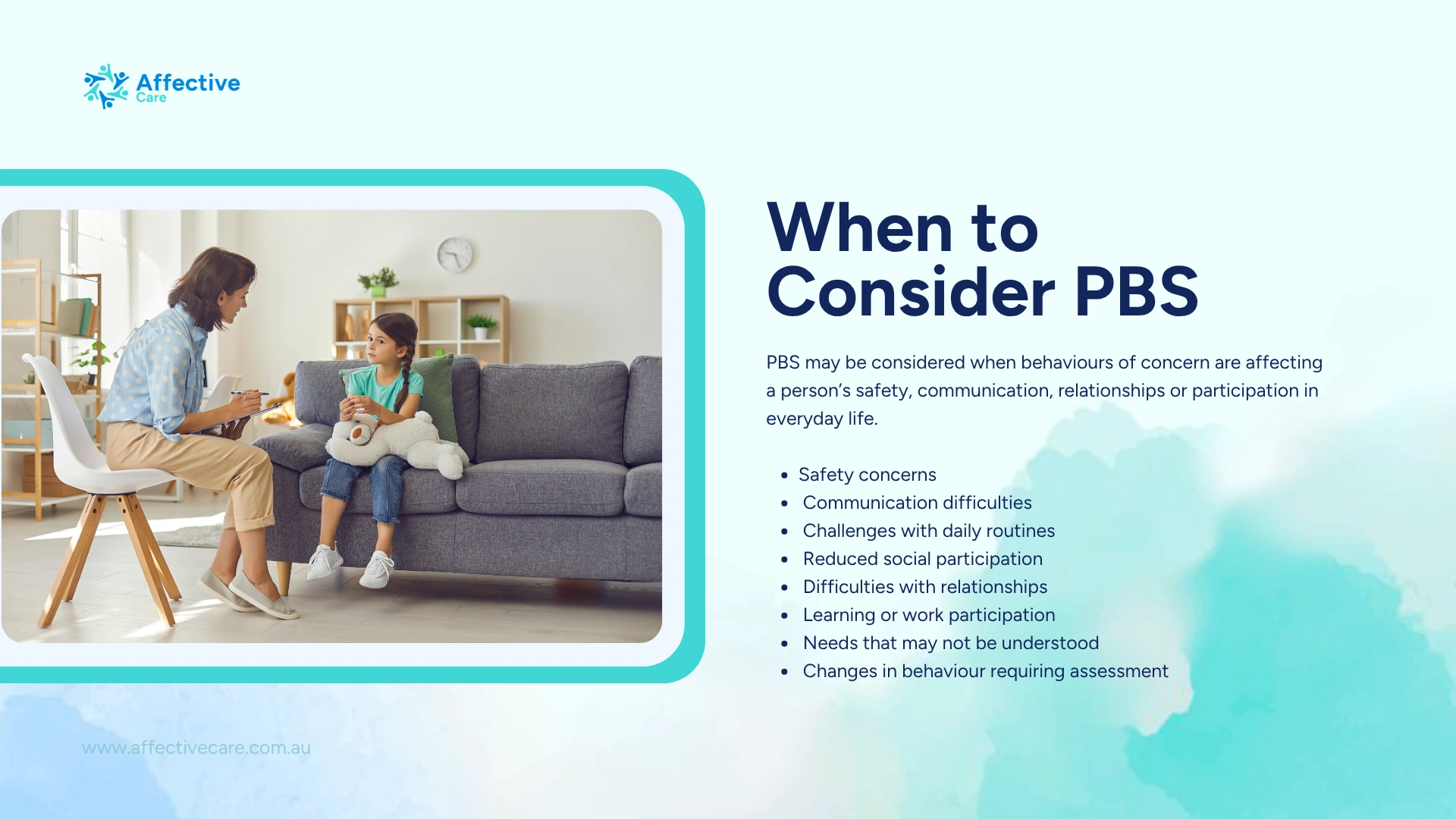
When Might Positive Behaviour Support Be Considered?
Positive Behaviour Support may be considered when behaviours of concern affect safety, communication, relationships, participation or everyday activities.
For example, a person may benefit from further assessment when behaviour appears to occur because their needs are not being effectively understood or met.
However, behaviour alone does not tell us why it is happening.
A Behaviour Support Practitioner can gather information, assess the individual's circumstances and determine what strategies may be appropriate.
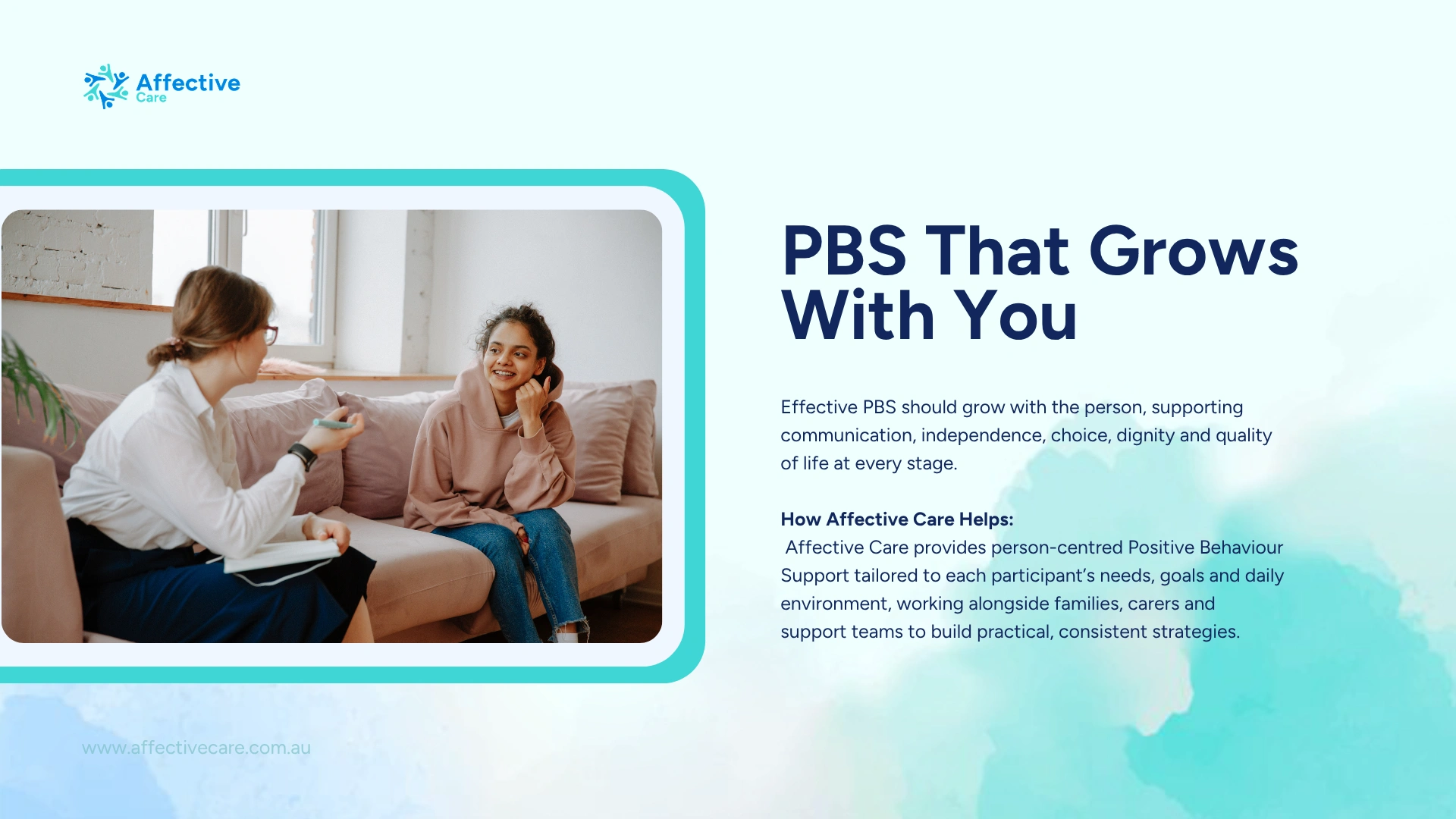
Positive Behaviour Support Should Grow With the Person
The key difference between PBS for children vs adults is not that one group needs an entirely different philosophy.
It is that every person's life, environment, responsibilities, relationships and goals are different.
Effective positive behaviour support for children and adults should respect those differences.
For children, that may mean working closely with families and everyday environments while developing communication, participation and life skills.
For adults, it may mean strengthening independence, choice, relationships, community participation and control over everyday life.
At every age, the person should remain at the centre of the support.
If you would like to understand whether Positive Behaviour Support may be appropriate for you, your child or someone you support, speak with Affective Care about your circumstances and available support options.