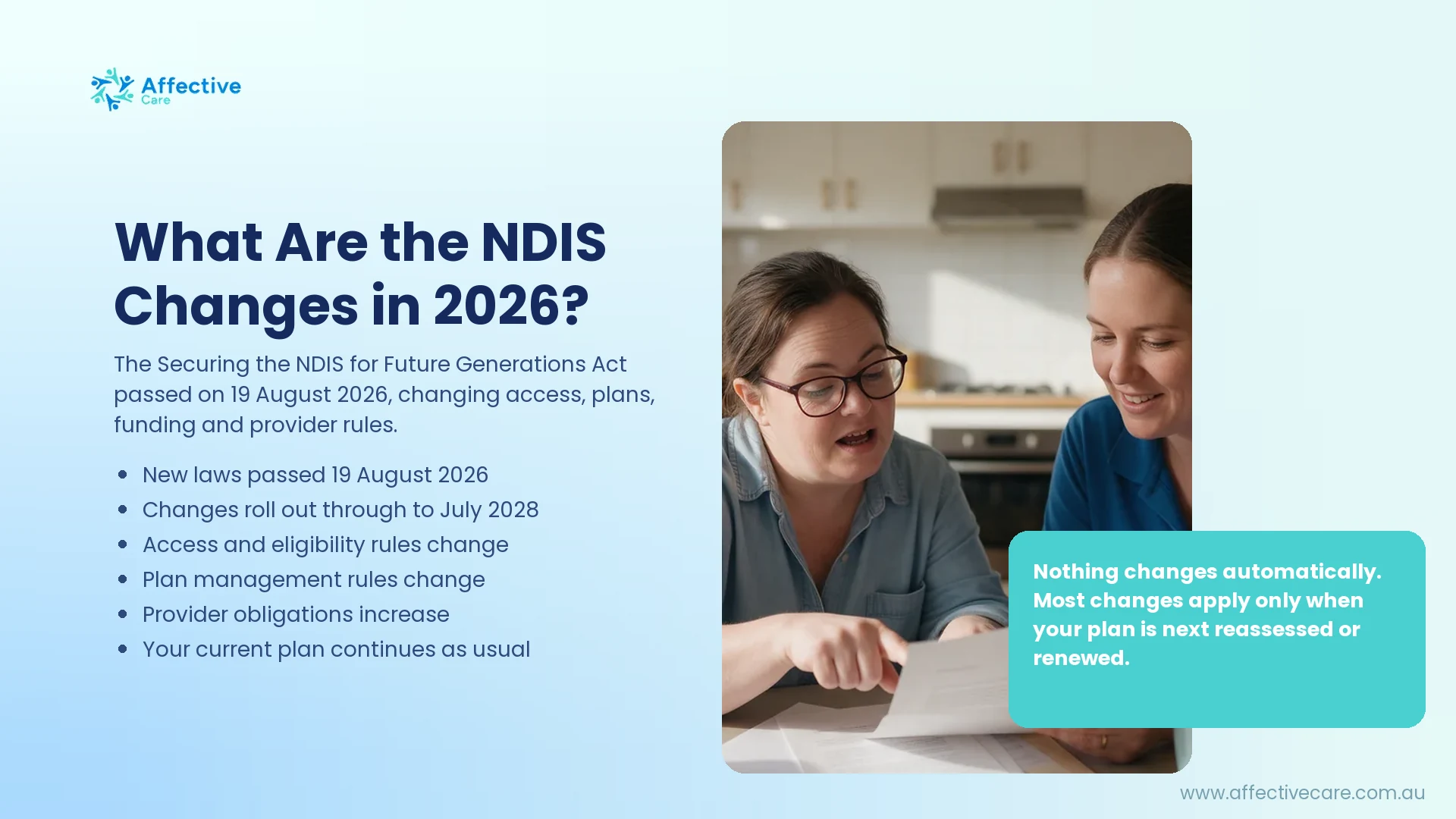
The NDIS changes in 2026 come from the Securing the NDIS for Future Generations Act, which passed Parliament on 19 August 2026. Some changes already apply, including new rules for plan reassessments.
The biggest change for most participants starts on 1 October 2026, when some support budgets begin to reduce at plan reassessment.
What are the NDIS changes in 2026?
The NDIS changes in 2026 are a set of reforms introduced by the National Disability Insurance Scheme Amendment (Securing the NDIS for Future Generations) Act 2026. They change who can access the NDIS, how plans are managed, how funding can be used and how providers operate.
The Australian Parliament passed the Bill on 19 August 2026. The Governor-General signed the new laws on 20 August 2026. According to the National Disability Insurance Agency (NDIA), the reforms will be introduced in stages between now and July 2028.
The important thing to know first: you can keep using your plan and your supports as usual. Nothing stops or switches off automatically. Most changes only apply when your plan is next reassessed or renewed.
Which NDIS changes are already in effect?
Four changes started as soon as the laws were signed in August 2026.
Plan reassessment requests
Only participants, plan nominees or child representatives can now ask for a plan reassessment before the scheduled reassessment date. Support workers, providers and other third parties can no longer make this request on your behalf.
You can still ask for an early reassessment when there is a significant and ongoing change to:
- your functional capacity and support needs
- your living, education, work or informal support arrangements.
The NDIA now has 90 days to decide whether or not to reassess your plan once it receives your request. You can still ask for short-term or urgent plan changes through a plan variation, which is a faster process.
NDIS pricing decisions
The Minister for Disability and the NDIS now has the power to make a pricing determination that sets the maximum amounts for NDIS supports. The NDIA advises the Minister through the existing Annual Pricing Review.
There are no immediate changes to prices. Providers can keep following the current NDIS pricing arrangements and price limits. The current NDIS pricing schedule has applied since 1 July 2026, and providers must discuss and agree any service agreement changes with participants before making them.
Stronger compliance and information gathering powers
The NDIA now has stronger compliance, enforcement and information gathering powers so it can respond faster to fraud and non-compliance. Participants and providers may be asked to give the NDIA information about how funding has been used. Providers can face a civil penalty if they do not comply with certain requirements, such as providing that information.
Automated administrative action
Computer systems can now be used to automate some administrative tasks, including claims and payment processing. Complex decisions, and decisions that need judgement such as plan decisions, are still made by people. The NDIA must publish details of how and where automated systems are used.
What changes on 1 October 2026?
From 1 October 2026, support budgets for social, economic and community participation supports and improved daily living skills will be reduced as plans are reassessed or renewed.
This is the change most participants will notice, so it is worth being precise about how it works.
The reduction is phased over 12 months:
| Date | What triggers the reduction |
|---|---|
| From 1 October 2026 | When a plan is reassessed, or a new plan is approved |
| From 1 February 2027 | When a plan is renewed |
These budgets are not affected:
- help with eating and drinking
- education supports
- employment supports
- disability-related health supports.
If you use funding for social and community participation or for improved daily living, this is the section to read closely before your next reassessment.
If you need 24-hour support
A new plan variation pathway is being created for participants with high support needs who require 24-hour disability support. If a support determination applies to you, you can apply for a plan variation within 90 days. The NDIA says it can increase funding through a plan variation where needed so people can keep receiving the supports that keep them safe at home.
Plan suspensions
From October 2026, the NDIA can suspend a plan if a participant does not respond to requests for information. This only happens after reasonable attempts to make contact, which the NDIA defines as at least five attempts over an extended period to reach you, your nominee or your authorised representative.
What is the full NDIS reform timeline?
Here is every confirmed date the NDIA has published.
| From | What changes |
|---|---|
| August 2026 | Plan reassessment request rules, ministerial pricing powers, compliance powers, automated processing |
| 1 October 2026 | Social and community participation and improved daily living budgets begin reducing at reassessment |
| December 2026 | Claims must be submitted within 90 days of delivering a support |
| 1 February 2027 | Plan renewals replace plan continuations; unspent funds are not carried over. New reasonable and necessary criteria |
| April 2027 | The new way of planning begins rolling out |
| July 2027 | Mandatory registration expands to more providers |
| October 2027 | A trusted panel of plan management providers is established |
| January 2028 | New access and eligibility assessment begins for new applicants |
| July 2028 | A new commissioned support coordination and connection function begins |
February 2027: plan renewals and unspent funds
From February 2027, when a plan is due to be reassessed it will either be reassessed by an NDIA planner or replaced by a new plan with the same supports. This is called a plan renewal, and it replaces the current plan continuation process.
Unspent funds from your previous plan will not carry over. If you are used to underspending early in a plan and catching up later, this is worth discussing with your plan manager or support coordinator well before 2027.
February 2027: what parents are expected to provide
New criteria will guide what the NDIA considers reasonable and necessary for new participants. There will be clearer guidelines on what a parent is expected to provide for a child with disability, covering supervision, personal care, transport, emotional support and behavioural support.
This does not include the additional support a child needs because of their disability, compared with children of a similar age without disability. The new criteria will be applied progressively to current participants when their plan is reassessed.
What is the NDIS new way of planning?
The new way of planning is a redesigned planning process that begins rolling out from April 2027. It aims to make NDIS decisions fairer, more consistent and less dependent on expensive reports.
Some parts are already in place:
- A clearer definition of NDIS supports, so it is easier to understand what the NDIS can and cannot fund.
- Funding periods, included in new and reassessed plans to help budgets last the full length of a plan.
- Impairment information, given to participants who entered the NDIS in 2025 as part of their access decision.
Support needs assessments
The NDIA is introducing support needs assessments, developed with the University of Melbourne and the Centre for Disability Studies. The NDIA says the assessment will suit a range of disability groups and will be culturally appropriate, trauma-informed and LGBTIQASB+ diversity enabled.
The goal is to reduce how much participants spend on reports. Instead of paying for assessments and evidence, participants can spend funding on supports, and allied health professionals can spend time delivering care rather than writing reports.
The NDIA is currently paying participants to help test the process before rollout. Taking part is voluntary and does not change your plan, funding, supports or eligibility. You can apply through NDIS Engage.
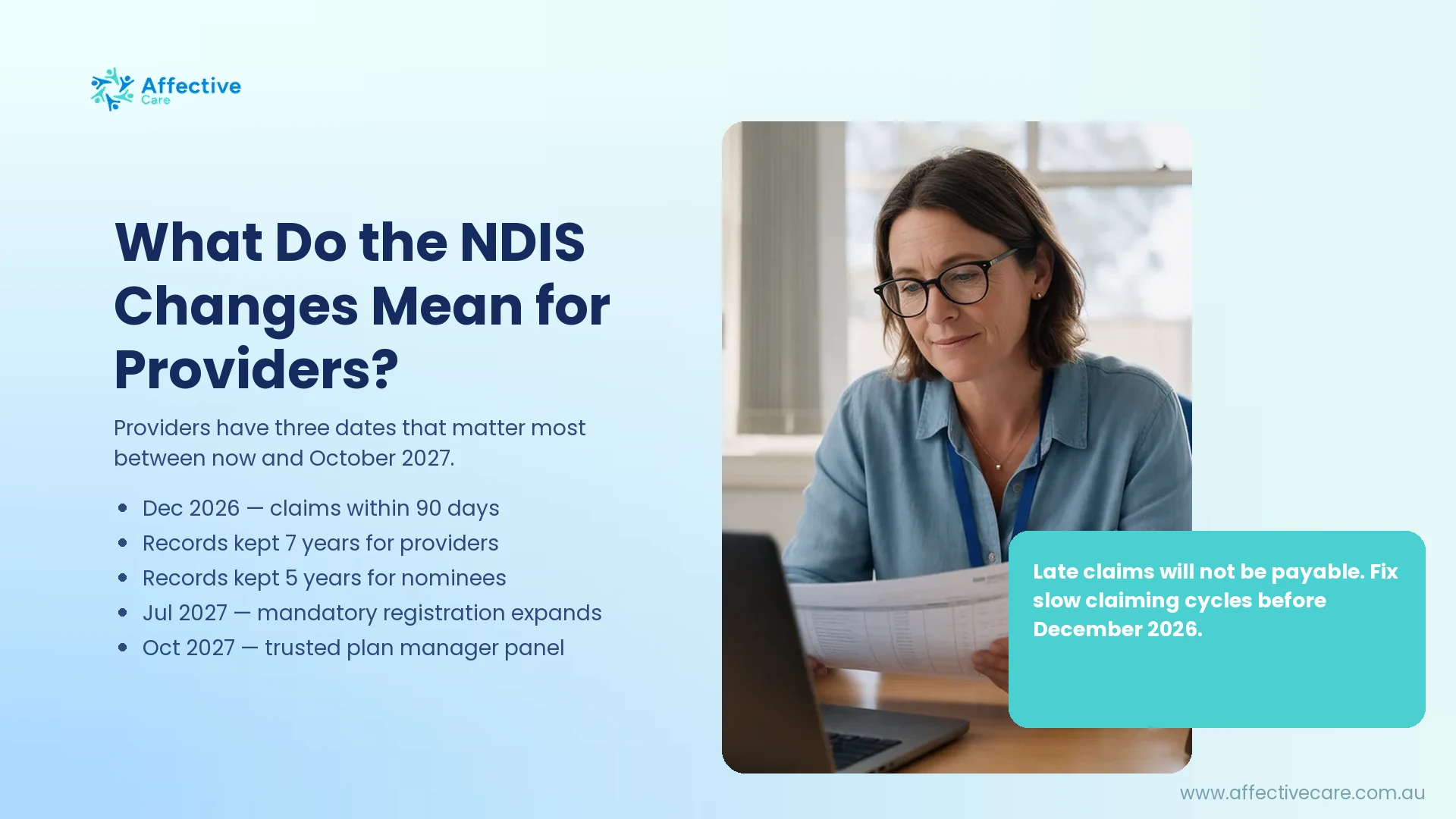
What do the NDIS changes mean for providers?
Providers have three dates that matter most.
December 2026 — claiming timeframes. Claims must be submitted within 90 days of delivering a support. Providers with slow claiming cycles should fix that now, because late claims will not be payable.
Record keeping. New retention periods are coming: 3 years for participants, 5 years for nominees and 7 years for providers. Funding may need to be repaid if you cannot show it was used correctly.
July 2027 — mandatory registration. Registration requirements will expand to providers delivering personal care and daily living supports, and supports provided in closed settings. If you are an unregistered provider offering personal care, plan now rather than in 2027. You can read our guide to registering with the NDIS for what the process involves.
From October 2027, a trusted panel of plan management providers will be established, and participants will be supported to move to a panel provider over six months.
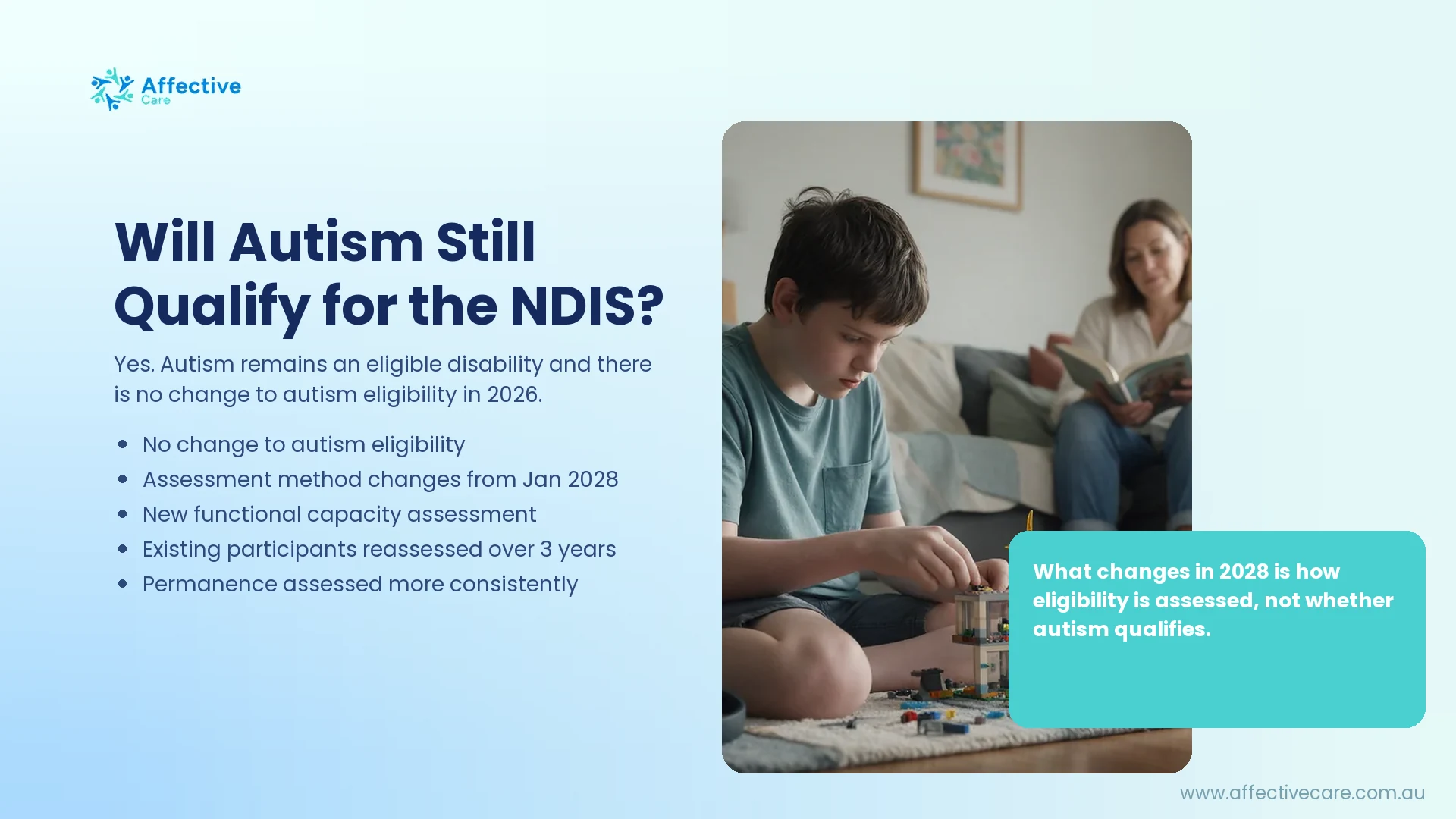
Will autism still qualify for the NDIS?
Yes. Autism remains an eligible disability, and there is no change to autism eligibility in 2026.
What changes from January 2028 is how eligibility is assessed for new applicants. Access decisions will be based on a new standardised, evidence-based assessment of functional capacity, informed by the NDIA's Technical Advisory Group.
There will also be more consistent assessment of whether an impairment is permanent or can be treated, and of access to other compensation schemes. Existing participants will be reassessed over three years from that date.
If you are unsure where you stand, our guide to NDIS eligibility explains the current access requirements.
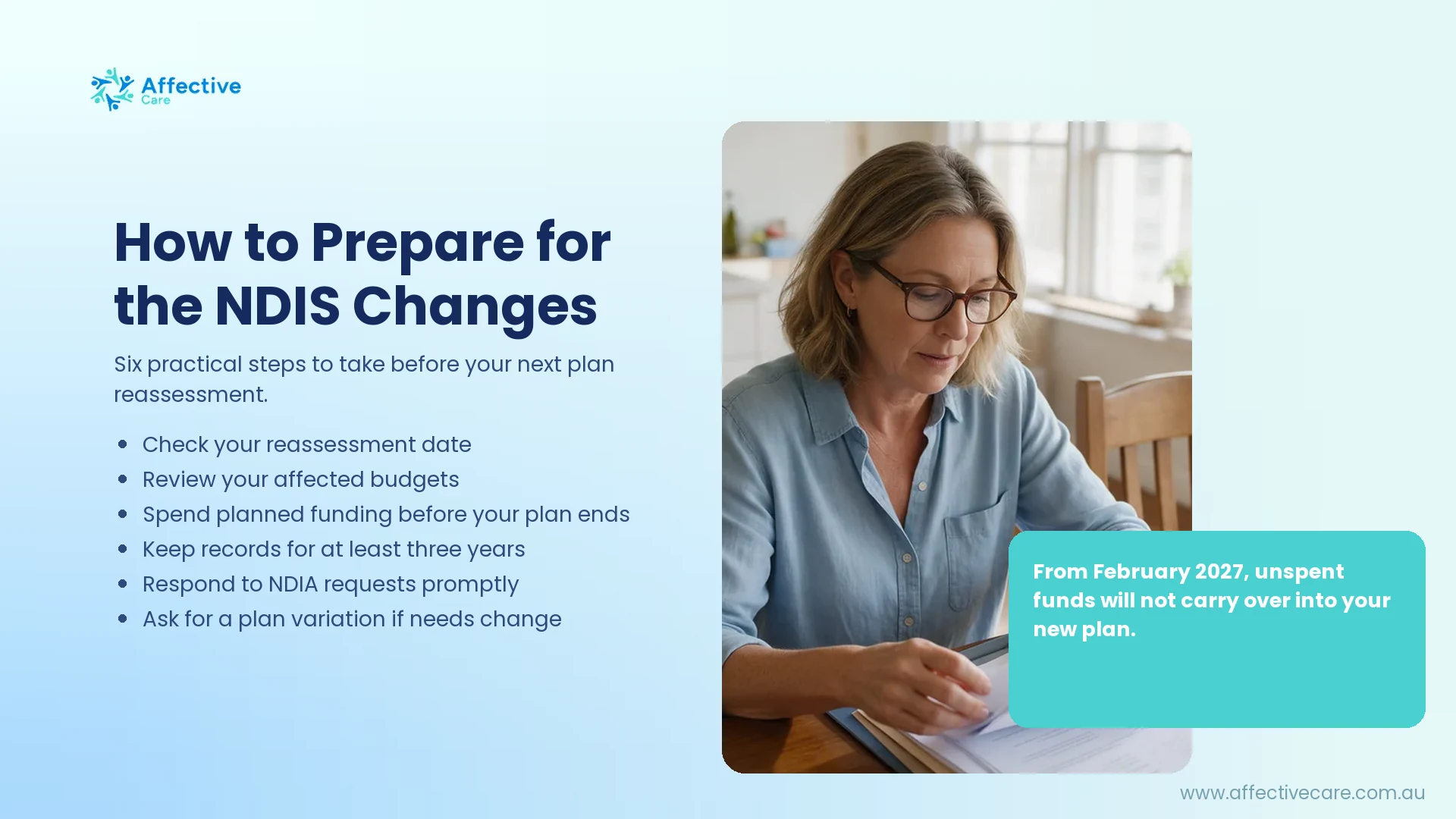
How to prepare for the NDIS changes
- Check your plan reassessment date. The date of your reassessment now decides which rules apply to you.
- Look at your social and community participation and improved daily living budgets. These are the categories reducing from 1 October 2026.
- Spend planned funding before your plan ends. From February 2027, unspent funds will not carry over.
- Keep your records. Keep invoices and service records for at least three years as a participant.
- Respond to NDIA requests promptly. Plans can be suspended after five unanswered contact attempts.
- Ask for a plan variation if your needs change. You do not have to wait for a full reassessment.

Talk it through with someone who knows the system
The NDIS changes in 2026 are real, but they are staged, and most of them only apply when your plan is next reassessed. The participants who do best are the ones who understand their reassessment date and plan for it early.
Affective Care supports participants across Sydney, the Central Coast, the Gold Coast and Canberra with daily living, community participation, SIL and therapy supports. If you are unsure how the changes affect your plan, get in touch with our team and we will walk you through it in plain language.
This article is general information only. It is not financial, legal or medical advice. Funding decisions are made by the NDIA. Please speak with your doctor, NDIS planner or support coordinator about your own situation.