The Labor–Greens NDIS tax negotiations were a June 2026 deal. The Greens agreed to pass Labor's capital gains tax and negative gearing changes, and in return the Senate inquiry into the NDIS bill was extended by eight weeks. The NDIS bill itself later passed on 19 August 2026 with Coalition votes, not Greens votes.
This update explains how the NDIS bill moved through Parliament, what each party got from the negotiations, and what the new law means for NDIS participants and families today.
What were the Labor–Greens NDIS tax negotiations?
They were talks in June 2026 in which Labor needed Greens votes in the Senate to pass its tax package, and the Greens used that leverage to push back on the NDIS bill.
Labor's first budget bill included changes to capital gains tax discounts and negative gearing. Labor does not hold a Senate majority, so it needed either the Coalition or the Greens to pass the bill. The Coalition opposed the tax changes, which gave the Greens bargaining power.
The Greens wanted the NDIS changes withdrawn. Greens leader Larissa Waters argued the reforms would leave disabled Australians worse off, according to The Canberra Times. The NDIS bill was not dropped, but the Greens did win more time for the disability community to be heard.
What the Greens got from the tax deal
According to ABC News, the Greens agreed to pass the tax changes in exchange for:
- an eight-week extension of the NDIS Senate inquiry, with a new reporting date of 14 August 2026
- an end to the exemption that lets self-managed super funds borrow money to buy residential property.
Disability advocates had criticised the original inquiry timeline as far too short. The extension gave people with disability, families, carers and providers more time to make submissions and give evidence.
What the tax deal did not do
The tax deal did not change what was in the NDIS bill, and it did not lock in Greens support for it. It delayed the Senate vote. When the NDIS bill came back to the Senate in August, the Greens voted against it.
NDIS bill timeline: from introduction to law
The NDIS reform bill took just over three months to pass Parliament, from 14 May to 19 August 2026.
| Date | What happened |
|---|---|
| 14 May 2026 | NDIS bill introduced and referred to the Senate Community Affairs Legislation Committee |
| 23 June 2026 | Labor–Greens tax deal extends the NDIS Senate inquiry by eight weeks; the committee's interim report is tabled |
| 2 July 2026 | House of Representatives passes the bill with 18 government and 12 crossbench amendments |
| 14 August 2026 | Senate committee's final report is tabled, recommending the bill be passed |
| 18 August 2026 | Senate passes the NDIS bill 28 votes to 12 with Coalition support, agreeing to 32 government amendments |
| 19 August 2026 | House agrees to the Senate amendments and the bill passes Parliament |
| 20 August 2026 | Royal Assent: the bill becomes the Securing the NDIS for Future Generations Act 2026 |
Dates are from the Parliament of Australia bill record and the Department of Health, Disability and Ageing.
Who passed the NDIS bill in the end?
The Coalition. In August 2026, Labor struck a separate deal with the Coalition, and the NDIS bill passed the Senate 28 votes to 12 on 18 August.
According to ABC News, the government agreed to fast-track a fix for an unintended "widow tax" in its negative gearing changes. That problem would have affected people who took over an investment property after a partner died or a marriage ended. The wider deal also created a pathway for Labor's gambling reforms and news media bargaining incentive.
The Greens opposed the final NDIS bill. Greens senator Jordon Steele-John described it as the "end of the NDIS as it was promised". Crossbenchers and disability advocates also warned the changes were going too far, too fast.
So the Labor–Greens negotiations decided when the NDIS bill was voted on. The Labor–Coalition deal decided whether it passed.
What is in the NDIS bill that became law?
The new law changes the NDIS Act 2013 in three main areas: eligibility and the supports the NDIS funds, fraud and integrity, and how the scheme is governed and run.
Based on the bill summary and the Minister's announcement, the key NDIS legislation changes are:
- Eligibility based on functional capacity. Functional capacity means how much your disability affects everyday activities. The law defines it and adds a clearer test of whether a disability is permanent.
- Supports linked to your impairments. Funded supports must be directly related to the impairments that made you eligible for the NDIS.
- A ministerial power to reduce funding. The Minister can reduce funding for specified groups of supports.
- Plan end dates and renewals. Plans will have end dates and a new renewal process, with limits on unscheduled reassessments.
- Stronger fraud measures. New criminal and civil penalties for kickbacks, stronger whistleblower protections and more enforcement powers for the National Disability Insurance Agency (NDIA).
- A safeguard for 24-hour care. People who need continuous 24-hour care can apply for a plan variation through an escalation pathway.
ABC News reported the reforms are expected to save about $37.8 billion over four years, in a scheme that costs more than $50 billion a year. The government aims to reduce participant numbers from about 760,000 to 600,000 by 2030, although that target is not written into the NDIS bill itself.
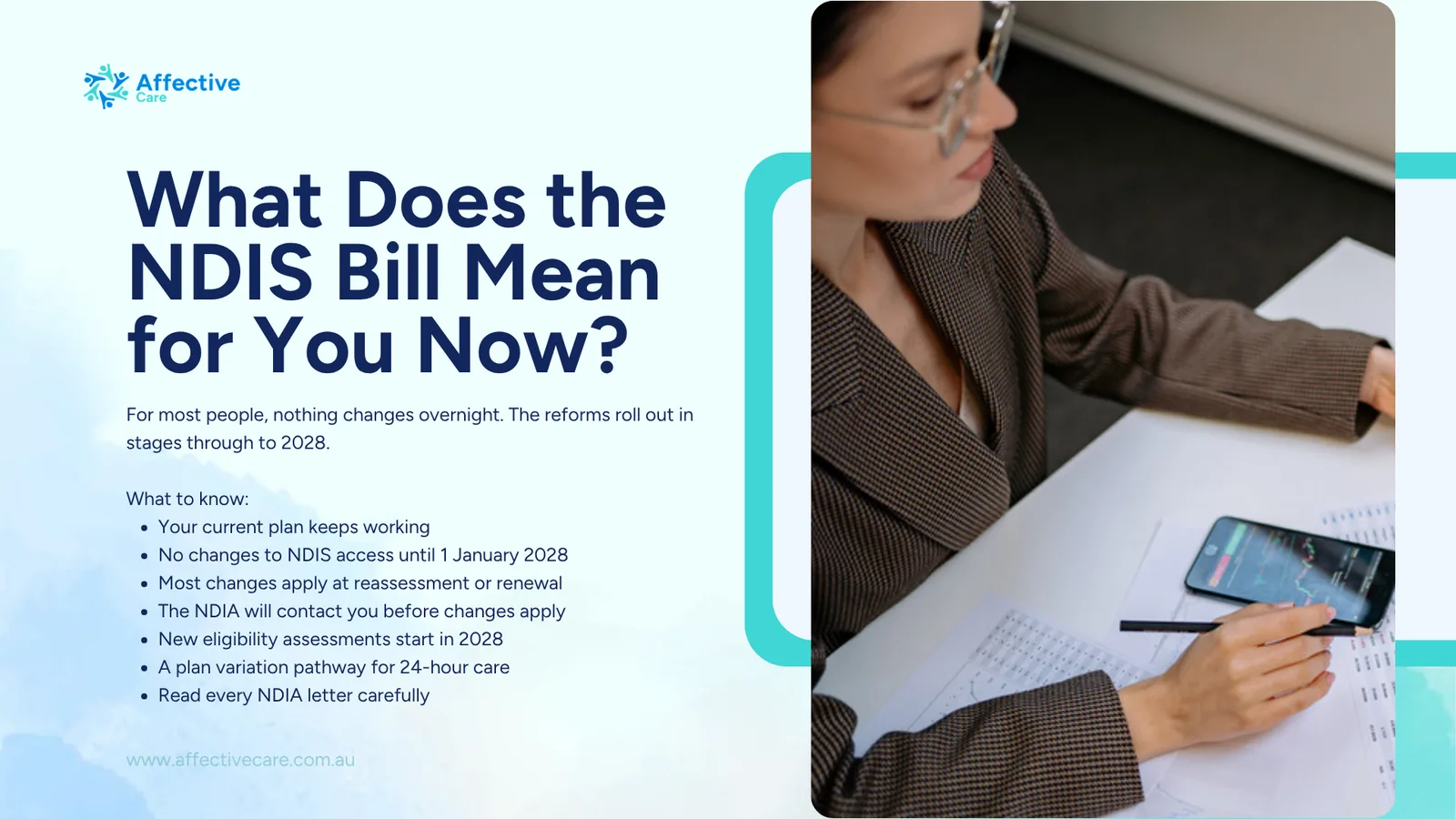
What does the NDIS bill mean for participants right now?
For most people, nothing changes overnight. The Department of Health, Disability and Ageing says there will be no changes to NDIS access until 1 January 2028, and the NDIA will contact participants before changes affect them.
The reforms are being introduced in stages through to 2028, and most apply when your plan is next reassessed or renewed. For every confirmed date, read our full guide to the NDIS changes in 2026. If you are worried about your budget, our explainer on NDIS funding cuts covers which supports are affected.
Things you can do now:
- Check your plan reassessment date, because it decides which rules apply to you.
- Keep invoices and records of how you use your NDIS funding.
- Reply to NDIA requests for information promptly.
- Ask for a plan variation if your needs change, rather than waiting for a full reassessment.
- Talk to your NDIS support coordinator about how the changes apply to your plan.
If you work in support coordination, see our guide to NDIS changes for support coordinators.
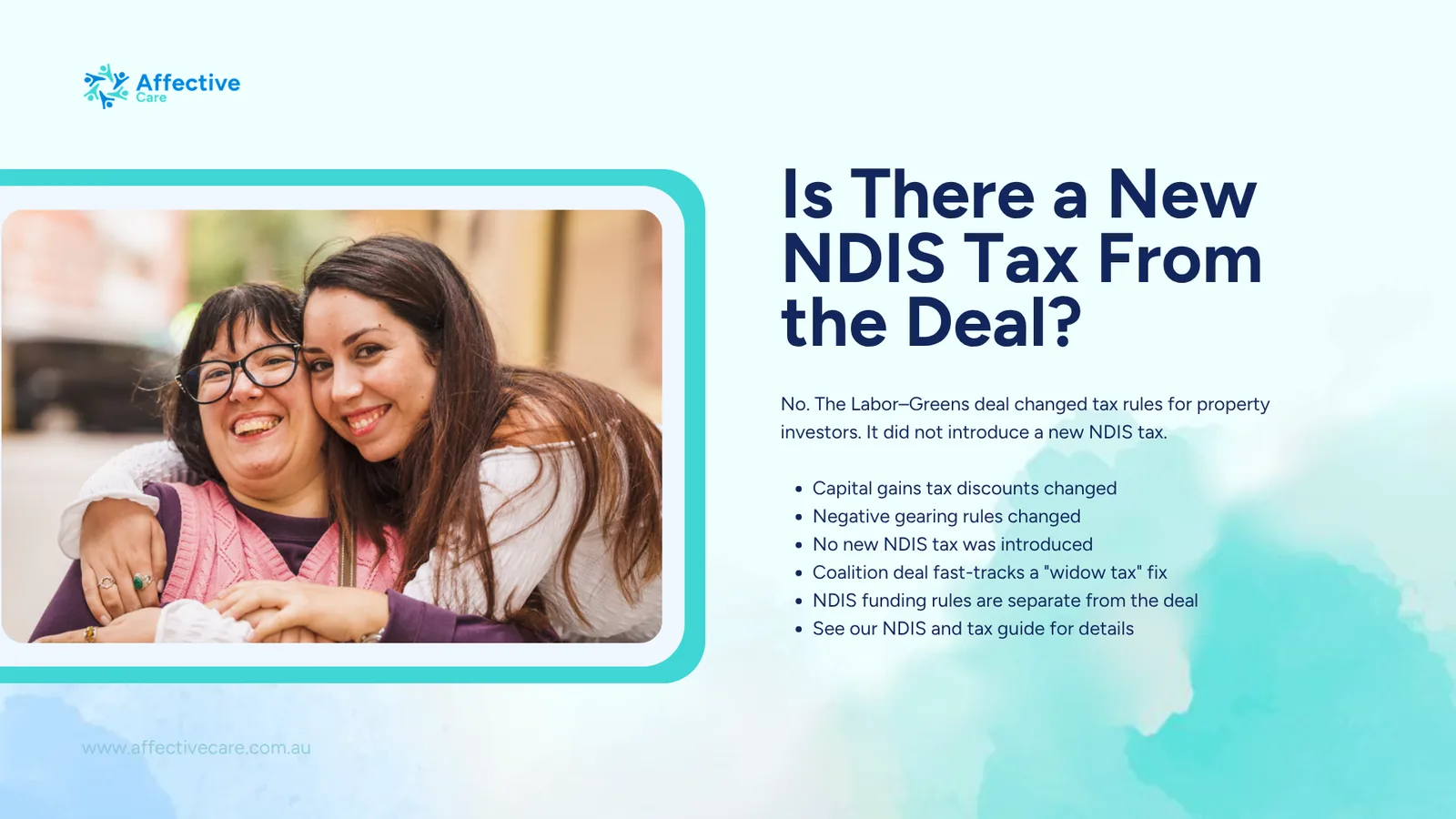
Is there a new NDIS tax because of the deal?
No. The Labor–Greens deal changed capital gains tax and negative gearing rules for property investors. It did not introduce a new NDIS tax.
Many people searching for "NDIS tax" want to know whether their own NDIS funding is taxed. Our guide on NDIS and tax explains how NDIS payments are treated.
Frequently asked questions
What is the NDIS bill 2026?
The NDIS bill is the National Disability Insurance Scheme Amendment (Securing the NDIS for Future Generations) Bill 2026. It changes the NDIS Act 2013 to clarify eligibility and funded supports, strengthen fraud measures and update how the scheme is run. It passed Parliament on 19 August 2026 and became law on 20 August 2026.
Did the Greens support the NDIS bill?
No. The Greens opposed the final bill. In June 2026 they backed Labor's tax changes in exchange for extending the NDIS Senate inquiry by eight weeks, but that deal did not include support for the bill itself. It passed the Senate in August 2026 with Coalition votes.
What was the Labor–Greens NDIS deal?
It was a June 2026 agreement where the Greens supported Labor's capital gains tax and negative gearing changes. In return, the NDIS Senate inquiry was extended to 14 August 2026, and an exemption letting self-managed super funds borrow to buy residential property was ended, according to ABC News.
When do the NDIS changes start?
Some changes started soon after the law passed in August 2026, and others roll out in stages to 2028. The Department of Health, Disability and Ageing says there will be no changes to NDIS access until 1 January 2028, and the NDIA will contact participants before changes affect them.
Will I lose my NDIS plan because of the NDIS bill?
Not automatically. Your current plan keeps working, and most changes only apply when your plan is reassessed or renewed. New eligibility assessments for applicants start from 1 January 2028. Speak with your support coordinator or NDIS planner about how the changes apply to your situation.
What did the Coalition get for supporting the NDIS bill?
According to ABC News, the government agreed to fast-track a fix to an unintended "widow tax" in its negative gearing changes. The wider deal also created a pathway for Labor's gambling reforms and news media bargaining incentive. The Senate then passed the bill 28 votes to 12 on 18 August 2026.
This article is general information only. It is not legal, financial or medical advice. Funding decisions are made by the NDIA. Please speak with your NDIS planner, support coordinator or doctor about your own situation.
Sources
- Legislation to secure the future of the NDIS passed by the Senate, Department of Health, Disability and Ageing, 18 August 2026
- NDIS Amendment (Securing the NDIS for Future Generations) Bill 2026, Department of Health, Disability and Ageing
- Bill progress and summary, Parliament of Australia
- Greens back CGT, negative gearing changes in return for extended NDIS inquiry, ABC News, 23 June 2026
- Federal government to pass NDIS overhaul, ABC News, 18 August 2026