Changes to the NDIS have created many questions for autistic people, parents, carers and families. Searches such as “NDIS autism changes 2026,” “NDIS autism funding changes 2026,” “NDIS changes for autistic children 2026,” and “is autism still covered by the NDIS?” reflect a common concern: what is actually changing, and what does it mean for current and future participants?
The most important point is that autism has not simply been removed from the NDIS in 2026.
Several NDIS reforms are happening at different times. Some changes are already in place, Thriving Kids begins rolling out from 1 October 2026, a new NDIS planning approach is expected to start from April 2027, and proposed changes affecting NDIS access for some children aged 8 and under are planned from 1 January 2028.
This guide explains the NDIS autism changes 2026, including autism eligibility, NDIS funding, changes for autistic children, Thriving Kids, functional evidence, therapy supports and what participants and families may want to consider next.
For background on how autism and the Scheme fit together, see our guide to autism and the NDIS, and for the wider reform timeline, read our overview of the NDIS changes in 2026.
NDIS Autism Changes 2026: Quick Answers
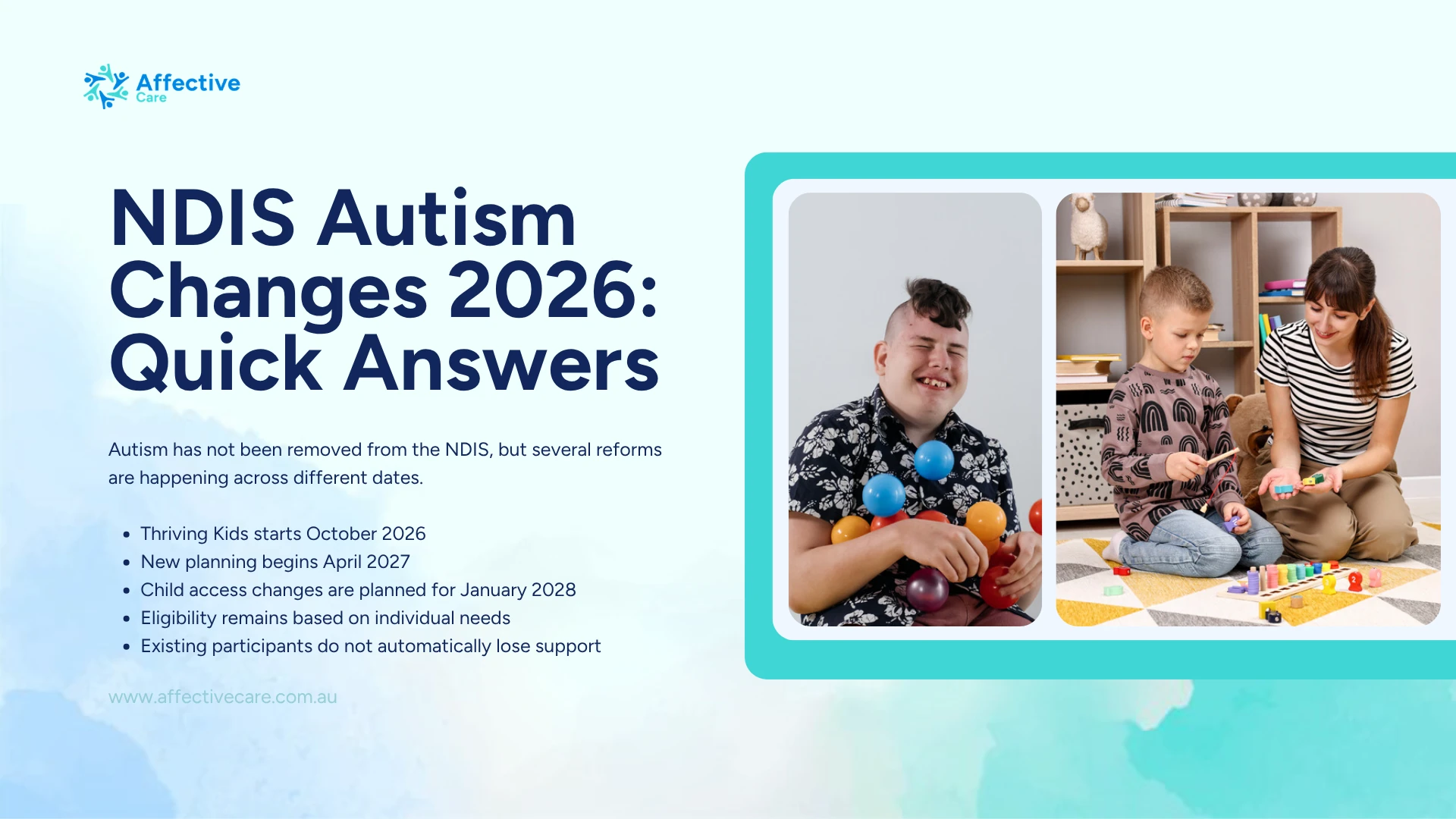
Here are the key autism NDIS changes 2026 in simple terms.
| Question | Quick answer |
|---|---|
| Is autism still covered by the NDIS in 2026? | Yes. Autism has not simply been removed from the NDIS. Eligibility depends on applicable NDIS access requirements and individual circumstances. |
| Are NDIS autism eligibility rules changing in 2026? | NDIS reforms are continuing, but important future access changes have later implementation dates. |
| What is Thriving Kids? | Thriving Kids is a new system of Foundational Supports for children aged 8 and under with developmental delay and/or autism with low to moderate support needs. |
| When does Thriving Kids start? | Services are scheduled to begin from 1 October 2026. |
| Are autistic children being removed from the NDIS in October 2026? | No. The planned access changes associated with Thriving Kids are expected from 1 January 2028, not October 2026. |
| Will autistic children with high support needs still be eligible? | Children with permanent and significant disability, including children with autism who have substantially reduced functional capacity and high support needs, can continue to meet NDIS eligibility requirements. |
| Are NDIS plans changing? | Yes. A new way of planning, including support needs assessments, is expected to begin rolling out from April 2027. |
Government guidance confirms that children aged 8 and under with developmental delay and/or autism and low to moderate support needs are the group specifically connected with the future Thriving Kids access arrangements.
Children with permanent and significant disability or high support needs will continue to be considered under NDIS arrangements.
What Are the NDIS Changes for Autism in 2026?
When people search for NDIS changes for autism 2026, they may find several reforms discussed together. However, there is no single change applying to every autistic participant in the same way.
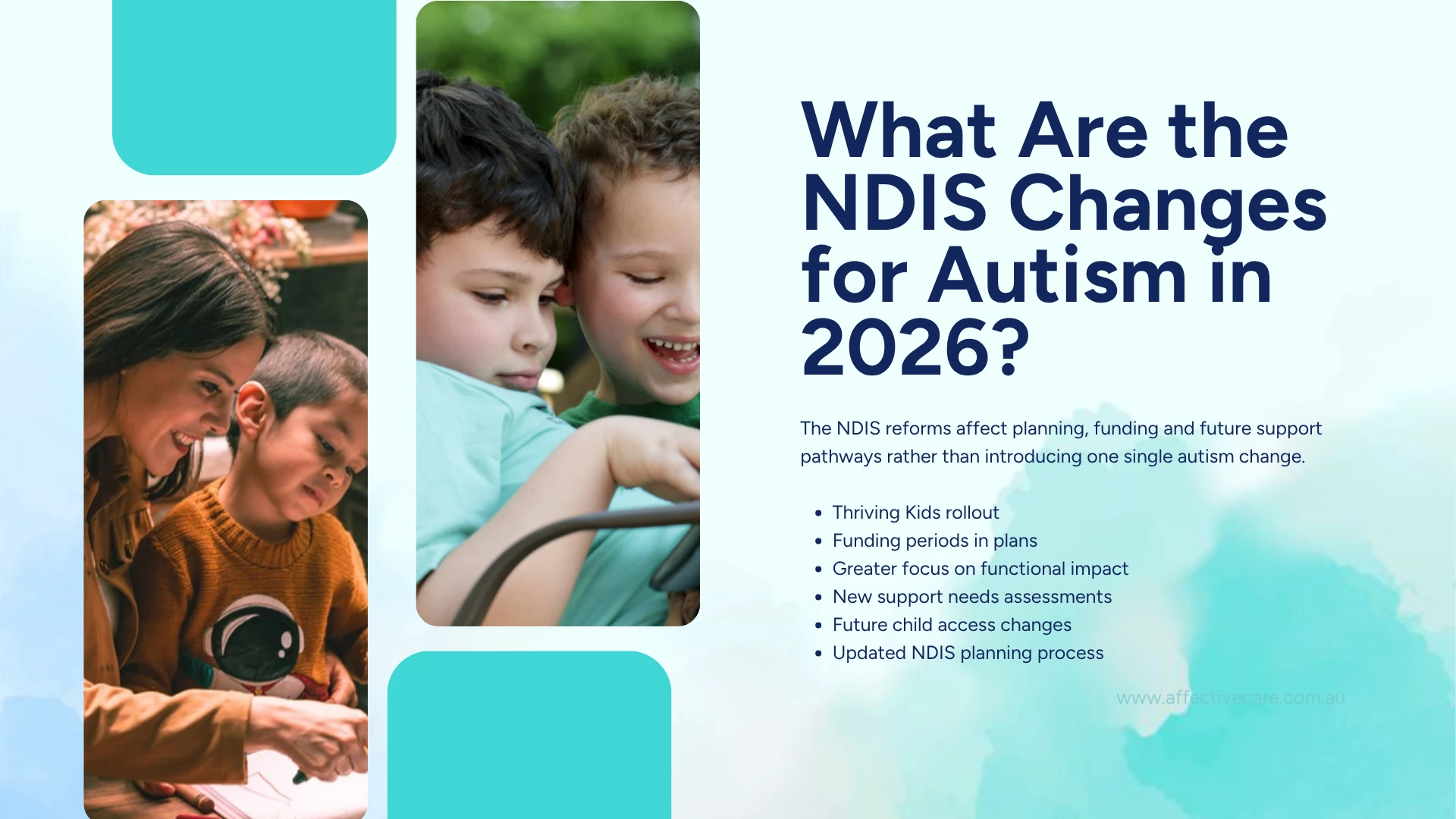
The main developments include:
- The rollout of Thriving Kids from October 2026
- Continued changes to what NDIS funding can be used for
- Funding periods within NDIS plans
- Greater clarity around impairments and eligibility
- Development of a new NDIS planning approach
- Future support needs assessments
- Proposed future changes to NDIS access for some young children.
Some reforms are already operating. For example, new and reassessed NDIS plans can include funding periods, and current NDIS rules distinguish between supports that can and cannot be purchased using NDIS funding.
Other reforms are still being prepared.
The NDIA states that support needs assessments and the new way of planning are now expected to start from April 2027.
Testing is occurring during 2026 and participation in this testing does not change a person's existing NDIS eligibility, plan, funding or supports.
This distinction matters when discussing new NDIS rules for autism 2026. An announced reform is not necessarily a rule already applying to every participant.
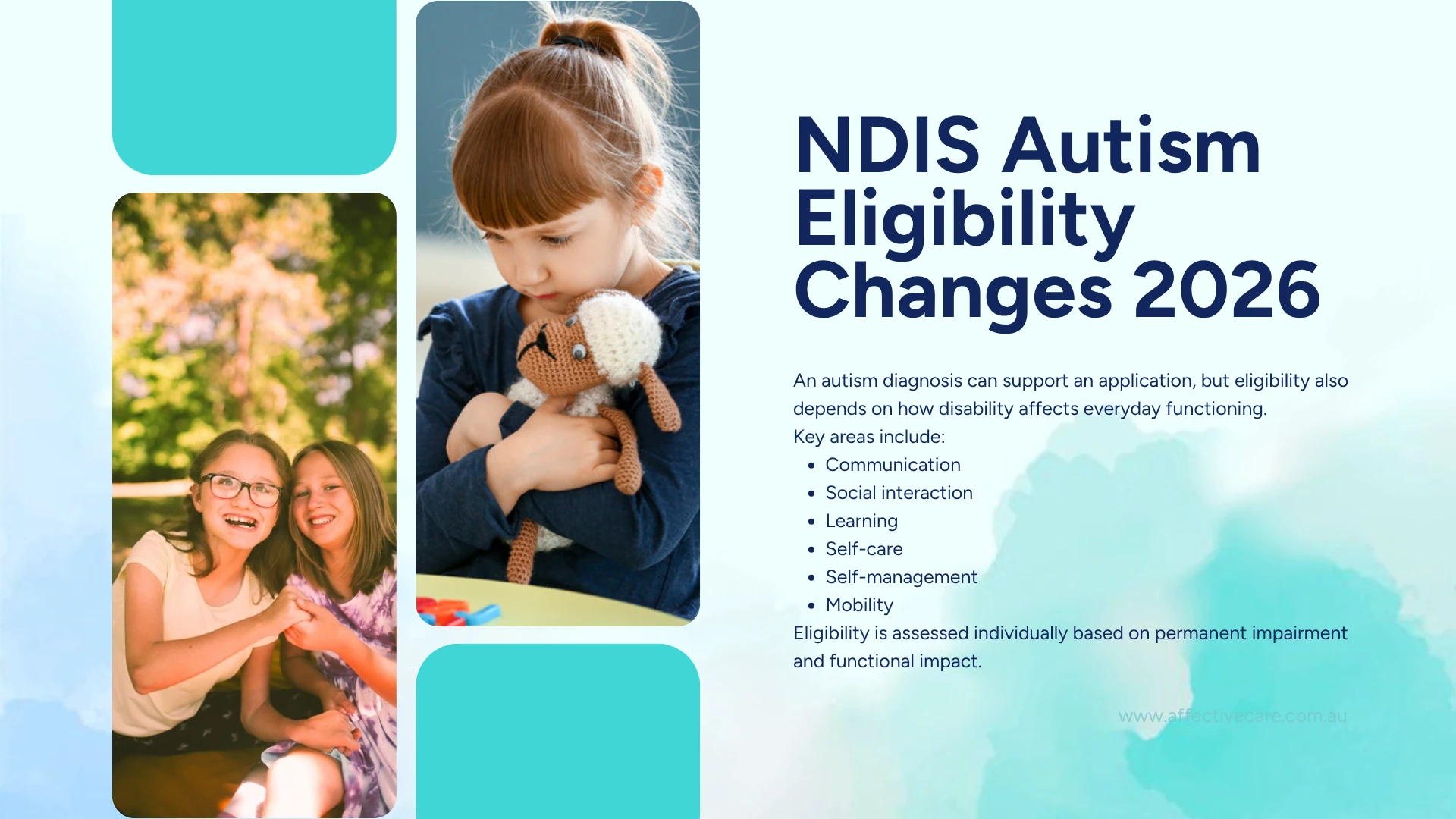
NDIS Autism Eligibility Changes 2026
One of the biggest areas of concern is NDIS autism eligibility changes 2026.
Under current NDIS eligibility requirements, eligibility is not determined simply by having a particular diagnostic label.
For the disability requirements, the NDIA considers matters including whether:
- The disability is related to one or more impairments
- The impairment is likely to be permanent
- The permanent impairment significantly affects everyday functioning
- The impairment affects social or economic participation
- The person is likely to require NDIS supports over their lifetime.
The NDIS also has age, residence and other applicable access requirements.
For people living with autism, this means the relationship between autism diagnosis, impairment and functional impact remains important.
Does an Autism Diagnosis Automatically Qualify for the NDIS?
No.
An autism diagnosis can be important evidence, but a diagnosis by itself should not be treated as a guarantee of NDIS access, a particular support or a particular funding amount. If you are still at the assessment stage, our guide to the autism diagnosis process in Australia explains what to expect.
The NDIA may need evidence showing how permanent impairments affect everyday activities and participation.
Relevant areas may include:
- Communication
- Social interaction
- Learning
- Self-care
- Self-management
- Mobility.
This is why searches such as autism NDIS access requirements, autism NDIS evidence requirements and NDIS autism diagnosis requirements 2026 need to be understood through the lens of functional impact rather than diagnosis alone.
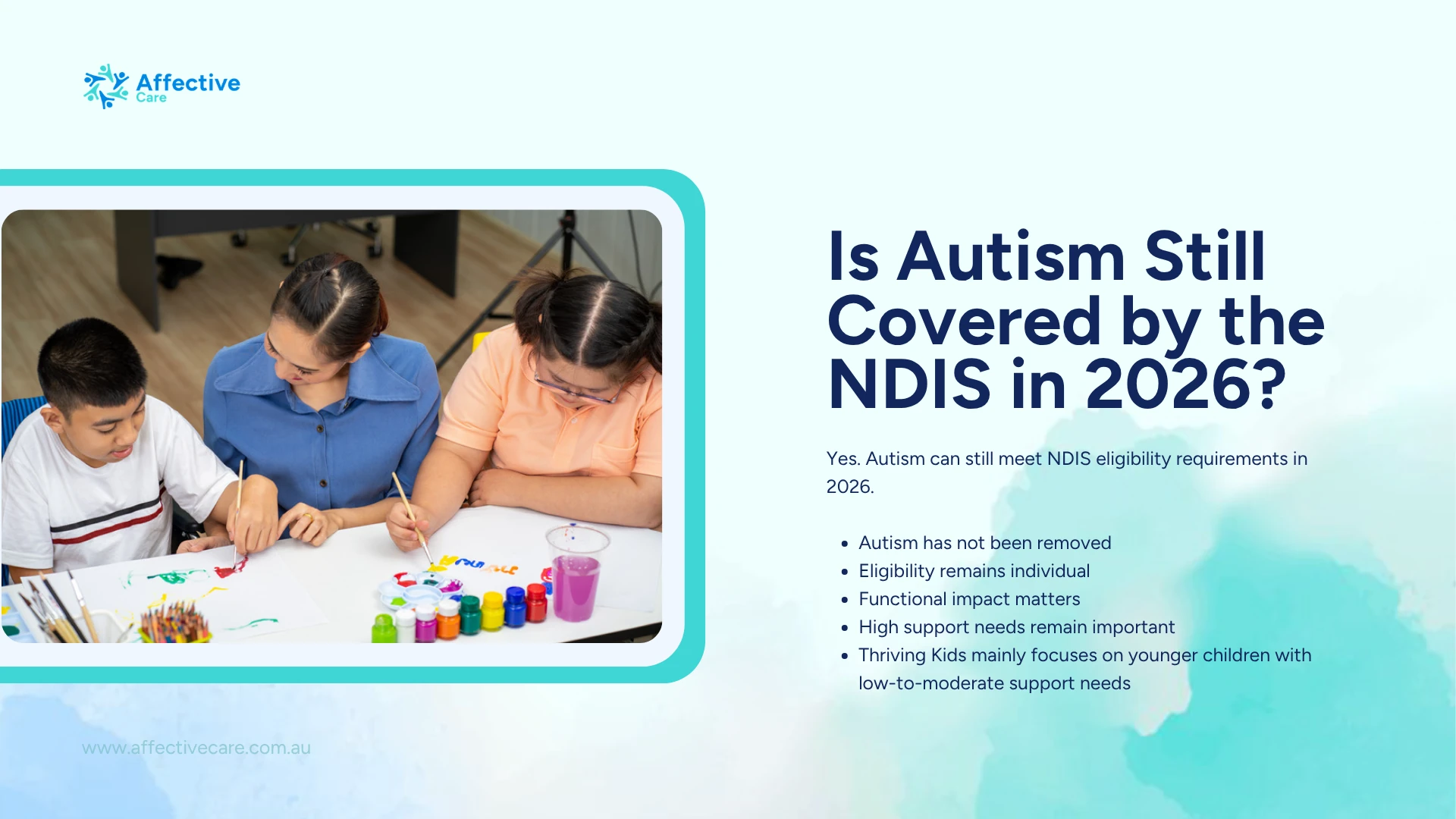
Is Autism Still Covered by the NDIS in 2026?
Yes. Autism is still relevant to NDIS access in 2026. Autism has not simply been removed from the NDIS.
This is important because online discussions around NDIS autism funding cuts 2026 or questions such as “is autism being removed from NDIS 2026?” can create confusion.
What is changing is the broader disability support system.
The Australian Government and state and territory governments are developing Foundational Supports, including Thriving Kids, so that some people can receive appropriate support outside the NDIS.
For children specifically, the Government says children aged 8 and under with developmental delay and/or autism and high support needs will continue to be considered for the NDIS, while future changes are intended to redirect children with low to moderate support needs towards Thriving Kids and other mainstream or Foundational Supports.
That is different from saying autism is no longer covered.
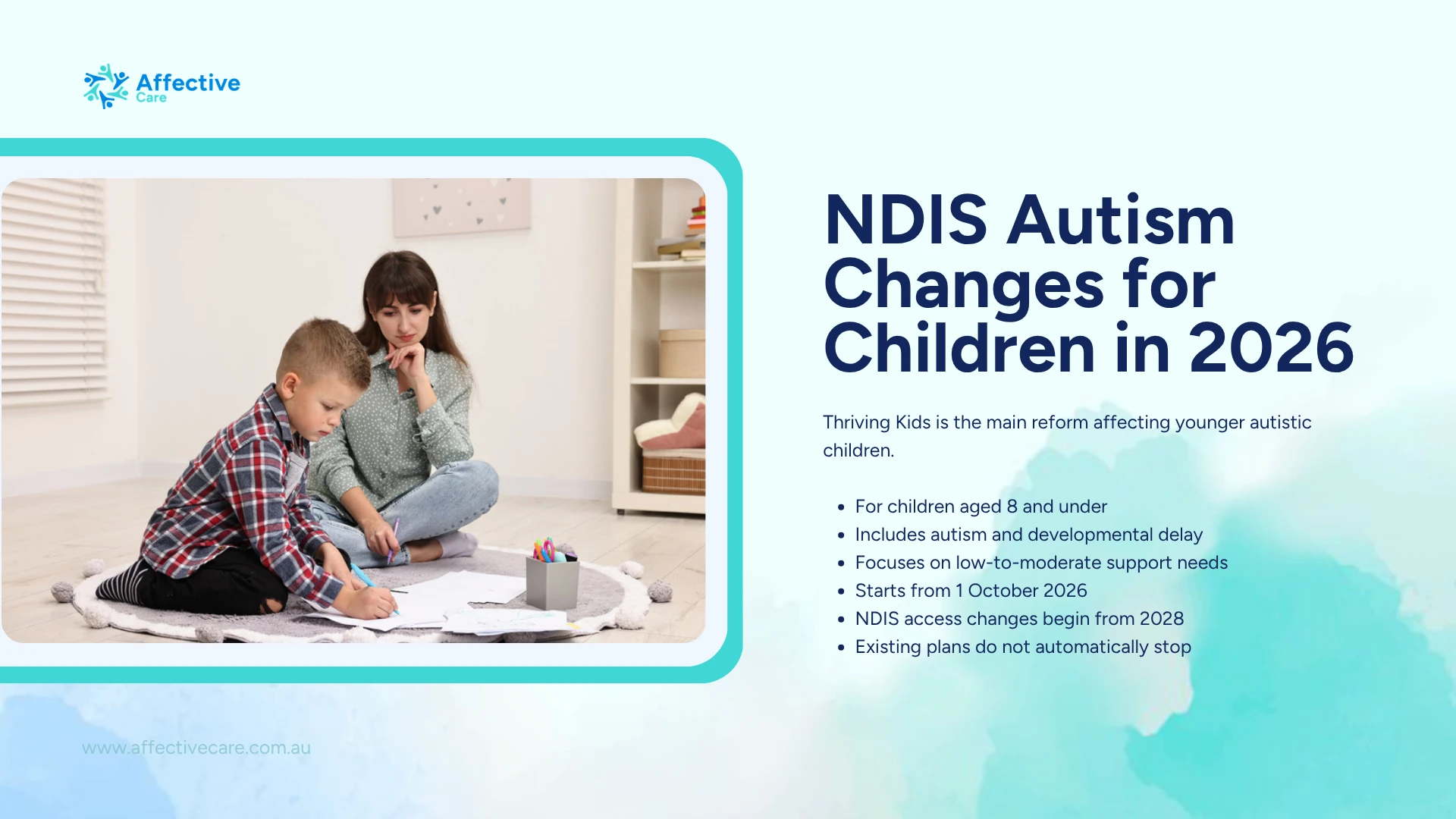
NDIS Autism Changes for Children in 2026
The NDIS autism changes for children are one of the most important parts of the current reforms.
Families may see headlines about children leaving the NDIS or being moved into another system. However, the dates and eligibility groups need to be understood carefully.
In 2026, the Australian Government announced further details about Thriving Kids, which is intended to support children aged 8 and under with developmental delay and/or autism with low to moderate support needs.
The program is part of a broader expansion of Foundational Supports outside the NDIS.
Governments have committed $4 billion over five years to the first phase of Foundational Supports through Thriving Kids.
What Do the NDIS Autism Changes for Children Mean Right Now?
As of August 2026, children who are already NDIS participants do not automatically lose their plans because Thriving Kids starts in October.
The Department of Health, Disability and Ageing states that children aged 8 and under who are enrolled in the NDIS before 1 January 2028 with developmental delay and/or autism with low to moderate support needs will be reassessed under the eligibility criteria applying before that date.
This is an important distinction for families searching:
- NDIS changes for autistic children 2026
- NDIS autism children changes
- NDIS children under 9 autism 2026
- NDIS early childhood autism changes 2026
The introduction of Thriving Kids in October 2026 does not itself mean every young autistic participant immediately moves out of the NDIS.
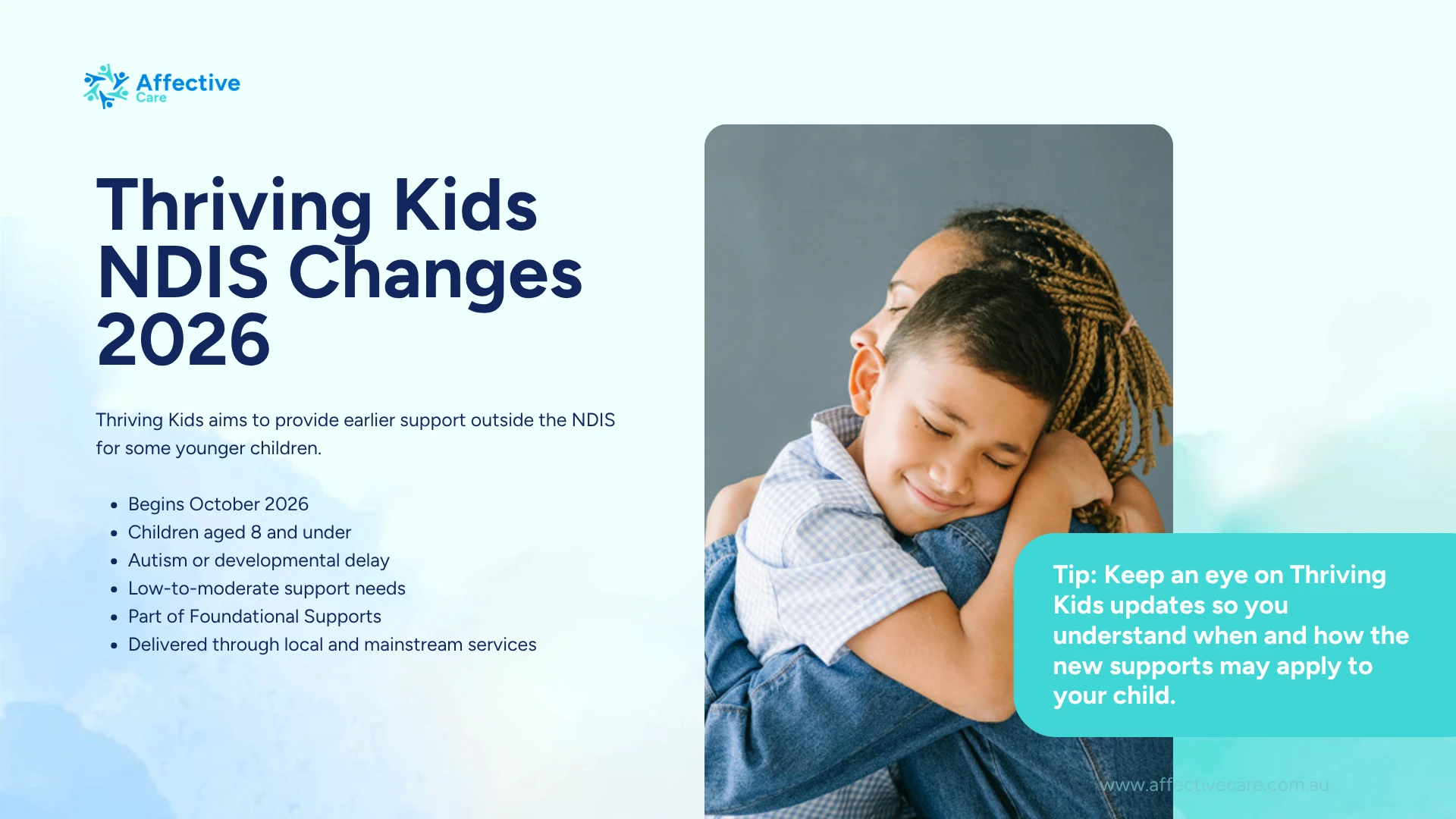
Thriving Kids NDIS Changes 2026
Thriving Kids is likely to be one of the most significant developments for families searching for information about NDIS autism changes 2026.
What Is Thriving Kids?
Thriving Kids is the first phase of a broader Foundational Supports system.
It is intended to provide earlier support through local and mainstream services for children aged 8 and under with developmental delay and/or autism with low to moderate support needs, as well as their families, carers and kin.
Services are scheduled to start progressively from:
1 October 2026.
The program is being developed jointly by the Australian Government and state and territory governments.
Who Is Thriving Kids For?
The current government description focuses on children aged 8 and under who:
- Have developmental delay and/or autism
- Have low to moderate support needs
The services available are intended to be matched to the child's needs and circumstances rather than applying one identical program to every child.
Are Thriving Kids NDIS Changes Happening in October 2026?
This requires an important clarification.
Thriving Kids services start from 1 October 2026, but the planned changes to NDIS access for the relevant group of children are scheduled from 1 January 2028.
The Department states that these future NDIS access changes will be limited to children aged 8 and under with developmental delay and/or autism with low to moderate support needs.
This means families should not interpret Thriving Kids NDIS changes 2026 as an automatic October 2026 removal from the NDIS.
Will Children With High Support Needs Still Access the NDIS?
Government guidance says children with permanent and significant disability will continue to be eligible for the NDIS subject to NDIS requirements.
It also specifically states that children aged 8 and under with developmental delay and/or autism who have substantially reduced functional capacity and high support needs will remain eligible for the NDIS under the proposed arrangements.
This distinction between low-to-moderate and high support needs is central to understanding Thriving Kids autism 2026.
NDIS Autism Level 1 Changes 2026
Families often ask whether the reforms affect Autism Level 1 differently.
An Autism Level 1 diagnosis does not, by itself, answer the question of NDIS eligibility.
When considering Autism Level 1 NDIS eligibility 2026, the focus should remain on the person's circumstances, permanent impairments, functional impact and the relevant NDIS access criteria.
For younger children, future Thriving Kids arrangements may become particularly relevant where the child is assessed as having low to moderate support needs.
However, families should avoid assuming that every person diagnosed with Level 1 autism will automatically receive or be excluded from a particular system.
Eligibility decisions remain individual. Learn more in our guide to NDIS funding for Autism Level 1.
NDIS Autism Level 2 Changes 2026
The same principle applies when discussing NDIS autism Level 2 changes 2026.
Autism support levels describe support needs associated with the diagnostic assessment, but they should not be treated as fixed NDIS funding categories.
Two people with the same autism support level can experience very different functional impacts.
One person may require significant assistance with communication and community participation, while another may have different needs across self-care, routines, sensory regulation, social interaction or self-management.
For Autism Level 2 NDIS eligibility 2026, appropriate evidence should explain the person's actual daily functional impact and disability-related support needs. Read more about NDIS funding for Autism Level 2.
NDIS Autism Level 3 Changes 2026
People living with Autism Level 3 may have very substantial support needs in areas such as communication, personal care, safety, self-management and participation.
However, even at Level 3, an NDIS plan should not be described as a standard funding package automatically attached to the diagnosis.
When considering NDIS autism Level 3 changes 2026, the person's functional circumstances and support needs remain important.
For children, current Thriving Kids guidance also distinguishes children with high support needs from children with low to moderate support needs.
Children with permanent and significant disability and those with substantially reduced functional capacity and high support needs are intended to remain within the NDIS subject to the applicable requirements.
Our guide to Autism Level 3 NDIS funding explains eligibility, evidence and how funding is decided.
NDIS Autism Funding Changes 2026
Another common search is NDIS autism funding changes 2026.
There is no single standard autism NDIS funding amount.
NDIS funding is individualised and linked to a participant's circumstances, disability-related needs and plan.
An important existing change is the introduction of funding periods.
New NDIS plans can show:
- Total funding amounts
- Funding components
- Funding periods
Funding periods determine when portions of a participant's funding become available. The NDIA says they will usually be three months and do not change the total amount of funding in the plan; they change when funding becomes available.
Participants also need to use their funding for supports that are recognised as NDIS supports, relate to their disability and align with their plan.
Therefore, NDIS autism funding changes 2026 should not be interpreted as every autistic participant receiving the same funding reduction or increase.
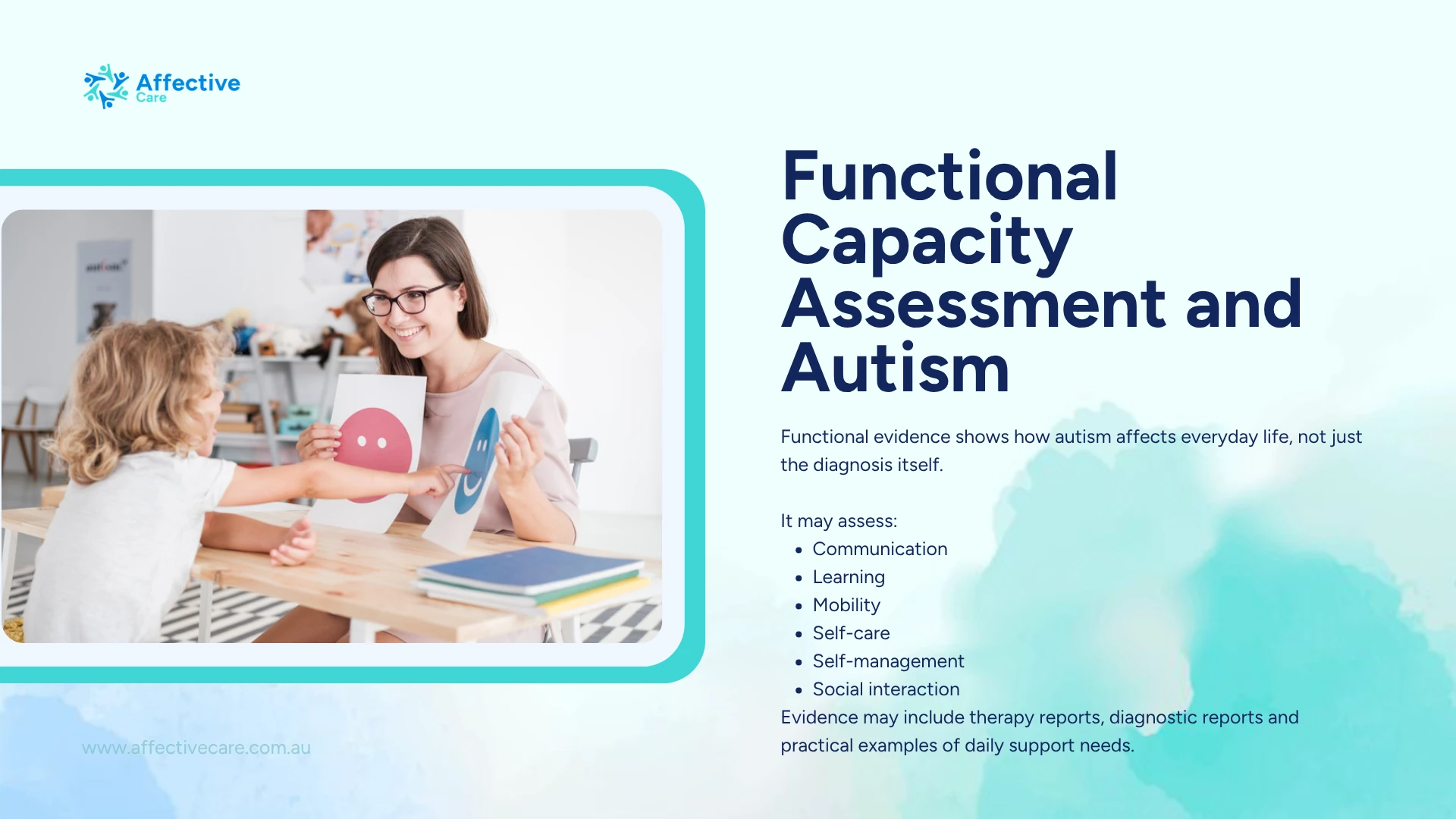
Functional Capacity Assessment Autism NDIS: What Evidence Matters?
Functional evidence remains an important concept for people researching NDIS autism eligibility 2026.
A diagnosis answers:
What condition or impairment does the person have?
Functional evidence helps explain:
How does that impairment affect everyday life?
The NDIA describes a Functional Capacity Assessment as an assessment of a person's ability to perform everyday tasks at home, work and in the community.
It can consider six areas:
- Communication
- Learning
- Mobility
- Self-care
- Self-management
- Social interaction.
Is a Functional Capacity Assessment Mandatory for Autism NDIS Eligibility?
No.
The NDIA specifically states that a person does not have to complete a Functional Capacity Assessment simply to be eligible for the NDIS.
However, it may help provide evidence of how a permanent impairment affects functional capacity.
Depending on circumstances, supporting evidence may include:
- Diagnostic assessments
- Occupational therapy reports
- Psychology reports
- Speech pathology reports
- Behaviour support information
- Medical reports
- Functional assessments
- Statements or records describing everyday support needs
The key is to provide relevant evidence rather than assuming that the diagnosis alone explains every functional support need. Learn more about autism assessments and reports for the NDIS.
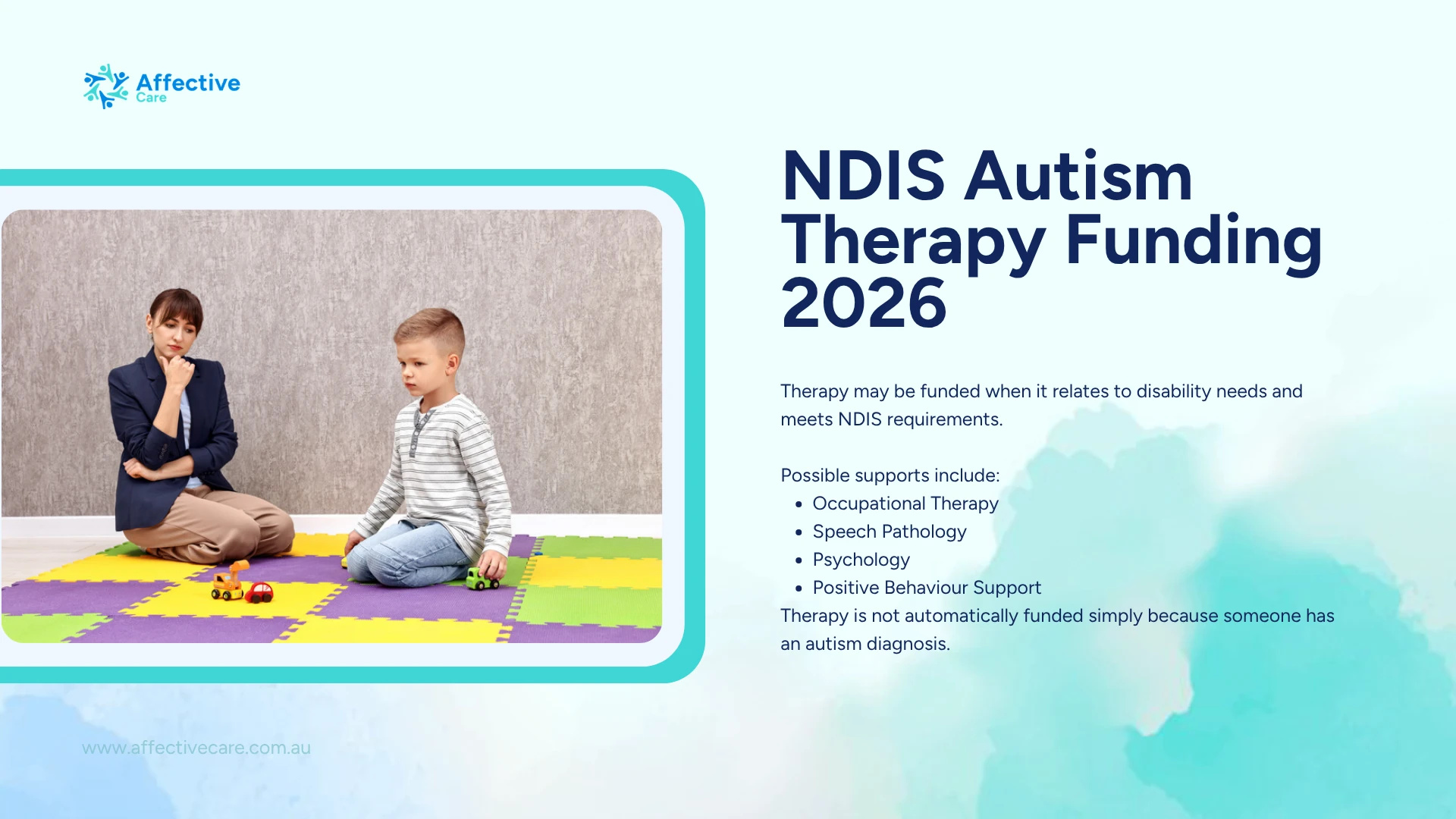
NDIS Autism Therapy Funding 2026
Families also frequently search for NDIS autism therapy funding 2026, including:
- NDIS autism occupational therapy funding
- NDIS autism psychology funding
- NDIS autism speech therapy funding
- Positive Behaviour Support autism NDIS.
The NDIS may fund disability-related supports where the support is an eligible NDIS support, relates to the participant's disability and is consistent with the participant's plan.
Depending on individual circumstances, autistic participants may have supports involving:
Occupational Therapy
Occupational therapy may support functional skills, routines, sensory needs, self-care, assistive technology and participation.
Speech Pathology
Speech pathology may support communication, receptive and expressive language, AAC and disability-related communication needs.
Psychology
Psychology may support disability-related emotional regulation, coping skills and other goals where the support meets applicable NDIS funding criteria.
Positive Behaviour Support
Positive Behaviour Support may help understand behaviours of concern, identify contributing factors and develop practical strategies designed to support quality of life and participation.
None of these therapies should be presented as automatically funded simply because a person has an autism diagnosis. Our guide to therapies for autism under the NDIS explains common options and funding considerations.
NDIS Autism Planning Changes 2026 and 2027
People searching NDIS autism planning changes 2026 may still find older information stating that new framework planning would begin in mid-2026.
That timeline has changed.
The NDIA now states that the new planning approach will begin rolling out from April 2027.
A key feature will be a support needs assessment.
The assessment is intended to provide a more consistent way of understanding a participant's disability-related support needs and informing NDIS budgets.
Testing is taking place during 2026.
Importantly, participants taking part in the testing are not having their existing plans, eligibility, funding or supports changed as a result of participating.
For current participants, this means there is generally no reason to assume that a new support needs assessment has already replaced the existing planning process in August 2026.
What Should Families Do About the NDIS Autism Changes 2026?
Families do not need to respond to every headline about NDIS reform.
Instead, consider a few practical steps.
Check the date of the information. NDIS reform timelines have changed, so older articles may still refer to mid-2026 implementation dates that are no longer current.
Keep useful evidence organised. Maintain relevant diagnostic, functional and therapy reports where appropriate.
Record everyday support needs. Practical examples can help explain how autism affects communication, self-care, routines, participation, safety and other areas.
Understand your current plan. Check what is funded, how funding periods work and what your funding can be used for.
Follow Thriving Kids updates if you have a young child. Details about services and implementation will continue to develop.
Do not assume an announcement automatically changes your plan. Check current NDIA or Australian Government information before making decisions.
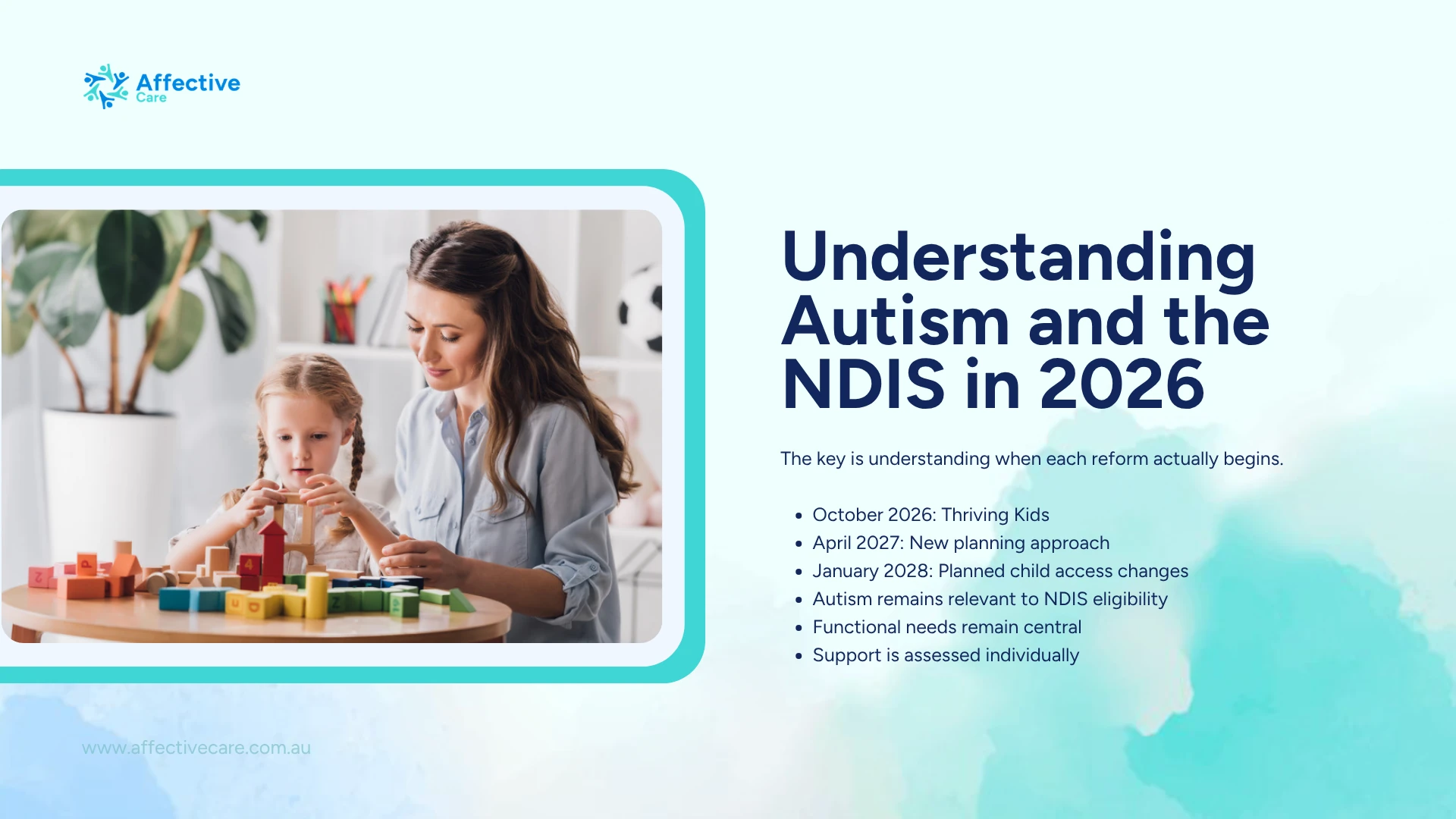
Understanding Autism and the NDIS in 2026
The NDIS autism changes 2026 are important, but they need to be understood according to their actual implementation dates.
In summary:
Thriving Kids starts from 1 October 2026.
It initially focuses on children aged 8 and under with developmental delay and/or autism with low to moderate support needs.
The new NDIS planning approach is expected from April 2027.
Planned NDIS access changes connected with Thriving Kids are expected from 1 January 2028, not October 2026.
Autism has not simply stopped being covered by the NDIS, and children with permanent and significant disability or high support needs are intended to continue accessing the NDIS where they meet the applicable requirements.
For participants and families, the strongest approach is to focus on the person's individual circumstances, functional impact, goals and appropriate supporting evidence rather than relying only on a diagnostic label or online claims about NDIS autism funding changes 2026.
At Affective Care, we support children and adults living with autism through a range of NDIS and therapy supports designed around individual needs, communication preferences, daily living goals and participation.
Need help understanding your support options? Contact Affective Care to discuss the services that may be relevant to you or your family.
Is autism still covered by the NDIS in 2026?
Yes. Autism has not simply been removed from the NDIS. Eligibility continues to depend on the applicable NDIS access requirements, including the impact of permanent impairments and individual circumstances.
Is autism being removed from the NDIS in 2026?
No blanket removal of autism from the NDIS has occurred in 2026. Future access changes are proposed for specific groups of children aged 8 and under with developmental delay and/or autism with low to moderate support needs, with those changes planned from 1 January 2028.
What are the NDIS autism changes for children?
The major child-focused development is Thriving Kids. It is intended to provide Foundational Supports for children aged 8 and under with developmental delay and/or autism with low to moderate support needs.
What are the Thriving Kids NDIS changes?
Thriving Kids services begin rolling out from 1 October 2026. Planned NDIS access changes for the relevant children are expected from 1 January 2028. These are two separate dates.
Will autistic children lose NDIS funding in October 2026?
Thriving Kids beginning in October 2026 does not mean every autistic child automatically loses NDIS funding at that time. Children already enrolled before 1 January 2028 will be treated according to the transition arrangements outlined by Government.
Will children with high support needs stay in the NDIS?
Government guidance says children with permanent and significant disability and children aged 8 and under with developmental delay and/or autism with substantially reduced functional capacity and high support needs will remain eligible subject to applicable NDIS requirements.
Does Autism Level 1 automatically qualify for NDIS funding in 2026?
Government guidance says children with permanent and significant disability and children aged 8 and under with developmental delay and/or autism with substantially reduced functional capacity and high support needs will remain eligible subject to applicable NDIS requirements.No. A diagnostic support level alone does not guarantee NDIS eligibility or funding. Individual functional impact and applicable eligibility requirements need to be considered.
Do I need a Functional Capacity Assessment for autism and the NDIS?
Not necessarily. The NDIA states that a Functional Capacity Assessment is not mandatory simply to qualify for the NDIS, although it may provide useful evidence about functional impact.
Is there a standard NDIS autism funding amount in 2026?
No. Funding is individualised. Participants with the same autism diagnosis or support level can have different support needs and different plans.
When are the new NDIS support needs assessments starting?
No. Funding is individualised. Participants with the same autism diagnosis or support level can have different support needs and different plans.The NDIA currently says the new way of planning, including support needs assessments, will begin rolling out from April 2027.