New NDIS funding cuts in 2026 have now been confirmed following major changes to NDIS legislation. The Australian Parliament passed the National Disability Insurance Scheme Amendment (Securing the NDIS for Future Generations) Bill 2026 on 19 August 2026, and the legislation received Royal Assent on 20 August 2026.
The changes include planned reductions to particular NDIS support budgets, including a 50% reduction to budget allocations for social, civic and community participation supports and a 10% reduction to capacity building daily activity allocations, described in the legislation as improved daily living skills.
However, this does not mean every NDIS participant will lose 50% of their total plan funding. The reductions relate to specific areas of participant budgets and will be progressively introduced through planning arrangements.
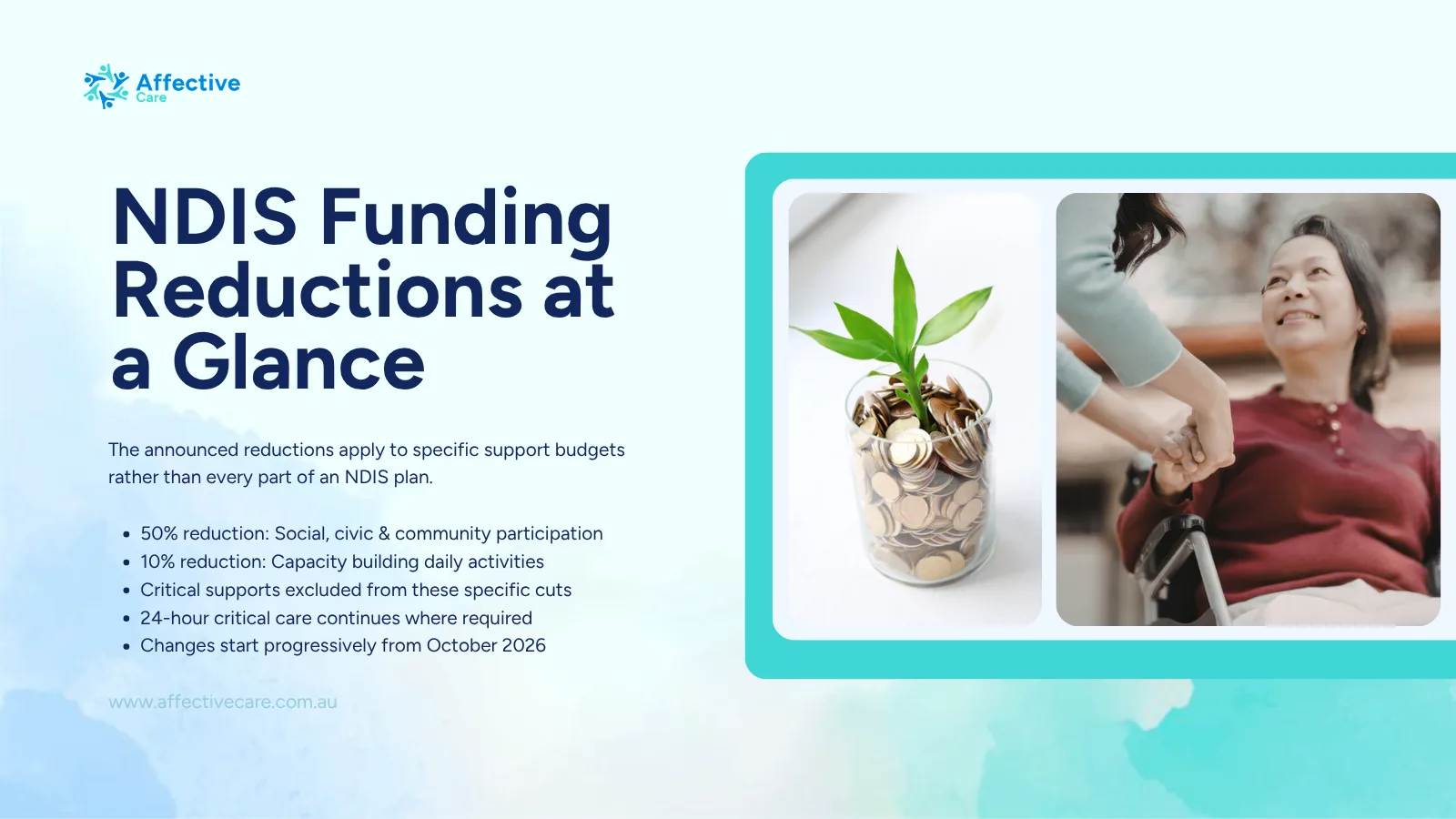
NDIS Funding Reductions at a Glance
| Support area | Announced change | When |
|---|---|---|
| Social, civic and community participation | 50% reduction to specified budget allocations | From 1 October 2026 |
| Capacity building daily activities / improved daily living skills | 10% reduction to specified budget allocations | From 1 October 2026 |
| Critical care and essential daily living supports | Not included in these specific reductions | Continue based on participant needs |
| Continuous 24-hour critical care | Government says these supports will continue where required | Ongoing |
| New framework plans | Separate reform | Progressive transition from 2027 |
The Department of Health, Disability and Ageing says affected budgets will begin to be progressively adjusted from 1 October 2026. If you are unsure how your plan is structured, our guide to how NDIS funding categories work explains each budget.
Is Every NDIS Participant Losing 50% of Their Funding?
No. One of the most important points for participants and families to understand is that the NDIS participant funding reduction is not a 50% cut to every participant's entire plan.
The 50% figure relates specifically to budget allocations for social, civic and community participation supports. A participant may have several different support categories within their NDIS plan, so a reduction to one area does not automatically mean the total plan will fall by the same percentage.
Similarly, the announced 10% reduction relates specifically to capacity building daily activities, referred to in the legislation as improved daily living skills. It should not be interpreted as a blanket 10% reduction to every therapy or Capacity Building support.
Individual plan amounts can also increase or decrease through the normal planning process when a participant's circumstances or support needs change. The NDIA has specifically warned that ordinary plan changes should not automatically be confused with the new reforms.
Which NDIS Supports Are Being Reduced?
Social, Civic and Community Participation
The most significant announced NDIS funding reduction in 2026 relates to social, civic and community participation. These supports can help participants take part in community, recreational and social activities and build greater participation outside the home.
The Australian Government says budget allocations in this area will be reduced by 50%, with spending intended to move closer to 2023 levels. The government has also announced a $200 million Inclusive Communities Fund to increase the capacity of community organisations to provide inclusive participation opportunities.
Capacity Building Daily Activities
The second major change is a 10% reduction to capacity building daily activity budget allocations, described as improved daily living skills in the legislation.
This area can relate to supports intended to build skills, independence and functional capacity. Because participant plans differ, people should check their individual plan rather than assuming all therapy or Capacity Building funding will automatically decrease by 10%.
What Supports Are Not Included in These Funding Cuts?
The government has stated that these particular NDIS funding cuts will not affect budgets for critical supports. It has also said participants with high support needs who require continuous 24-hour care will continue to receive those critical supports.
According to the Department of Health, Disability and Ageing, supports such as help with eating, drinking, dressing, toileting, laundry, cleaning, nurse care and medication are not affected by the reset. You can read more about these supports in our guide to NDIS assistance with daily life.
However, this should not be interpreted as meaning that a participant's SIL, Core Supports or other funding can never change. Individual plans can still be reassessed or renewed based on the participant's circumstances, evidence and support needs.
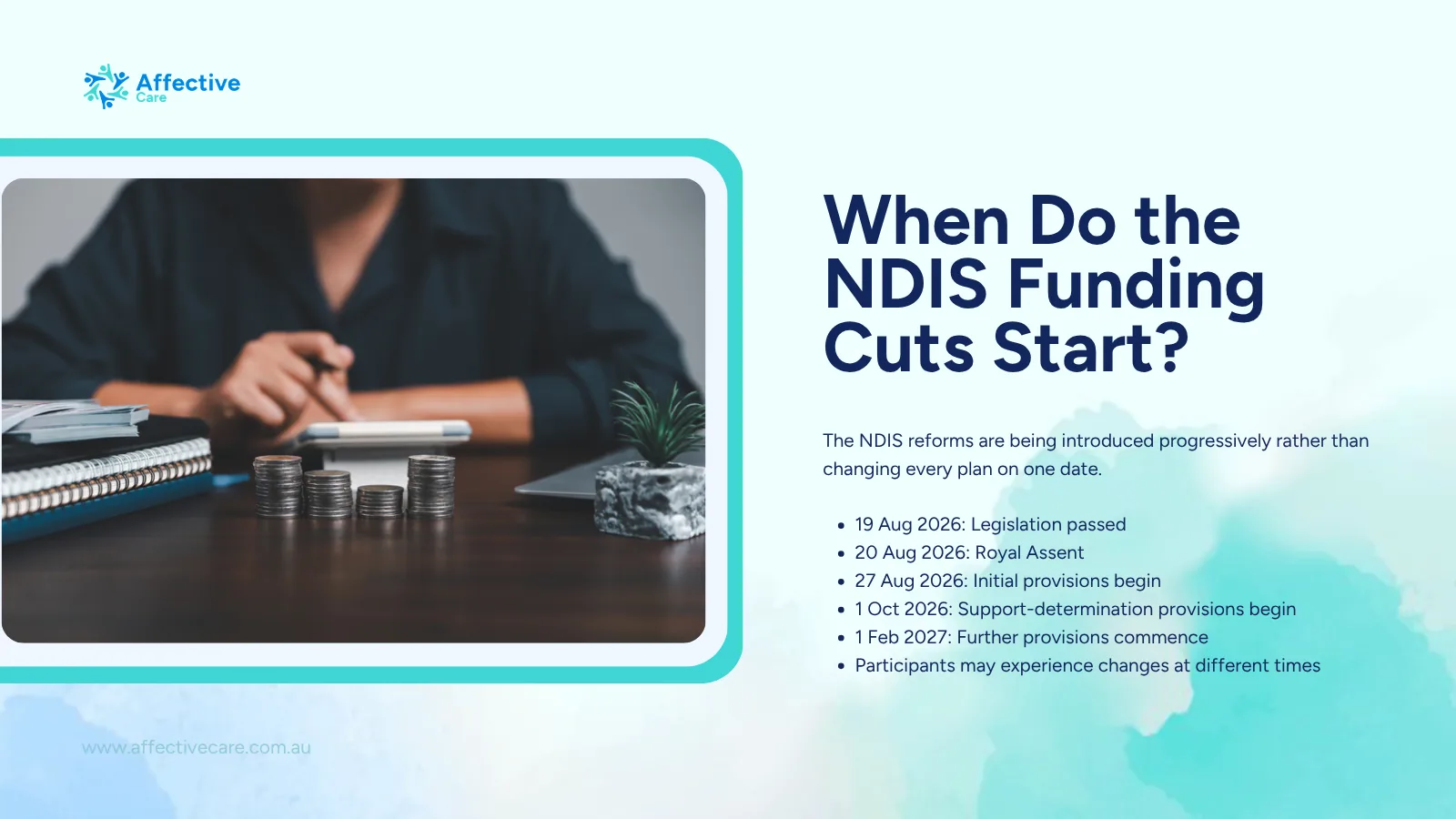
When Do the NDIS Funding Cuts Start?
The reforms are being introduced in stages rather than changing every participant's plan on the same day.
- 19 August 2026: Parliament passed the legislation.
- 20 August 2026: The legislation received Royal Assent and became the National Disability Insurance Scheme Amendment (Securing the NDIS for Future Generations) Act 2026.
- 27 August 2026: Initial provisions relating to areas including functional capacity and plan reassessments commence.
- 1 October 2026: The support-determination provisions of the Act commence. Affected social and community participation and capacity building budgets begin being progressively adjusted from this date.
- 1 February 2027: Further provisions relating to plan renewal and reasonable and necessary supports commence.
How the reset is applied to your plan
The reset is applied one plan at a time over 12 months, according to the Department of Health, Disability and Ageing.
| From | What triggers the change to your plan |
|---|---|
| 1 October 2026 | A new plan is created or your plan is reassessed |
| 1 February 2027 | Your plan is renewed |
| 30 September 2027 | End of the 12-month roll-out |
Participants are therefore unlikely to experience the changes in exactly the same way or at exactly the same time. The NDIA will notify you before your plan is reassessed or renewed.
What Happens to My Current NDIS Plan?
For now, the NDIA says participants can continue using their existing plans and supports as usual.
If your plan is renewed or reassessed, carefully compare the new plan with your previous plan. Look beyond the total dollar amount and check which individual support categories, funding periods or support allocations have changed.
A reduced plan does not necessarily mean the reduction was caused by the new legislation. The NDIA says plans normally increase or decrease as participants' needs change, and these ordinary planning decisions should be distinguished from the 2026 reforms.
What recent reassessment data shows
Separate from the October reset, reassessment data reported by ABC News shows more plans being reduced at reassessment. In January to March 2026, 18,037 reassessed plans went down, the most in any quarter since early 2024–25, while 26,998 went up, the lowest number since July 2024. More than $2.8 billion was taken out of plans reviewed between 1 July 2024 and 31 March 2026.
What Should You Do If Your NDIS Funding Is Reduced?
If your NDIS plan funding is reduced, first identify exactly which part of the plan has changed.
- Read your new plan carefully. Identify exactly which budget changed.
- Compare it with your previous plan. Compare categories, support hours and funding periods, not only the total amount.
- Read the NDIA's explanation. Check whether the change relates to the new reforms or to an individual planning decision.
- Gather current evidence. Focus on functional impact and actual support needs.
- Speak with your treating professionals or providers. Where appropriate, ask for evidence about your current support requirements.
- Understand your review options. Read the decision notice carefully and check which review rights apply, because different decisions can have different review pathways.
New rules for requesting a plan reassessment
Since 27 August 2026, only a participant, their nominee or their child representative can request a plan reassessment, according to the NDIS. A support coordinator or advocate can no longer submit the request for you, although they can still help you prepare it.
Requests must be made on the official form, explain what has changed and include evidence, which may need to come from a GP or health professional. You need to show a significant and ongoing change in your functional capacity, support needs or life circumstances. Once the NDIA has the information it needs, it will decide within 90 days. For urgent, minor or short-term changes, you can ask for a plan variation instead. Our NDIS support coordination team can help you work through the process.
Worried about a change to your NDIS plan?
Our team can talk through your current supports and help you understand your options after a reassessment or funding change.
What Evidence May Help if Your Support Needs Have Changed?
Current evidence can help explain how disability affects everyday functioning and why particular supports remain important. Depending on your circumstances, useful evidence may include:
- Functional Capacity Assessments
- Occupational therapy reports
- Psychology reports, where relevant
- Behavioural assessments and Behaviour Support Plans
- Daily support records and progress reports
- Relevant incident information
- Evidence of changes in functional capacity
Evidence does not guarantee a particular level of NDIS funding, but it can help the NDIA understand your current functional impact and support requirements. Our psychology services and occupational therapy teams can provide assessments and reports where they are part of your supports.
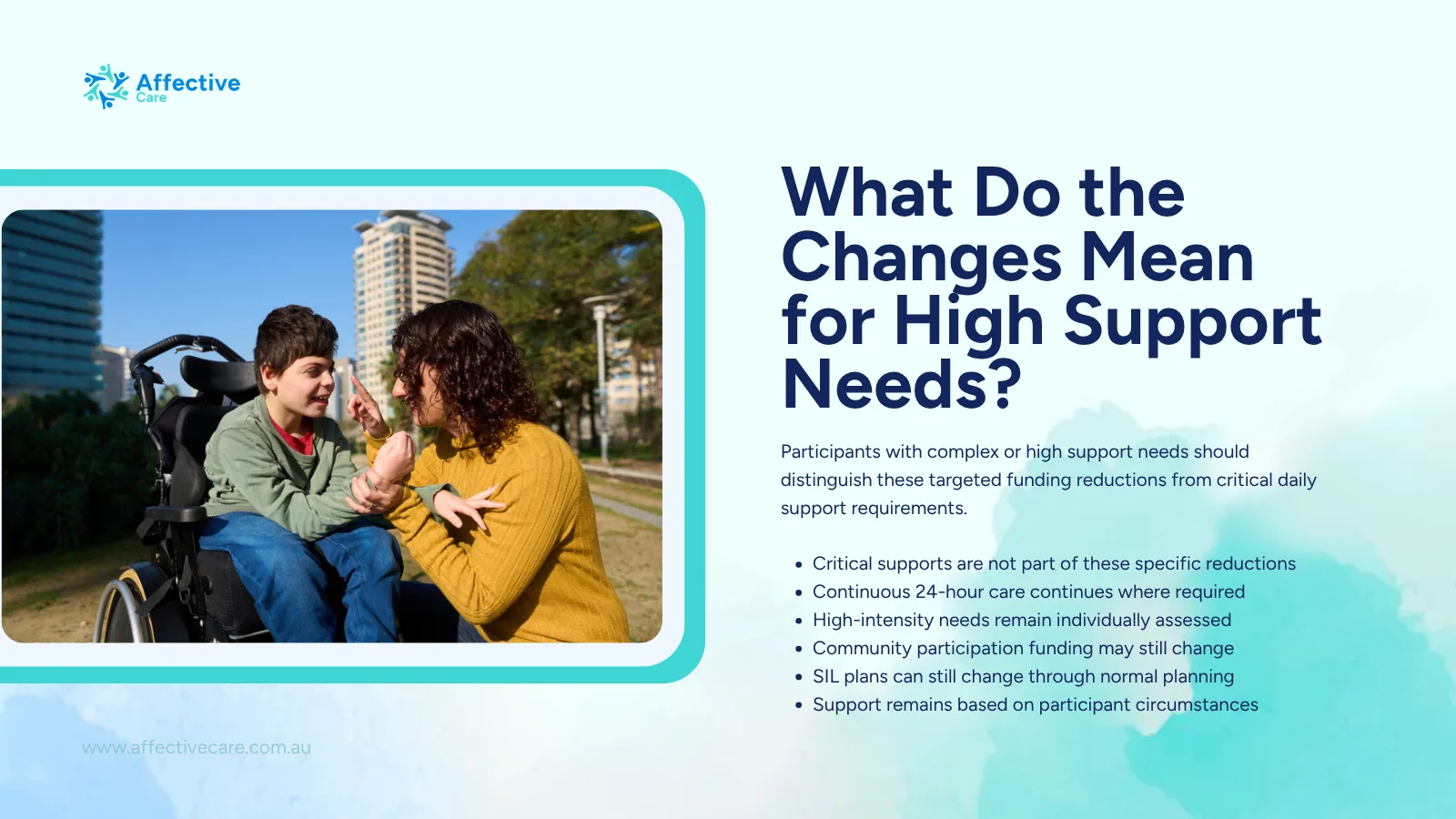
What Do the New Rules Mean for People With High Support Needs?
Participants with complex or high support needs should distinguish these targeted funding reductions from their critical daily support requirements. The government has stated that critical supports are not part of these specific reductions, and that continuous 24-hour care will continue where required.
If a support determination applies to you and you have high support needs, you can apply for a plan variation within 90 days of the funding reset being applied to your plan. The NDIA says it can increase funding through a plan variation where needed.
Community participation funding may still change, and Supported Independent Living plans can still change through normal planning. Learn more about NDIS high intensity supports and what the NDIS pays for in SIL.
What Do These Changes Mean for Participants Right Now?
The key point is that the NDIS funding cuts 2026 are targeted changes to particular support budgets, not an automatic 50% reduction to every participant's entire NDIS plan.
The reforms will also be introduced progressively. Participants should continue using their existing plans, monitor correspondence from the NDIA and carefully review any future plan changes.
Further NDIS reforms are also coming. Participants are expected to begin transitioning to new framework planning progressively from 1 April 2027, while some access and eligibility-related provisions have later commencement dates. Our guide to NDIS changes in 2026 covers the full reform timeline.
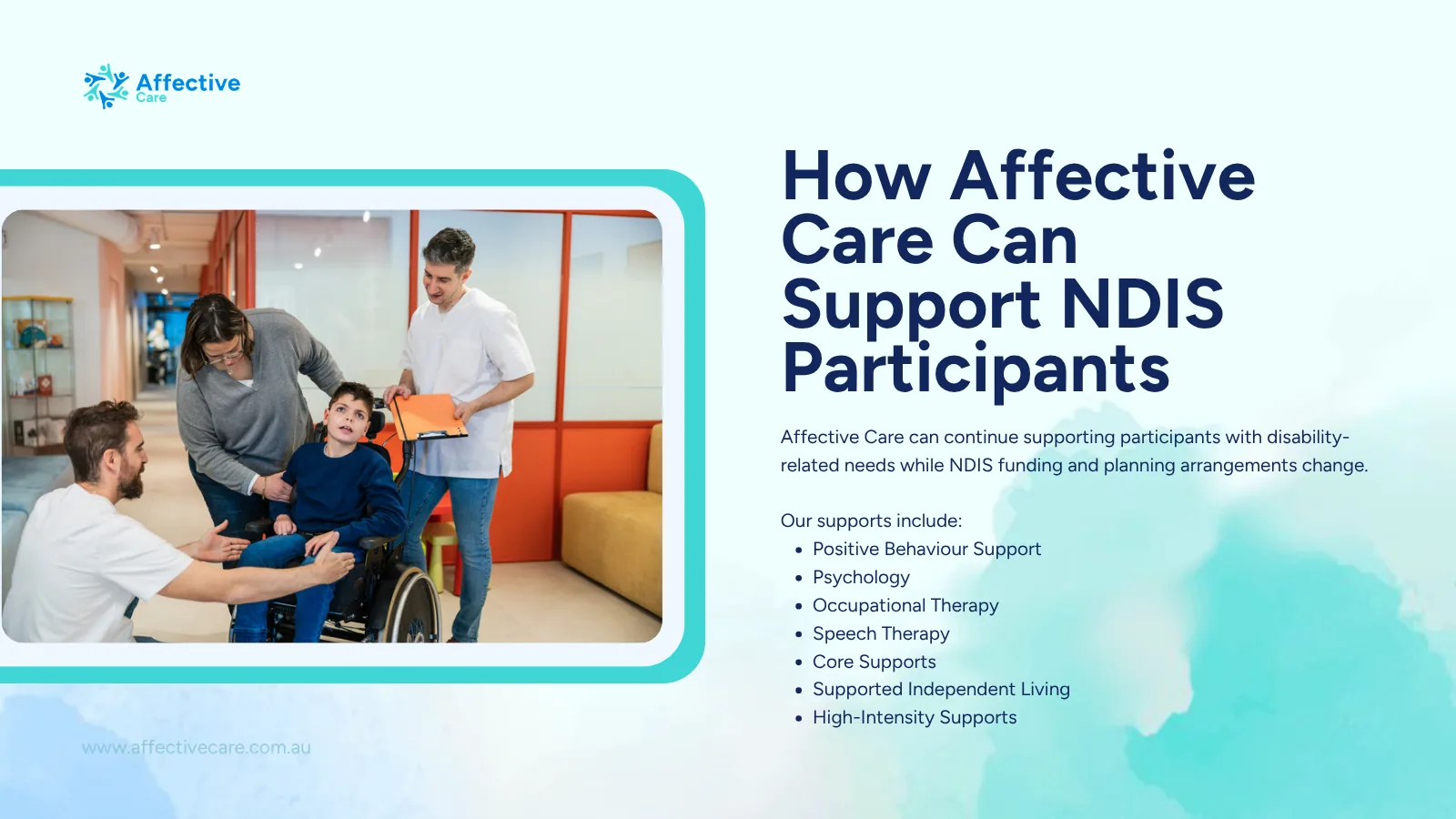
How Affective Care Can Support NDIS Participants
Changes to NDIS funding can make it especially important to understand how your available supports relate to your current disability-related needs.
Affective Care supports participants across services including Positive Behaviour Support, psychology, occupational therapy, speech therapy, Core Supports, Supported Independent Living and high-intensity supports.
Refer someone to Affective Care
Support coordinators, families and health professionals can refer a participant online, or call our team on 1300 615 193.
Frequently Asked Questions
Is NDIS funding being cut in 2026?
Yes. The government has announced reductions to particular support budget allocations, including a 50% reduction to social, civic and community participation and a 10% reduction to capacity building daily activities. This is not a blanket reduction to every participant's total NDIS funding. Other parts of your plan are assessed on your individual needs.
Is every NDIS participant losing 50% of their plan?
No. The 50% figure relates only to specified social, civic and community participation budget allocations, not a participant's entire NDIS plan. A participant may have several support categories, so a reduction in one area does not mean the total plan falls by the same percentage.
When will the new NDIS funding reductions start?
Affected budgets began being progressively adjusted from 1 October 2026. The reset is applied when a plan is created or reassessed from 1 October 2026, or renewed from 1 February 2027, over a 12-month roll-out. The exact timing for each participant depends on their planning arrangements, and the NDIA will notify participants beforehand.
Is Improved Daily Living funding being reduced?
Yes, by 10%. The reduction applies to capacity building daily activity allocations, described in the legislation as improved daily living skills. It is not a blanket 10% cut to every therapy or Capacity Building support, so check your own plan to see which budget has changed.
Are critical NDIS supports or Core Supports being cut?
The government has stated that these specific reductions will not apply to critical support budgets, including continuous 24-hour care for participants who require it. Help with eating, dressing, toileting, cleaning, nurse care and medication is not affected by the reset. However, Core Supports can still change through normal planning based on your needs and evidence.
Will SIL funding be reduced?
Supported Independent Living is not one of the two budgets targeted by the October 2026 reset, and continuous 24-hour critical care is protected. However, SIL plans can still increase or decrease through normal reassessment based on a participant's circumstances, evidence and support needs.
Can my support coordinator request a plan reassessment for me?
Not anymore. Since 27 August 2026, only a participant, their nominee or child representative can request a plan reassessment. The request must use the official form and include evidence of a significant and ongoing change. Your support coordinator can still help you gather evidence and prepare the request.
What should I do if my NDIS plan has been reduced?
Check which budget changed, compare it with your previous plan, read the NDIA's reasons and keep evidence of your current functional needs up to date. If you have high support needs, you may be able to apply for a plan variation within 90 days. If you disagree with a decision, check the review options in your decision notice.
Editorial note: This article reflects NDIS legislation and Australian Government guidance available as at 6 October 2026. Implementation details may continue to change as the reforms are rolled out. It is general information only. Please speak with your NDIS planner, support coordinator or health professional about your own situation.