
A person with Autism Level 3 may qualify for the NDIS when their autism-related impairments are permanent and substantially affect everyday activities such as communication, social interaction, learning, self-care or self-management.
However, an Autism Level 3 diagnosis does not automatically guarantee NDIS access, a particular service or a fixed funding package.
The NDIA considers the person’s functional capacity, support needs, goals, living arrangements and supporting evidence.
This guide explains how to apply for NDIS funding for Autism Level 3, what reports may be required and how the NDIS Level 3 autism funding amount is determined.
It also covers:
- The difference between a diagnosis and functional evidence
- NDIS support for children and adults with Level 3 autism
- Therapy and Positive Behaviour Support
- Assistance with Daily Life and community participation
- Short Term Accommodation
- Supported Independent Living for Autism Level 3
- Application and planning timeframes
- Common application mistakes
The latest available NDIS Quarterly Report covers the Scheme to 31 March 2026 and provides current information about participant access, planning, payments and children in the NDIS.
Autism Level 3 NDIS: Quick Answers
|
Question |
Answer |
|
Does Autism Level 3 automatically qualify for the NDIS? |
No. The applicant must meet the NDIS access requirements and provide evidence showing permanent and substantial functional impairment. |
|
How do you apply for NDIS funding? |
The applicant or their representative completes an access request and provides evidence about diagnosis, permanence and everyday functional impact. |
|
Is there a fixed NDIS Level 3 autism funding amount? |
No. Funding is individualised and based on the supports considered reasonable and necessary for that participant. |
|
What evidence may be needed? |
Evidence may include diagnostic reports, Functional Capacity Assessments, allied health reports, daily support records and carer statements. |
|
What may the NDIS fund? |
Depending on individual needs, funding may cover daily support, therapy, behaviour support, communication assistance, community access and home and living support. |
|
Can someone with Autism Level 3 receive 24-hour support? |
Potentially, when evidence shows substantial daytime and overnight assistance or supervision is required. |
|
Can an adult with Autism Level 3 receive SIL? |
Supported Independent Living may be considered when significant support is required at home throughout the week. |
What Does Autism Level 3 Mean?
Autism Level 3 generally describes a person who requires very substantial support with social communication and restricted or repetitive patterns of behaviour.
A person may use spoken language, limited speech, gestures, pictures or augmentative and alternative communication.
Some people require direct assistance throughout the day, while others can complete certain activities independently but need significant support with communication, safety, sensory regulation or unexpected changes.
Autism Level 3 support needs may include substantial assistance with:
- Communication: The person may require an AAC device, visual supports or a familiar communication partner to express choices, pain, hunger or personal-care needs.
- Personal care: Direct prompting, supervision or physical assistance may be required for showering, dressing, toileting, eating and medication routines.
- Safety: The person may require close supervision because of limited danger awareness, leaving safe environments, self-injury or difficulty responding during emergencies.
- Daily routines: Transitions, unfamiliar activities and changes to expected routines may lead to significant distress without structured support.
- Community participation: The person may need one-to-one assistance to attend appointments, use transport or participate safely in community activities.
The support level is relevant evidence, but it does not fully explain the participant’s individual functional capacity.
If you are still at the assessment stage, our guide to the autism diagnosis process in Australia explains screening, assessments, who can diagnose autism and what to expect after diagnosis.
Does Autism Level 3 Qualify for the NDIS?
Autism Level 3 may provide significant diagnostic evidence, but it does not create automatic NDIS eligibility.
The applicant must first meet the age and residency requirements. They must then meet the disability requirements, early intervention requirements or both.
Under the disability requirements, the NDIA considers whether the person has permanent impairments that substantially reduce their functional capacity and affect social or economic participation.
For Level 3 autism NDIS eligibility, the evidence should demonstrate how autism affects areas such as:
- Communication and the ability to express or understand information
- Social interaction and the ability to form or maintain relationships
- Learning and applying new information
- Self-care activities such as dressing, toileting and eating
- Self-management, planning, decision-making and emotional regulation
- Functional mobility and the ability to move safely through the community
The NDIA has previously explained that an autism diagnosis should be considered together with a functional assessment when identifying support needs and determining NDIS access.
The strongest applications connect the diagnosis to clear examples of daily assistance, supervision, prompting and risks.
Moreover, Support needs can vary considerably between autism support levels. Learn more about NDIS funding for Autism Level 1 and how eligibility depends on functional impact rather than diagnosis alone.
Who Can Apply for Autism Level 3 NDIS Funding?
A person can generally apply for the NDIS when they are younger than 65, live in Australia and meet the relevant citizenship or residency requirements.
They must also meet the disability or early intervention requirements.
The application may be made by:
- The person with autism
- A parent or guardian
- A legally authorised representative
- Another person authorised to act on the applicant’s behalf
Families of children may also receive guidance from an early childhood partner or another NDIS partner, depending on the child’s age and circumstances.
The March 2026 NDIS Quarterly Report recorded 167,787 children younger than nine with approved plans.
A further 22,128 children accessed early connections during the quarter, whether or not they were NDIS participants.
The report also states that children with permanent and significant disability will continue to be eligible for the NDIS under applicable access requirements.
Meeting the access requirements does not mean every requested support will be funded. Each support must also satisfy current NDIS funding rules.
Moreover, for information about participants who require substantial support, read our guide to NDIS funding for Autism Level 2.
How to Apply for NDIS Funding for Autism Level 3
Applying for Autism Level 3 NDIS funding involves demonstrating both the diagnosis and its functional impact.
Step 1: Check the access requirements
Confirm that the person appears to meet the age, residency and disability or early intervention requirements.
Step 2: Begin an access request
The person, their representative or an appropriate NDIS partner can begin the application process.
The access request collects identity, residency, disability and supporting professional information.
Step 3: Gather diagnostic evidence
Include a report confirming the autism diagnosis, diagnostic method, support level, permanence and relevant developmental or clinical history.
Step 4: Gather functional evidence
Provide reports showing how autism affects communication, self-care, learning, social interaction, safety, routines and participation.
Step 5: Submit the application
Submit the completed access information and supporting documents through an accepted NDIA process.
Step 6: Respond to further requests
The NDIA may ask for additional information where the reports do not clearly address permanence or functional impact.
Step 7: Prepare for planning
When access is approved, the participant moves into the planning process, where goals, current supports and reasonable and necessary disability supports are discussed.
What Should an Autism Level 3 Access Request Explain?
A strong access request should provide a realistic picture of the person’s ordinary day.
It should explain:
- Which activities the person cannot complete independently
- Whether support involves prompting, supervision or physical assistance
- How frequently support is required
- Whether the person needs one-to-one or shared assistance
- Whether needs occur during the day, overnight or both
- What risks arise when support is unavailable
- What treatment, therapy or strategies have already been tried
- How autism affects participation at home, school, work and in the community
Avoid relying on a broad statement such as:
The applicant has Level 3 autism and requires very substantial support.
A more useful description would be:
The applicant cannot independently communicate pain, hunger or toileting needs. They require a familiar communication partner throughout the day and use visual supports to make choices.
Another example could state:
The applicant requires direct prompting and physical assistance to complete showering, dressing and oral hygiene. Without assistance, these activities are not initiated or completed safely.
Specific examples make the relationship between diagnosis, impairment and support needs easier to understand.
Moreover, Autism can present differently across individuals, and some traits may be recognised later in life. Our guide to autism in women and why it is often missed explores signs, masking and diagnosis.
Evidence Needed for an Autism Level 3 NDIS Application
The NDIA considers evidence about the person’s disability, impairments, functional capacity, treatment history and support needs.
Evidence should come from professionals who understand the participant and the areas being assessed.
|
Evidence |
What it may demonstrate |
|
Autism diagnostic report |
Diagnosis, support level, developmental history and clinical presentation |
|
Functional Capacity Assessment |
Ability to complete activities at home, school, work and in the community |
|
Occupational therapy report |
Self-care, sensory regulation, routines, safety and daily living skills |
|
Speech pathology report |
Receptive and expressive communication, AAC and mealtime needs |
|
Psychology report |
Cognitive functioning, adaptive behaviour and emotional regulation |
|
Behaviour support assessment |
Behaviours of concern, triggers, risks and recommended strategies |
|
Medical specialist report |
Diagnosis, treatment history and permanence |
|
School or workplace report |
Functional impact within education or employment |
|
Daily support records |
Frequency, duration and intensity of assistance |
|
Carer statement |
Informal support currently provided and whether it is sustainable |
The reports should be consistent and detailed enough to show why disability-specific support is likely to be required over time.
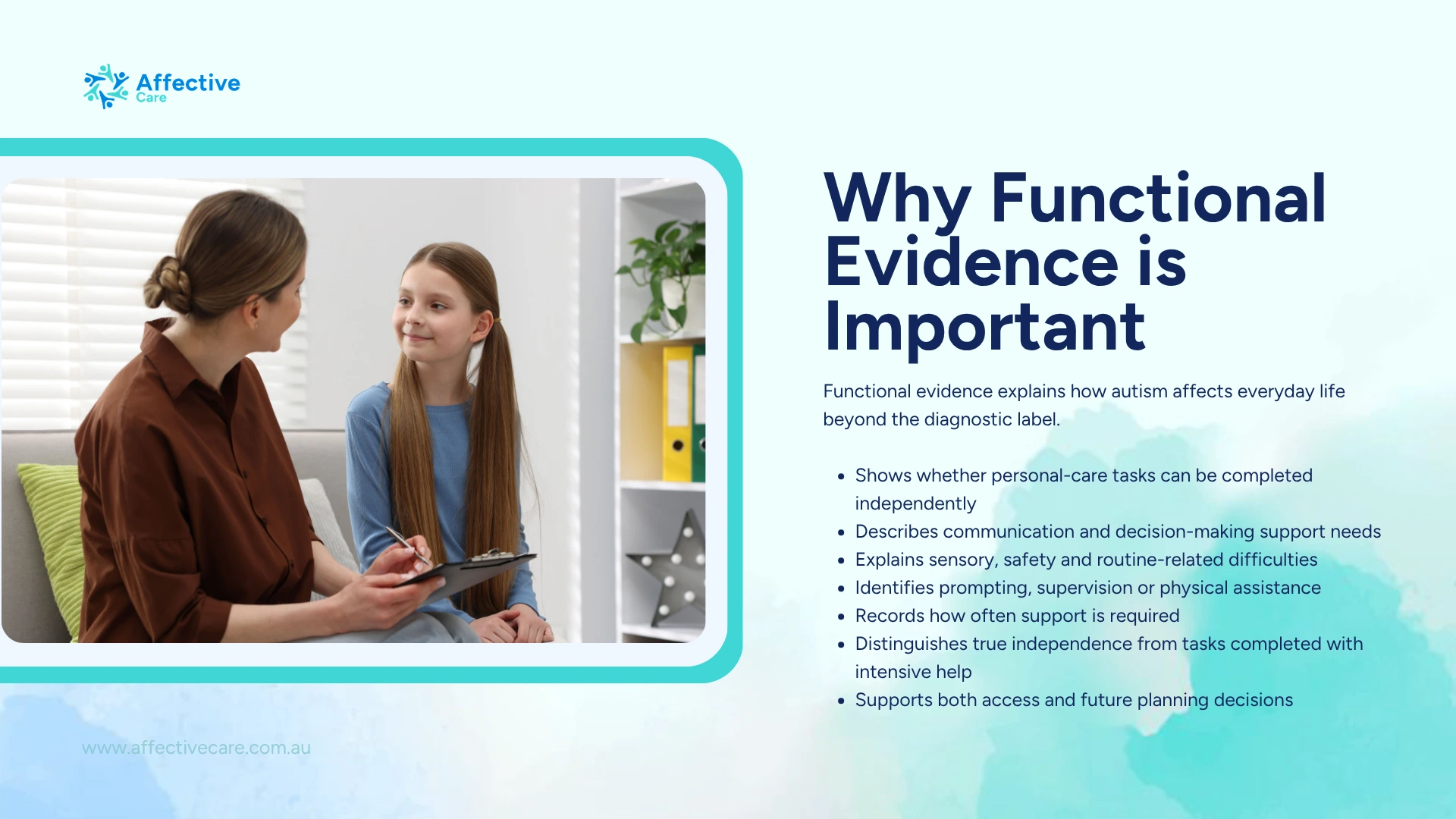
Why Functional Evidence is Important
A diagnostic assessment confirms autism. Functional evidence explains how autism affects daily life.
A Functional Capacity Assessment examines the person’s ability to perform daily activities at home, at work and in the community.
It may be completed by an occupational therapist, psychologist, physiotherapist or medical specialist with suitable experience.
For an Autism Level 3 NDIS application, functional evidence may examine whether the person can:
Initiate and complete personal-care activities
- Understand instructions and communicate needs
- Prepare food and eat safely
- Manage sensory experiences
- Cope with changes to routine
- Recognise hazards
- Make decisions
- Travel or participate in the community
- Complete household activities
- Sleep safely without overnight support
The assessment should also describe the level of help required. For example, verbal prompting is different from active supervision or hands-on assistance.
Reports should clarify whether the participant performs an activity independently or only because another person provides intensive support.
This distinction is important when describing functional capacity.
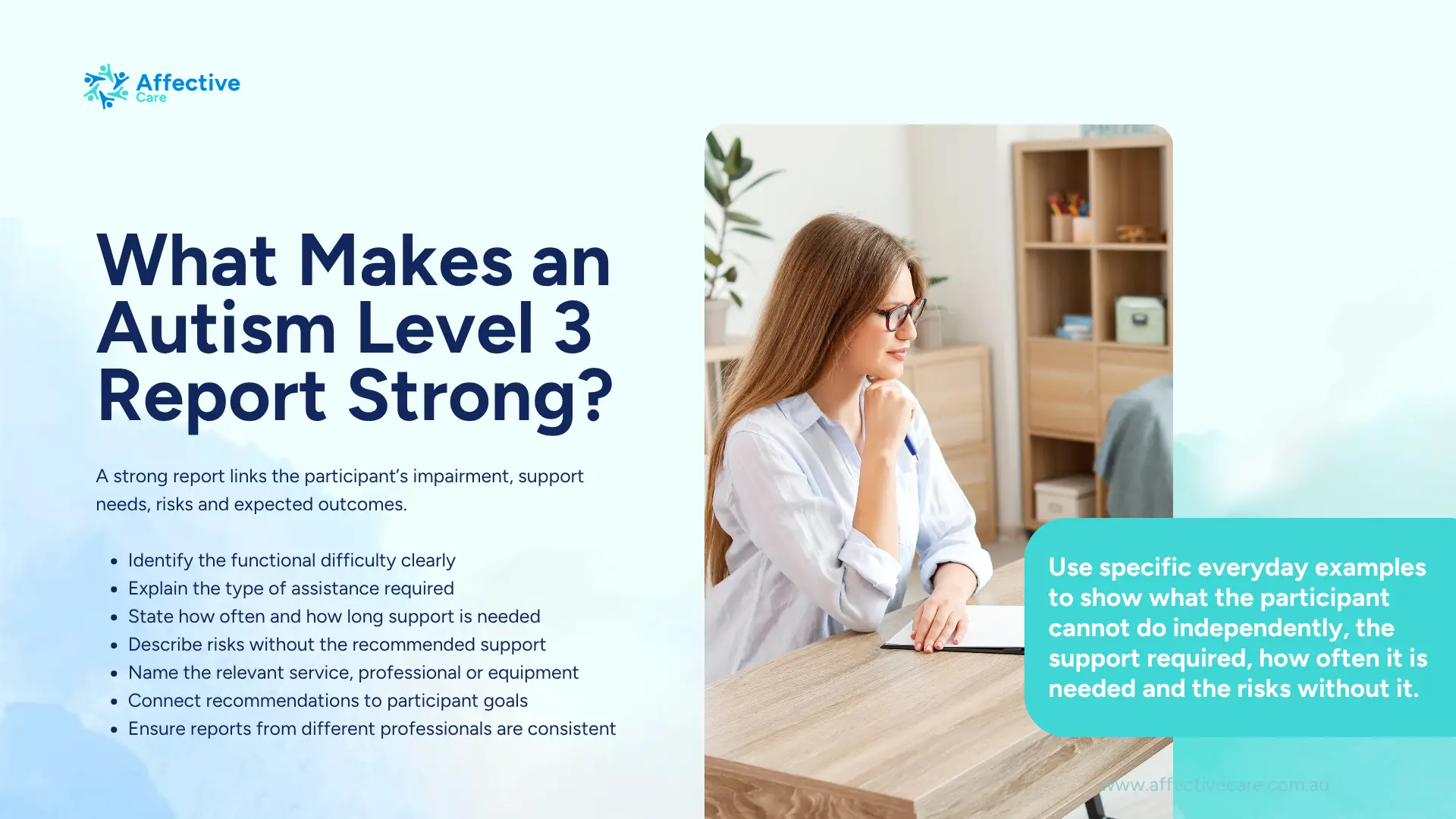
What Makes an Autism Level 3 Report Strong?
A strong report connects the participant’s impairment, functional difficulty, required support and expected outcome.
Each recommendation should explain:
- The functional difficulty: Identify the activity or participation area affected by autism.
- The support required: State whether the participant needs prompting, supervision, physical assistance, environmental changes or specialist intervention.
- The frequency: Explain how often the support is required and how long it may take.
- The risk without support: Describe likely consequences for safety, wellbeing or participation.
- The recommended service: Identify the professional, support worker or equipment required.
- The intended outcome: Explain how the support may maintain capacity, build skills or enable participation.
Instead of simply stating that occupational therapy is recommended, a report might recommend fortnightly occupational therapy to build personal-care routines, trial visual supports and train the participant’s support team.
Reports from different professionals should present a consistent picture.
If one report describes continuous supervision while another states the person is largely independent, the NDIA may seek clarification.
Moreover, for participants who use or may benefit from alternative ways to communicate, explore our guide to autism, sign language and NDIS communication supports, including Key Word Sign and Auslan.
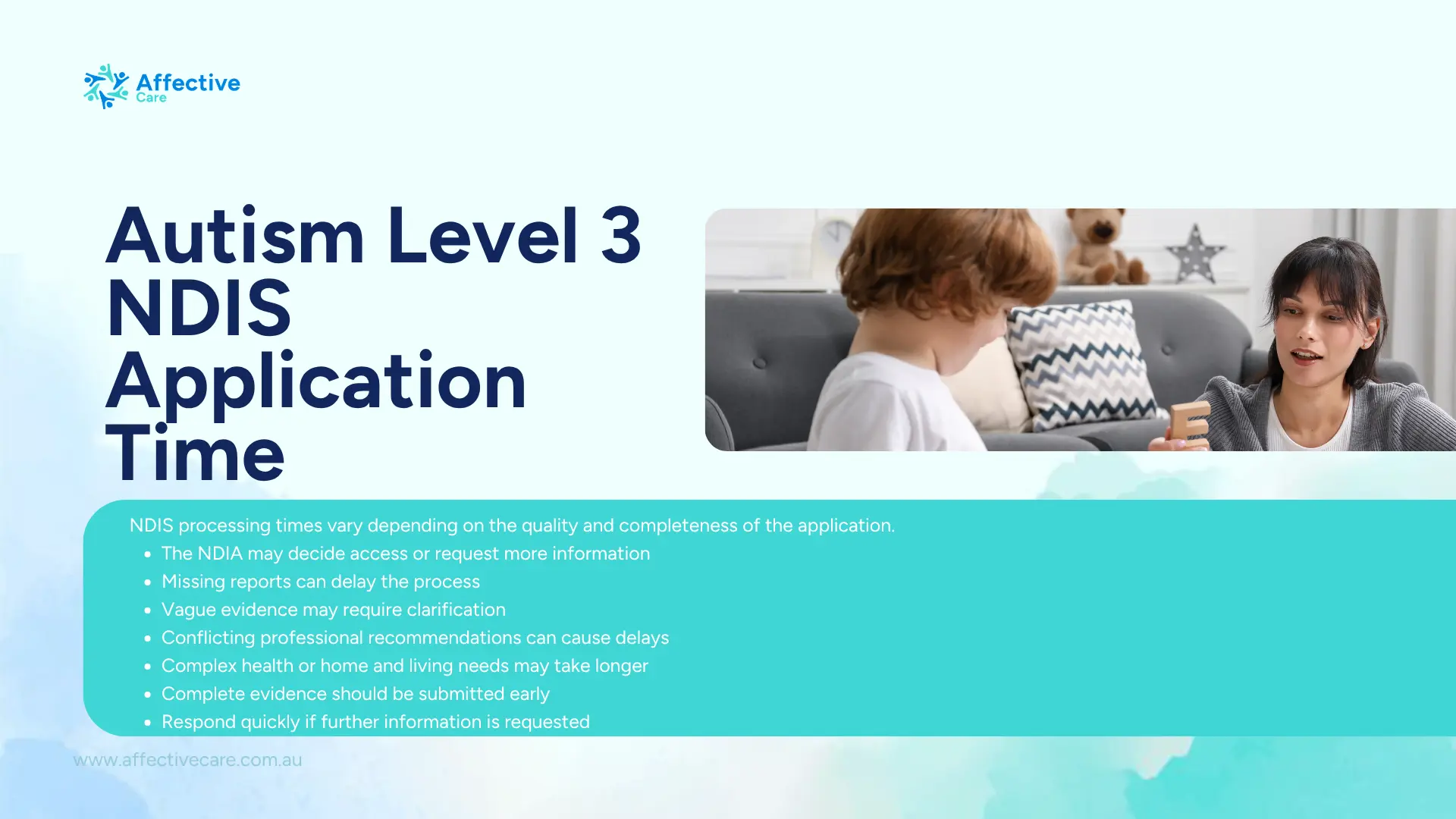
How Long Does an Autism Level 3 NDIS Application Take?
There is no single processing time that applies to every application.
The Participant Service Guarantee sets a target of 21 days for the NDIA to make an access decision or request more information after receiving an access request.
In the March 2026 quarter, this target was met in 82% of cases. When additional information was submitted, the separate 14-day target was met in 68% of cases.
The same report states that 96% of first plans were approved within the applicable 56-day service timeframe during that quarter.
An application may take longer when:
- Diagnostic or functional reports are missing
- Reports do not clearly establish permanence
- Functional impacts are described vaguely
- Professional recommendations conflict
- The NDIA requests additional information
- The participant has complex health, behavioural or home and living needs
Families should provide complete evidence at the beginning where possible and respond promptly to requests for further information.
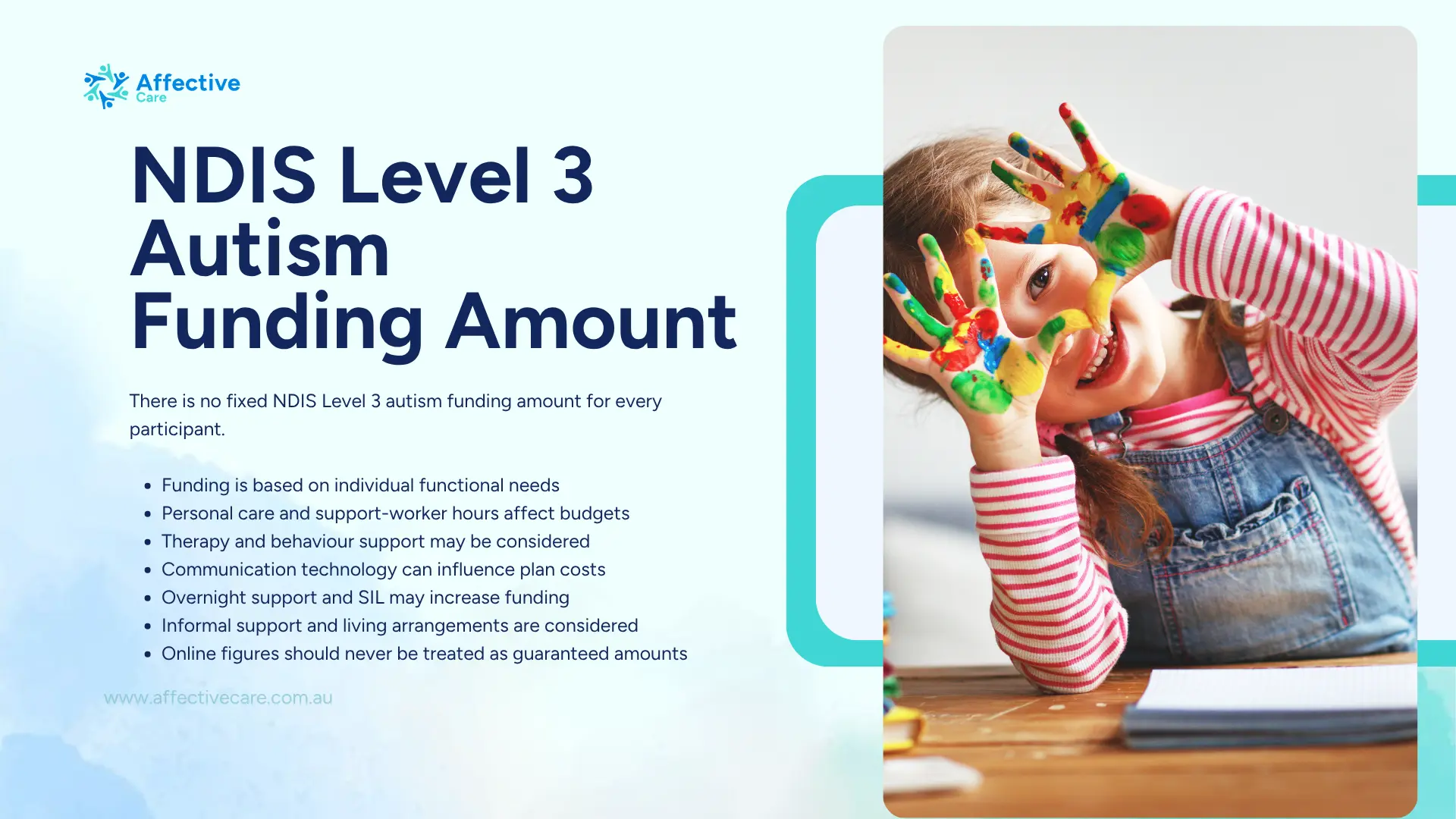
NDIS Level 3 Autism Funding Amount
There is no fixed NDIS Level 3 autism funding amount.
The NDIA does not assign one standard budget to every person diagnosed with Autism Level 3.
Funding is based on the individual participant’s disability-related support needs, goals, current circumstances and supporting evidence.
The Autism Level 3 NDIS funding amount may be influenced by:
- The amount of personal-care assistance required
- Communication and AAC needs
- Occupational therapy, speech therapy or psychology recommendations
- Positive Behaviour Support needs
- Community participation requirements
- Support-worker hours
- Overnight supervision or active overnight assistance
- Assistive technology
- Home and living requirements
- The availability and sustainability of informal support
- The length of the plan
- Two participants with the same diagnosis may therefore receive significantly different plans.
One person may need therapy and several hours of weekly support. Another may require personal care, behaviour support, extensive community access and 24-hour Supported Independent Living.
Online funding figures should not be treated as expected or guaranteed NDIS Level 3 autism funding amounts.
Employment goals may form part of an adult participant’s broader participation goals. Explore job ideas and employment supports for people living with autism in Australia.
What Recent NDIS Reports Say About Funding Amounts
The March 2026 Quarterly Report recorded an average payment of $66,800 and a median payment of $19,300 across all NDIS participants for the year ending 31 March 2026.
Participants who were in the Scheme at 31 March 2025 and continued to 31 March 2026 had an average payment of $69,800.
These figures are Scheme-wide statistics. They include people with different disabilities, ages, plans and support arrangements.
They are not specific to Autism Level 3 and should not be presented as the expected NDIS Level 3 autism funding amount.
The report explains that the average payment is much higher than the median because a smaller number of participants receive very high-cost supports, while a larger number receive lower-cost supports.
This means averages can be misleading when used to estimate an individual plan.
The best way to describe expected funding is to identify the person’s support needs across a typical week and obtain professional recommendations specifying the type, frequency and purpose of each support.
How is Autism Level 3 NDIS Funding Decided?
The NDIA considers whether requested supports meet the reasonable and necessary criteria.
A support generally needs to:
- Relate to the participant’s disability
- Help the participant work towards their goals
- Support participation in social, educational or economic life
- Represent value for money
- Be likely to be effective and beneficial
- Work alongside mainstream, community and informal supports
- Be an eligible NDIS support or approved replacement support
These requirements mean funding is based on the participant rather than the diagnostic label.
The NDIA may also consider whether another support could achieve the same outcome at a lower cost, whether a mainstream service is responsible for the support and whether the requested frequency is supported by evidence.
The participant’s total funding is then divided into relevant components or support budgets.
Current NDIS information explains that plans show a total amount allocated to reasonable and necessary supports over the plan period.
Example Autism Level 3 Funding Scenarios
These scenarios demonstrate why there is no standard NDIS Level 3 autism funding amount.
|
Scenario |
Possible support focus |
|
Child with complex communication needs |
Speech pathology, AAC, occupational therapy, caregiver coaching and assistance with participation |
|
Teenager with behaviours of concern |
Positive Behaviour Support, communication strategies, occupational therapy and structured community support |
|
Adult living with family |
Personal care, community participation, behaviour support, transport-related assistance and capacity building |
|
Adult preparing to move from home |
Functional assessment, daily living support, Home and Living evidence and skill development |
|
Adult needing continuous assistance |
Personal care, active daytime support, overnight assistance and possibly Supported Independent Living |
These are examples only. The supports approved for one participant do not establish what another participant will receive.
What Can the NDIS Fund for Autism Level 3?
An Autism Level 3 NDIS support package may include several support types where they relate to the participant’s disability and meet the funding criteria.
|
Support area |
Examples |
|
Assistance with Daily Life |
Personal care, meal preparation, household routines and skill development |
|
Community participation |
Support to attend activities, appointments and community settings |
|
Occupational therapy |
Functional assessment, sensory strategies, self-care and daily living skills |
|
Speech pathology |
Communication, AAC, social communication and mealtime support |
|
Positive Behaviour Support |
Functional behaviour assessment, behaviour support plans and team training |
|
Psychology |
Emotional regulation, coping strategies and disability-related therapeutic support |
|
Assistive technology |
Communication devices, visual supports and eligible disability equipment |
|
Support coordination |
Help implementing and coordinating a complex plan |
|
Short Term Accommodation |
Temporary disability support and accommodation where the criteria are met |
|
Home and living supports |
Supported Independent Living, ILO or other suitable arrangements |
Not every participant will require or receive every support.
The NDIS also cannot ordinarily replace supports that should be provided by health, education, housing or another mainstream service.
Depending on individual needs and plan funding, participants may access different therapeutic supports. Our guide to therapies for autism under the NDIS explains common therapy options and funding considerations.
Autism Level 3 Therapy Funding
Autism Level 3 therapy funding may be included when therapy is disability-related, goal-focused and supported by evidence.
Occupational Therapy
Occupational therapy may address personal care, sensory regulation, household routines, safety, assistive technology and independent living skills. An occupational therapist may also complete a Functional Capacity Assessment.
Speech Pathology
Speech pathology may support receptive and expressive communication, AAC, social communication, communication-partner training and disability-related mealtime needs.
Positive Behaviour Support
Positive Behaviour Support may involve functional behaviour assessment, behaviour support planning, environmental changes, communication strategies and training for families or support workers.
Psychology
Psychology may support emotional regulation, anxiety, coping with change, distress tolerance and adaptive skills where these needs are connected to the participant’s disability and plan goals.
A therapy report should explain the intended outcome, recommended frequency and how progress will be measured.
A diagnosis or general therapy recommendation does not automatically guarantee funding.
Autism Level 3 NDIS Funding for Children
Autism Level 3 NDIS funding for children may focus on communication, development, personal care, participation and family-centred capacity building.
Possible supports may include speech pathology, occupational therapy, Positive Behaviour Support, psychology, communication technology and assistance to participate in community activities.
Evidence should distinguish disability-related support from the care ordinarily expected for another child of the same age.
For example, all young children need supervision. However, a child with high support needs autism may require considerably more intensive or specialised care because they:
- Need continuous supervision due to leaving safe environments
- Cannot communicate pain, hunger or toileting needs
- Require hands-on assistance with all personal care
- Experience severe distress during transitions
- Have limited awareness of everyday hazards
- Need specialised communication or behaviour support
The latest quarterly reporting also confirms that early connections may be available to children and families regardless of whether the child is an NDIS participant.
Strong evidence should explain how autism affects everyday functioning, not simply confirm a diagnosis.
Learn more about autism assessments and reports for the NDIS and what the assessment process may involve.
Autism Level 3 NDIS Funding for Adults
Autism Level 3 NDIS funding for adults may support daily life, communication, relationships, meaningful activities and greater independence.
An adult’s plan may include assistance with:
- Personal care and household routines
- Preparing and eating meals
- Communication and supported decision-making
- Attending appointments
- Community access
- Volunteering or employment-related goals
- Emotional and sensory regulation
- Behaviour support
- Independent living skills
- Overnight care
- Home and living arrangements
Adult planning should recognise the participant’s privacy, choices, communication methods, relationships and personal goals.
Independence does not mean performing every activity without assistance. For one participant, independence may mean choosing their daily routine and directing support workers.
For another, it may mean learning one stage of a personal-care activity while continuing to receive substantial assistance.
Funding should therefore reflect the person’s individual version of participation and independence.
Supported Independent Living for Autism Level 3
Autism Level 3 Supported Independent Living may be considered when an adult requires significant assistance or supervision at home for a substantial amount of the day.
SIL may include support with personal care, cooking, household routines, behaviour support implementation, communication, medication-related assistance and skill development.
It may also include sleepover or active overnight support where evidence demonstrates that assistance is required during the night.
SIL funds the support delivered in the home. It does not ordinarily pay for rent, mortgage payments, groceries, utilities or other everyday living costs.
The NDIS explains that it is not generally SIL when a person only requires a few hours of support each day or week.
An Autism Level 3 diagnosis does not automatically result in SIL funding.
The request should be supported by functional evidence, risk information, daily support records and an explanation of why lower-intensity arrangements would not meet the participant’s needs.
Short Term Accommodation and Respite
Families often search for Autism Level 3 respite care NDIS, but funding decisions focus on the participant’s disability-related needs and outcomes.
Short Term Accommodation may provide temporary accommodation and disability support where it is an eligible, reasonable and necessary support.
An application should explain:
- What support the participant requires during the stay
- How the arrangement relates to autism-related needs
- What risks arise without the support
- How the support contributes to the participant’s goals
- What informal support is currently provided
- Whether the existing arrangement is sustainable
- Why the requested frequency is appropriate
Other options may include in-home support, community participation assistance or support workers helping the participant maintain routines while their usual informal support is unavailable.
Avoid describing the request only as a break for carers. The evidence should remain centred on the participant’s needs, safety, development and participation.
Preparing for an NDIS Planning Meeting
After access is approved, the participant’s goals, current supports and disability-related needs are discussed during planning.
Families should prepare:
- Current diagnostic and functional reports
- Therapy and behaviour support recommendations
- A description of an ordinary week
- Information about communication and personal care
- Daily support records
- Details of overnight needs
- School, workplace or community information
- A description of support currently provided by family
- Short- and long-term goals
- Evidence of risks without assistance
The information should explain what support is required, how often it is needed, who currently provides it and what happens when it is unavailable.
Include ordinary days rather than focusing only on the most difficult or most successful occasions.
A typical weekly support schedule can help the NDIA understand the difference between occasional assistance and ongoing, intensive support.
Example Weekly Support Schedule
|
Activity |
Support required |
Frequency |
Impact without support |
|
Showering and dressing |
Direct prompting and physical assistance |
Every morning |
Personal care is not completed safely |
|
Meals |
Preparation, prompting and supervision |
Three times daily |
Meals may be missed or eaten unsafely |
|
Communication |
AAC and communication-partner support |
Throughout the day |
Needs, pain and choices may not be understood |
|
Community access |
One-to-one supervision and transport assistance |
Several times each week |
The participant cannot travel or participate safely |
|
Transitions |
Visual schedule and regulation strategies |
Multiple times daily |
Distress may prevent participation |
|
Night routine |
Supervision, sleepover or active overnight assistance |
According to assessed need |
Safety and personal-care needs may not be met |
The schedule should be consistent with professional reports and support-worker records.
Common Autism Level 3 NDIS Application Mistakes
- Relying only on the diagnosis: A diagnostic report confirms autism but may not demonstrate substantial functional impairment.
- Requesting a standard funding package: There is no guaranteed NDIS Level 3 autism funding amount, even for people with similar diagnoses.
- Using vague statements: Phrases such as “needs full support” should be replaced with detailed examples of the activity, support level, frequency and risk.
- Providing inconsistent evidence: Reports should not contradict each other about communication ability, personal care, safety or required support hours.
- Leaving out informal support: Explain what parents, family members or others currently provide and whether that level of unpaid support can continue.
- Combining mainstream and NDIS responsibilities: Separate disability supports from services that should be provided by health, education, housing or another system.
- Focusing only on deficits: The evidence should also explain how the requested supports may build skills, maintain function, reduce risk or increase participation.
What Happens After the Application is Submitted?
After receiving the access request, the NDIA reviews the information and may approve access, request additional evidence or decide that the applicant does not currently meet the requirements.
When more information is requested, respond with evidence that directly addresses the identified gap.
This may involve clarification from a treating professional, an updated functional assessment or more detailed examples of daily support needs.
If access is approved, the participant progresses to plan development.
If access is not approved, the decision notice should explain the outcome and available review options.
Before seeking a review or submitting another application, assess whether the evidence clearly addressed:
- Permanence of the impairments
- Substantially reduced functional capacity
- Social or economic participation
- Likely lifelong support requirements
- Treatment already undertaken
- Daily assistance and supervision
- Risks without support
The quality and relevance of evidence are often more important than the total number of reports.
Getting Help With an Autism Level 3 NDIS Application
A strong Autism Level 3 NDIS application does more than confirm a diagnosis.
It shows how autism affects daily life, what assistance the participant requires and why those needs are likely to continue.
Before submitting an application:
- Make sure the diagnostic and functional reports are consistent.
- Describe the participant’s support needs across a typical week.
- Record personal-care, communication and safety assistance in detail.
- Explain what family members currently provide and whether that support is sustainable.
- Ask professionals to make specific, goal-linked recommendations.
- Document the frequency, duration and purpose of each recommended support.
At Affective Care, our multidisciplinary team supports children and adults with autism through psychology, Positive Behaviour Support, occupational therapy, speech therapy, Assistance with Daily Life, community participation and Supported Independent Living.
Contact Affective Care to discuss assessments and supports that reflect the participant’s communication, sensory, emotional regulation, personal-care and independence goals.