


Good jobs for people living with autism Australia are not about finding one “perfect” career; they’re about matching strengths, work environment, and the right supports.
Many autistic adults prefer roles with clear expectations, predictable routines, manageable sensory input, or flexible work options.
In Australia, employment help may be available through different pathways, including Disability Employment Services (DES), JobAccess for workplace adjustments, and NDIS supports in employment where they relate to individual goals and funding criteria.
Myth-bust: there isn’t one “best job for autism” and support is never one-size-fits-all.
The strongest outcomes usually come from aligning tasks, environment, and supports with what helps you work confidently and sustainably.
In this guide, you’ll learn how to find roles that match your strengths and work style, explore autism-friendly jobs, and understand DES, NDIS employment supports, SLES, and supported employment in Australia.
It also outlines how workplace adjustments work and the practical steps you can take to choose the right pathway and request support with confidence.
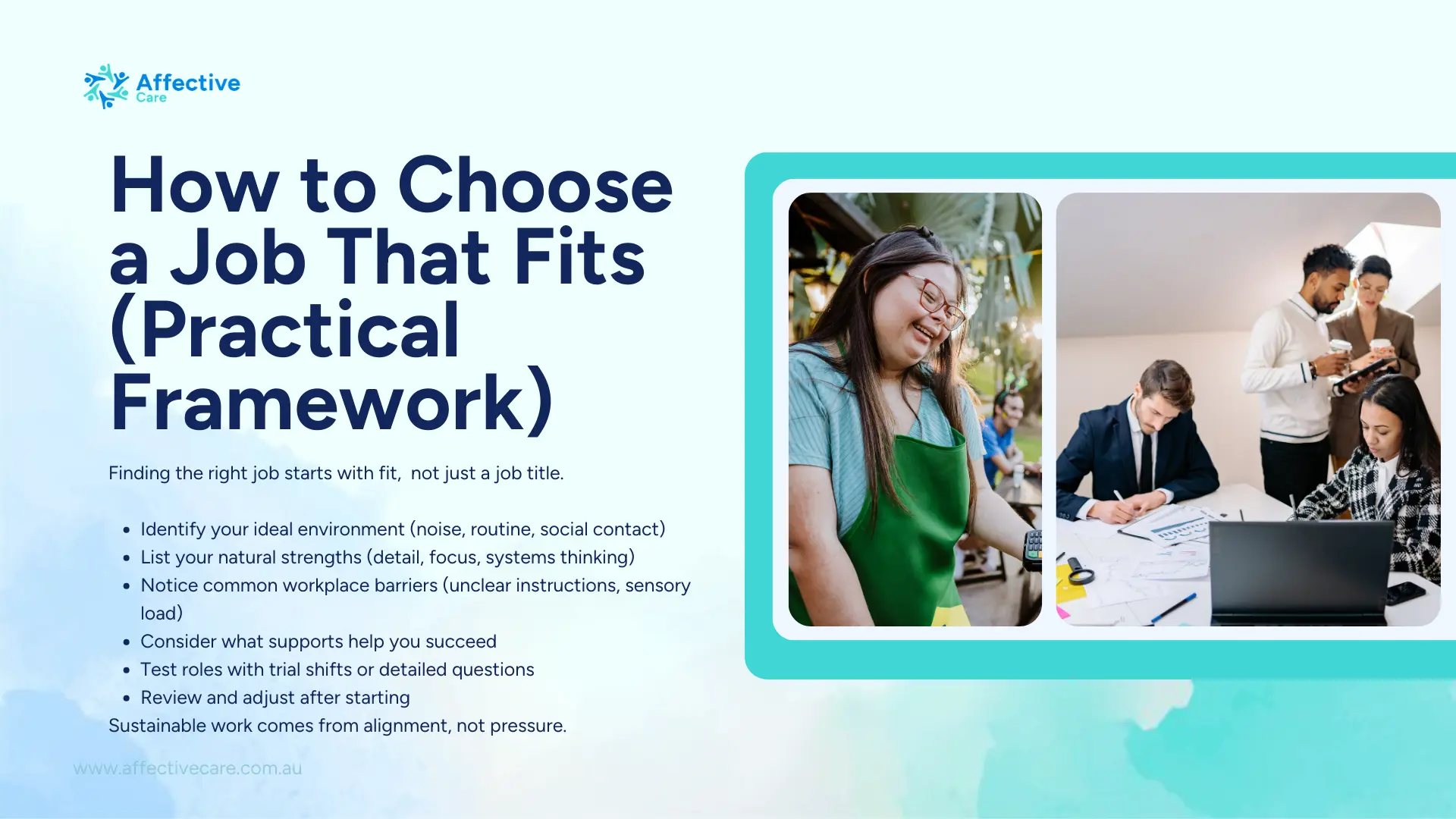
How to Choose a Job That Fits (A Practical “Role-Fit” Framework)
Choosing the right job starts with autism strengths-based career planning, not job titles alone.
Many barriers to employment for autistic adults in Australia relate to the environment and expectations, not capability.
Step 1: Identify Work Environment Fit
|
Fit Factor |
What Helps |
Example Job Types |
|
Noise & Sensory Input |
Quiet space, noise control, structured breaks |
Data entry, laboratory work |
|
Social Contact |
Clear communication channels, limited customer interaction |
Back-office admin, warehousing |
|
Task Clarity |
Written instructions, predictable processes |
IT support, bookkeeping |
|
Routine vs Variety |
Repetition or structured workflow |
Quality control, inventory roles |
Step 2: Identify Strengths
Many autistic employees bring valuable workplace strengths, including:
- Pattern recognition
- Attention to detail
- Deep focus
- Reliability and honesty
- Systems thinking
Rather than asking, “What are the best jobs for autistic adults in Australia?”, a better question is: What environments allow my strengths to show?
Step 3: Recognise Environmental Barriers
Common barriers to employment for autistic adults in Australia include unclear instructions, unpredictable scheduling, high sensory load, or excessive social demands.
These are often workplace design issues, not personal limitations.
Step 4: Consider Support Needs
Understanding this makes it easier to explore NDIS employment supports, DES assistance, or workplace adjustments where appropriate.
Think about what supports help you work confidently:
- Written task lists
- Structured check-ins
- Flexible start times
- Reduced sensory input
- Clear performance expectations
Step 5: Test Before Committing
Small insights early can prevent long-term stress. Where possible:
- Request a trial shift
- Ask detailed questions about daily tasks
- Clarify expectations in writing
- Observe the environment during interviews
Step 6: Review and Adjust
Career development is an evolving process. The goal is sustainable employment, not forcing yourself into an unsuitable environment.
Job fit is not permanent. After 4–6 weeks, reflect:
- What feels manageable?
- What feels draining?
- Are adjustments needed?
If you’re exploring NDIS-related supports, this guide on autism diagnosis in Australia and the reports that support funding requests may be useful.
Jobs for Level 2 Autism
There is no fixed list of jobs for Level 2 autism. Autism levels describe the support a person may require; they do not determine intelligence, interests, qualifications or employment potential.
A suitable role may involve:
- Clear and consistent instructions
- Predictable routines and schedules
- Tasks broken into manageable steps
- Reduced sensory and social demands
- Regular support from a supervisor or job coach
- Flexible hours or gradual onboarding
- On-the-job assistance where appropriate
Possible jobs for people with Level 2 autism may include:
- Stock sorting and inventory work
- Packing and order preparation
- Data entry or document scanning
- Gardening and grounds maintenance
- Animal care support
- Kitchen preparation
- Cleaning and household services
- Manufacturing or assembly tasks
- Library shelving
- Supported administration
The right role depends on the individual rather than the diagnosis.
Some people may work independently with adjustments, while others may benefit from ongoing workplace support or supported employment.
NDIS employment supports may help eligible participants build work skills or maintain employment when the support relates to their goals and disability-related needs.
The type and level of assistance should reflect where the participant is in their employment journey.
Employment goals and support requirements are highly individual, and people with higher support needs can learn more in our guide to Autism Level 3 NDIS funding and support options.
Autism-Friendly Job Ideas by Work Environment
When people search for low-social-interaction jobs in Australia or sensory-friendly jobs for autistic adults in Australia, they are usually looking for environmental fit, not a specific job title.
The same role can feel supportive in one workplace and overwhelming in another, depending on culture, expectations, and sensory conditions.
Quiet or Low-Social Roles
Examples may include:
- Back-office administration
- Inventory or warehousing roles
- Laboratory technician roles
- Library support work
- Data-focused positions
- Records processing or compliance support
These roles often involve structured tasks, independent work, and reduced customer-facing demands.
Clear processes and defined responsibilities can help reduce ambiguity and social pressure.
You can also explore autism sign language and communication supports if verbal communication feels challenging in certain environments.
Predictable Routine Jobs
Structured workflows, consistent expectations, and measurable outcomes can support confidence and focus.
If a predictable routine supports your performance, consider:
- Quality assurance
- Archiving and records management
- Manufacturing line roles with clear processes
- Repetitive technical tasks
- Inventory tracking or stock control
Sensory-Friendly Workplaces
There is no universal “quiet job”; workplace design, management style, and flexibility often matter more than the industry itself.
Rather than focusing only on job titles, look for employers who offer:
- Clear written procedures
- Flexible seating or quiet break spaces
- Noise management options (e.g., headphones permitted)
- Structured supervision and feedback
- Predictable scheduling
When exploring employment-related supports, it can also help to understand the NDIS Price Guide, as it explains how different NDIS supports may be priced and claimed.
Remote and Work-From-Home Options (When It Helps and When It Doesn’t)
Searches for remote jobs for autistic adults in Australia and work-from-home jobs in Australia are increasing.
Remote work can reduce sensory load, commuting stress, and unpredictable social interactions.
However, it can also introduce:
- Increased reliance on written or digital communication
- Reduced day-to-day structure
- Potential isolation
- Blurred boundaries between work and home
Remote Work
- Lower sensory load
- Flexible scheduling
- Reduced commute
- Greater environmental control
On-Site Work
- Clearer in-person communication cues
- More structured daily routine
- Direct access to supervisors
- Built-in social interaction
Common Remote-Friendly Categories Include
- Data administration]
- IT support
- Content writing or design work
- Virtual bookkeeping
- Online customer support (structured systems)
Flexibility works best when combined with clear expectations, defined deliverables, and regular check-ins.
The goal is not just flexibility, it is a sustainable structure that supports performance and wellbeing.
If anxiety, burnout, or workplace stress are affecting your confidence, our psychological therapy services in Australia can provide structured, evidence-based support.
Job Ideas by Strengths (Numbers, Detail, Repetition, Visual Thinking)
Choosing a role based on strengths, rather than stereotypes, can lead to more sustainable employment.
If you’re searching for jobs for autistic people who are good with numbers in Australia, or exploring strengths-based career options, consider how your natural abilities align with task demands.
If You Enjoy Numbers
Roles that involve structure, logic, and measurable outcomes may include:
- Bookkeeping
- Payroll support
- Data analytics
- Inventory control
- Accounts administration
- Financial reconciliation
If You’re Detail-Oriented
If you notice patterns, inconsistencies, or small errors others might miss, consider:
- Quality control
- Editing and proofreading
- Compliance support roles
- Archiving
- Software testing
- Technical documentation review
If Repetition Helps You Focus
Some people perform best when tasks are predictable and structured. Examples include:
- Manufacturing process roles
- Data validation
- Laboratory processing tasks
- Scanning and document indexing
- Stock auditing
If You Think Visually or Systematically
Visual clarity and structured outputs can make expectations easier to interpret. For those who prefer visual or structured thinking:
- Graphic design (with clear briefs)
- CAD drafting
- Web design support
- GIS mapping
- Process mapping roles
When reviewing job ads, look beyond the title. Examine:
- Social expectations
- Time pressure
- Sensory conditions
- Task clarity
- Level of autonomy
- Performance measurement style
This strengths-based approach aligns with the capabilities many autistic employees bring to the workplace and avoids overgeneralising career fit.
The goal is not to label jobs as “for autism,” but to identify environments where strengths can genuinely thrive.
If you are earning income, starting work or managing support-related costs, it may be useful to understand NDIS Taxation and how tax considerations may apply in different situations.
Jobs for People With Autism and ADHD
Jobs for people with autism and ADHD should balance the person’s need for structure with their preferred level of movement, stimulation, creativity and variety.
Some autistic people with ADHD may enjoy detailed work but struggle with repetitive tasks, unclear priorities or long periods of sitting. Others may prefer routine and predictable responsibilities.
Potential job areas include:
- Software testing
- Graphic design
- Video editing
- IT support
- Trades and technical work
- Animal care
- Gardening and landscaping
- Stock management
- Photography
- Content production
- Emergency services administration
- Project-based freelance work
Helpful workplace features may include:
- Written priorities and deadlines
- Visual task-management tools
- Regular but brief check-ins
- Movement breaks
- Flexible scheduling
- Quiet working areas
- A combination of routine and varied tasks
The Services Australia Aurora Neuroinclusion Program is one example of an Australian employment pathway specifically designed for neurodivergent people with an autism or ADHD diagnosis.
However, availability, eligibility and job types differ, so applicants should review current program requirements.
Job Ideas by Industry (IT, Trades, Admin, Warehousing, Creative, Animal Care)
Industry can shape the tasks you perform, but the environment and workplace culture still matter just as much.
The same industry can feel very different depending on structure, supervision style, and sensory demands.
Best IT Jobs for Autistic Adults Australia
IT is often highlighted because many roles involve systems, logic, and structured problem-solving. Examples may include:
- Software testing
- Technical support (structured ticket systems)
- Cybersecurity analysis
- Database administration
- Data engineering support
- Helpdesk roles with clear scripts
Many IT roles provide defined deliverables, written communication, and measurable outcomes.
However, some positions may involve tight deadlines or team collaboration, so reviewing expectations is important.
Best Trades for Autistic Adults Australia
Trades may suit individuals who prefer hands-on, practical tasks and visible outcomes. Examples include:
- Electrical trades
- Carpentry
- Automotive mechanics
- Metal fabrication
- Landscaping
Trades can offer task clarity and skill progression. However, job-site variability, noise levels, and team coordination should be considered when assessing fit.
Administration & Warehousing
Admin jobs for autistic adults in Australia often involve predictable workflows. These roles may provide routine and written instructions.
- Records management
- Scheduling coordination
- Data processing
- Accounts support
Warehousing jobs autism Australia may suit individuals who prefer physical, task-based work, including:
- Picking and packing
- Inventory management
- Stock control
- Logistics support
Creative & Animal Care
Creative jobs for adults with autism in Australia may suit those with strong visual thinking or deep interest areas, including:
- Graphic design
- Illustration
- Video editing
- Content production (structured briefs)
Animal care jobs, autism Australia may appeal where passion aligns with environment, such as:
- Veterinary assistant roles
- Animal shelter support
- Pet grooming
- Stable or farm work
Job Match for People Living With Autism: Comprehensive Guide
Different roles can vary widely in social demands, structure, and training requirements.
Looking at job characteristics side-by-side can help you compare options more clearly and decide what aligns with your preferences and strengths.
The table below outlines general patterns across common roles searched by adults with autism in Australia.
|
Role |
Social Load |
Routine Level |
Training Level |
|
Data entry jobs autism Australia |
Low |
High |
Short course |
|
Library jobs autism Australia |
Moderate |
Moderate |
Certificate |
|
Laboratory technician jobs autism Australia |
Low |
High |
Formal qualification |
|
IT support roles |
Moderate |
Structured |
Certificate/Diploma |
|
Warehousing roles |
Low–Moderate |
High |
On-the-job training |
|
Bookkeeping roles |
Low |
High |
Certificate |
This table highlights general patterns, not guarantees.
Social load, routine level, and training requirements can vary significantly between employers, team structures, and workplace cultures.
When assessing fit, consider:
- Team size and communication style
- Noise levels and physical environment
- Flexibility in scheduling
- Availability of written instructions
- Openness to reasonable adjustments
The key is to evaluate both the industry and the specific workplace environment.
A well-matched setting can make a significant difference in confidence, sustainability, and long-term job satisfaction.
Teens & Young Adults: Transition Pathways (SLES and School Leaver Supports)
For families searching for jobs for teens with Autism Australia, transition planning is one of the most important steps.
Employment success rarely starts with a job application; it starts with building confidence, skills, and realistic expectations before entering the workforce.
What is SLES?
School Leaver Employment Supports (SLES) is an NDIS-funded support designed to help eligible young people transition from school into employment.
It focuses on building practical, work-readiness skills rather than placing someone directly into a job.
SLES may include support with:
- Communication skills in workplace settings
- Understanding workplace expectations and behaviour
- Travel training and independence
- Routine development and time management
- Confidence building and social interaction
- Exploring suitable industries and role types
SLES programs are usually time-limited and tailored to individual goals.
They aim to prepare participants for open employment, supported employment, or further training pathways.
If you are exploring SLES autism NDIS, confirm eligibility within the participant’s plan and discuss options with your support coordinator, planner, or local provider.
Transition planning works best when it begins early and aligns school goals, family expectations, and long-term employment interests.
Jobs for Teens Living with Autism
Jobs for autistic teens can provide early experience, confidence and practical workplace skills.
The most suitable starting role will depend on age, interests, communication needs, sensory preferences and the level of supervision available.
Possible entry-level jobs include:
- Library shelving
- Supermarket stock work
- Pet sitting or dog walking
- Gardening
- Car washing
- Kitchen preparation
- Filing and scanning
- Packing online orders
- Sports club assistance
- Tutoring in a strong subject
- Family-business support
- Volunteer work that builds employment skills
Part-Time Jobs for Autistic Teens
Part-time jobs for autistic teens may be easier to manage when shifts are short, predictable and scheduled around school, rest and other supports.
Families and young people should consider:
- Whether instructions are provided clearly
- How busy and noisy the workplace becomes
- Whether the teen will work alone or with a supervisor
- Transport to and from shifts
- How last-minute roster changes are handled
- Whether the employer can provide a gradual introduction
- Applicable child-employment laws in their state or territory
A teenager does not need to begin with formal paid work. Work experience, volunteering, school-based training and supported placements can also build useful skills.
For eligible young people, School Leaver Employment Supports may build communication, time management, travel skills, work experience and understanding of workplace instructions.
SLES is intended to support the transition from school towards employment rather than guarantee direct job placement.
NDIS and Employment: What Support Might Help You Work Towards a Goal
NDIS employment supports for autism are linked to individual plan goals and funding criteria.
The NDIS does not fund “a job” itself; it may fund supports that help you build capacity to obtain or maintain employment, where this aligns with your stated goals.
Depending on your plan and circumstances, the NDIS may fund supports that:
- Build work-related skills (communication, time management, task completion)
- Provide employment-focused coaching or mentoring
- Support job preparation activities
- Assist with maintaining employment
- Fund support workers for on-the-job assistance where appropriate
Funding is not automatic. Supports must meet the “reasonable and necessary” criteria and demonstrate functional impact and clear goal alignment.
Example Employment Goal Wording
- “I want to build the skills and confidence to obtain part-time employment within 12 months.”
- “I aim to maintain stable employment with appropriate workplace supports.”
Clear, measurable goals make it easier to demonstrate the purpose of employment-related supports.
Always check the latest guidance, as NDIS funding rules and interpretations can change. Outcomes vary based on individual circumstances.
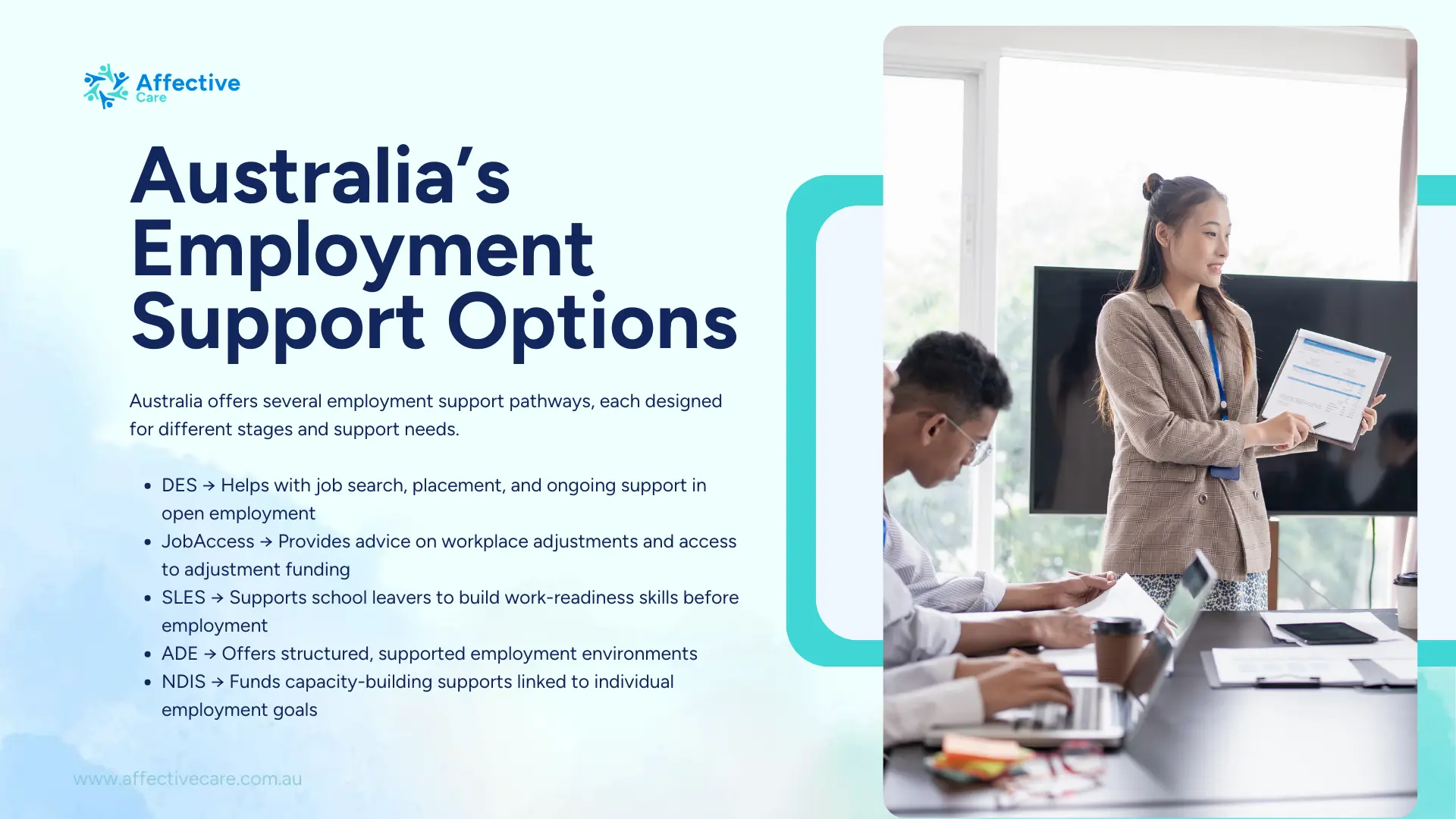
Australia’s Employment Support Options
When comparing Disability Employment Services (DES) autism Australia, and other employment supports, clarity is essential.
Each pathway serves a different purpose, and they are not interchangeable.
DES (Inclusive Employment Australia)
DES is a government-funded program that helps eligible people prepare for, find, and maintain employment in open workplaces.
DES focuses primarily on open employment and workplace integration.
Support may include:
- Job search assistance
- Resume and interview preparation
- Employer matching
- On-the-job support after placement
- Ongoing contact to help maintain employment
JobAccess
JobAccess is not a job placement service. It supports practical workplace adjustments rather than job matching.
Instead, it provides:
- Advice on workplace adjustments
- Information about employer obligations
- Guidance for both employees and employers
- Access to the Employment Assistance Fund (where eligible)
Supported Employment (ADE)
Australian Disability Enterprises (ADEs) offer structured employment environments designed for individuals who may require higher levels of ongoing workplace support.
Suitability depends on individual goals, preferences, and support needs. These settings can provide:
- Supervised work environments
- Modified tasks
- Structured routines
- Additional support staff
Support Pathways Overview
|
Pathway |
Focus |
Best For |
|
DES |
Job placement & ongoing support |
Open employment |
|
NDIS supports |
Skill-building tied to goals |
Capacity development |
|
SLES |
School-to-work transition |
Young people leaving school |
|
ADE |
Supported workplace |
Structured environments |
Understanding the purpose of each pathway can help you choose the right combination of supports.
In some cases, individuals may access more than one pathway at different stages of their employment journey.
Comparison Table: NDIS vs DES vs SLES vs Supported Employment (ADE)
Understanding the differences between employment pathways can reduce confusion and help you choose the right support at the right time.
While these programs may overlap in conversation, they serve different purposes within Australia’s employment support system.
|
Feature |
NDIS Employment Supports |
DES |
SLES |
Supported Employment (ADE) |
|
Focus |
Goal-related capacity building |
Job search & retention |
Transition from school |
Supported workplace |
|
Primary Aim |
Build skills to obtain or maintain work |
Place and support in open employment |
Develop work-readiness skills |
Provide structured employment |
|
Funding Type |
Individual NDIS plan-based |
Government-funded program |
NDIS-funded |
Wage-based employment |
|
Best For |
Capacity development |
Open employment seekers |
Young people leaving school |
Structured work settings |
|
Support Type |
Coaching, skill development, on-the-job support |
Job matching, employer liaison, ongoing support |
Confidence building, travel training, routine development |
Supervised work with structured tasks |
|
Duration |
Based on the plan funding period |
Ongoing while eligible |
Time-limited transition support |
Ongoing employment |
|
Who Manages It? |
Participant & NDIS plan |
DES provider |
NDIS provider |
ADE organisation |
|
Next Step |
Review plan goals |
Contact the DES provider |
Discuss with the planner |
Explore local ADE |
Each pathway has different eligibility requirements and processes.
Some individuals may use more than one pathway over time, for example, starting with SLES, then moving to DES, or combining NDIS supports with open employment.
Always confirm eligibility and current program details through official sources, as funding rules and program structures can change.
Choosing the right pathway depends on your goals, support needs, and preferred work environment.
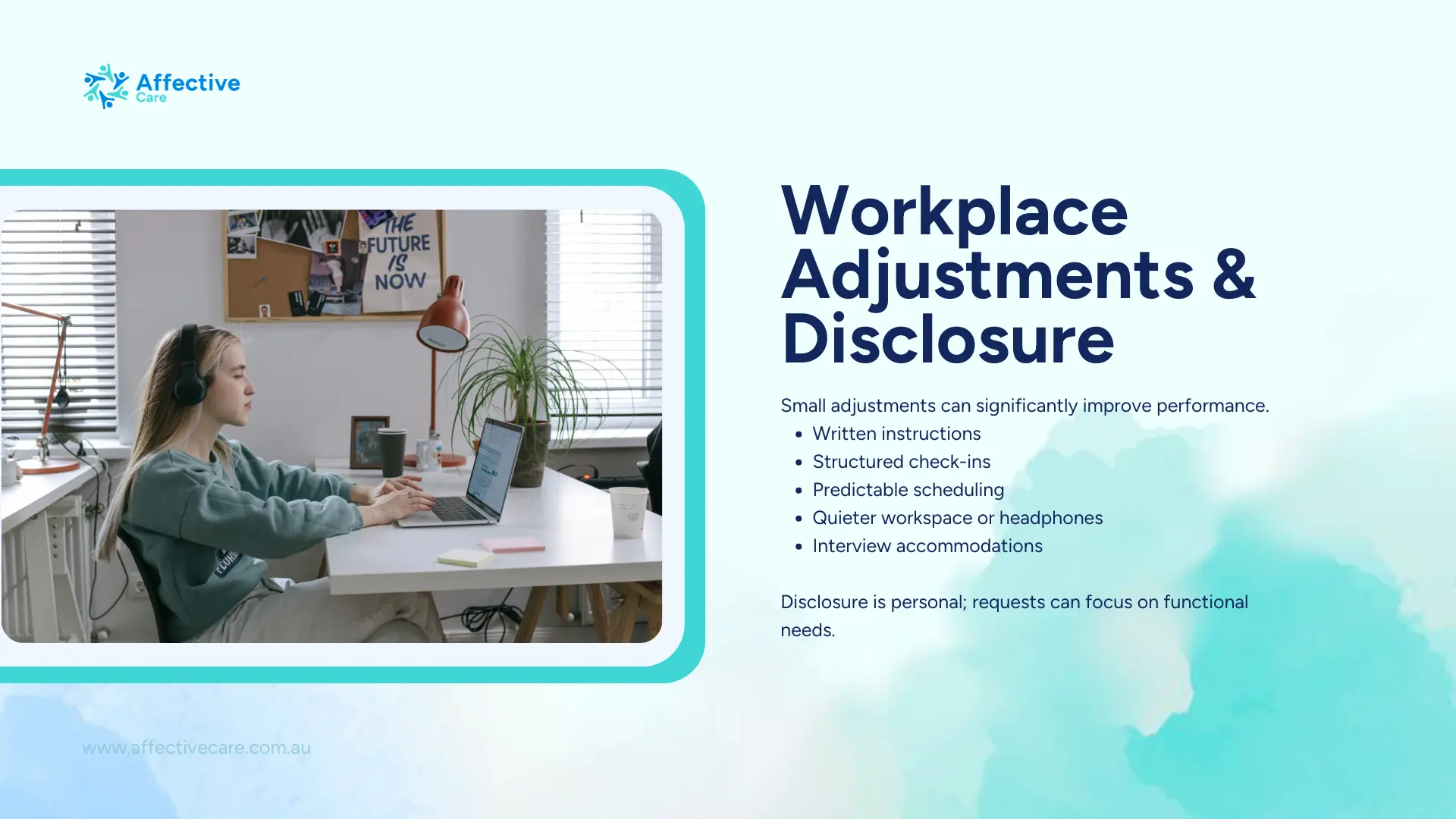
Workplace Adjustments & Disclosure (Scripts, Checklists, Templates)
Workplace success is often supported by practical adjustments, not by changing who you are, but by adjusting how work is structured.
Reasonable adjustments for autistic employees in Australia are designed to reduce barriers and support performance.
Examples of reasonable adjustments may include:
- Written instructions instead of verbal-only directions
- Structured check-ins with clear agendas
- Flexible start and finish times
- Predictable scheduling
- Reduced sensory input (quiet workspace, headphones, lighting adjustments)
- Interview accommodations (questions provided in advance, extra processing time)
Adjustments focus on enabling you to perform your role effectively.
What is considered “reasonable” depends on the job requirements and workplace context.
Myth vs Fact
Myth: You must disclose you’re autistic to get adjustments.
Fact: Disclosure is personal. Some people disclose their diagnosis; others request adjustments based on functional needs without sharing medical details.
Myth: There’s one “best job” for autistic people.
Fact: Job fit depends on environment, tasks, expectations, and supports, not diagnosis alone.
Myth: All employment supports are the same.
Fact: DES, NDIS supports, SLES, JobAccess, and ADE each serve different purposes within Australia’s employment system.
Sample Adjustment Request Structure
If you’re unsure how to ask for adjustments, a structured approach can help:
- Describe the work impact
Briefly explain how a specific task or environment affects your performance. - Suggest practical changes
Propose realistic solutions (e.g., written instructions, scheduled check-ins). - Propose a trial period
Suggest testing the adjustment for a set timeframe (e.g., four weeks). - Offer a follow-up review
Agree to review effectiveness and adjust if needed.
Framing the conversation around performance, productivity, and clarity can help keep discussions practical and collaborative.
Adjustments are about enabling sustainable work, not lowering standards.
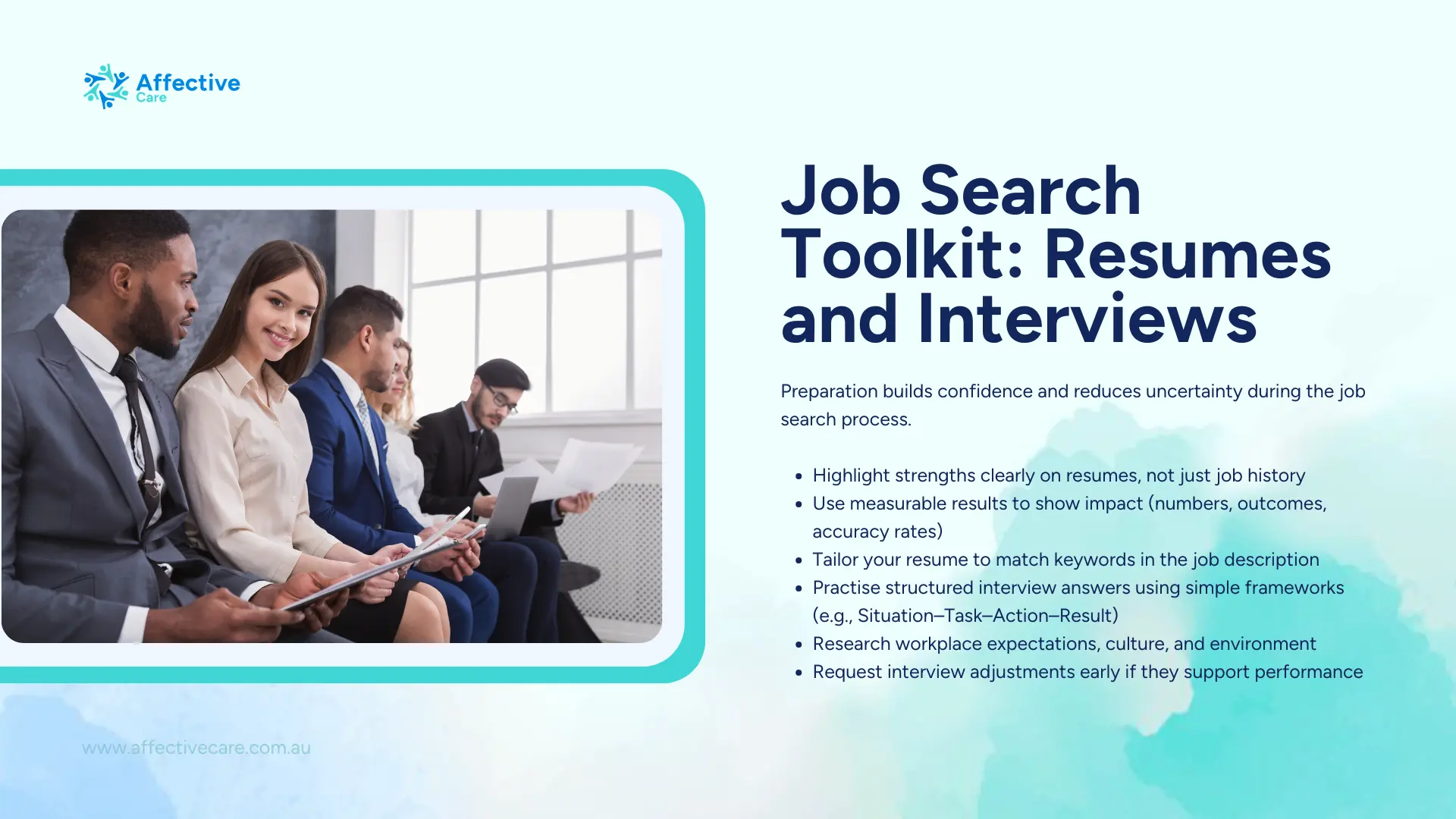
Job Search Toolkit: Resumes, Interviews, and Accommodations
Job searching can feel uncertain, but preparation and structure can make the process more manageable.
If you’re looking for interview tips for autistic adults Australia, focusing on clarity, predictability, and strengths can improve confidence and outcomes.
Resume Tips
Your resume should highlight what you do well, not just where you’ve worked.
- Clearly list strengths relevant to the role (e.g., attention to detail, data accuracy, reliability).
- Use structured bullet points rather than long paragraphs.
- Focus on measurable outcomes (e.g., “Processed 200+ records per week with 99% accuracy”).
- Keep formatting clean and easy to read.
- Tailor the resume to match the job description keywords.
Interview Preparation
Interviews often follow predictable formats, which can work in your favour with preparation.
Preparation reduces uncertainty and increases confidence.
- Practise common questions (e.g., strengths, teamwork, problem-solving).
- Prepare structured examples using a simple framework (Situation, Task, Action, Result).
- Research the workplace environment beforehand.
- Write down questions you’d like to ask the employer.
- Plan logistics (travel time, clothing, location) in advance to reduce stress.
How to Request Interview Accommodations (5 Steps)
Requesting accommodations is about creating equal opportunity to demonstrate your skills, not gaining an advantage.
Clear communication and preparation can make a meaningful difference in your job search experience.
If adjustments would support your performance, you can request them professionally and early.
- Identify what would help: For example, receiving questions in advance or having extra processing time.
- Contact the employer early: Reach out once the interview is scheduled.
- Explain the impact briefly: Focus on how the adjustment supports performance.
- Suggest specific changes: Keep requests practical and role-related.
- Confirm arrangements in writing: Ensure both parties are clear on expectations.
Getting a Job With Asperger’s or Autism
Focus on roles that match your strengths, interests and preferred work environment.
Helpful steps include:
- Tailor your resume
- Practise interview answers
- Review sensory and social demands
- Request clear workplace adjustments
- Confirm duties and expectations in writing
Interview supports may include extra processing time, advance questions, a quiet room or permission to use notes.
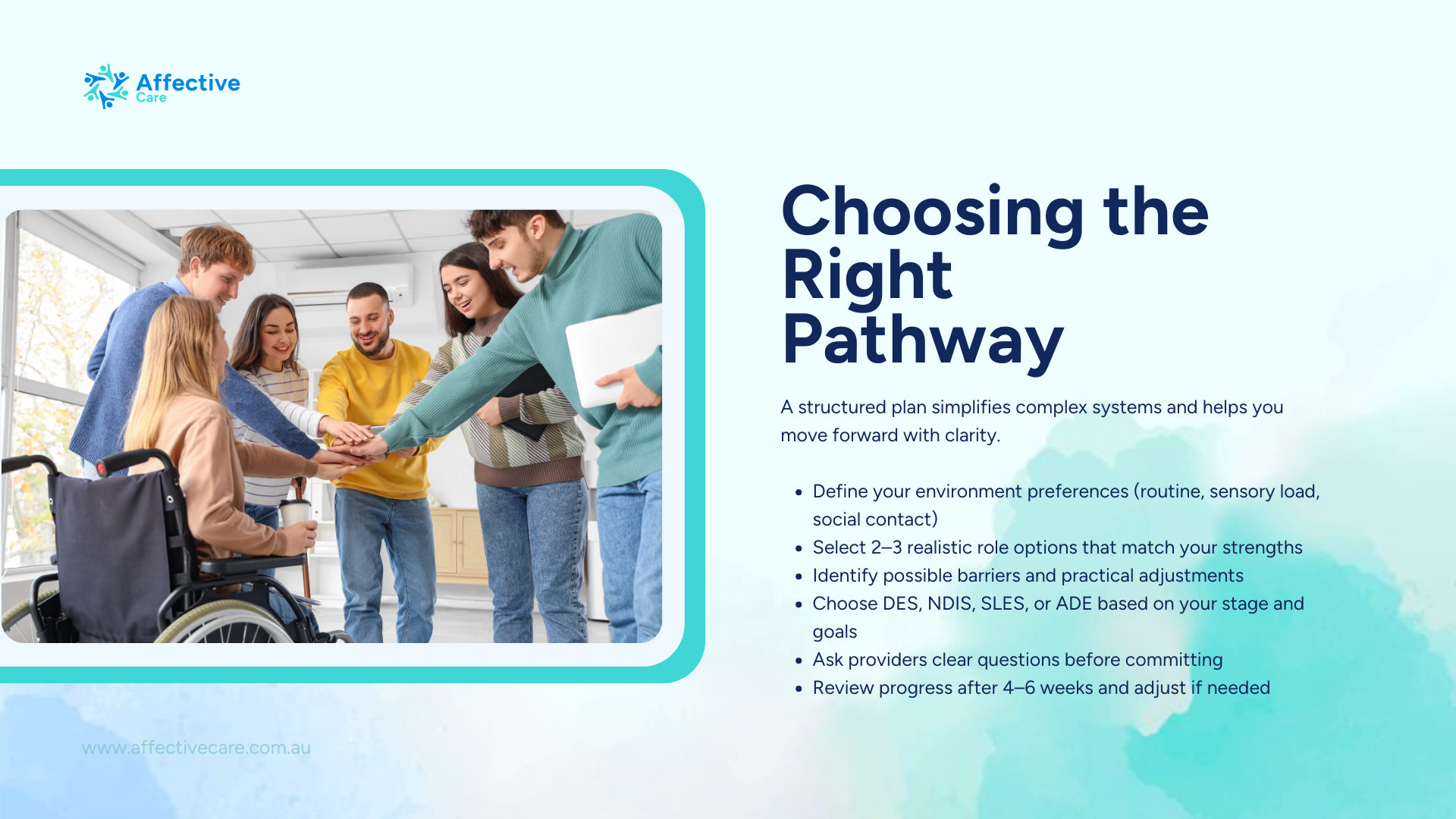
Step-by-Step: How to Choose a Pathway and Ask for Supports (NDIS/DES/JobAccess)
Choosing the right employment pathway in Australia can feel complex, especially when multiple systems are involved.
Breaking the process into clear steps can help you move forward with confidence and structure.
Step 1: Define Your Environment and Task Fit
Start by identifying what helps you work well. Consider sensory preferences, social load, routine needs, communication style, and task clarity.
Knowing your preferred environment makes it easier to filter roles realistically.
Step 2: Choose 2–3 Target Roles
Rather than applying broadly, narrow your focus to a few roles that match your strengths and environment preferences.
This allows you to tailor resumes, prepare effectively, and identify specific support needs.
Step 3: Identify Barriers and Possible Adjustments
Examples may include written instructions, structured check-ins, modified shifts, or interview accommodations.
Ask yourself:
- What might make this role challenging?
- What practical changes would help?
Step 4: Select the Right Pathway
Some people use more than one pathway over time. Different supports serve different purposes:
- DES → Job search, placement, and ongoing support
- NDIS employment supports → Capacity-building aligned with goals
- SLES → Transition from school to work
- ADE → Structured supported employment
Step 5: Prepare Questions for Providers
Before committing to a provider, prepare clear questions about how they work, what industries they support, and how they handle adjustments.
Step 6: Draft Your Support Request
Keep it practical and goal-focused. Outline your employment goal, the barriers you experience, and the support you believe would help.
Step 7: Review Progress After 4–6 Weeks
Employment planning is not static. After starting a role or support program, reflect on what is working and what needs adjusting.
Scenario A
Alex prefers low social interaction and structured routines.
After identifying data-focused roles, Alex works with a DES provider to refine applications and requests interview accommodations.
Once employed, Alex negotiates written instructions and scheduled check-ins.
With the right adjustments, productivity and confidence improve.
Scenario B
Sam is finishing school and feels uncertain about entering the workforce.
Sam explores SLES to build communication skills, travel confidence, and workplace expectations.
After completing transition support, Sam works with a DES provider to secure part-time employment in a structured environment.
These examples show how different pathways can align with different stages and needs.
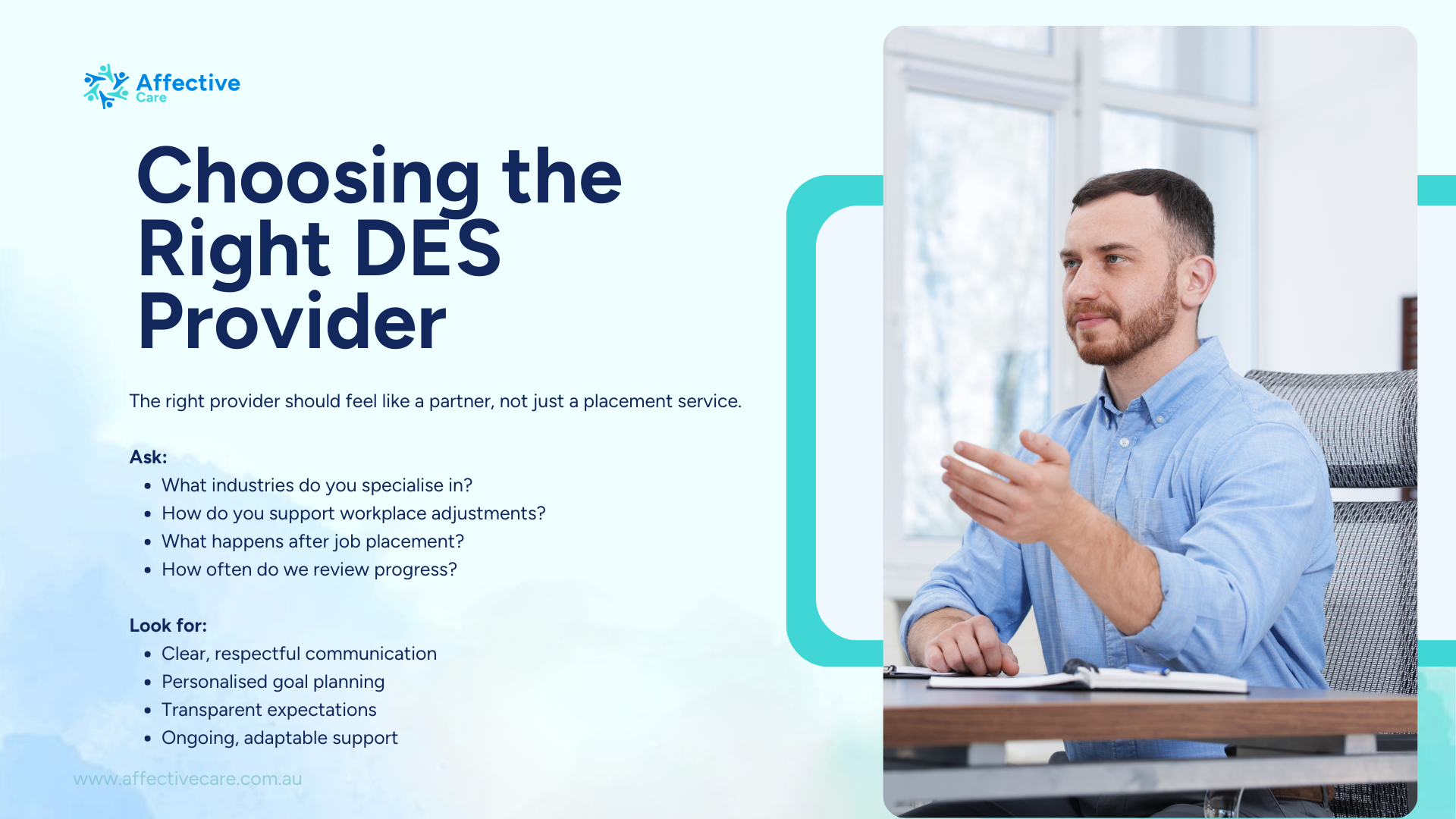
Provider Selection: How to Choose a DES Provider (and what to ask)
When researching how to choose a DES provider autism Australia, consider both practical capability and communication style.
Ask:
- What industries do you specialise in?
- How do you support workplace adjustments?
- What ongoing support is available after job placement?
- How often will we review progress?
- How do you personalise support plans?
Choosing a provider is about partnership. The right provider should help you clarify goals, reduce barriers, and support sustainable employment, not just focus on job placement alone.
Look For:
- Clear, respectful communication
- Collaborative goal setting
- Transparent expectations about outcomes
- Willingness to adapt supports
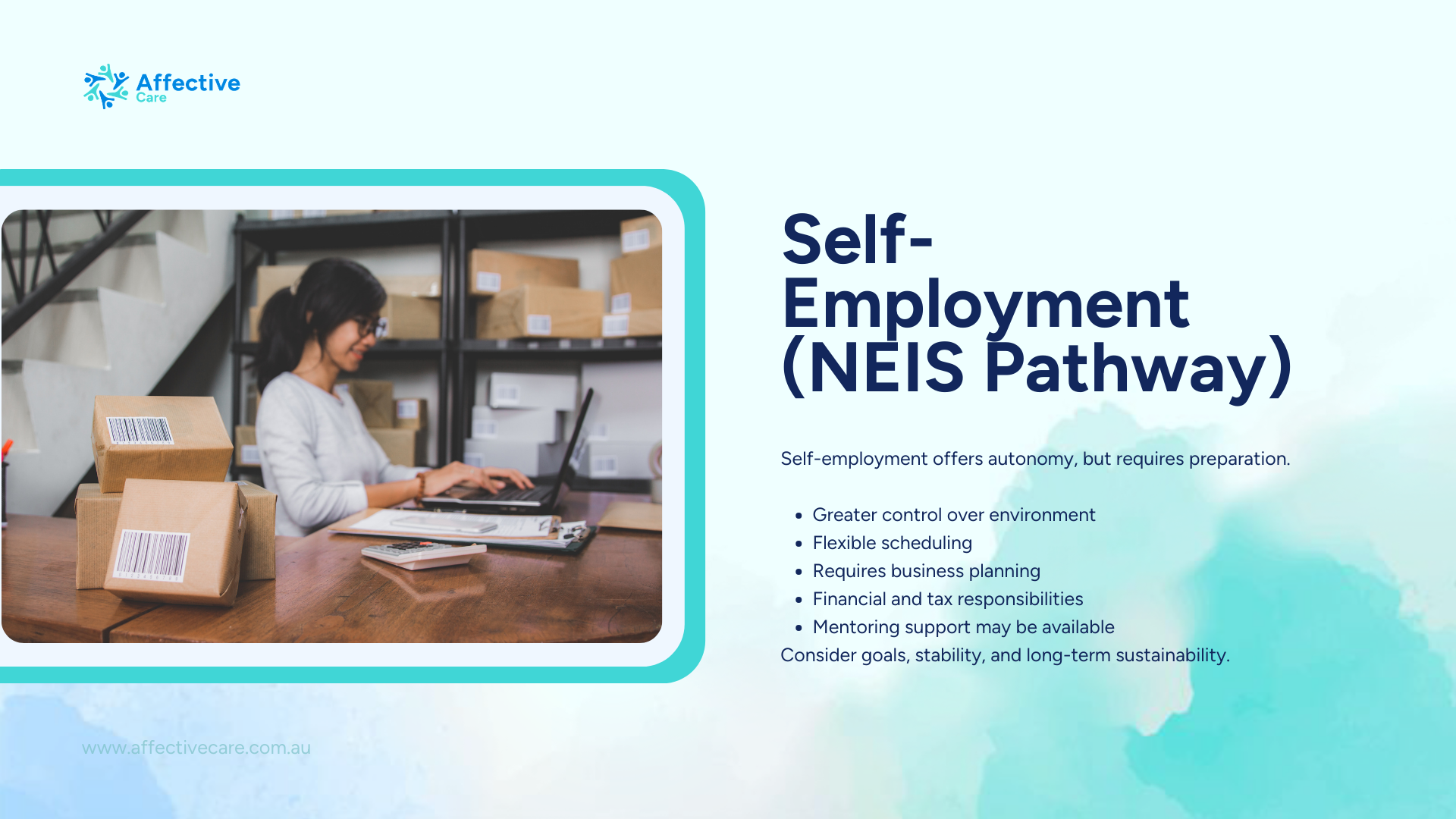
Self-Employment Pathway (NEIS): When it Might Fit and What to Prepare
For some people, traditional workplaces may not feel like the best fit.
If you are exploring NEIS self-employment autism Australia, self-employment can offer greater autonomy, flexibility, and control over your work environment.
Self-employment may suit individuals who:
- Prefer independence and decision-making control
- Have specialised or niche skills
- Thrive with structured routines they design themselves
- Want flexibility around sensory or scheduling needs
However, running a business also requires planning, organisation, and financial responsibility.
Preparation may include:
- Developing a clear business plan
- Seeking financial advice and budgeting support
- Conducting market research to assess demand
- Understanding tax and regulatory obligations
- Building a support network (mentor, accountant, advisor)
Programs such as NEIS (New Enterprise Incentive Scheme) may provide structured support for eligible participants, including training and mentoring.
Before committing, seek professional advice and carefully assess whether self-employment aligns with your long-term goals, financial situation, and support needs.
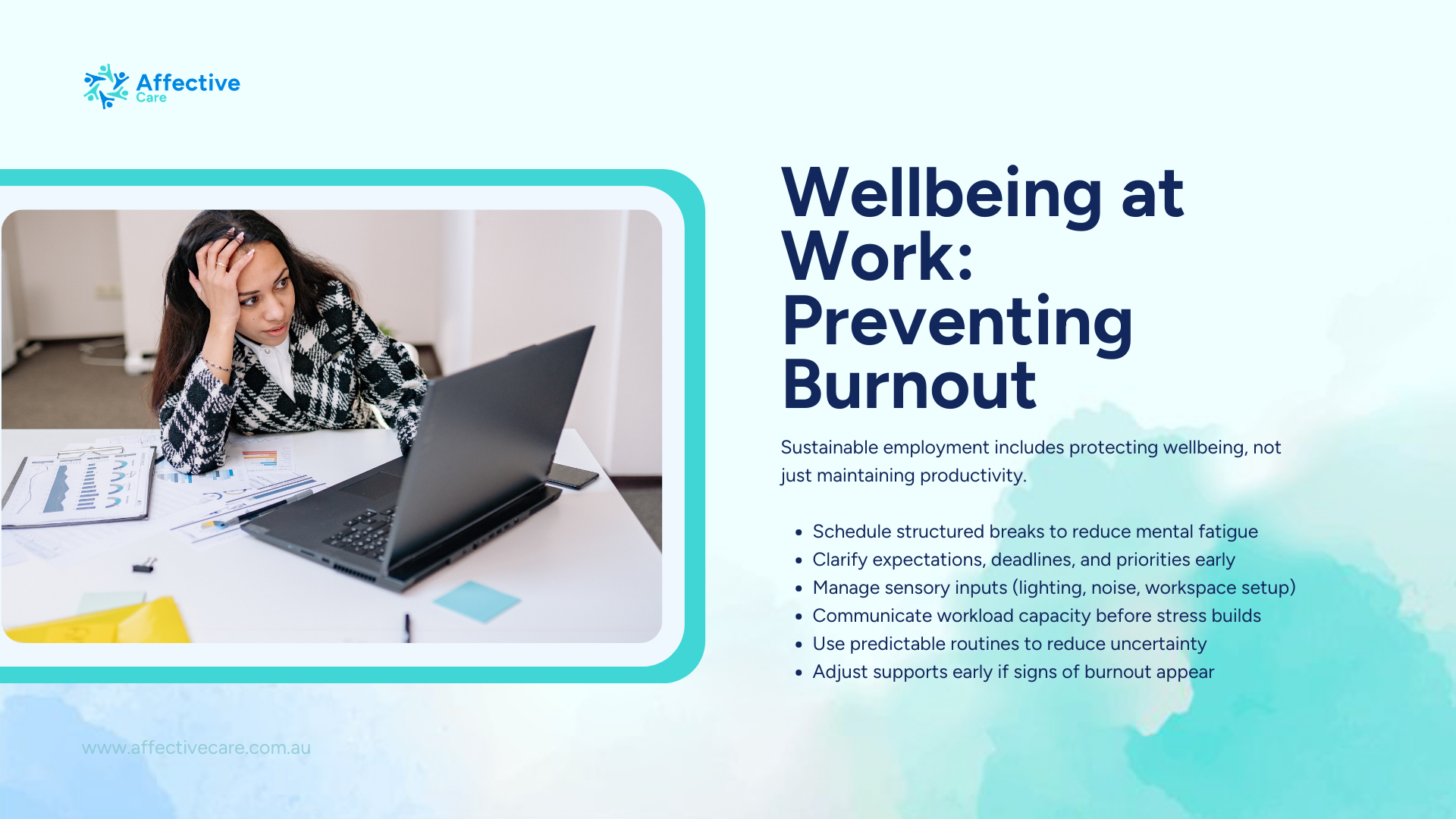
Wellbeing at Work: Preventing Burnout and Managing Sensory Load
Sustainable employment is not only about finding the right role, it’s also about maintaining wellbeing over time.
Burnout prevention for autistic employees in Australia often involves proactive planning rather than waiting until stress becomes overwhelming.
Helpful strategies may include:
- Structured breaks scheduled throughout the day to reduce mental fatigue
- Clear expectations about tasks, deadlines, and performance standards
- Predictable scheduling to minimise last-minute changes
- Sensory management, such as quiet spaces, noise-cancelling headphones, or adjusted lighting
- Open communication with supervisors about workload and capacity
Burnout can develop gradually through accumulated stress, unclear instructions, or ongoing sensory strain.
Recognising early signs such as exhaustion, reduced concentration, or increased anxiety allows you to adjust before difficulties escalate.
If experiencing sensory overload at work in Australia, consider discussing practical adjustments early.
Small changes in environment, communication style, or workflow can significantly improve long-term sustainability.
Wellbeing is not a luxury, it is a key part of maintaining consistent performance and confidence at work.
Resources: Where to Look for Roles and Support
Finding the right job or support pathway often starts with knowing where to search.
The platforms below can help you explore roles, workplace adjustments, and employment programs across Australia.
Always confirm eligibility criteria and current program details through official sources.
Employment & Support Resources Overview
|
Resource |
Type |
What It Offers |
Best For |
|
SEEK (Autism jobs Australia SEEK) |
Job board |
Broad job listings across industries; keyword filtering |
Exploring open employment roles |
|
Indeed (Autism jobs Australia Indeed) |
Job board |
National job listings; company reviews; flexible role search |
Comparing employers and job types |
|
Disability Employment Job Boards Australia |
Specialist job boards |
Roles inclusive of disability-friendly employers |
Targeted disability employment search |
|
NDIS Employment Supports (Official Pages) |
Government information |
Guidance on NDIS-funded employment supports |
Understanding plan-based supports |
|
DES (Inclusive Employment Australia) |
Government program |
Job search assistance and ongoing workplace support |
Open employment with support |
|
JobAccess |
Government advisory service |
Workplace adjustment advice & Employment Assistance Fund info |
Adjustment and employer guidance |
|
SLES (School Leaver Employment Supports) |
NDIS-funded support |
Transition support for young people |
School-to-work pathway |
|
ADE (Australian Disability Enterprises) |
Supported employment |
Structured workplace environments |
Higher-support employment settings |
Using multiple sources can improve outcomes.
Job boards help identify available roles, while government and program pages clarify eligibility, funding rules, and support options.
For readers who are new to the scheme, our guide to the NDIS explained provides a simple overview of how the NDIS supports eligible participants with disability-related needs.
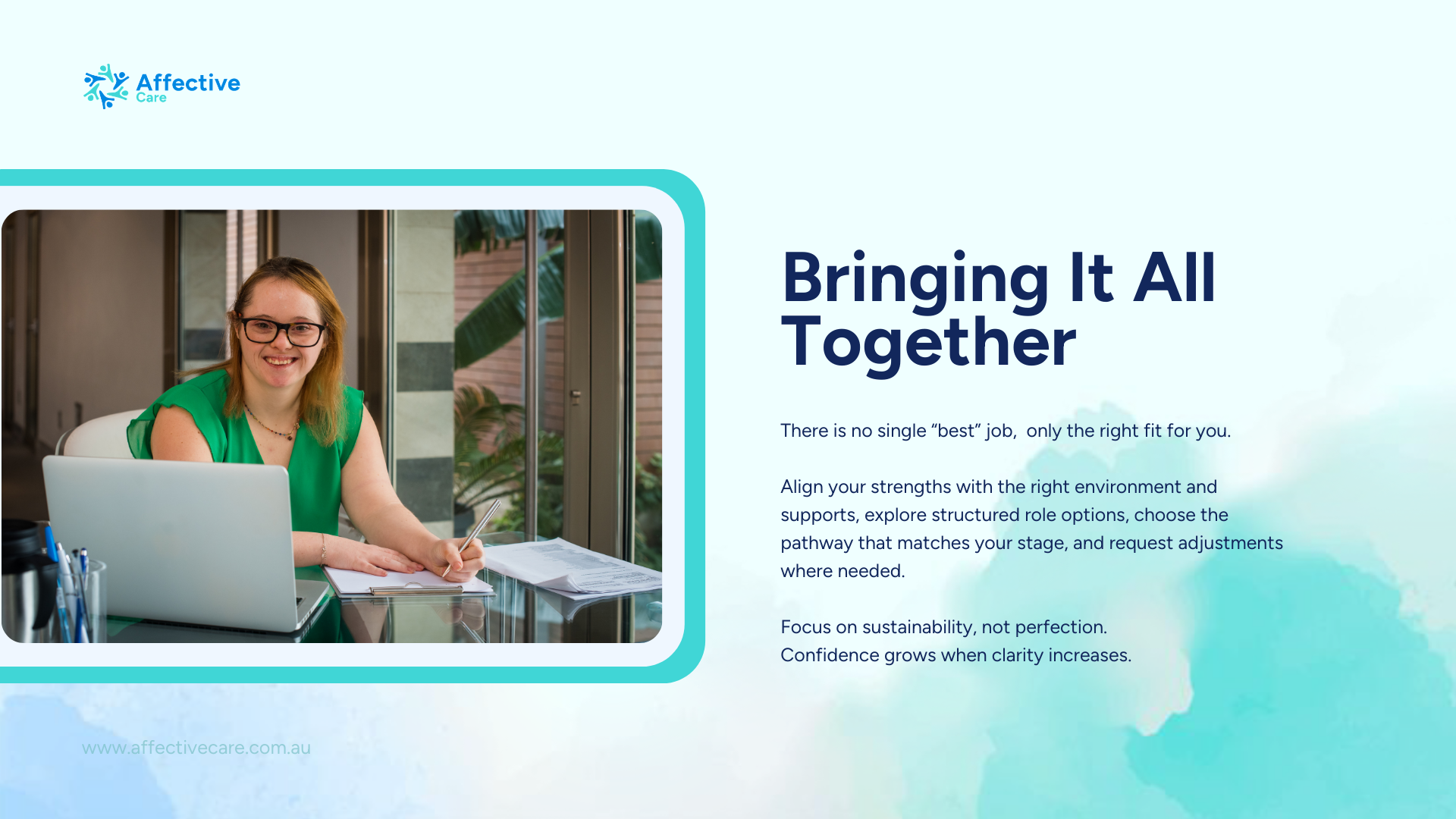
Bringing It All Together: Finding the Right Employment Pathway
There is no single “best job” for people living with autism in Australia, and there doesn’t need to be. Sustainable employment comes from aligning strengths, environment, and the right supports.
Whether that means exploring quiet, structured roles, considering remote work, accessing DES, building capacity through NDIS employment supports, or starting with SLES after school, the pathway should reflect individual goals and preferences.
Employment success is not about changing who you are. It is about understanding what helps you perform confidently and consistently and choosing systems, workplaces, and supports that recognise that.
With clarity, realistic expectations, and the right planning, work can become not just possible, but sustainable and meaningful.