


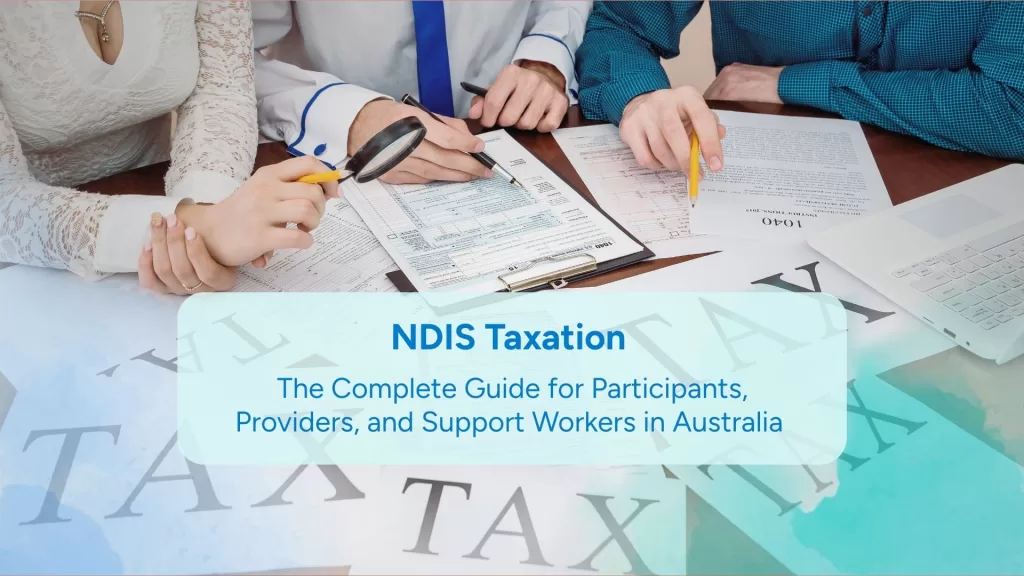
NDIS Taxation can feel overwhelming, especially at tax time when participants, support workers, and providers all face different rules.
Knowing what’s reportable, what’s claimable, and what’s GST-free often leads to confusion and stress.
This guide simplifies NDIS Taxation so you can confidently meet your responsibilities.
Whether you’re a participant managing your plan, a support worker organising deductions, or a provider delivering essential services, understanding your tax obligations is essential.
The good news is: you don’t have to navigate it alone.
NDIS Tax and GST: Quick Answers for 2026
NDIS tax treatment depends on whether you are a participant, provider, support worker, contractor or plan manager.
The following table answers the most common questions.
| Question | General answer |
|---|---|
| Is NDIS income GST free? | Some NDIS supplies are GST-free, but business income earned from providing NDIS services is generally still assessable for income tax. |
| Do NDIS providers pay GST? | Providers do not add GST to a supply that meets all GST-free NDIS requirements. GST may apply when those conditions are not met. |
| Do NDIS providers pay tax? | Yes. Providers generally report their business income and pay income tax on taxable profit after allowable deductions. |
| Do support workers charge GST? | GST-registered support workers do not charge GST on qualifying GST-free NDIS supports. They may charge GST on taxable services. |
| Do you charge GST on NDIS invoices? | Not when the particular support satisfies all GST-free NDIS conditions. Otherwise, a GST-registered supplier may need to charge GST. |
| Is NDIS funding taxable for participants? | NDIS amounts received and used for approved supports are generally not assessable income for the participant. |
| Are NDIS worker expenses deductible? | Some expenses may be deductible when they directly relate to earning income, were paid by the worker and were not reimbursed. |
A service being GST-free does not mean the provider’s income is exempt from income tax.
GST applies to the sale or supply, while income tax generally applies to the profit earned by the provider or worker.
Are NDIS Payments Taxable for Participants?
This is often the first and most important question: Do you need to pay tax on NDIS funding?
For participants, the answer is generally no. NDIS funding is not considered assessable income and is exempt from tax. That means you do not report it as income when you do your tax return.
What is Included Under This Exemption?
- Funding used to pay for therapies, personal care, equipment, transport, and other supports
- Supports provided through agency, plan, or self-managed models
- Items paid directly to providers or reimbursed to you from your plan
Even though NDIS funds are tax free, you still need to keep detailed records. Invoices, service agreements, and receipts help with plan reviews and NDIA audits.
And just to be clear: you cannot claim tax deductions for NDIS funded items.
Because NDIS funds cover these costs, they are not considered your personal expenses, so you cannot claim them as deductions on your tax return.
Moreover, if you want the latest pricing overview, our guide to the NDIS Price Guide 2026 and how current price limits affect different supports can help you understand what providers may charge.
NDIS Tax and GST Updates for 2026
Several developments are relevant to NDIS participants, providers and support workers in 2026.
The NDIS GST-Free Determination Continues Until 2027
The application period of the current GST-free NDIS supports determination has been extended to 30 June 2027.
This means qualifying NDIS supplies can continue to be treated as GST-free when all requirements under the GST legislation are satisfied.
The extension does not mean every service purchased with NDIS funding is automatically GST-free. Providers must still assess each supply against the legislative requirements.
The 2026–27 NDIS Pricing Schedule Applies From 1 July 2026
The NDIA released the 2026–27 NDIS Pricing Schedule, effective from 1 July 2026.
It contains current support items and national, remote and very remote recommended maximum prices.
Providers should discuss price changes with participants and obtain agreement before changing an existing service arrangement.
NDIS price limits should not be treated as GST-inclusive prices when the underlying supply is GST-free. Providers must first determine the correct GST treatment of the service.
Updated ATO Guidance for Support Workers
The ATO updated its community support worker and direct carer deduction guidance in May 2026.
Workers should continue applying the usual deduction rules: they must have paid the expense themselves, the expense must directly relate to earning their income, and they must keep appropriate evidence.
Do Not Confuse GST-Free Services With Tax-Free Income
The biggest taxation misunderstanding remains the difference between GST and income tax.
A provider may make a GST-free NDIS supply but must generally still declare the payment as business income.
The provider may then claim eligible business deductions and pay income tax on the resulting taxable profit.
NDIS Self-Management and Tax Responsibilities in 2026
Self-management gives you greater control over your plan, but it also comes with more responsibility, especially if you’re hiring your own workers.
Worker Classification: Employee or Contractor?
Example: Sarah is a self-managed participant who hires Jane to provide daily support.
Jane follows Sarah’s routine, does not supply her own tools, and works only for Sarah without issuing invoices. In this scenario, Jane is likely classified as an employee.
As an employer, Sarah would need to:
- Register with the ATO for PAYG withholding
- Withhold tax from Jane’s pay
- Pay superannuation
- Meet any workers compensation or insurance obligations
If Jane worked for multiple clients and issued invoices with an ABN, she might instead be a contractor, in which case she handles her own tax and super.
Why This Matters: Misclassifying a worker can result in fines or unpaid tax liabilities. The ATO offers an online decision tool to help determine the correct classification.
If self-managing, consider speaking with a tax professional to understand your responsibilities and remain compliant.
What is GST and How Does It Apply to NDIS Supports?
GST stands for Goods and Services Tax. It’s a 10% tax added to most goods, services, and other items sold or consumed in Australia.
In the context of the NDIS, some NDIS-funded supports are GST-free, meaning providers do not charge GST if certain conditions are met.
GST Considerations
Most NDIS supports are GST free. But not all. If your worker is a contractor who charges GST, you may need to account for that in your plan budget.
Always check their ABN status and GST registration.
For a closer look at service costs, our guide on what are typical NDIS price guide rates for support services explains common rate structures and how prices may vary by support type.
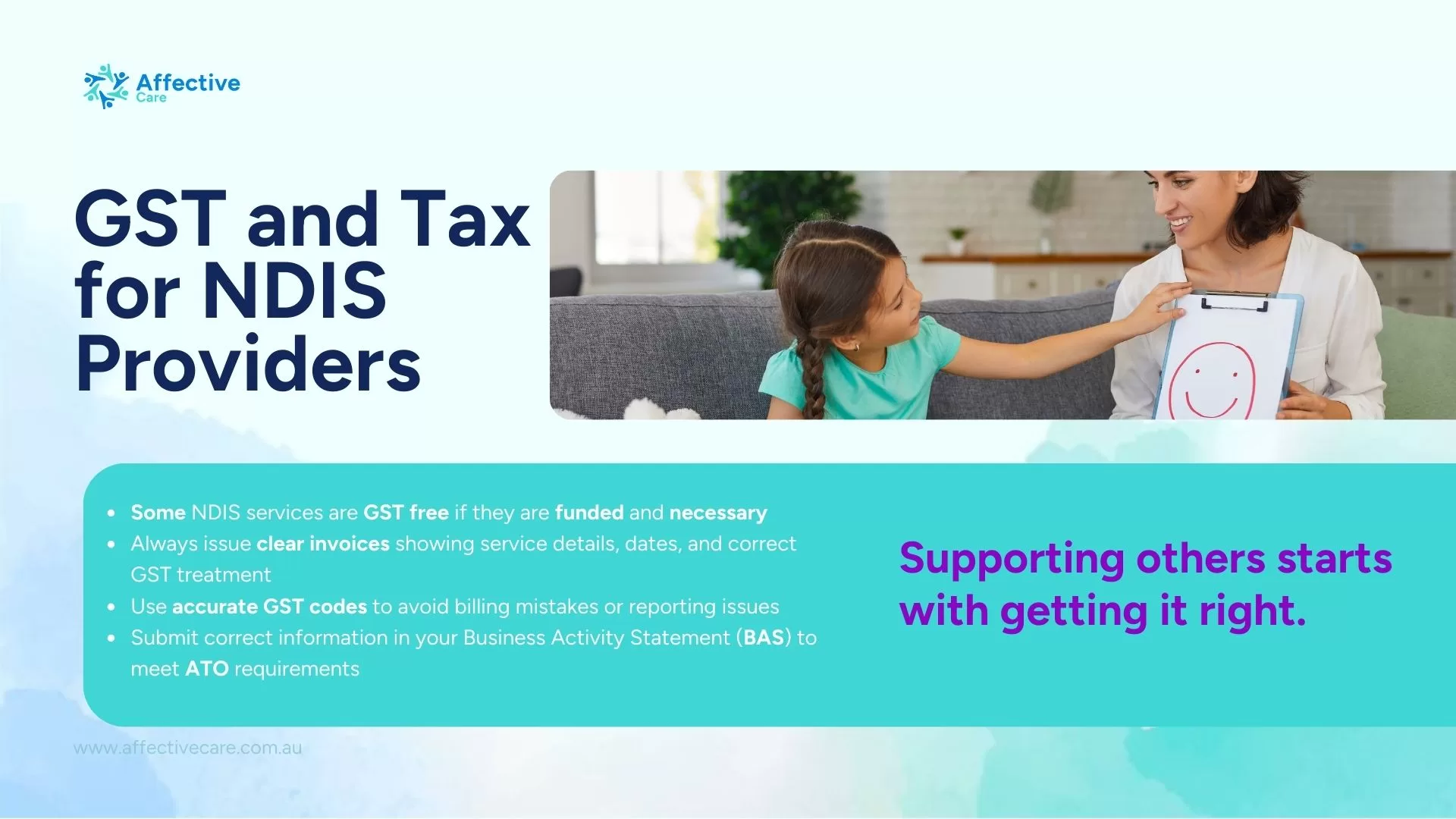
NDIS Providers: Your GST and Tax Responsibilities
As a provider, you offer services that change lives. But when it comes to tax, there are specific rules you need to follow to keep your business on the right side of the ATO.
When Are Your Services GST Free?
The ATO allows some services under the NDIS to be GST free. To qualify:
- The service must be funded by the NDIS
- It must be reasonable and necessary
- The participant must have an approved plan
- A written agreement or service booking must be in place
If you meet all four, you do not charge GST. But if one is missing, GST may apply. This includes services like room and board, or some transport options.
Keep Your Records Clean
As a provider, make sure to:
- Issue clear invoices that outline the service provided, the date of delivery, and the correct GST treatment. This ensures transparency for both the participant and the ATO.
- Use correct GST codes based on whether the service is GST free under NDIS rules. Misapplying GST can result in overcharging or underreporting.
- Report GST accurately in Business Activity Statements (BAS), which are submitted to the ATO to declare your GST obligations. BAS reports include GST collected, GST paid on business expenses, and other tax details, helping you calculate what you owe or what is refundable.
For a more detailed explanation of official pricing rules, our article on NDIS Pricing Arrangements and how pricing rules apply across different support categories may be a helpful next read.
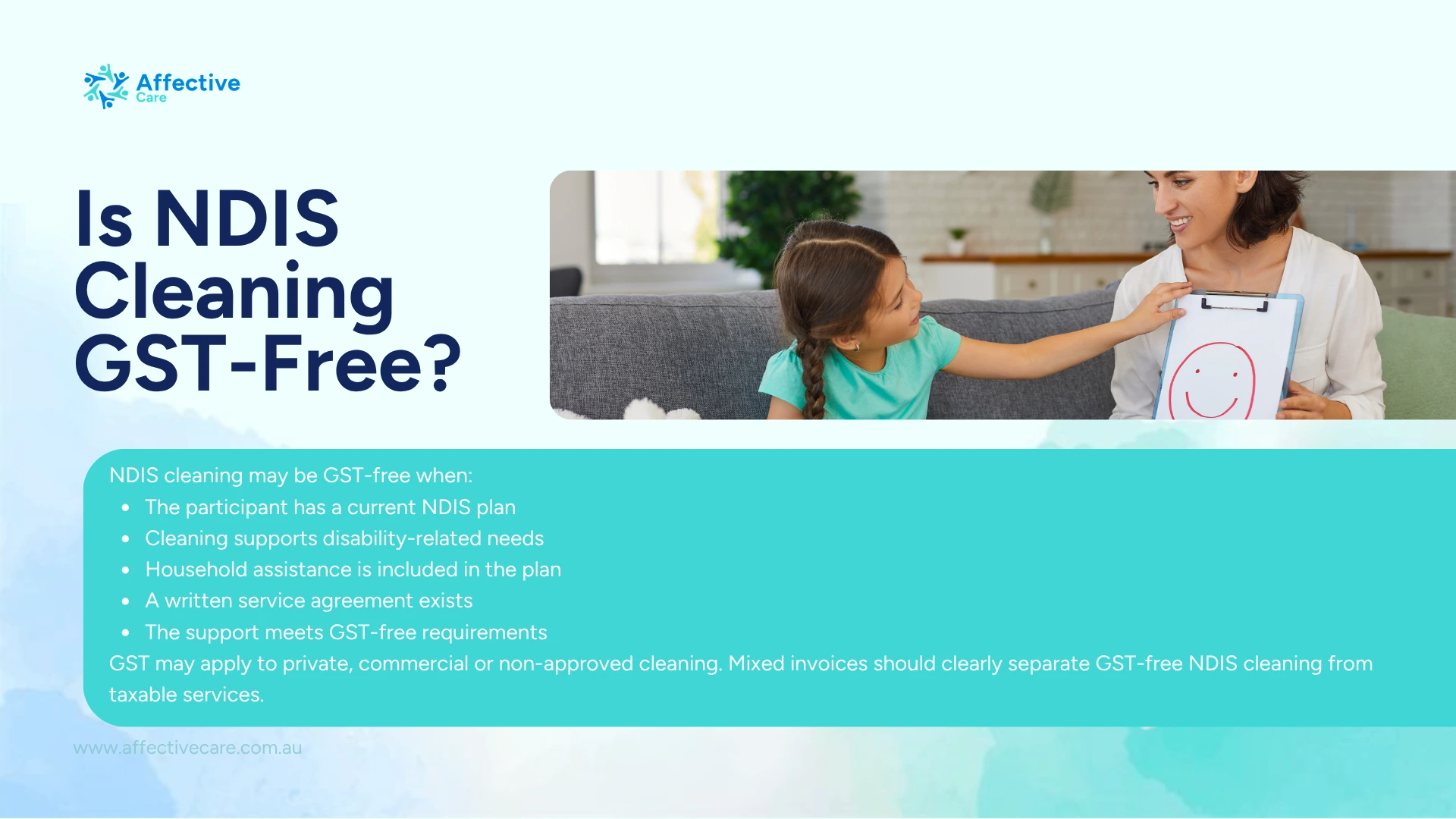
Is NDIS Cleaning GST-Free in Australia?
NDIS cleaning services may be GST-free in Australia, but they are not automatically GST-free simply because the participant uses NDIS funding to pay the invoice.
The GST treatment depends on the participant’s plan, the purpose of the cleaning support, the written agreement and whether the service is covered by the GST-free NDIS supports determination.
When is NDIS Cleaning GST-Free?
NDIS domestic cleaning may be GST-free when:
- The participant has a current NDIS plan
- Assistance with household tasks or domestic activities is a reasonable and necessary support in the plan
- The cleaning is supplied to help the participant because of their disability-related support needs
- The provider and participant have a written agreement covering the cleaning service
- The cleaning service is a kind of support covered by the GST-free determination
When these requirements are satisfied, a GST-registered cleaning provider generally invoices the eligible cleaning support as GST-free rather than adding 10% GST.
When is GST Charged on NDIS Cleaning Services?
GST may apply when:
- The cleaning is ordinary private cleaning unrelated to the participant’s disability support needs
- The cleaning is not covered by the participant’s current plan
- The provider does not hold adequate written evidence of the agreement
- The service is purchased outside the NDIS arrangement
- The provider supplies commercial or office cleaning rather than an eligible participant support
- The invoice includes separate taxable services or products
- Cleaning continues after the plan or relevant funding arrangement has ended
NDIS Cleaning Vs Commercial Cleaning
| Cleaning arrangement | Likely GST treatment |
|---|---|
| Disability-related domestic cleaning specified in a participant’s plan, covered by the determination and supported by a written agreement | May be GST-free |
| Privately purchased home cleaning with no connection to an NDIS plan | Generally taxable when supplied by a GST-registered business |
| Office, retail, strata or other commercial cleaning | Generally taxable when supplied by a GST-registered business |
| NDIS cleaning without a sufficient written agreement | GST-free requirements may not be satisfied |
| Cleaning beyond the amount or type of support covered by the plan | The additional service may be taxable |
| Invoice containing eligible NDIS cleaning and a separate taxable service | Each component should be treated and shown separately |
Commercial cleaning is ordinarily a taxable service when supplied by a GST-registered business.
By comparison, eligible NDIS domestic cleaning can be GST-free because it is supplied as a disability-related support under the specific NDIS GST provisions.
Is NDIS Domestic Cleaning GST-Free in Australia?
NDIS domestic cleaning can be GST-free when household assistance is included as a reasonable and necessary support and all legislative conditions are met.
The key question is not simply, “Is the customer an NDIS participant?” The provider should ask:
- Is the support included in the participant’s current plan?
- Is the cleaning connected to the participant’s disability-related needs?
- Is there a written agreement covering the service?
- Is the service covered by the GST-free determination?
- Is the service being supplied within the agreed scope and quantity?
If any requirement is missing, the provider should obtain professional tax advice before treating the invoice as GST-free.
Do NDIS Cleaners Charge GST?
An NDIS cleaner who is registered for GST should not add GST to a qualifying GST-free NDIS cleaning service.
However, the same cleaner may need to charge GST on commercial cleaning, ordinary private cleaning or other taxable services.
A cleaner who is not registered for GST does not charge GST on invoices. This is different from describing a service as GST-free under the NDIS rules.
The invoice should accurately reflect whether the supplier is unregistered for GST or whether the supply itself is legally GST-free.
How Should GST Appear on an NDIS Cleaning Invoice?
An invoice for eligible NDIS cleaning should clearly include:
- The provider’s business name and ABN
- The participant’s name or relevant reference
- The date the service was supplied
- A clear description of the household support
- Hours, units and rate charged
- The total amount payable
- The appropriate GST treatment
- Any applicable NDIS support item or claim reference
Where a cleaning invoice contains both GST-free NDIS support and taxable commercial work, the provider should separate the charges.
The invoice should not apply one GST treatment to the entire amount when different components have different tax treatments.
NDIS Cleaning GST Questions Answered
| Question | Answer |
|---|---|
| Is NDIS cleaning GST free Australia-wide? | It can be GST-free when all NDIS GST requirements are satisfied. |
| Is NDIS cleaning GST exempt Australia-wide? | “GST-free” is the more accurate term. Eligibility depends on the individual supply. |
| Is NDIS cleaning services GST free in Australia? | Yes, qualifying disability-related domestic cleaning may be GST-free. |
| Is NDIS domestic cleaning GST free Australia-wide? | It may be when the support is included in the plan and the other requirements are met. |
| Is GST charged on NDIS cleaning services? | Not on a qualifying GST-free supply, but GST may apply when the conditions are not met. |
| What about GST on cleaning services Australia NDIS versus commercial? | Eligible NDIS cleaning may be GST-free; commercial cleaning is generally taxable for GST-registered businesses. |
| Is every NDIS cleaning invoice GST-free? | No. Each cleaning arrangement must be assessed against the legislative conditions. |
The expressions “NDIS cleaning services GST exempt Australia” and “is NDIS cleaning GST exempt Australia” are commonly searched, but the technically appropriate GST description is generally GST-free, rather than exempt.
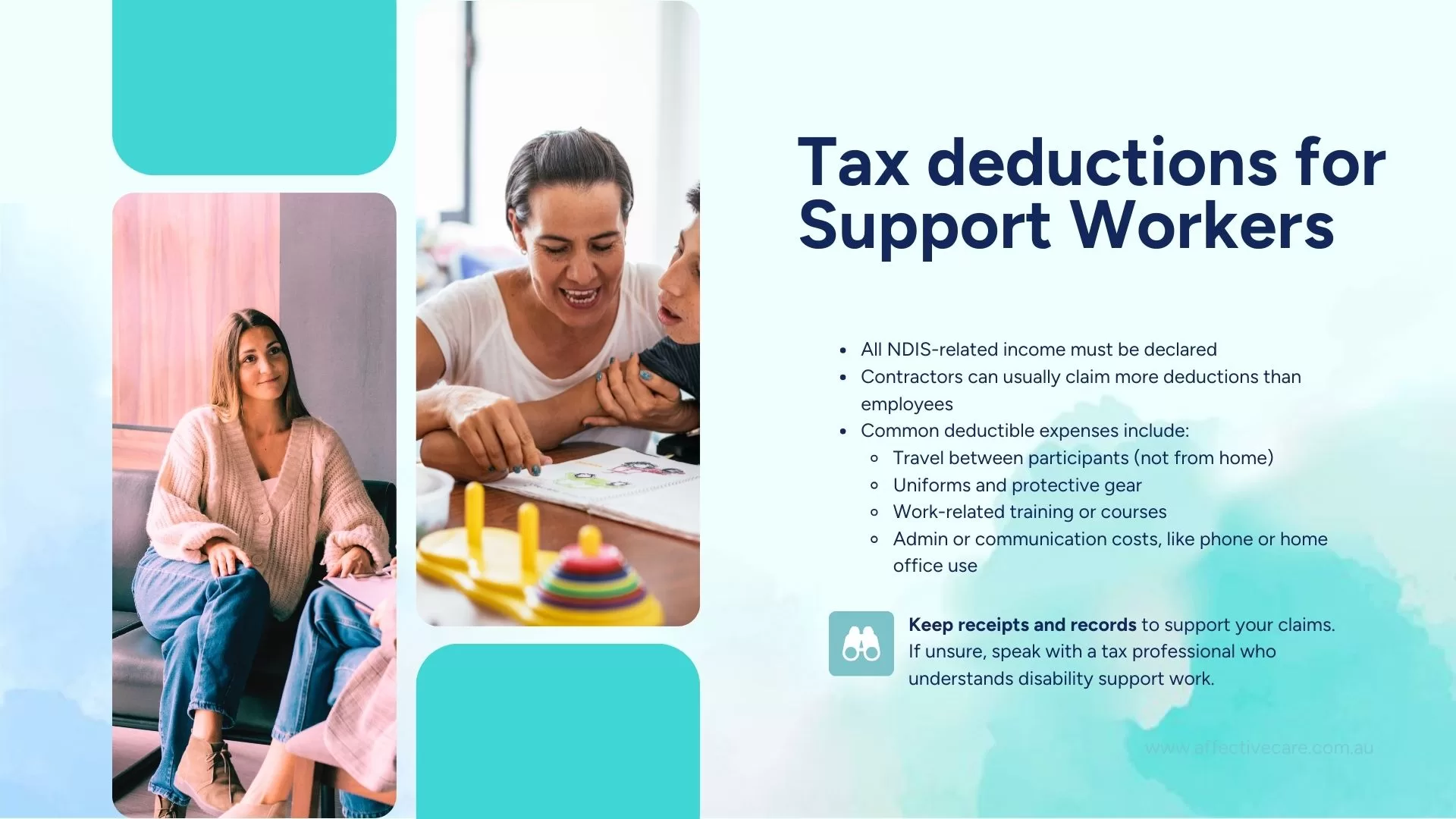
Tax Deductions for Support Workers
Support work often involves more than direct care. You might travel to multiple participants, complete admin from home, or upskill through professional training.
Many of these expenses may be tax deductible.
All income earned from NDIS-related work should be declared in your tax return, regardless of whether you’re a sole trader or employee.
Not all support workers have the same tax rights or responsibilities. Employees have a limited scope for claiming deductions and rely on employer-provided summaries like PAYG statements.
Contractors or sole traders, on the other hand, are responsible for declaring their full income and may be eligible to claim a wider range of deductions related to their business operations.
Eligible Work-Related Deductions
Support workers can usually claim expenses for:
- Travel between participant appointments (excluding commuting to or from home)
- Uniforms and protective gear, including laundering costs
- Job-related training or courses
- Professional indemnity insurance
- Home office expenses for admin or remote work
- A portion of phone or internet bills used for work communication
To be eligible, the expenses need to be paid out-of-pocket, not reimbursed, and properly documented with receipts or logbooks.
If you are new to the system, our guide to the National Disability Insurance Scheme gives a simple overview of the scheme, who it supports and how participants may use their plans.
Example: Luke, a casual support worker, drives between participants, wears a required uniform, uses his phone to coordinate shifts, and completes admin from home.
Because these are necessary for his work and not reimbursed, Luke can claim them on his tax return.
If you’re unsure about your deductions, a tax agent familiar with community and disability services can provide tailored advice.
Furthermore, for a more practical breakdown of service costs, our guide to NDIS price rates for support services and how charges vary across different support types can help you compare pricing more confidently.
Moreover, alongside understanding taxation and financial responsibilities, participants may also benefit from learning how to respond when their NDIS funding feels limited.
Can You Claim an NDIS Worker Check on Tax?
Whether a worker can claim the cost of an NDIS Worker Screening Check depends on why the expense was incurred and the worker’s circumstances.
A renewal or screening expense required to continue earning income in an existing disability-support role may have a stronger connection to current employment than an initial check obtained before starting work.
However, an initial screening cost that enables someone to qualify for or enter new employment may not be deductible as an employee expense.
Contractors and sole traders may also need to consider whether the expense is a business operating cost or a cost of establishing the business.
The ATO has specific published guidance for comparable suitability checks, such as Working with Children Checks.
It states that an existing employee may be able to claim a check needed to continue earning income, while a new worker obtaining an initial check may not qualify unless they are continuing recent work in the same child-related field.
Because the outcome depends on employment history, the type of screening and whether the worker is an employee or sole trader, support workers should confirm the treatment with a registered tax agent.
Keep:
- The payment receipt
- Screening application or renewal documents
- Employer requirements
- Evidence of the role held when the fee was paid
- Evidence showing whether the check was initial or renewed
What Plan Managers Need to Know
If you are a plan manager, you handle other people’s money. That brings a lot of trust, and with it, a high level of responsibility.
Tax Tips for Plan Managers
Plan managers also need to manage GST carefully. Some of your services may be GST free, while others are not. Review each line item closely.
- Income earned from plan management services is taxable and should be reported
- You cannot claim participant expenses as deductions
- Funds should be kept in a separate trust account
Moreover, understanding NDIS taxation rules, participants may benefit from an NDIS plan implementation checklist to keep records, invoices and plan documents organised.
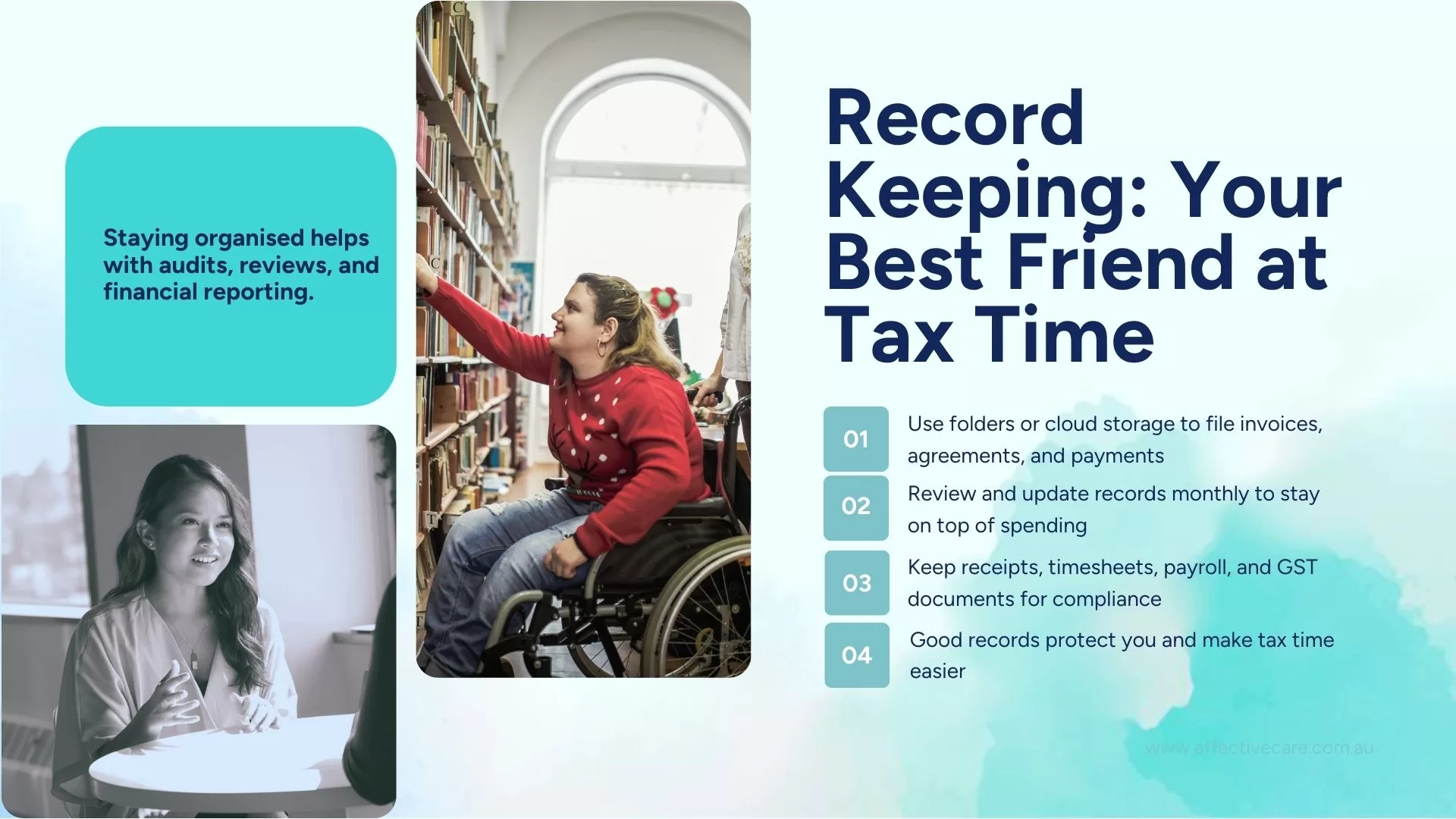
Record Keeping: Your Best Friend at Tax Time
Organised records are essential. They protect you during audits, support accurate reporting, and bring clarity to your finances.
Audit Tip: If the ATO or NDIA requests evidence, having a digital folder system can speed up your response.
Consider organising your files into categories like Invoices, Agreements, Worker Payments, and GST Statements.
Cloud storage options like Google Drive or Dropbox can make this easy to manage from your phone or computer.
Planning Tip: At the end of each month, set aside 30 minutes to review receipts and update your records. It saves time at tax time and keeps your business or plan running smoothly.
Whether you are a participant, provider or worker, keeping good records is key. It helps you:
- Track spending
- Meet reporting obligations
- Avoid disputes
- Prepare for audits
Furthermore, whether you’re self-managing or using a plan manager, it’s worth understanding the steps to apply for Positive Behaviour Support funding if PBS has been recommended as part of your supports.
What Should You Keep?
You should retain a complete and well organised record of all your NDIS related financial documents.
This includes invoices for services you have delivered or received, service agreements that outline the scope and terms of support, and timesheets that track hours worked.
Payroll records are essential if you employ staff, as are documents relating to superannuation contributions and tax obligations.
Keeping these documents secure and accessible will help you prepare for audits, track spending, and meet your ongoing reporting requirements.
If you have heard people talking about holiday funding, our article What is the NDIS $15,000 holiday in Australia? explains what the term means and what participants should check before making assumptions.
When to Seek Help
Tax is tricky, and no one expects you to be an expert. If you are feeling unsure, it might be time to reach out.
Consider Speaking to a Professional If:
- You are self-managing and hiring your own team
- You are unsure whether your worker is an employee or contractor
- You are running a support business and need clarity on GST
- You are a support worker and want to maximise deductions
Final Thought
Tax and disability support may seem like an unlikely pair, but financial clarity is an essential part of strong support.
But the truth is, financial clarity is part of strong support. Understanding your obligations helps you protect your funding, your team, and your peace of mind.
Whether you are navigating the NDIS as a participant, provider, or support worker, remember that support exists for you too.
Keep good records, ask for help when needed, and know that every step you take strengthens your foundation.
Disclaimer
The information provided in this article is for general informational purposes only and does not constitute professional advice.
It should not be relied upon as a substitute for financial, legal, or taxation advice.
NDIS-related taxation matters can be complex and may vary depending on your individual circumstances.
We strongly recommend that you consult with a qualified tax professional or financial advisor before making any decisions related to your taxation obligations.
Affective Care accepts no responsibility for any loss, liability, or damage incurred as a result of reliance on the information contained in this article.