


If you’ve seen posts online about a “$15,000 NDIS holiday,” you might be wondering whether the NDIS actually provides a lump-sum payment for travel.
This article explains the truth behind the $15,000 holiday claim, what the NDIS actually funds for travel and short breaks, and how Short-Term Accommodation (STA) and respite supports work in 2026.
In short, the NDIS does not fund holidays for leisure. There is no automatic $15,000 payment.
However, the NDIS may fund disability-related supports during travel, such as support workers or STA, if they meet reasonable and necessary criteria and align with your approved plan goals.
Below, we break down:
- Where the $15,000 myth came from
- What STA and respite funding really cover
- Eligibility requirements in 2026
- Interstate and overseas travel rules
- Real examples of funded short breaks
- How to discuss travel supports with your planner
Understanding the difference between a holiday and funded disability supports can help you make informed decisions about your NDIS plan.
Read the article to understand more about what NDIS may and may not fund.
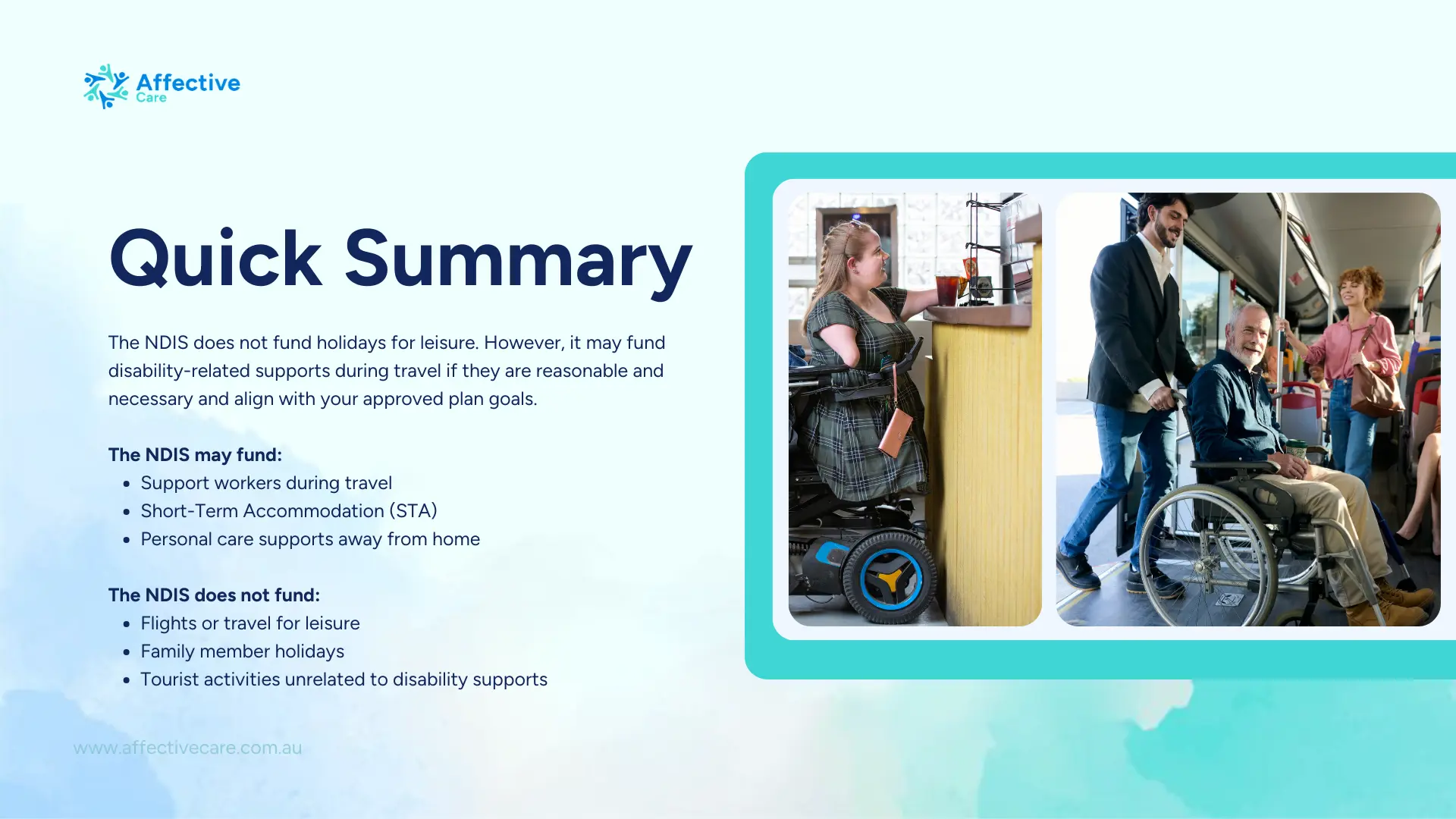
Quick Summary: What NDIS May Fund and May not Fund
The NDIS does not fund holidays for leisure, but it may fund disability-related supports during travel if they are considered reasonable and necessary and align with your approved plan goals.
NDIS may fund
- Support workers during travel
- Short-Term Accommodation (STA)
- Personal care supports away from home
NDIS does not fund
- Flights for leisure
- Family member holidays
- Tourist activities unrelated to disability supports
All funding decisions are made by the NDIA. Supports must meet the reasonable and necessary criteria under the NDIS Act, be directly related to your disability, represent value for money, and help you pursue the goals outlined in your individual NDIS plan.
To better understand how budgets are structured and what different categories cover, you can read our guide on the NDIS Price Guide 2026.
The Myth of the $15,000 NDIS Paid Holiday
The idea of a $15,000 NDIS paid vacation in Australia is a common online myth.
Social media posts often suggest that every NDIS participant receives a lump sum for holidays. This is not accurate.
There is no automatic $15,000 holiday payment under the NDIS.
Funding varies from person to person based on individual goals, assessed support needs, and approved budgets such as Core Supports or Capacity Building.
The NDIA assesses all funding against the reasonable and necessary criteria set out in the NDIS Act.
Supports must relate directly to a participant’s disability and help them pursue their goals.
Myth vs Fact: NDIS $15,000 Holiday
Myth: Every participant gets $15,000 for a holiday.
Fact: There is no guaranteed amount. Funding depends on individual plans.
Myth: The NDIS pays for family holidays.
Fact: The NDIS may fund disability-related supports, not leisure travel for family members.
Myth: You can use Core Supports for anything while travelling.
Fact: Core Supports must still meet reasonable and necessary criteria.
If you are unsure how funding works, it helps to review broader guidance on NDIS funding explained to understand how budgets are structured.
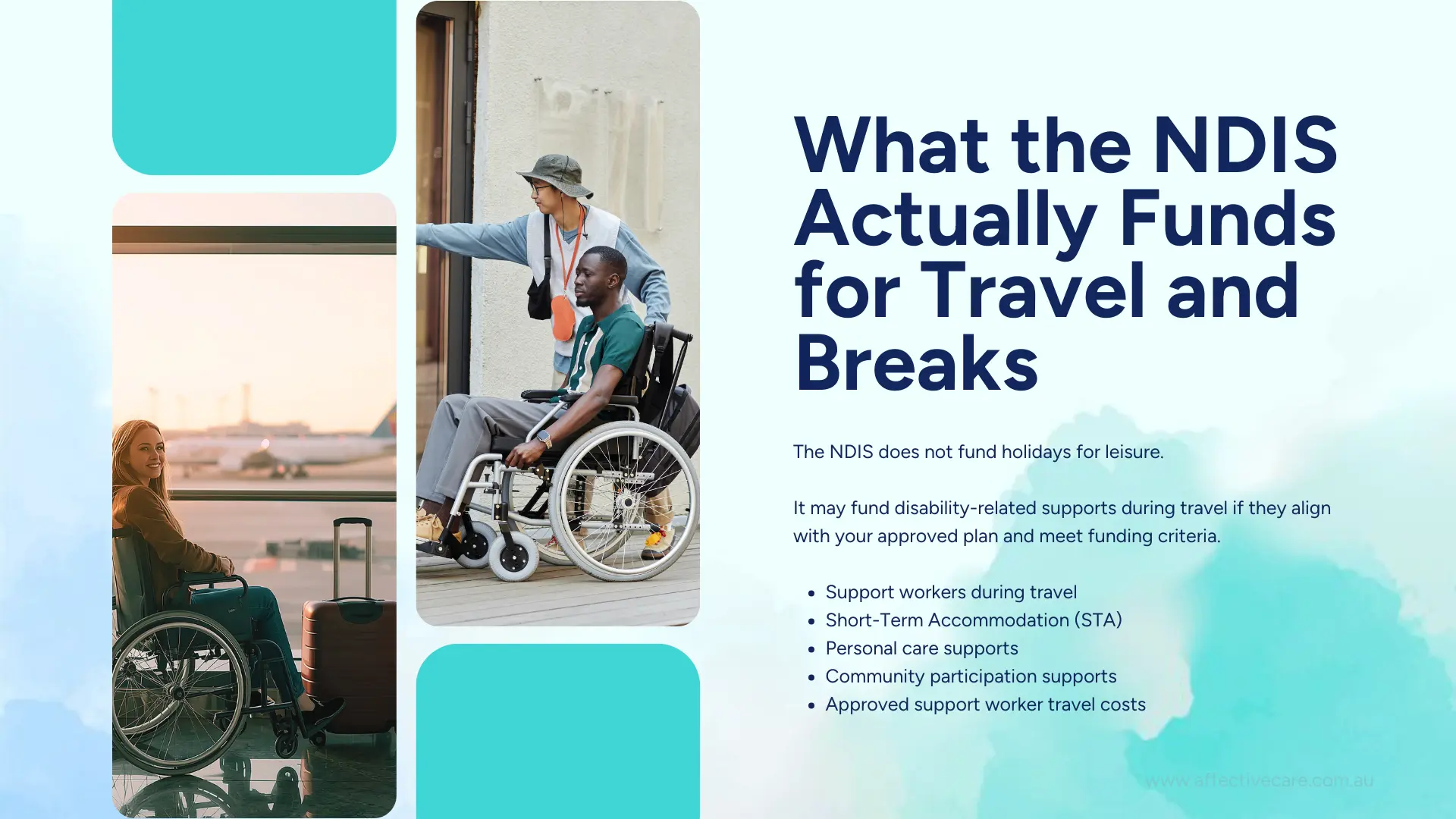
What the NDIS Actually Funds for Travel and Breaks
NDIS holiday funding explained clearly means understanding that the scheme funds support, not holidays.
The focus is always on disability-related assistance that helps you pursue your goals, not leisure expenses.
Depending on your plan, funding may come from:
- Core Supports for assistance with daily personal activities such as showering, dressing, meal preparation, or community access
- Short-Term Accommodation (STA) funding for temporary stays that include care and support
- Community participation supports to help you engage in social or skill-building activities while away
- Support worker travel costs, if directly related to delivering approved disability supports
NDIS Travel Support
If you travel interstate, your supports can generally continue, provided they remain reasonable and necessary.
For example, a participant from Sydney may use STA funding for a supported short break in regional NSW.
A participant in Melbourne may access respite supports during school holidays if this aligns with their goals.
Overseas Travel
The NDIS generally does not fund overseas holidays. Limited exceptions may apply for temporary travel, but supports must still meet criteria and be approved in advance.
It is important to seek clarification before making bookings, as overseas arrangements may affect how support can be delivered and claimed.
Supports must:
- Still meet reasonable and necessary criteria
- Be directly related to your disability
- Be within your approved budget
- Be discussed with the NDIA in advance
Moreover, if you are new to the system, our guide to the National Disability Insurance Scheme (NDIS) provides a broader overview of what the scheme is, who it supports and how participants may use their plans.
KEY POINTS
- The NDIS funds disability supports, not leisure expenses.
- Supports must align with your plan goals.
- Interstate travel is usually permitted with approved supports.
- Overseas supports are limited and require approval.
- Evidence from allied health professionals can support requests.
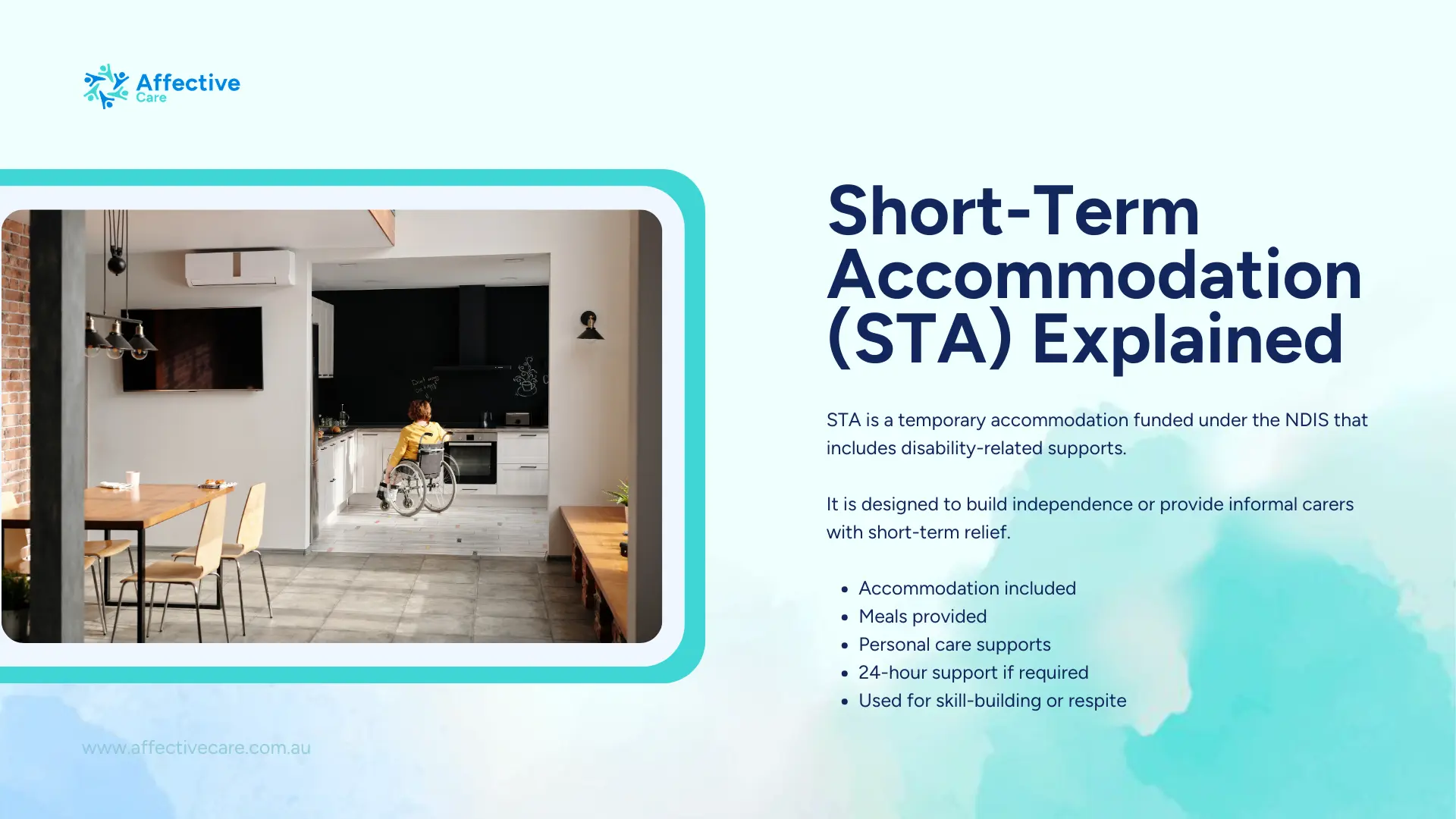
Short-Term Accommodation (STA)
Short-Term Accommodation (STA) under the NDIS is temporary accommodation that includes personal care, meals, and disability-related supports for a short period away from a participant’s usual home.
It is designed to support independence, skill development, and carer sustainability, not leisure travel.
Short-Term Accommodation (STA)
Short-Term Accommodation (STA) under the NDIS is temporary accommodation that includes personal care, meals, and disability-related supports for a short period away from a participant’s usual home.
It is designed to support independence, skill development, and carer sustainability, not leisure travel.
What is NDIS STA Funding Used For?
STA may include:
- Accommodation Personal care and daily living supports
- Food and agreed activities
- 24-hour support if required
- Community access supports during the stay
- Structured programs focused on capacity building
STA is commonly used for short breaks, building daily living skills, increasing social participation, testing independent living arrangements, or providing informal carers with planned respite.
Funding duration and frequency vary depending on individual support needs and approved budgets.
STA must meet reasonable and necessary criteria and align with your NDIS goals.
Because rules and pricing may change, it is important to check current NDIA guidance and Pricing Arrangements before confirming bookings.
Eligibility for NDIS Holiday Supports (2026)
When discussing NDIS $15,000 holiday eligibility criteria 2026, it is important to focus on eligibility for disability-related supports, not holidays themselves.
The NDIS does not approve funding simply because a participant would like to travel.
Instead, the NDIA assesses whether the requested supports meet the legislative requirements under the NDIS Act.
To access STA or travel-related supports:
- The support must be directly related to your disability and functional needs.
- It must align clearly with the goals outlined in your current NDIS plan.
- It must meet the reasonable and necessary criteria under Section 34 of the NDIS Act.
- It must represent value for money compared to alternative support options.
- It must be effective and beneficial in supporting your independence, skill development, or community participation.
You may need to discuss supports at your plan review or request a plan variation if your needs have changed. Funding decisions are made by the NDIA.
In many cases, supporting evidence may be required from allied health professionals such as occupational therapists, psychologists, or support coordinators.
Reports may need to explain why the support is required during travel and how it connects to your goals.
If your current plan does not include sufficient funding for STA or travel-related supports, you may need to:
- Raise the request at your scheduled plan review, or
- Request a plan variation if your circumstances or support needs have changed.
Each request is assessed individually. There is no guaranteed funding amount, and all final decisions are made by the NDIA based on your specific situation and documented needs.
Furthermore, rather than relying on misleading claims about what the NDIS may pay for, participants should focus on practical ways to manage limited NDIS funding for essential supports.
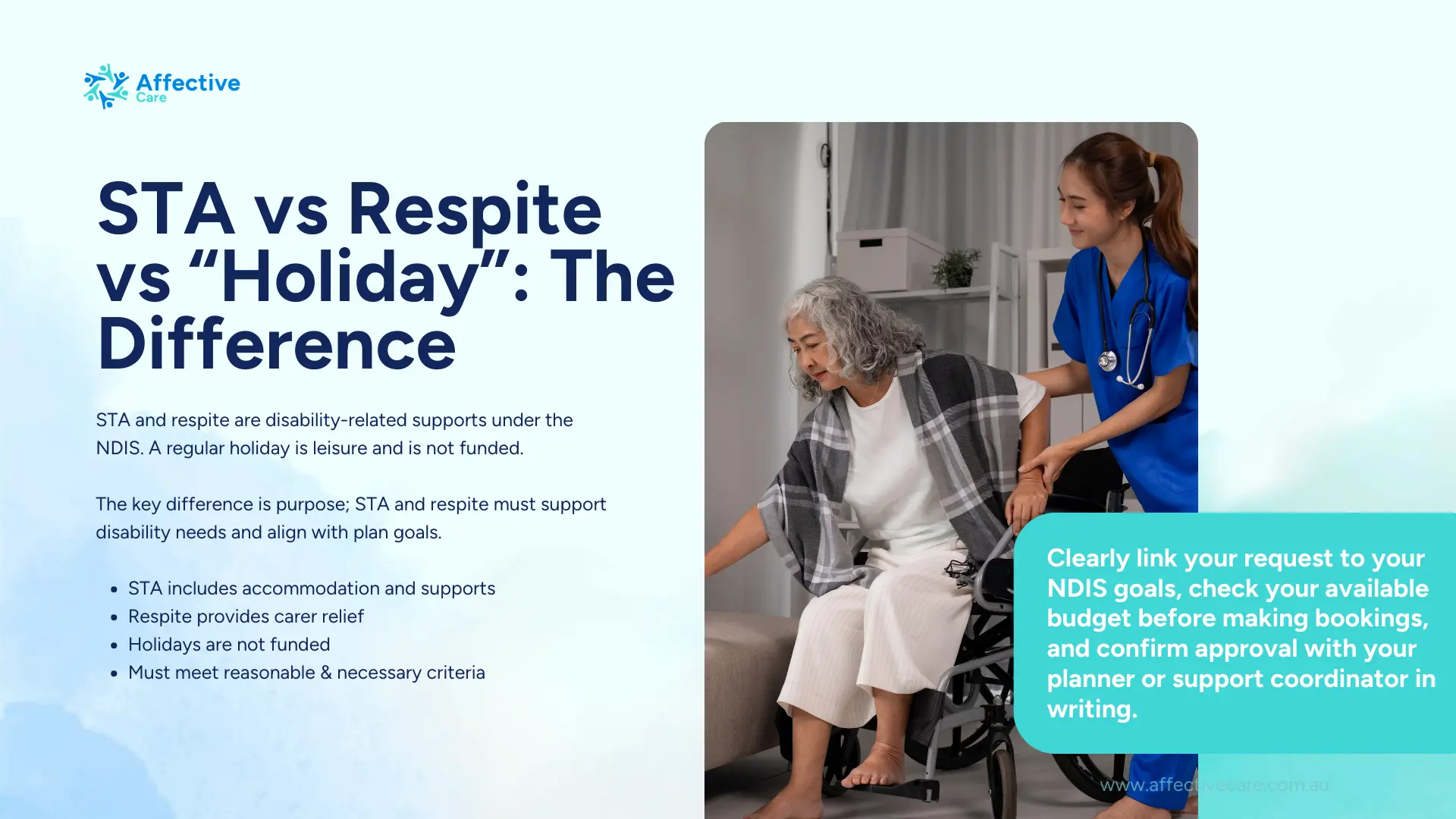
STA vs Respite vs “Holiday”: What’s the Difference?
There is often confusion between Short-Term Accommodation (STA), respite, and what people commonly refer to as a “holiday.”
While they may look similar on the surface a short stay away from home, their purpose and funding rules are very different under the NDIS.
When comparing respite vs STA NDIS supports, clarity is important.
The key difference is that STA and respite are disability supports, whereas a regular holiday is a personal leisure expense.
STA is a funded NDIS support category that includes accommodation and disability-related care for a short period.
Respite is commonly used to describe a short break that also provides informal carers with temporary relief.
A regular holiday, however, is taken for recreation and is not funded by the NDIS.
When comparing respite vs STA NDIS supports, clarity is important.
|
Feature |
STA |
Respite |
Regular Holiday |
|
Funded by NDIS |
Yes, if approved |
Yes, if approved |
No |
|
Includes support workers |
Yes |
Sometimes |
No |
|
Covers flights |
Rarely |
Rarely |
No |
|
Must meet reasonable and necessary |
Yes |
Yes |
Not applicable |
Both STA and respite must align with the participant’s NDIS goals and meet reasonable and necessary criteria.
Funding is based on disability-related needs, not the destination or leisure aspect of the trip.
A regular holiday, even if it provides relaxation or enjoyment, does not qualify for NDIS funding unless it includes approved disability supports.
For more detailed guidance, refer to an NDIS respite supports guide or speak with your planner or support coordinator.
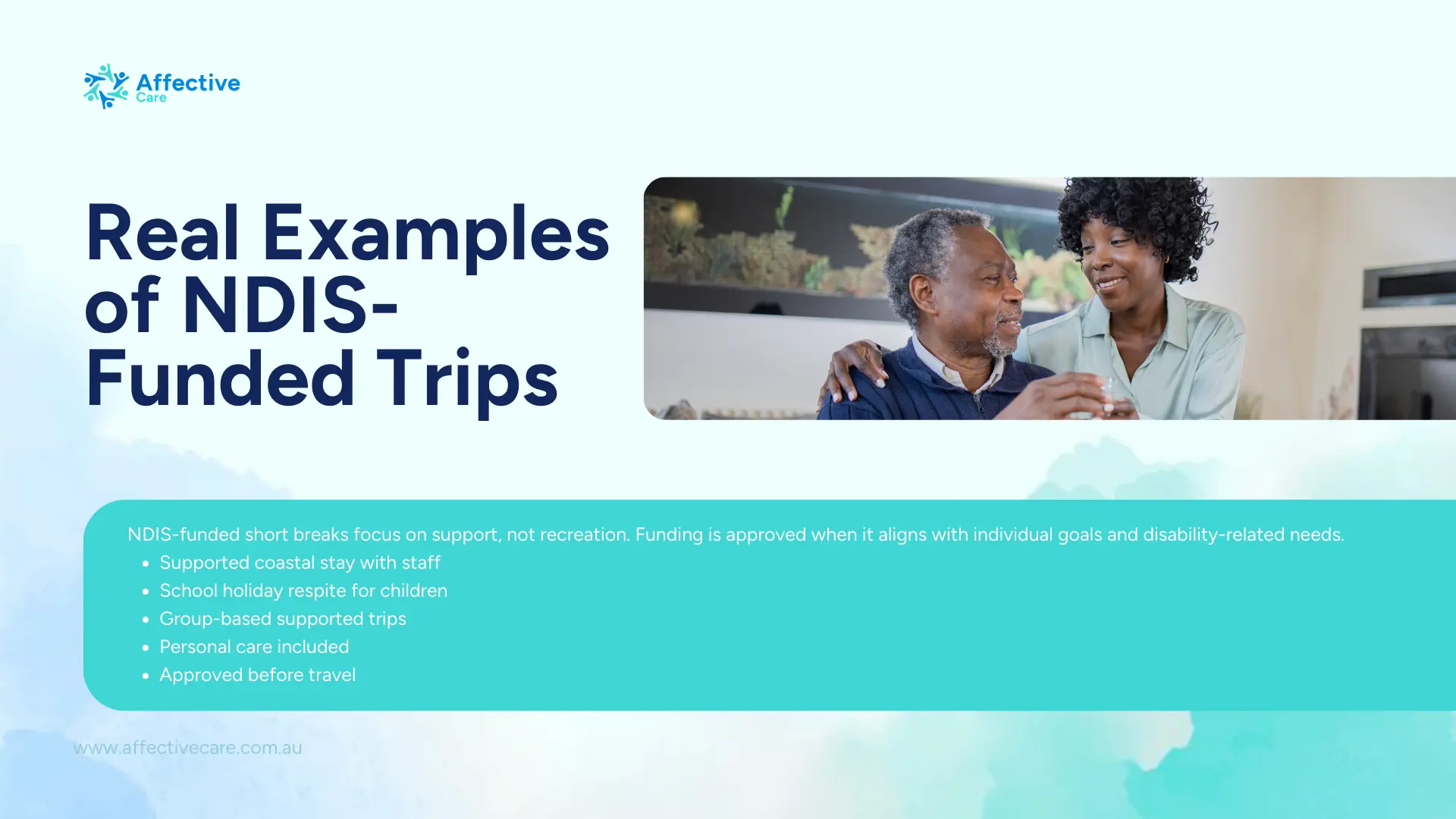
Real Examples of NDIS-Funded Trips
NDIS funding travel examples can help make this clearer.
Scenario 1: Adult Participant Using STA
An adult participant uses STA funding for a supported coastal stay.
During the trip, support workers assist with personal care and community access activities aligned with independence goals.
Scenario 2: Child During School Holidays
A child participant accesses NDIS school holiday respite supports.
The short break provides structured activities and gives family carers planned downtime.
Scenario 3: Group-Based Short Break
A small group of participants attend a supported community trip with rostered support workers.
Funding covers support hours and accommodation, not leisure flights for family members.
All supports were aligned to individual plans and approved before travel.
Support coordination services can help you prepare documentation and communicate effectively with the NDIA.
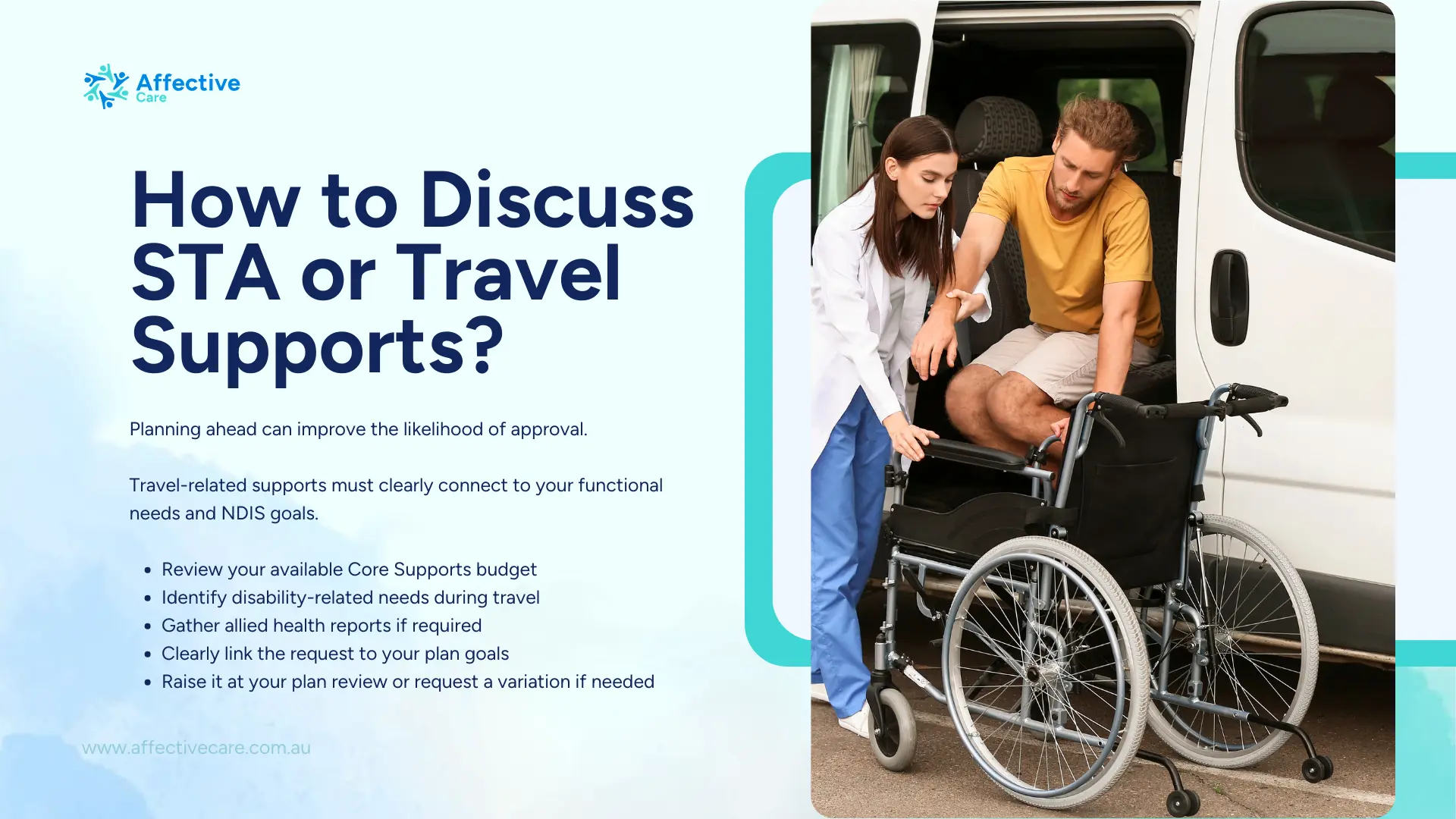
How to Discuss STA or Travel Supports With Your Planner
If you are considering STA or travel-related supports, preparation helps.
Use the steps below to guide your discussion with your planner or support coordinator:
- Review your current Core Supports budget: Check whether you already have funding available for daily living supports or Short-Term Accommodation (STA), and understand how much remains in your budget.
- Clarify your disability-related support needs during travel: Identify what assistance you require away from home, such as personal care, supervision, behavioural supports, medication management, or community access support.
- Be specific about functional impact: Explain how your disability affects you during travel and why supports are still required outside your usual home environment.
- Gather supporting evidence if needed: Allied health reports from occupational therapists, psychologists, or other professionals can help demonstrate why the support is reasonable and necessary.
- Link the request clearly to your NDIS goals: For example, improving independence, building social skills, increasing community participation, or maintaining wellbeing.
- Discuss timing and approval pathways: Raise the request at your scheduled plan review or request a plan variation if your needs have changed.
- Understand budgeting and claims: Speak with your plan manager about pricing limits, service agreements, and how STA claims are processed to avoid unexpected costs.
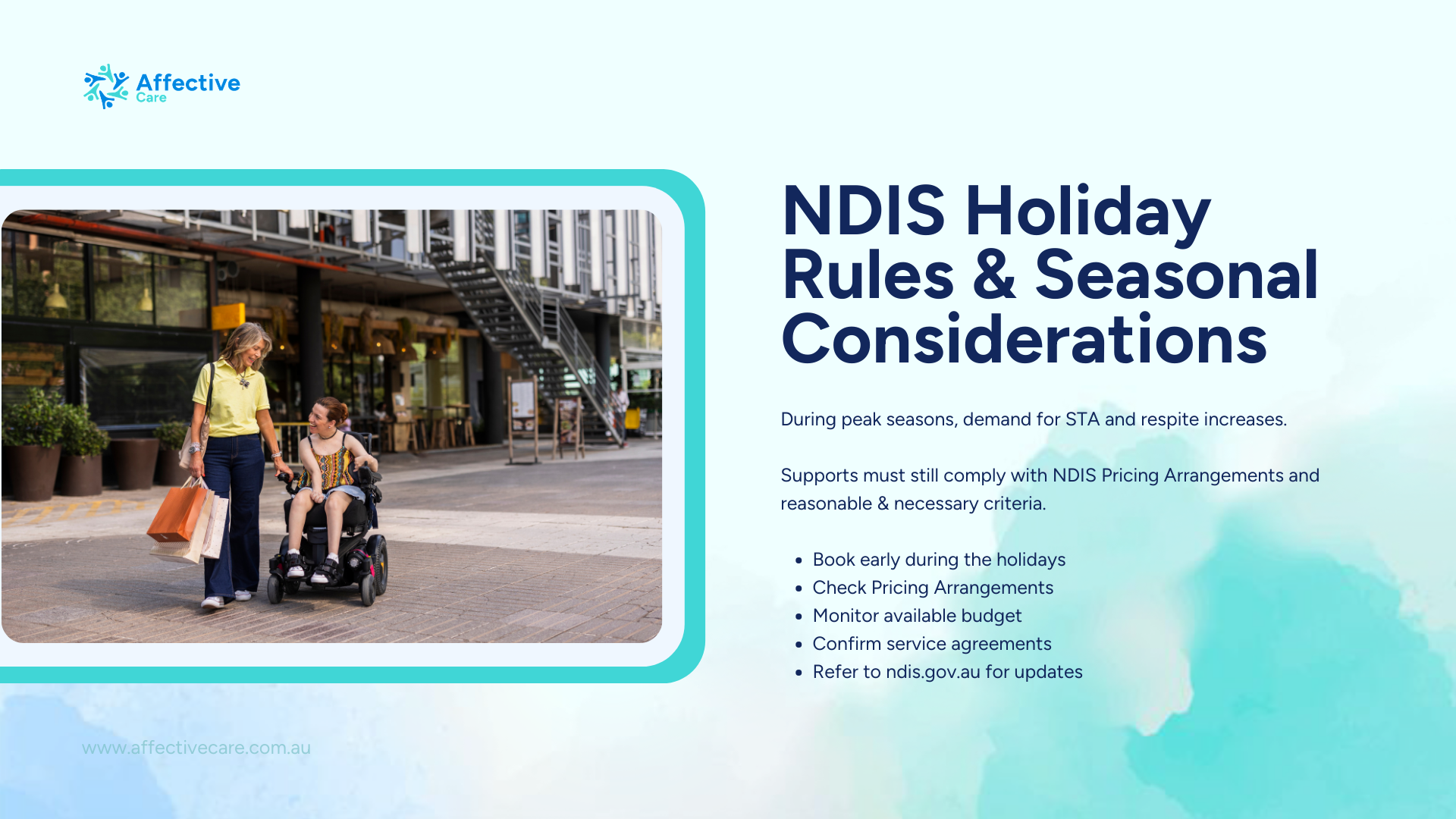
2026 NDIS Holiday Rules & Seasonal Considerations
Last updated: 2026
NDIS Christmas holiday funding and school holiday respite requests typically increase during peak periods such as December–January and mid-year school breaks.
While the NDIS does not fund holidays for leisure, participants may continue to access approved disability-related supports during these times, provided they meet reasonable and necessary criteria under the NDIS Act.
Important seasonal considerations include:
- Higher provider demand: Many STA and respite providers book out months in advance during Christmas and school holidays. Early planning is strongly recommended.
- Pricing Arrangements compliance: Supports delivered over weekends or public holidays may attract higher rates in line with the current NDIS Pricing Arrangements and Price Limits. Always check the latest version on the official NDIS website.
- Plan budget availability: Increased usage during peak seasons can impact your Core or STA budgets. Monitor your funding to ensure it remains within approved limits.
- Goal alignment remains essential: School holiday respite or seasonal STA must still align with your documented NDIS goals, such as community participation or skill development.
- Service agreements: Confirm cancellation policies, public holiday rates, and staffing arrangements in writing.
Before confirming arrangements, review the latest operational guidelines and pricing updates on the official NDIS website.
All funding decisions remain subject to NDIA approval and must meet reasonable and necessary requirements.
For questions about tax, invoices or financial responsibilities, our guide to NDIS Taxation explains key points participants, families and providers may need to understand.
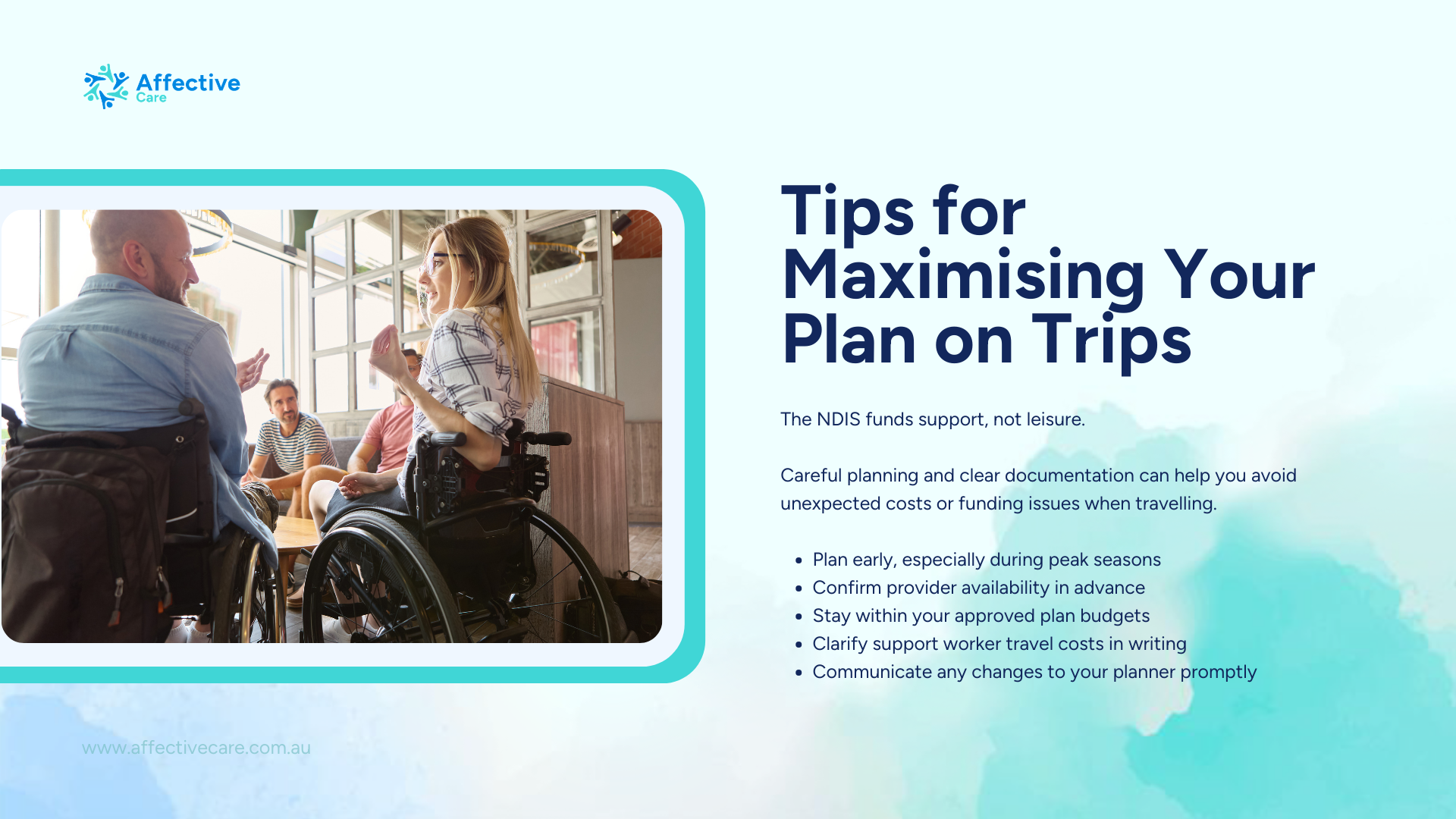
Tips for Maximising Your Plan on Trips
NDIS participant holiday tips focus on structured planning, documentation, and compliance.
While the NDIS funds supports rather than leisure activities, careful preparation can help you use your approved funding effectively.
- Plan early: Confirm provider availability well in advance, particularly during peak seasons.
- Review your plan budgets: Check available funding in Core Supports or STA before making commitments.
- Check current Pricing Arrangements: Public holiday, weekend, and travel-related rates must comply with the latest NDIS Pricing Arrangements and Price Limits available at ndis.gov.au.
- Clarify support worker travel costs in writing: Discuss whether provider travel time, transport, or overnight allowances apply, and ensure this is reflected in your service agreement.
- Document everything clearly: Ensure the scope of supports, staffing ratios, accommodation inclusions, and pricing are outlined in a signed service agreement.
- Stay within approved funding categories: Avoid assuming leisure expenses are claimable unless clearly disability-related and agreed in advance.
- Communicate changes promptly: If your needs change, contact your support coordinator, plan manager, or planner to discuss next steps, including possible plan variations.
For the most accurate and up-to-date guidance, always refer to the official NDIS website (ndis.gov.au).
Funding decisions are made by the NDIA and must meet reasonable and necessary criteria.
Funding is assessed within the structure of your individual plan, including Core and Capacity Building budgets, as outlined in our overview of how NDIS funding works.
Still Unsure About the NDIS $15,000 Holiday?
The idea of a guaranteed “$15,000 NDIS holiday” is a myth. There is no automatic lump sum payment for travel under the NDIS.
What the NDIS may fund are disability-related supports during travel such as Short-Term Accommodation (STA), respite, or support workers provided they:
- Relate directly to your disability
- Align with your approved NDIS goals
- Meet the reasonable and necessary criteria
- Represent value for money
The key distinction is simple: The NDIS funds supports, not leisure.
If you are considering a short break, interstate travel, or STA, careful planning is essential. Review your budget, gather supporting evidence if required, and clearly link your request to your functional needs and goals.
Because funding decisions are made individually by the NDIA, there is no guaranteed amount, and approval depends on your documented needs and plan structure.
If you’re unsure how STA or travel supports may apply to your situation, speaking with a support coordinator or planner can help you understand your options and prepare appropriately.
Understanding the rules helps you make informed decisions and use your NDIS plan in a way that genuinely supports your independence and goals.