



Choosing between Telehealth vs face-to-face psychology depends on therapy goals, communication preferences, accessibility needs, location and clinical circumstances.
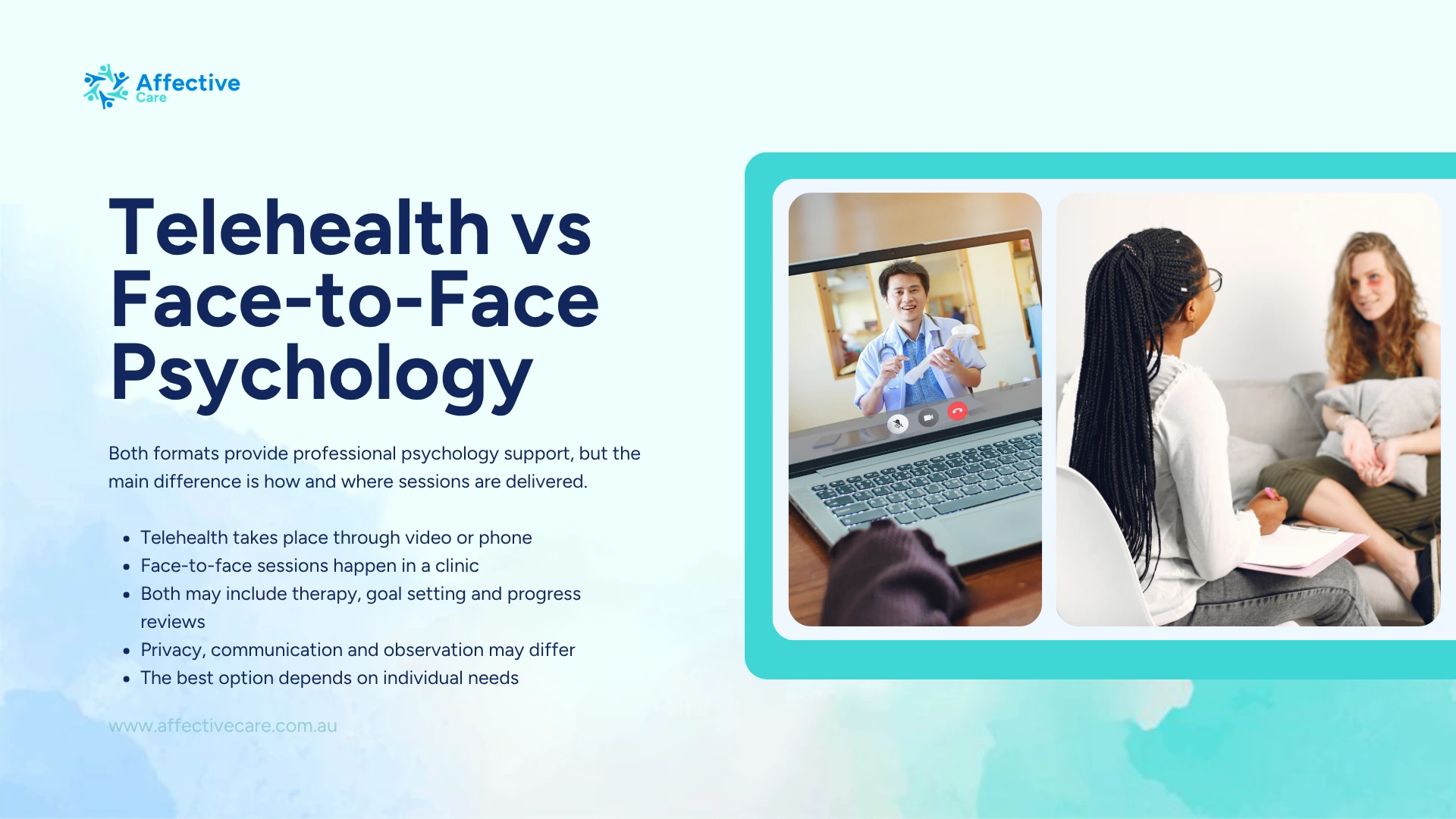
Telehealth psychology is delivered remotely, usually through secure video or, where appropriate, by telephone.
Face-to-face psychology involves attending a clinic or suitable service location and meeting the psychologist in person.
Understanding Telehealth vs face-to-face psychology can help people choose the format that best supports comfort, participation and therapy outcomes.
Telehealth may suit people who experience travel barriers, live in regional areas or feel more comfortable attending from home.
Face-to-face psychology may be better for people who prefer direct interaction, need a private clinical setting or require assessment activities that are easier to complete in person.
Neither option is automatically better. The most suitable choice depends on what is clinically appropriate, accessible and comfortable for the individual.
The main difference: Telehealth offers remote access and reduced travel, while face-to-face psychology provides in-person interaction and a dedicated therapy environment.
What is the Difference Between Telehealth and Face-to-Face Psychology?
When comparing Telehealth vs face-to-face psychology, the main difference is where the appointment occurs and how the psychologist and client communicate.
During Telehealth psychology, the client joins the appointment through a computer, tablet or phone. The person may attend from home, work, supported accommodation or another suitable private setting.
During face-to-face psychology, the client travels to a clinic or agreed service location and meets the psychologist in person.
Both formats may include:
- Discussing current psychological or emotional concerns;
- Identifying therapy goals;
- Learning coping and emotional regulation strategies;
- Completing therapeutic activities;
- Reviewing progress;
- Receiving psychological education; and
- Planning strategies to use between appointments.
The discussion around online psychology vs in-person psychology should not focus only on convenience.
The appointment format may also affect privacy, communication, observation, technology access and the suitability of particular assessment methods.
Telehealth Psychology and Face-to-Face Psychology Compared
|
Area |
Telehealth psychology |
Face-to-face psychology |
|
Location |
The client joins from home or another private location. |
The client attends a clinic or agreed service setting. |
|
Travel |
Travel may be reduced or avoided. |
Transport and travel time may be required. |
|
Communication |
Communication takes place through video or telephone. |
Communication occurs in the same physical room. |
|
Observation |
The psychologist sees what is visible through the camera. |
The psychologist may observe a wider range of movements and non-verbal communication. |
|
Privacy |
Depends partly on the client having a private space. |
A clinic generally provides a dedicated confidential room. |
|
Technology |
Requires a suitable device, internet connection and platform. |
Does not usually require the client to use digital technology during the session. |
|
Accessibility |
May suit people with travel, mobility or location barriers. |
May suit people who prefer direct interaction or find technology difficult. |
|
Assessments |
Some assessment components may be completed remotely. |
Some standardised assessments may be more suitable in person. |
|
Flexibility |
May provide greater location flexibility. |
Requires attendance at a specific physical location. |
These differences are general. The suitability of online psychology vs in-person psychology depends on the person’s individual needs, the therapy approach and the psychologist’s professional judgement.
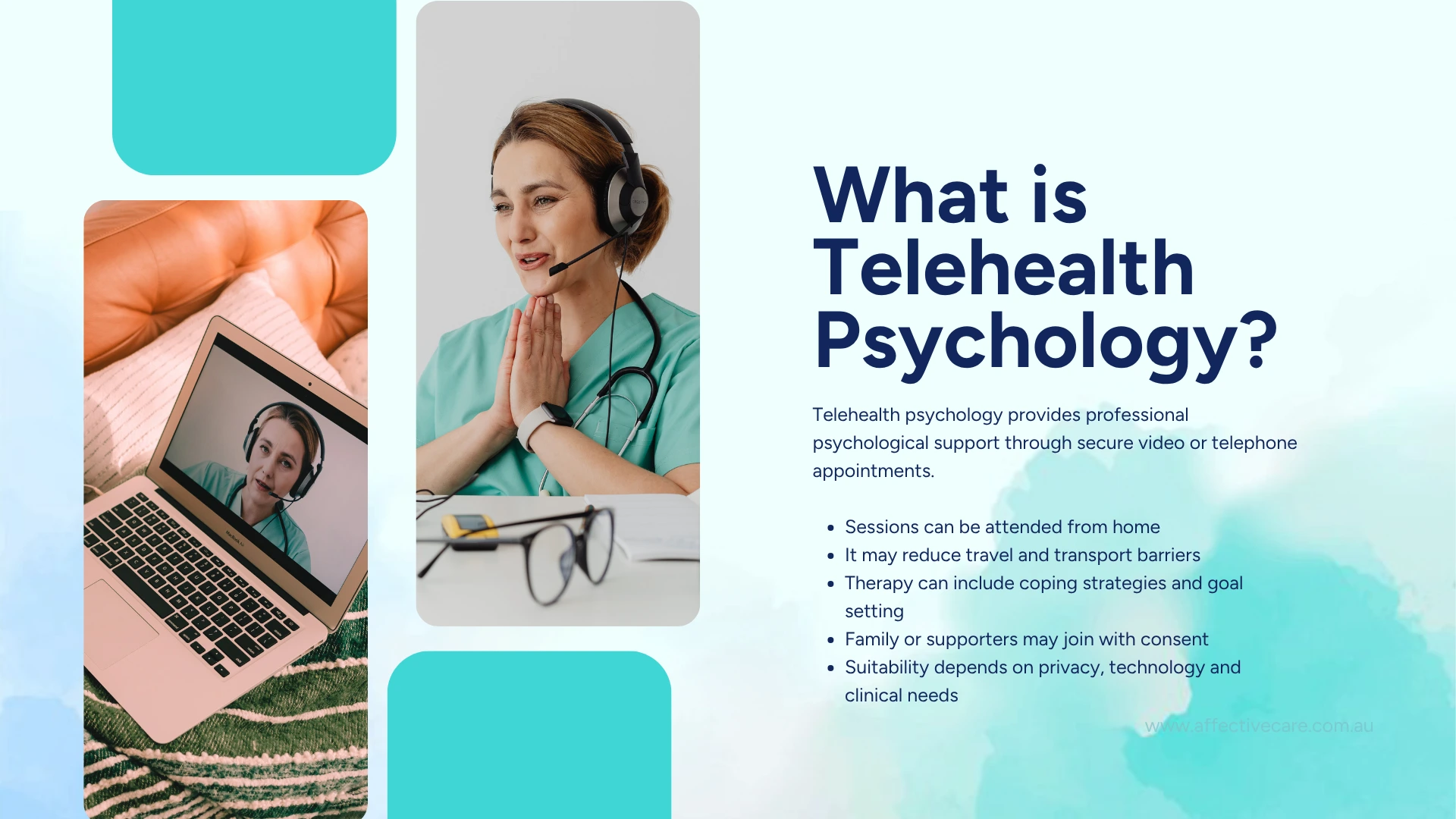
What is Telehealth Psychology?
Telehealth psychology is psychological support delivered remotely through digital communication technology.
Most appointments occur through a secure video platform, although telephone sessions may be used when appropriate.
A Telehealth psychology appointment is still a professional psychological service.
For people who prefer remote appointments, Affective Care offers Telehealth psychology services across Australia where online delivery is suitable for the person’s needs.
It is not the same as using an automated wellbeing app, completing an online questionnaire or communicating with an artificial intelligence tool.
During online psychology services, a psychologist may:
- Discuss emotional, behavioural or psychological concerns;
- Identify practical therapy goals;
- Provide evidence-based psychological intervention;
- Teach coping and emotional regulation strategies;
- Review changes in everyday functioning;
- Involve a family member or support person with consent;
- Provide psychological education; and
- Plan future sessions.
Telehealth psychology can be used for initial consultations, regular therapy, progress reviews and some parts of psychological assessment.
However, not every assessment or therapy activity can be delivered remotely.
For example, a person living in regional Australia may have limited access to a psychologist with suitable disability experience. Travelling to a major city could require several hours.
Accessing an online psychologist in Australia may allow the person to attend regular sessions without spending most of the day travelling.
The psychologist should still confirm that remote therapy is suitable for the client.
Privacy, communication needs, technology, safety arrangements and the person’s comfort with video appointments should be considered before ongoing sessions begin.
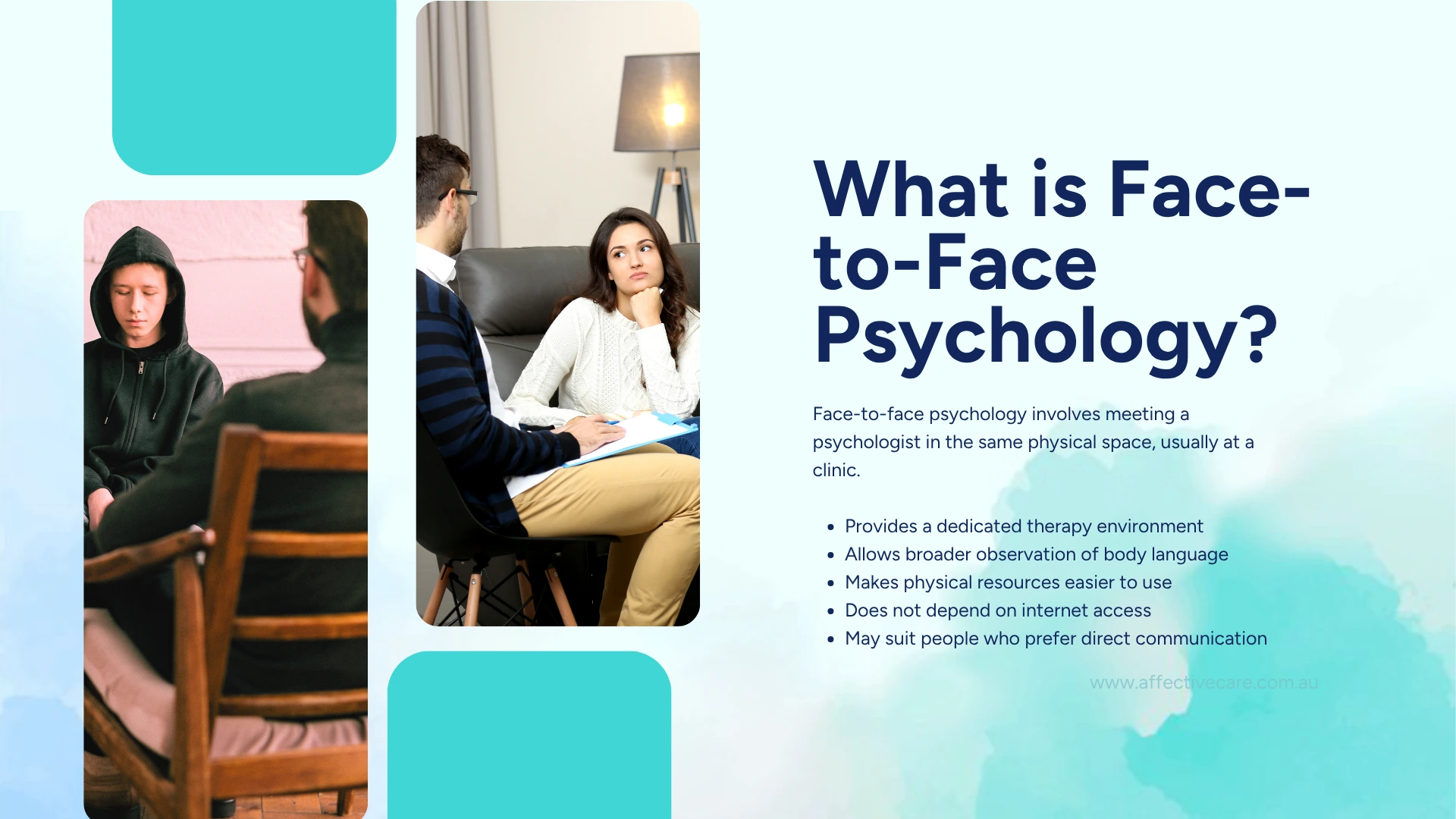
What is Face-to-Face Psychology?
Face-to-face psychology involves meeting a psychologist in the same physical space. Appointments usually take place in a clinic, community health setting or another suitable service location.
In-person psychology sessions may address the same concerns as Telehealth appointments.
If you are comparing broader therapy and appointment options, our guide to psychology services in Australia explains common services, access pathways and what to expect.
A psychologist may support someone with anxiety, emotional regulation, behaviour, relationships, routines, communication, confidence or participation in everyday activities.
A key feature of face-to-face psychology is the dedicated therapy environment. Attending a clinic may help someone separate therapy from home, work or family responsibilities.
A private consultation room may also provide greater confidentiality for someone who cannot speak freely at home.
The psychologist may be able to observe a wider range of body language and movement during an in-person psychology session.
This may be useful when communication is limited or when the psychologist needs to understand how the person responds to physical activities, sensory materials or assessment tasks.
However, face-to-face psychology should not automatically be described as more effective or personal.
Therapy quality depends on the psychologist’s competence, the person’s engagement, the therapeutic relationship and whether the approach suits the client’s needs.

Is Telehealth Psychology as Effective as Face-to-Face Psychology?
A central question in Telehealth vs face-to-face psychology is whether online appointments can produce outcomes similar to in-person therapy.
Telehealth psychology can be effective for many people when the therapy is suitable for remote delivery and the client can participate comfortably.
However, it should not be assumed that Telehealth is equally appropriate for every person, condition or assessment.
Online psychology may work well when:
- The therapy approach is suitable for video delivery;
- The person is comfortable communicating online;
- The internet connection is reasonably reliable;
- The person has access to a private space;
- Communication and accessibility needs can be supported;
- The psychologist is experienced in delivering Telehealth; and
- Safety procedures are in place.
The effectiveness of online psychology vs in-person psychology depends on more than whether a screen is used.
Outcomes are also influenced by the quality of the therapeutic relationship, the psychologist’s skills, the client’s engagement and whether the therapy addresses the person’s actual needs.
Some people find it easier to open up online because they are in a familiar environment. Others feel more connected and focused when they are in the same room as their psychologist.
Certain psychological assessments, risk situations and communication needs may require face-to-face support or a blended approach.
Neither format is universally superior when considering online therapy vs in-person therapy. The better option is the one that provides safe, accessible and clinically suitable support.
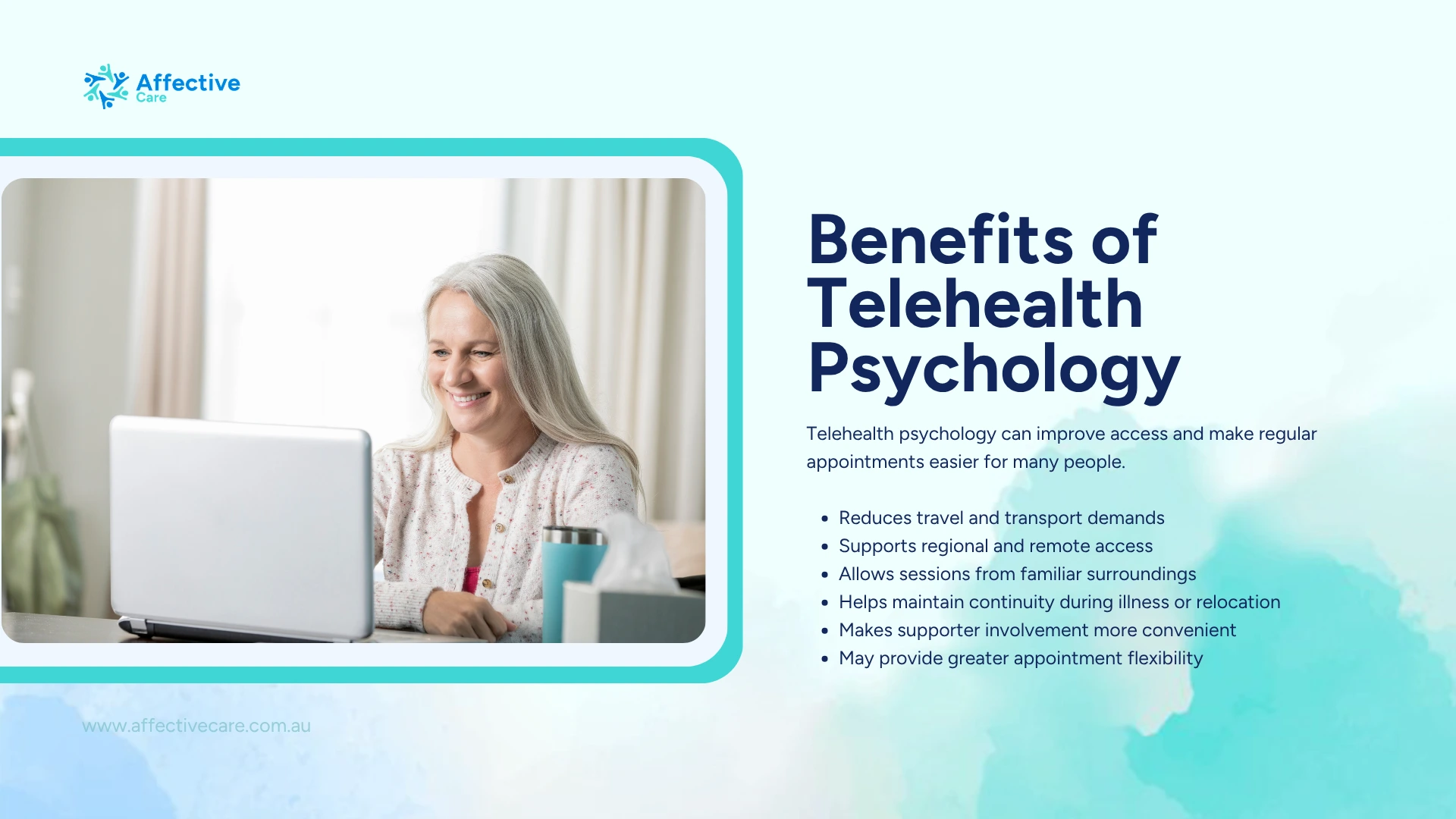
Benefits of Telehealth Psychology
Telehealth psychology may reduce several barriers that can make regular psychological support difficult.
Reduced travel
Travel can be physically and emotionally demanding for people living with disability, chronic pain, fatigue or limited mobility.
Attending face-to-face psychology may require organising a support worker, using public transport or spending significant time in a vehicle.
Telehealth psychology can allow the person to use their energy for the appointment rather than the journey.
Better regional and remote access
People living outside major cities may have fewer local psychology services.
Even when a psychologist is available nearby, that provider may not have experience with the person’s specific disability, communication needs or therapy goals.
Online psychology services may provide access to a wider range of providers across Australia, subject to professional and service requirements.
Familiar surroundings
Some people feel more comfortable speaking from home. This may be especially helpful for people who experience sensory stress in unfamiliar environments or anxiety when travelling.
The psychologist may also be able to see aspects of the person’s everyday environment, which can support discussions about routines, communication or practical coping strategies.
Appointment continuity
Telehealth psychology may help someone continue appointments during periods of reduced mobility, illness, weather disruption or changes in location.
A person who usually attends a clinic may temporarily move online after surgery.
Someone who moves to another city may be able to continue working with the same psychologist through Telehealth.
Support-person participation
With the client’s consent, a family member, carer, support coordinator or other professional may join part of an online appointment from another location.
This can support collaboration without requiring everyone to travel to the same clinic.
Your preferred appointment format may also depend on funding, so learn how the NDIS covers telehealth psychology services before deciding between online and face-to-face support.
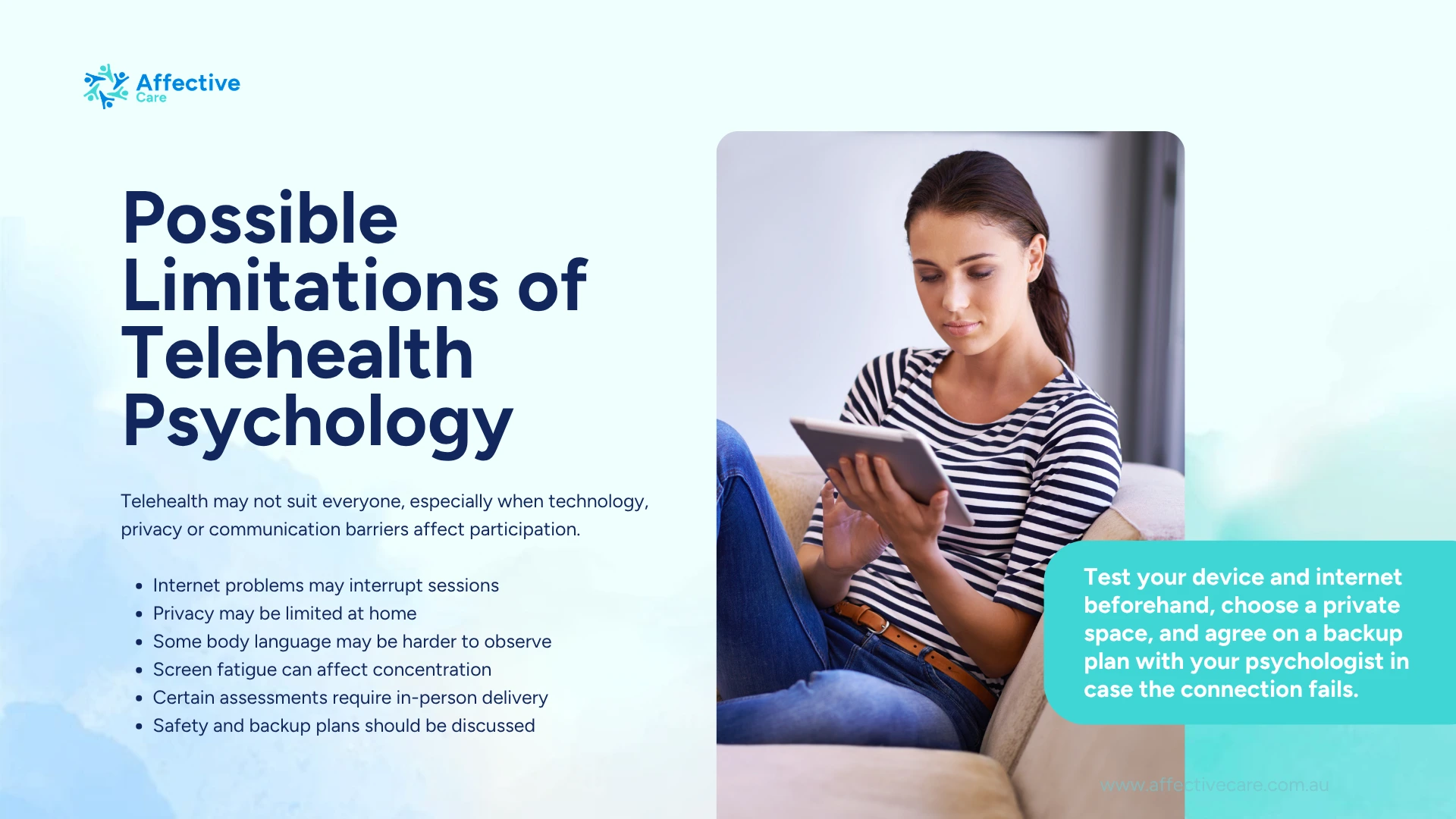
Possible Limitations of Telehealth Psychology
Although Telehealth psychology can improve accessibility, it may also create barriers.
Technology difficulties
Poor internet, low-quality audio or device problems can interrupt communication. Repeated disruptions may make it difficult to discuss sensitive topics or complete structured activities.
The client and psychologist should agree on a backup plan. This may include reconnecting, using a telephone or rescheduling the appointment.
Limited privacy
A person may not have a private room at home. Family members, housemates or support staff may be nearby.
This can affect what the person feels comfortable discussing. Face-to-face psychology may be more appropriate when a confidential home environment is not available.
Headphones, closed doors and scheduling appointments when others are away may help, but these options are not practical for everyone.
Reduced physical observation
The psychologist may see facial expressions and upper-body movements through video, but other physical responses may be outside the camera frame.
The person’s movements, posture or reactions to the environment may not be fully visible.
This can matter when behaviour and non-verbal communication are important parts of the assessment or therapy.
Screen fatigue
Some people find video appointments tiring. Maintaining eye contact with a screen, processing audio and managing technology can affect concentration.
The psychologist may use shorter sessions, movement breaks or visual resources. Face-to-face psychology may be considered when screen fatigue consistently affects engagement.
Assessment limitations
Some psychological assessments use standardised physical materials or require controlled conditions. These assessments may not be appropriate for remote delivery.
The psychologist should decide whether a particular assessment can be completed through Telehealth without affecting the validity of the results.
Safety considerations
The psychologist may need to confirm the client’s location and emergency contact details at the start of a Telehealth appointment.
This information can help the psychologist respond appropriately if a serious health or safety concern occurs during the session.
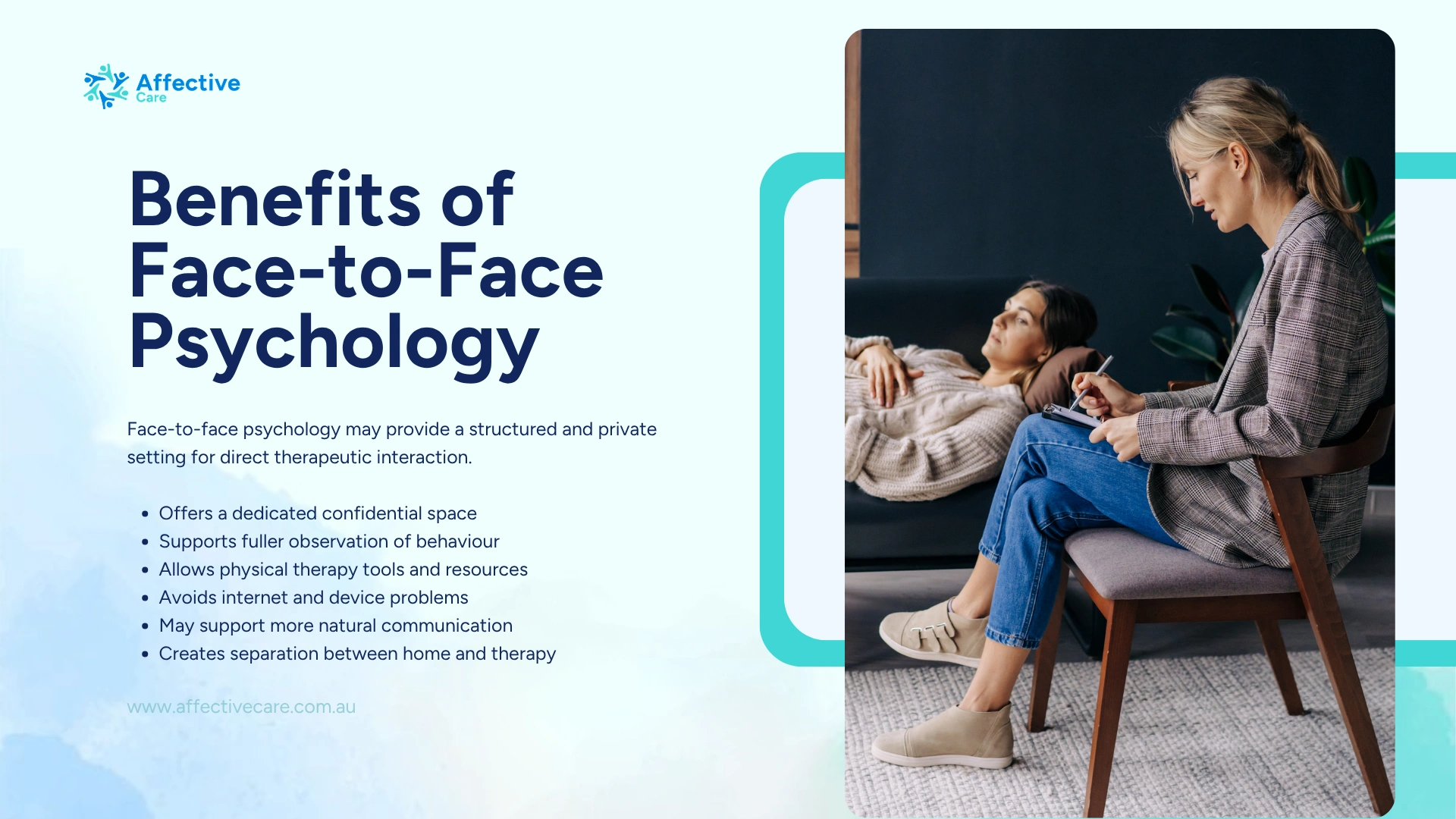
Benefits of Face-to-Face Psychology
Face-to-face psychology may provide a more suitable experience for people who value direct interaction and a dedicated therapy environment.
A private clinical environment
A psychology clinic generally offers a confidential room where the client can speak without being overheard.
This may be particularly important for people living with family, housemates or support workers.
More complete observation
An in-person psychologist may observe posture, movement, eye contact and broader non-verbal behaviour.
This can be useful when the person communicates through gestures or behaviour, or when the psychologist needs to understand reactions to physical activities and resources.
Use of physical materials
In-person psychology sessions may involve worksheets, games, cards, sensory resources or standardised assessment materials.
These can sometimes be easier to use when the psychologist and client are in the same room.
No internet requirement
Face-to-face psychology does not depend on internet speed, a working camera or confidence using video technology.
This may reduce stress for people who find online platforms difficult or inaccessible.
Direct communication
Some people find conversation more natural in person. Pauses, tone and non-verbal signals may be easier to interpret.
This is a personal preference rather than proof that in-person psychology is better for everyone.
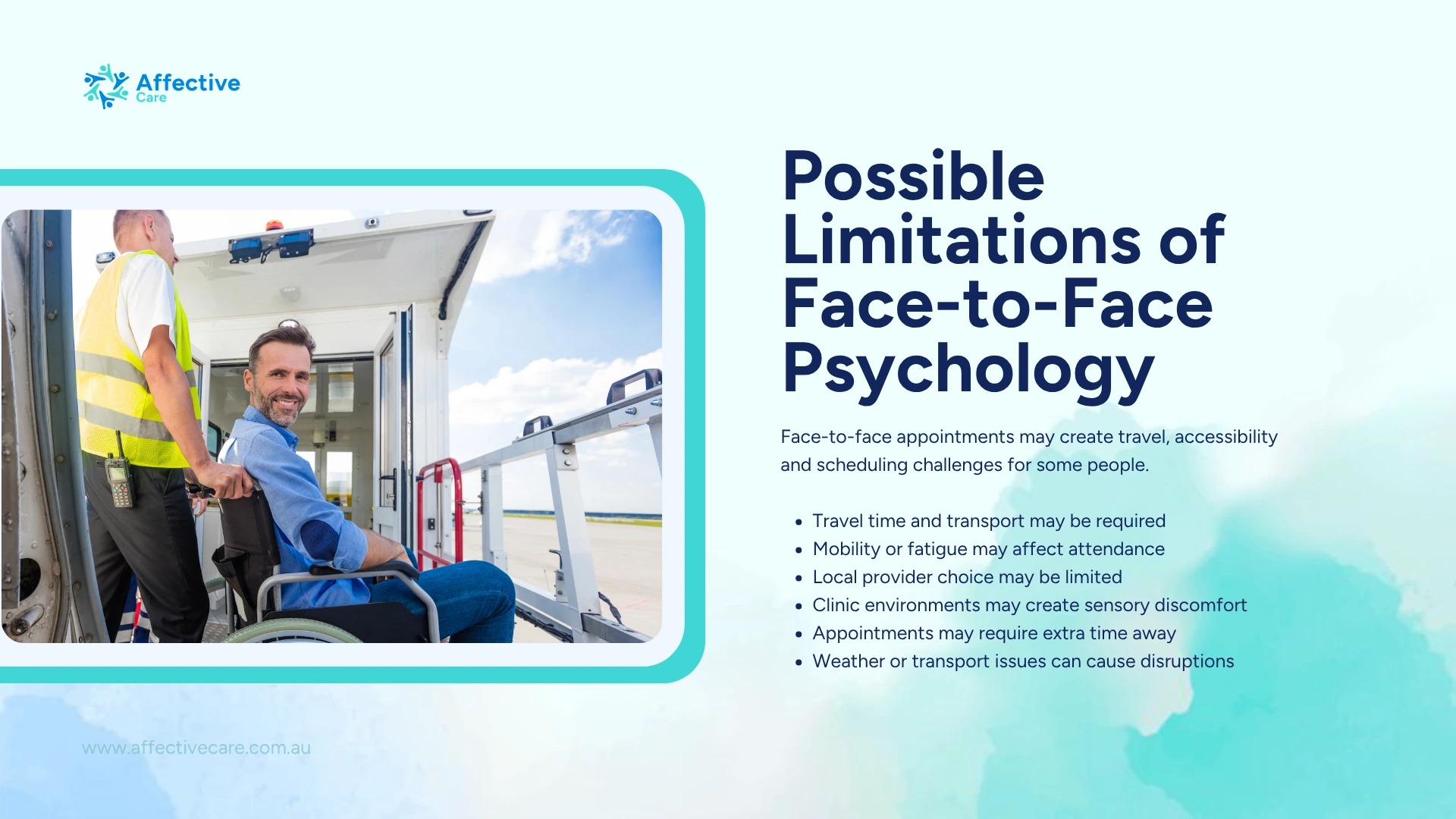
Possible Limitations of Face-to-Face Psychology
Face-to-face psychology may create practical barriers for people who have difficulty travelling or accessing a suitable clinic.
Travel time can be significant, especially when the psychologist is located outside the person’s local area. The client may also need to organise transport or support-worker assistance.
People living with physical disability, pain or fatigue may find that the journey affects their ability to participate during the appointment.
Clinic environments can also create sensory challenges. Bright lights, busy waiting rooms, unfamiliar sounds or changes in routine may affect some people before the session begins.
In-person psychology sessions may require time away from work, education or other services. A one-hour appointment can take several hours once travel and waiting time are included.
These limitations do not affect everyone. For some people, travelling to a clinic supports better focus and engagement.
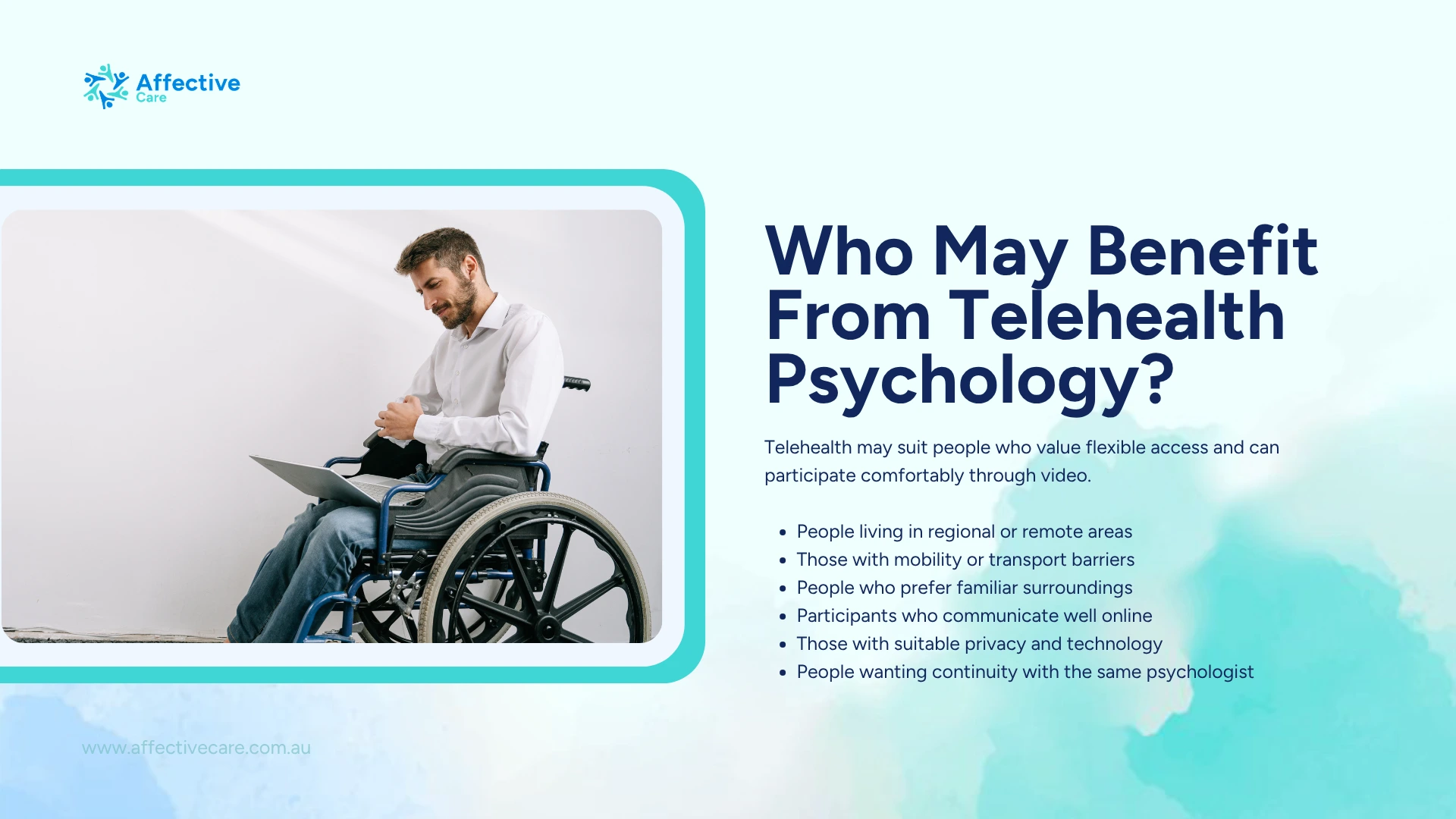
Who May Benefit From Telehealth Psychology?
Telehealth psychology may suit people who can communicate comfortably through video and have access to suitable privacy and technology.
It may be particularly helpful for people who:
- Live in regional or remote locations;
- Experience mobility or transport barriers;
- Become fatigued after travelling;
- Prefer attending from a familiar environment;
- Need greater location flexibility;
- Communicate effectively through video;
- Want to continue with the same psychologist after moving; or
- Need supporters to join from different locations.
For example, a participant living several hours from Sydney may want support from a psychologist experienced in psychosocial disability.
Regular travel may not be realistic, but Telehealth psychology could provide more consistent access.
These characteristics do not automatically make Telehealth suitable. The person’s communication needs, safety, therapy goals and comfort should still be reviewed.
Moreover, people considering remote support can also explore how to access Telehealth psychologists in Australia and what to consider when choosing an online provider.
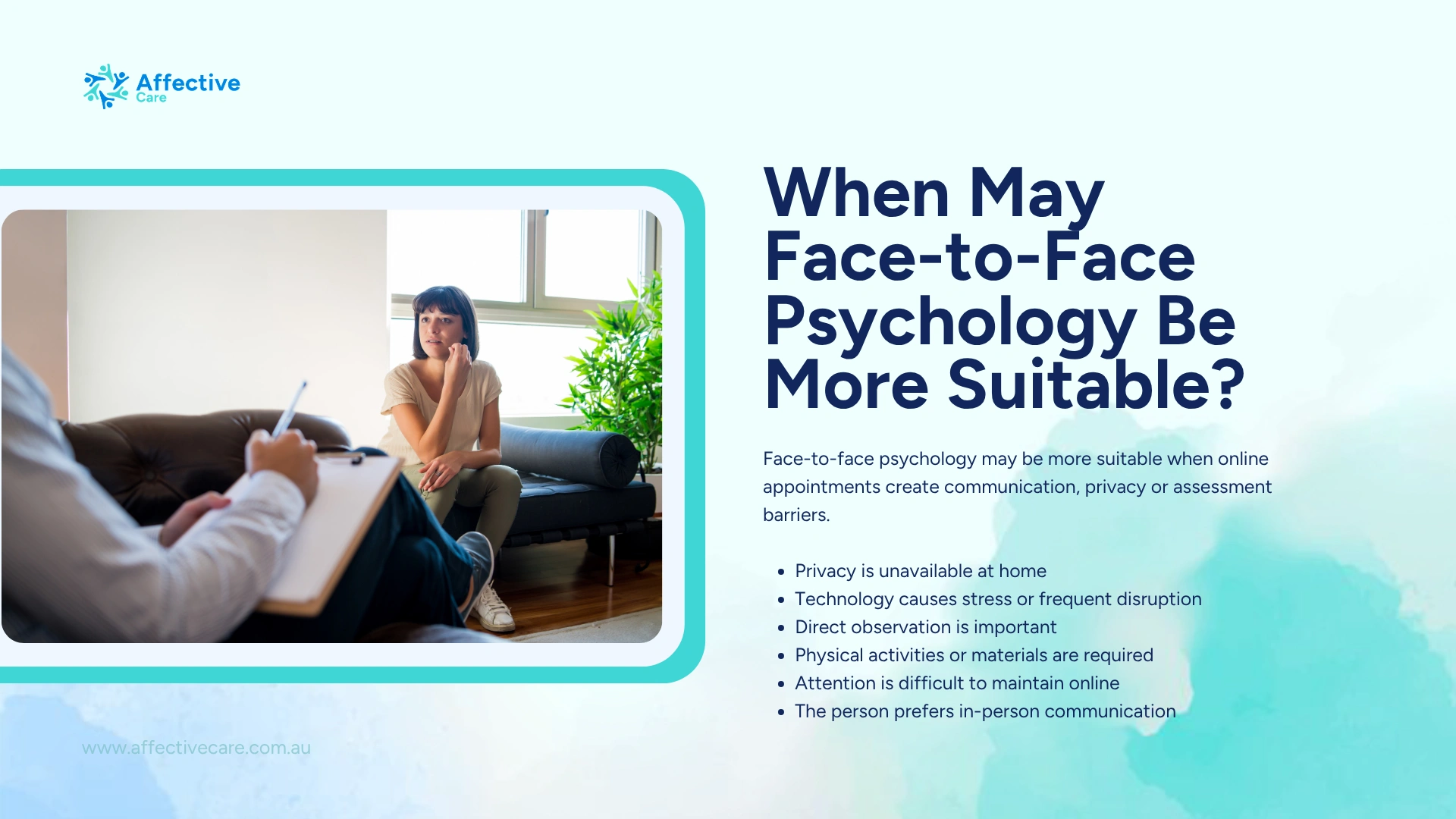
When May Face-to-Face Psychology Be More Suitable?
Face-to-face psychology may be more suitable when online communication creates significant barriers.
In-person psychology may be considered when:
- The person does not have a private space;
- Internet problems repeatedly disrupt communication;
- Video calls increase stress;
- Physical therapy resources are required;
- Broader behavioural observation is important;
- A psychological assessment requires face-to-face administration;
- The person has difficulty maintaining attention online;
- Risk or communication needs require direct support; or
- The person strongly prefers being in the same room as their psychologist.
For example, someone living in shared supported accommodation may not have a room where private conversations can occur.
Even with suitable technology, the person may not feel comfortable discussing personal concerns online.
A clinic appointment could provide the privacy needed for effective psychological therapy.
Complex needs do not always require in-person psychology. Some people with complex disabilities participate successfully through Telehealth when the service is planned carefully.
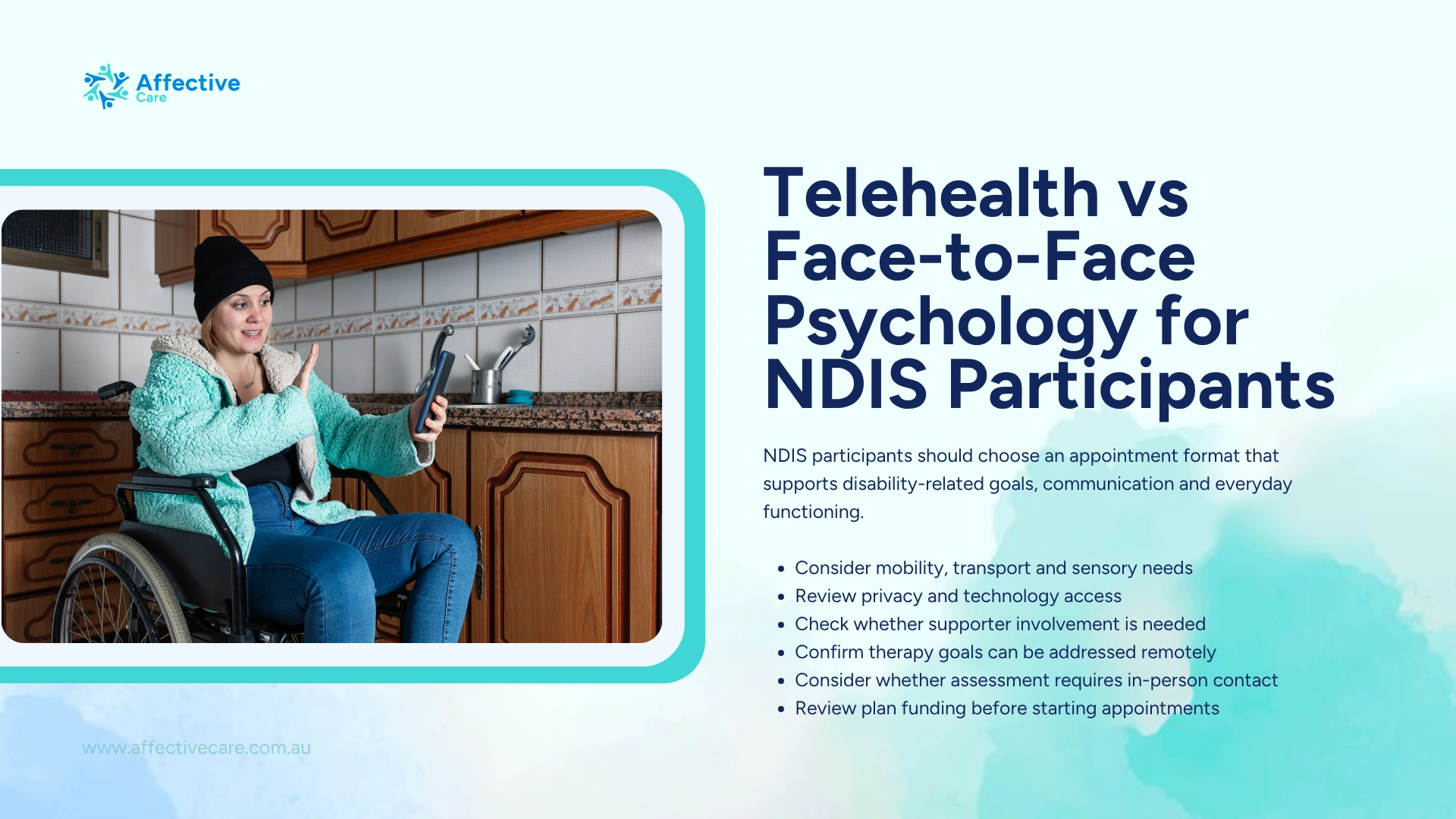
Telehealth vs Face-to-Face Psychology for NDIS Participants
The choice between Telehealth vs face-to-face psychology for NDIS participants should be linked to disability-related needs, NDIS goals and functional outcomes.
Psychology may help a participant build or maintain skills related to emotional regulation, communication, relationships, decision-making and community participation.
When considering Telehealth psychology NDIS services, participants and support teams should review:
- Communication and accessibility requirements;
- Technology and internet access;
- Privacy at home;
- The need for a support person;
- Whether therapy goals can be addressed remotely;
- How functional progress will be measured;
- Whether an assessment requires face-to-face contact; and
- How the service relates to the participant’s plan.
An NDIS participant may choose Telehealth psychology because travelling causes significant fatigue.
Another participant may prefer face-to-face psychology NDIS appointments because they communicate more effectively through physical activities and gestures.
The choice between online psychology vs in-person psychology should support the participant’s goals rather than create additional barriers.
Telehealth or face-to-face psychology may be included when psychology is an appropriate disability-related support and meets the participant’s plan and current NDIS requirements.
Funding should not be assumed simply because the service is delivered by a psychologist.
Participants should check their plan, available funding and service agreement before beginning regular appointments.
Psychology may also be accessed through mainstream health pathways in some circumstances. Our guide to Medicare rebates for psychology explains rebates, eligibility and potential out-of-pocket costs.
Can Psychological Assessments Be Completed Through Telehealth?
Some parts of a psychological assessment may be completed through Telehealth, while others require face-to-face administration.
Our guide to psychological assessments for the NDIS explains common assessment purposes, what may be involved and how reports can support functional evidence.
Online assessment components may include:
- Interviews with the client;
- Discussions with family members or supporters;
- Questionnaires;
- Review of existing reports;
- Observation through video; and
- Selected standardised measures.
Other assessments may require physical materials, controlled conditions or direct observation.
The psychologist should consider:
- The purpose of the assessment;
- The person’s communication needs;
- The reliability of the technology;
- Privacy and environmental conditions;
- Test administration requirements;
- The risk of another person influencing responses; and
- Whether the results will remain valid.
A blended approach may sometimes be suitable. Interviews may occur online, while specific testing tasks are completed face to face.
The psychologist should decide whether Telehealth vs face-to-face psychology is appropriate for the assessment rather than relying only on convenience.
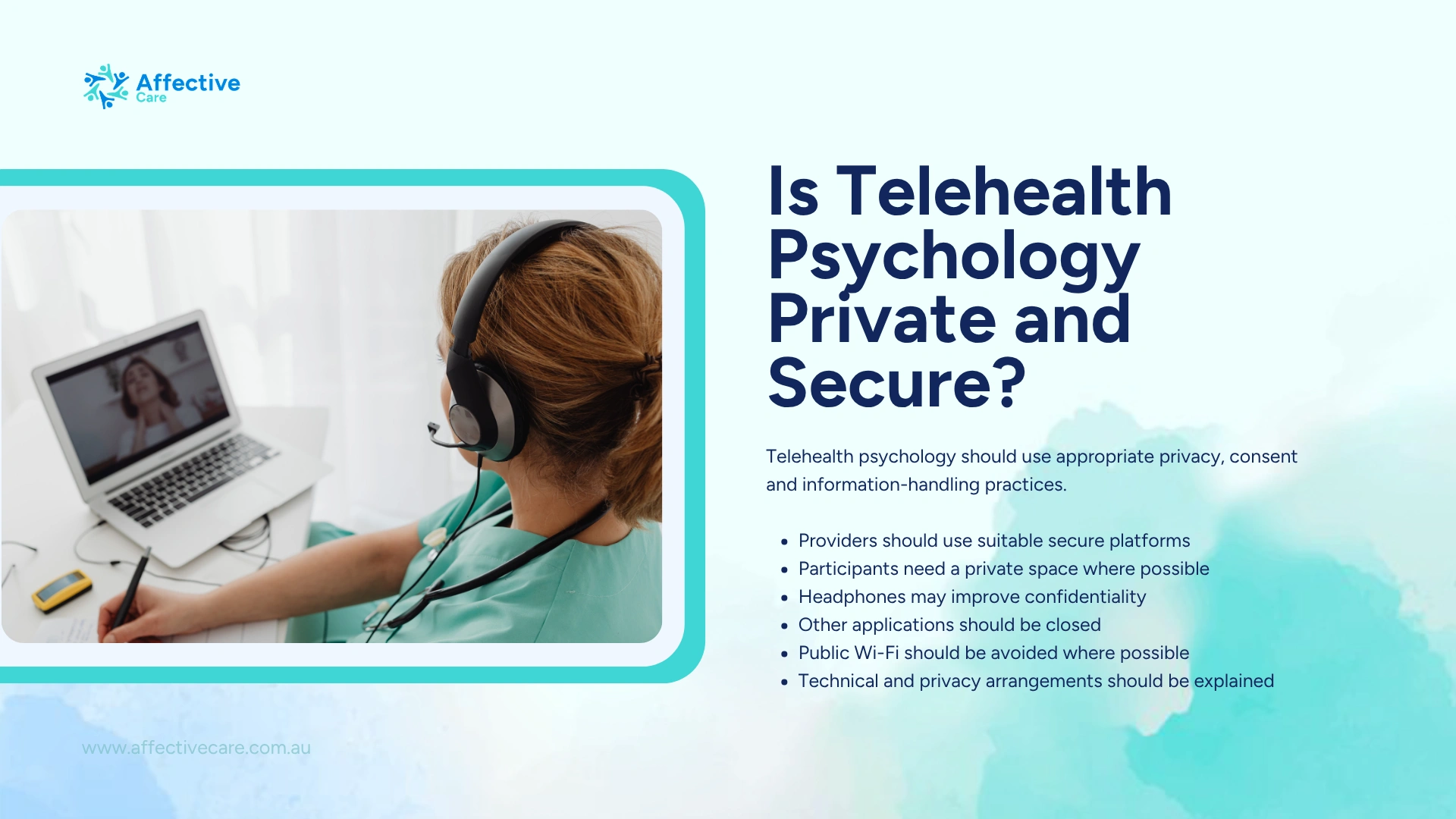
Is Telehealth Psychology Private and Secure?
Telehealth psychology should follow appropriate privacy, consent and information-handling practices. Privacy also depends on the client’s own environment.
Before sessions begin, the psychologist should explain which platform will be used and how personal information is managed.
They should also explain whether sessions are recorded, the limits of confidentiality and what happens if the connection fails. Clients should also know how urgent safety concerns will be handled.
Clients can support their own privacy by using a private room and wearing headphones where helpful.
They may also ask others not to interrupt during the session. Closing other applications and avoiding public Wi-Fi can provide added protection.
No online system should be described as completely risk-free.
Clients should feel comfortable asking how their personal information will be protected before starting Telehealth psychology services.
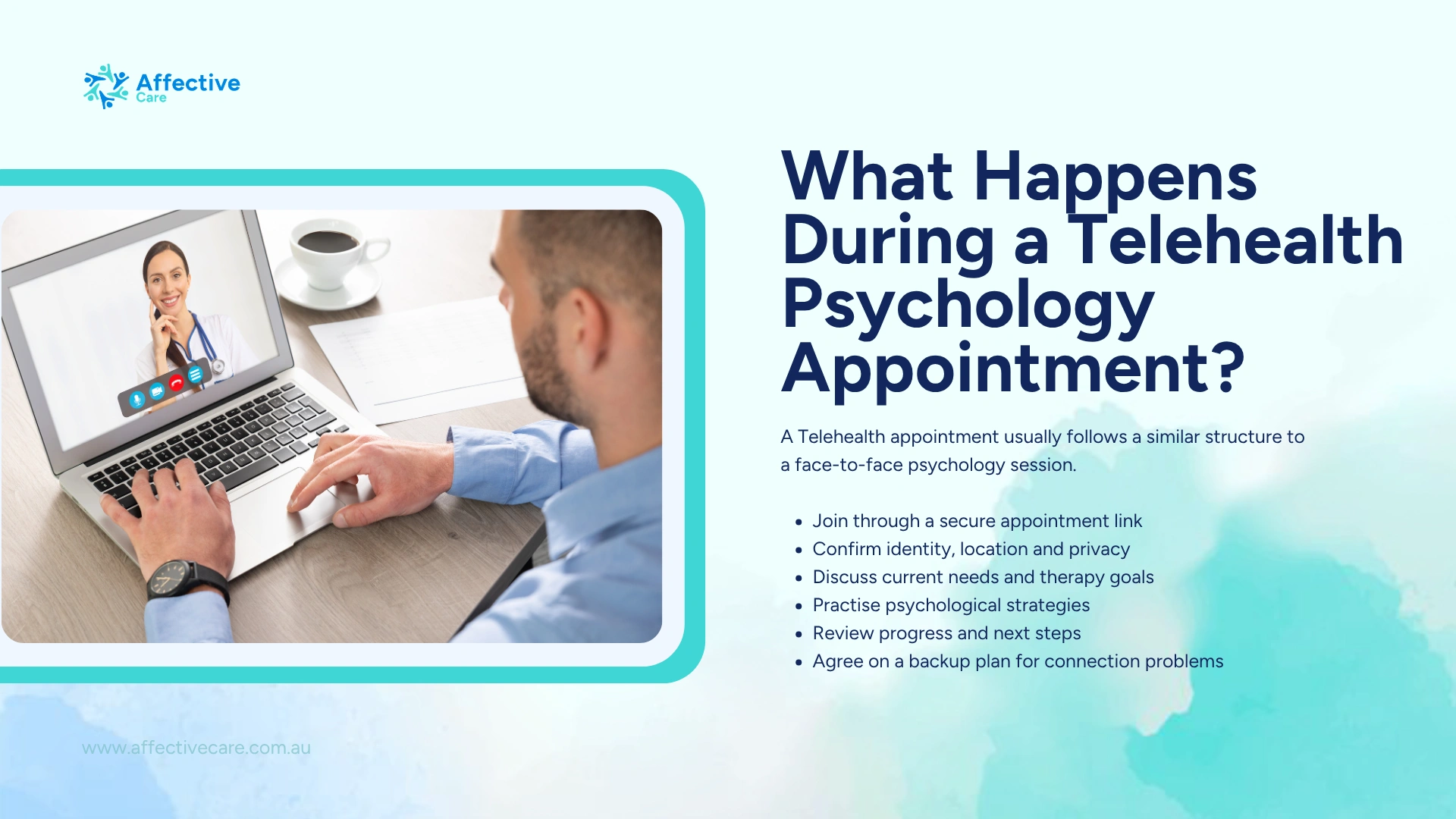
What Happens During a Telehealth Psychology Appointment?
A Telehealth psychology appointment usually follows a similar process to a face-to-face session.
Before the appointment, the client receives a secure video link or joining instructions. They may be asked to test their camera, microphone and internet connection.
At the beginning of the appointment, the psychologist may confirm:
- The client’s identity;
- Their current location;
- Privacy;
- Consent;
- Emergency contact information; and
- What will happen if the connection fails.
The main part of the appointment may involve discussing current concerns, reviewing goals, practising strategies and planning how the client can use those strategies in daily life.
A support person may join when the client wants their involvement and provides consent.
When Telehealth is not working well, the psychologist and client may discuss changing technology, shortening sessions or moving to face-to-face psychology.
If online appointments are new to you, our guide to how Telehealth psychology works explains preparation, session steps and what to expect from remote psychology support.
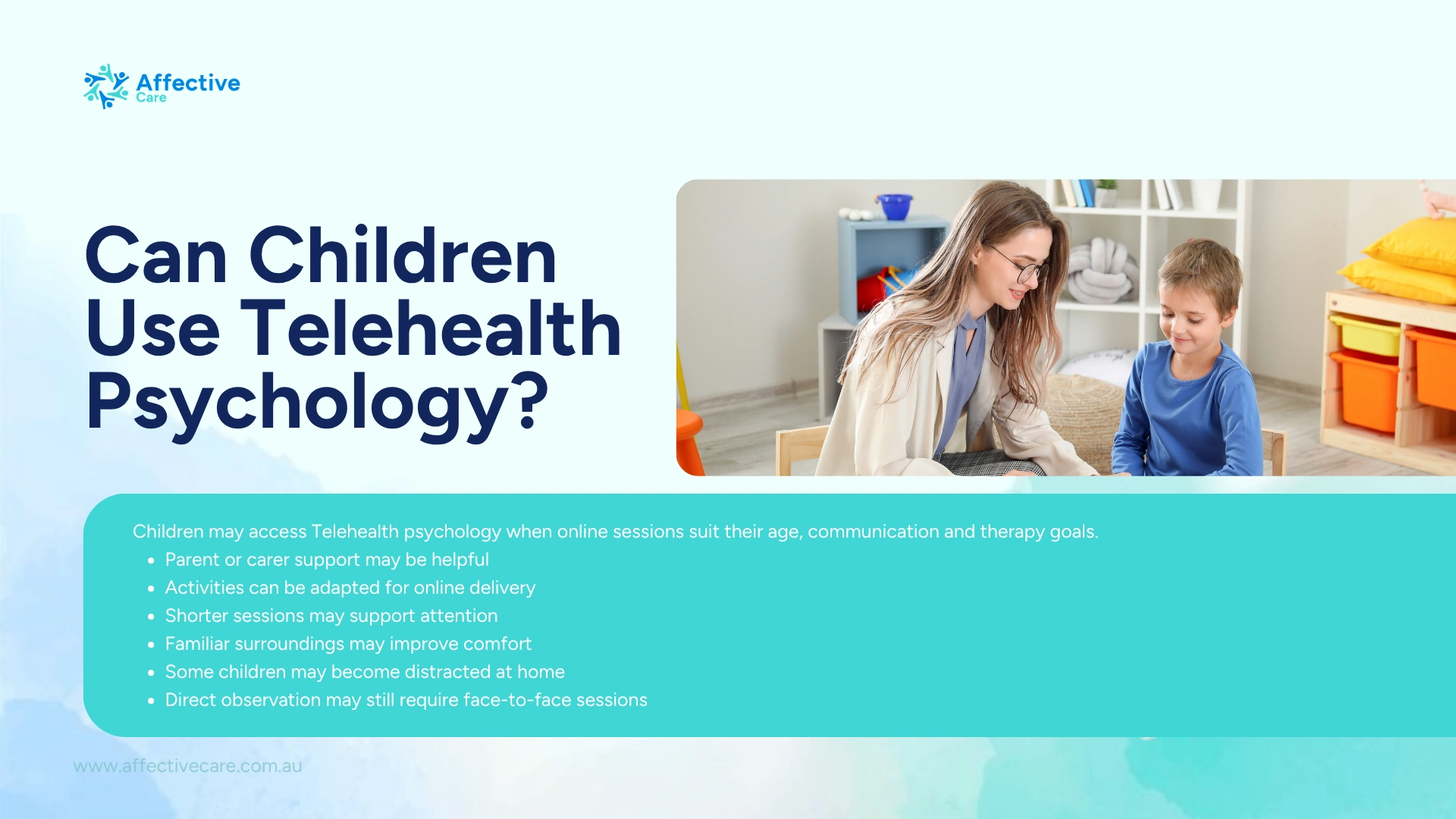
Can Children Use Telehealth Psychology?
Children may access Telehealth psychology when online delivery suits their age, developmental level, attention, communication and therapy goals.
Telehealth may work well for a child who is comfortable using video and benefits from attending from a familiar environment.
A parent or carer may help set up the device, prepare materials and support the child’s engagement. Parent participation may also be part of the therapy where clinically appropriate.
Telehealth may be less suitable when the child:
- Finds it difficult to remain near the screen;
- Becomes distracted by items at home;
- Needs physical play-based resources;
- Requires direct observation;
- Finds video communication difficult; or
- Strongly associates the device with games.
The psychologist may use shorter activities, visual supports and movement breaks.
Suitability should be based on the individual child rather than diagnosis alone.
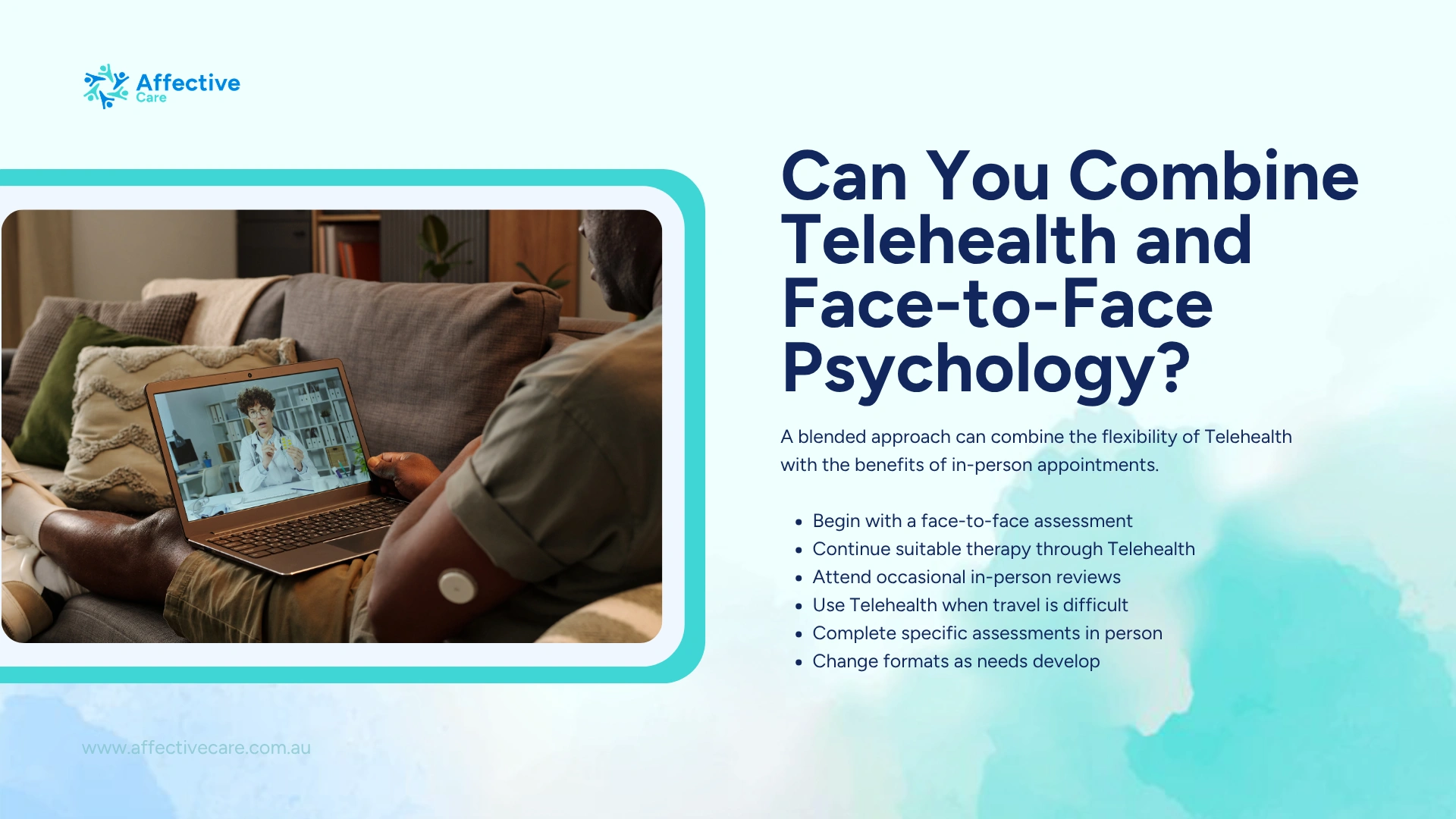
Can You Combine Telehealth and Face-to-Face Psychology?
Telehealth and face-to-face psychology can sometimes be combined in a blended approach. This allows the appointment format to change depending on the person’s needs.
For example, someone may attend an initial face-to-face assessment and then continue therapy through Telehealth. Others may have regular online appointments with occasional clinic reviews.
Telehealth may also be used when travel is difficult, while in-person sessions may be preferred for certain assessment activities.
A participant might attend the first session in person so the psychologist can better understand their communication and accessibility needs. Follow-up sessions could then take place online.
A blended approach can offer the benefits of both formats. It also gives people more flexibility as their circumstances, preferences or therapy needs change.
How to Choose Between Telehealth and Face-to-Face Psychology
Choosing between Telehealth vs face-to-face psychology begins with identifying the person’s therapy goals and practical needs.
Identify the intended outcome
Start with what the person wants to improve. Instead of saying, “I want support for anxiety,” consider a more specific goal:
I want to manage anxiety so I can attend community activities more regularly.
A clear goal makes it easier to decide whether remote or in-person psychology can support the desired outcome.
Discuss clinical suitability
Ask the psychologist whether the therapy or assessment can be delivered appropriately through Telehealth.
Some interventions transfer easily to video, while others require physical materials or direct observation.
Consider Accessibility
Review mobility, travel, fatigue, sensory needs and communication preferences.
Telehealth may reduce transport barriers but introduce screen-related difficulties.
Face-to-face psychology may support direct interaction but require more physical preparation.
Check technology and privacy
For online psychology, confirm access to:
- A working device;
- Reliable internet;
- A private room;
- Accessible audio and video;
- A backup contact method; and
- Support to use the technology where needed.
Consider personal preference
Some people communicate more openly online. Others feel disconnected when speaking through a screen.
The comparison between online psychology vs in-person psychology should include how comfortable and engaged the person feels in each format.
If you decide Telehealth may suit you, our guide to choosing the right NDIS online psychologist covers experience, communication, accessibility and provider fit.
Discuss a blended approach
The decision does not need to be permanent. Ask whether the provider offers both online and in-person psychology and whether formats can be changed.
Questions to Ask Before Choosing an Appointment Format
Before choosing online or in-person psychology, ask the provider:
- Is Telehealth suitable for my therapy goals?
- Can the required assessment be completed online?
- Which platform will be used?
- What happens if the connection fails?
- How will privacy be protected?
- Can a support person attend?
- Are the fees different between formats?
- Can I switch formats later?
- How will progress be measured?
- Where are face-to-face appointments available?
If appointment availability is important, learn more about same-day psychology appointments and the options that may be available when earlier support is needed.
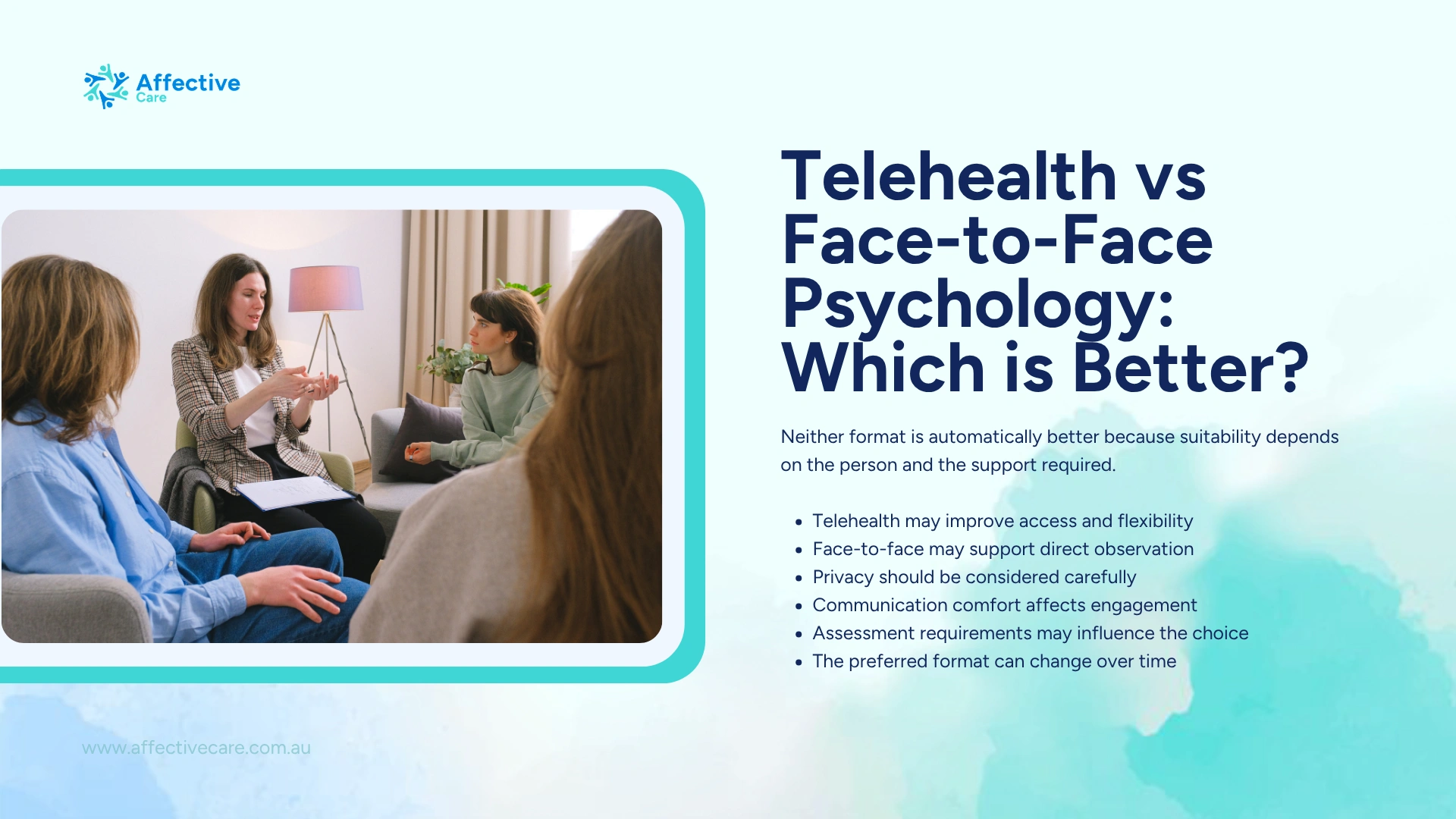
Telehealth vs Face-to-Face Psychology: Which is Better?
Neither format is automatically better when comparing Telehealth vs face-to-face psychology.
Telehealth psychology may be better for someone who experiences travel barriers, lives outside a metropolitan area or prefers attending from home.
Face-to-face psychology may be better for someone who needs a confidential clinic environment, finds video communication difficult or requires an assessment involving physical resources.
The benefits of online psychology vs in-person psychology depend on the person’s clinical needs, communication style, privacy, accessibility and preferences.
The better format is the one that supports safety, clear communication and meaningful engagement. It should also allow for appropriate assessment, accessibility and privacy.
Most importantly, it should help the person make progress towards their therapy goals.
The best option can change over time. For example, someone may use Telehealth during a period of reduced mobility and later return to face-to-face psychology sessions when circumstances change.
How Affective Care Supports Your Psychology Journey
Affective Care provides flexible psychology support based on each person’s goals, communication needs and preferred appointment format.
Face-to-face psychology is available in Sydney, while Telehealth psychology may be available across Australia where suitable.
Our psychologists support children and adults with emotional regulation, coping, confidence, communication, relationships and everyday functioning.
With consent, they may also work with families, carers, support coordinators and other professionals.
Whether you prefer Telehealth, face-to-face or a blended approach, our team can discuss your needs and help you choose psychology support that fits your circumstances.
Affective Care provides flexible psychology services based on individual goals, communication needs and preferred appointment format.

Choose Psychology Support That Fits Your Needs
Affective Care supports people considering Telehealth vs face-to-face psychology, with face-to-face psychology appointments available in Sydney and Telehealth psychology available across Australia where clinically suitable.
Our psychologists can discuss therapy goals, communication preferences, accessibility needs and the most appropriate appointment format.
Support may also involve families, carers, support coordinators and other professionals where suitable and with the participant’s consent.
Speak with our team about Telehealth, face-to-face or blended psychology appointments.
Information reviewed: July 2026.
This article provides general information and does not determine whether Telehealth or face-to-face psychology is suitable for a particular person.
Clinical suitability should be discussed with a qualified psychologist. NDIS participants should also review their current plan and funding arrangements before beginning ongoing services.