



Accessing psychology support does not always require travelling to a clinic. Telehealth psychology allows people to speak with a psychologist through a secure video or telephone appointment from home or another suitable location.
For NDIS participants, telehealth may make psychology support easier to access when distance, mobility, transport, health, sensory needs or limited local services create barriers to attending in-person appointments.
It can also provide greater flexibility for families, carers and support coordinators arranging services around other commitments.
However, telehealth psychology is not simply an ordinary video call.
It involves a structured process that includes intake, consent, assessment, goal setting, privacy arrangements and ongoing review.
This guide explains how telehealth psychology works, what happens during a telehealth psychology appointment, how NDIS funding may apply and how participants can prepare for online psychology sessions.

What Is Telehealth Psychology?
Telehealth psychology is the delivery of psychological services through digital communication technology.
Most appointments take place through secure video conferencing, although telephone sessions may sometimes be used when clinically appropriate.
Telehealth is a method of delivering psychology support rather than a separate form of psychology.
A psychologist should still follow the same professional, ethical, privacy and clinical responsibilities that apply to in-person services.
A telehealth psychologist may provide support through:
- Secure video appointments
- Telephone consultations where appropriate
- Online psychological assessments
- Digital worksheets and therapy resources
- Parent or carer consultations
- Progress reviews
- Capacity-building sessions
- Collaboration with other members of a participant’s support team
- Reports related to functional needs and agreed support goals
Registered psychologists providing virtual care remain responsible for delivering safe and appropriate services in line with professional standards.
The Psychology Board of Australia advises that virtual care should meet the same expectations for safe, effective and professional practice as other forms of service delivery.
Telehealth psychology services may be suitable for adults, children, families and people living with disability.
The format of each appointment should be adapted to the participant’s communication style, preferences, goals and level of support.
How Does Telehealth Psychology Work?
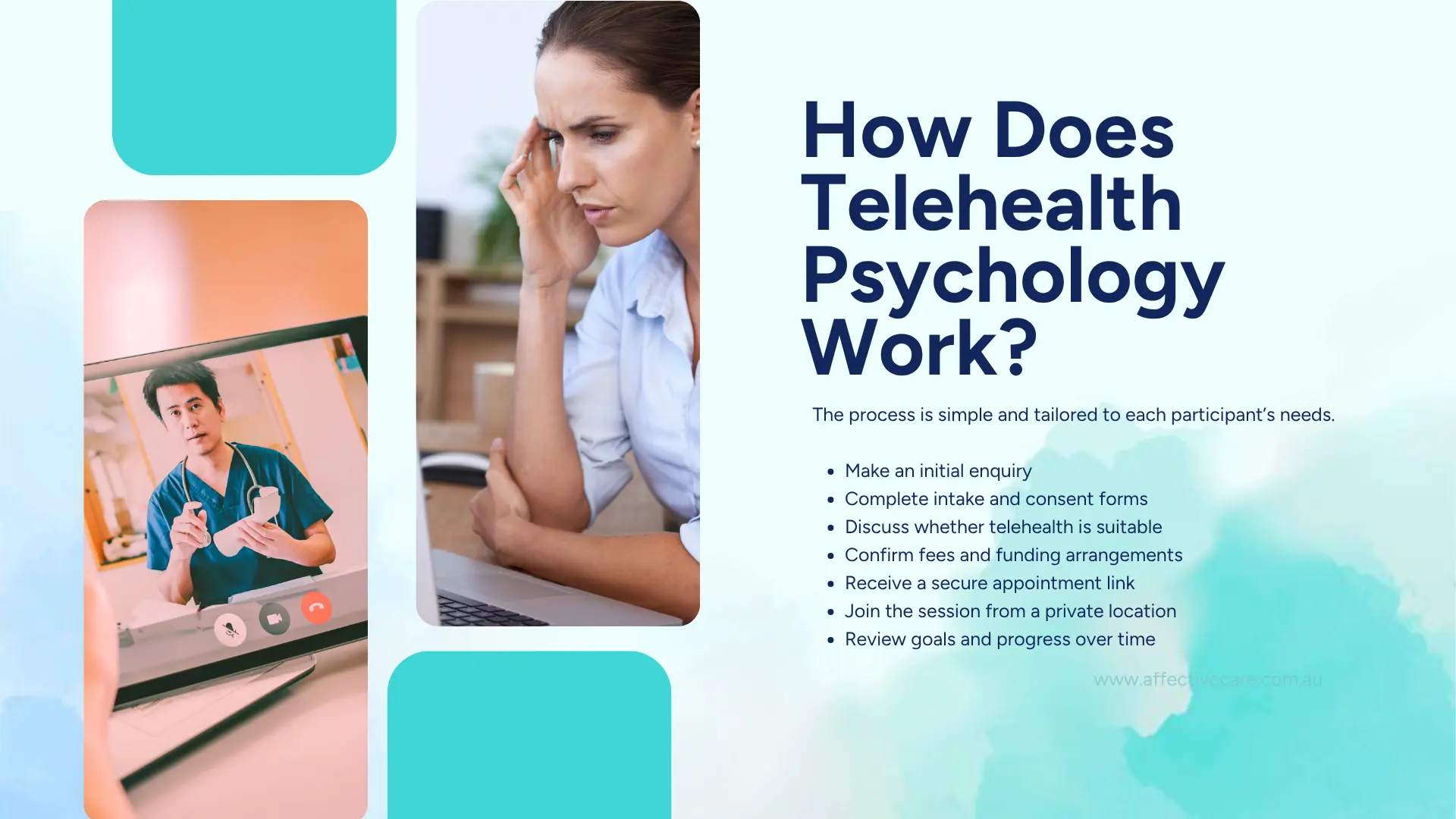
Understanding how telehealth psychology works can help participants feel more prepared before their first online psychology appointment.
Although the exact process varies between providers, telehealth psychology generally follows several clear stages.
Step 1: Making an Enquiry
The first step is contacting a psychology provider. An enquiry may be made by:
- The participant
- A parent or carer
- A nominee or guardian
- A support coordinator
- An allied health professional
- Another person acting with the participant’s consent
During the initial enquiry, the provider may ask for general information about the person seeking support.
This could include:
- The participant’s name and age
- Their preferred method of communication
- The reason psychology support is being requested
- Disability-related needs and goals
- Preferred appointment days and times
- Whether the participant has an NDIS plan
- How the plan is managed
- Any accessibility or interpreter requirements
- Whether a support person may attend
- Any immediate safety concerns
Step 2: Completing the Intake Process
The participant may then be asked to complete an intake form.
The intake process gives the psychologist a clearer understanding of the participant’s circumstances, strengths, current concerns and support goals.
It may also help identify any practical changes needed to make the telehealth psychology appointment more accessible.
Intake documents may ask about:
- Current living arrangements
- Relevant diagnoses or disability information
- Communication needs
- Current services and supports
- Medications where clinically relevant
- Previous psychology support
- Cultural or language preferences
- NDIS goals
- Emergency contact details
- Consent to collect and store information
Participants should only be asked to provide information that is reasonably relevant to the service.
Step 3: Assessing Whether Telehealth Is Suitable
Telehealth psychology can be helpful for many people, but it may not be suitable in every situation.
Before beginning, the psychologist may consider:
- Whether the participant can communicate comfortably by video or telephone
- Whether they have access to an appropriate device
- Whether the internet connection is reliable
- Whether the participant has a private place for appointments
- Whether sensory or cognitive needs can be accommodated
- Whether a support person needs to be present
- Whether the participant can engage safely through telehealth
- Whether an in-person assessment is needed
- Whether there are immediate risks that require a different service
Suitability should be reviewed throughout the support relationship.
A participant may begin with telehealth and later decide that in-person sessions are more appropriate, or they may use a combination of both formats.
Step 4: Agreeing on Services, Fees and Consent
Before the first appointment, the provider should explain important service information.
This may include:
- The type of psychology support being offered
- Appointment length
- Fees and payment arrangements
- NDIS claiming arrangements
- Cancellation terms
- Privacy and confidentiality
- Limits to confidentiality
- Report-writing fees
- How information may be shared
- What happens if technology fails
- How emergencies will be managed
- Whether family members or support workers can attend
NDIS participants may also receive a service agreement outlining the responsibilities of the participant and provider.
The participant should have an opportunity to ask questions before agreeing to the service.
Step 5: Receiving the Appointment Link
After booking, the provider will usually send:
- The appointment date and time
- A secure video link
- Instructions for joining
- Contact details for technical difficulties
- Any documents needed before the session
- Information about cancellation or rescheduling
Participants should avoid sharing the appointment link with anyone who has not been invited to attend.
Step 6: Joining the Telehealth Psychology Appointment
On the day of the appointment, the participant clicks the secure link from a smartphone, tablet or computer.
The psychologist may begin by confirming:
- The participant’s identity
- Their current location
- Whether they are in a private place
- Who else is present
- Whether they consent to continuing
- What to do if the connection fails
- Emergency contact details where relevant
The psychologist may then discuss the participant’s needs, strengths, goals and current concerns.
Step 7: Developing a Support Plan
After gathering enough information, the psychologist may work with the participant to identify appropriate goals and strategies.
The support plan may focus on areas such as:
- Emotional regulation
- Communication
- Daily routines
- Decision-making
- Social participation
- Confidence and independence
- Coping with disability-related challenges
- Relationships
- Community participation
- Understanding thoughts, feelings and behaviour
Step 8: Reviewing Progress
Telehealth psychology is generally an ongoing and collaborative process.
During later sessions, the psychologist may:
- Review what has changed
- Discuss strategies that have been helpful
- Adjust goals
- Address new barriers
- Practise skills
- Provide resources
- Collaborate with family or support professionals with consent
- Discuss whether telehealth remains suitable
This ongoing review is an important part of how telehealth psychology works.
People considering online or face-to-face support can explore the different psychology services available across Australia to understand which delivery option may best suit their needs.
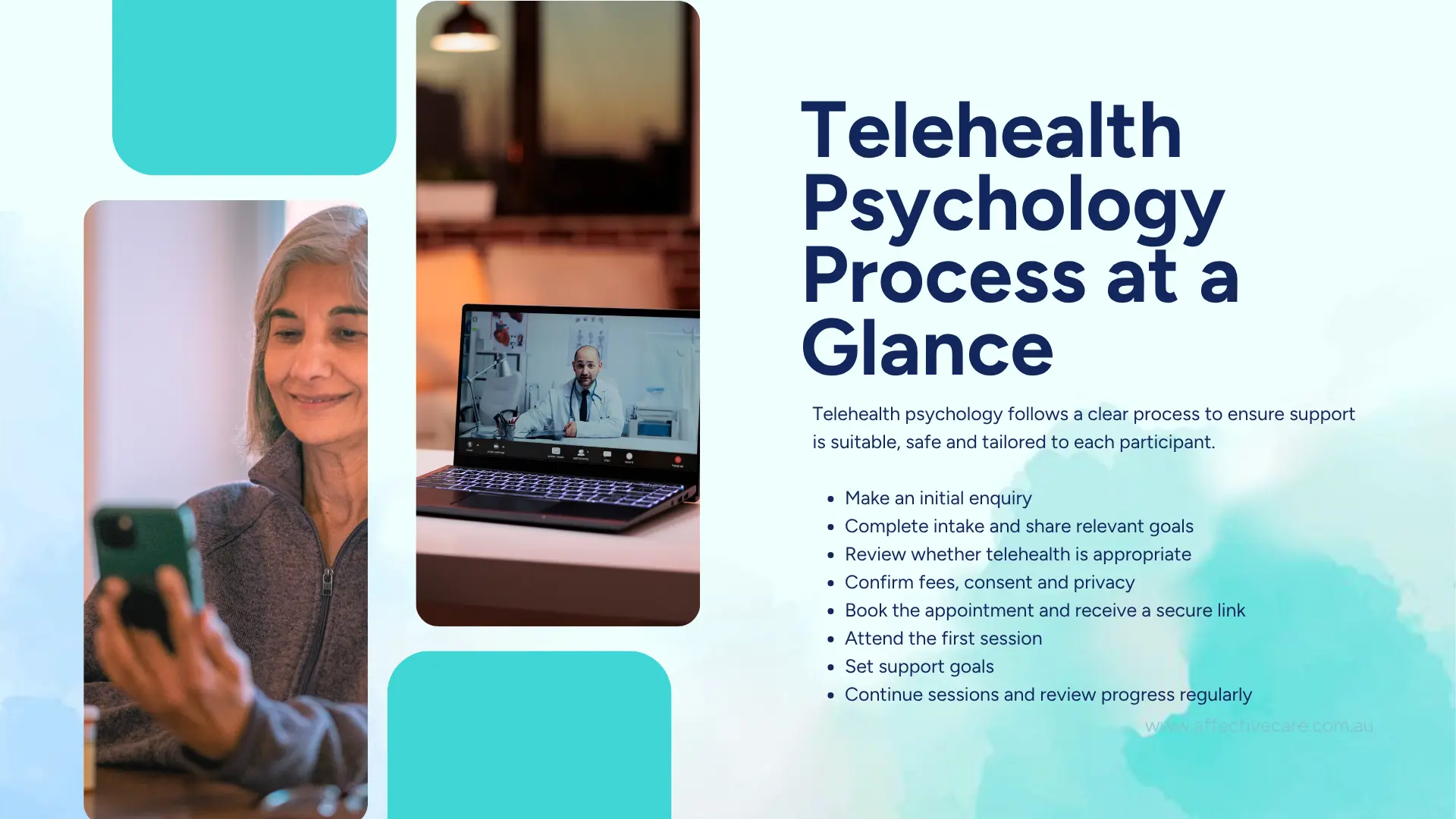
Telehealth Psychology Process at a Glance
|
Stage |
What usually happens |
|
Initial enquiry |
The participant, family or support coordinator contacts the provider |
|
Intake |
Relevant information, goals and communication needs are collected |
|
Suitability review |
The provider considers whether telehealth is safe and appropriate |
|
Service agreement |
Fees, consent, privacy and service conditions are explained |
|
Appointment booking |
A date, time and secure link are provided |
|
First session |
The psychologist learns about the participant’s strengths and needs |
|
Goal setting |
The participant and psychologist agree on areas of support |
|
Ongoing sessions |
Strategies are practised and progress is reviewed |
|
Review |
The approach, goals and suitability of telehealth are reassessed |
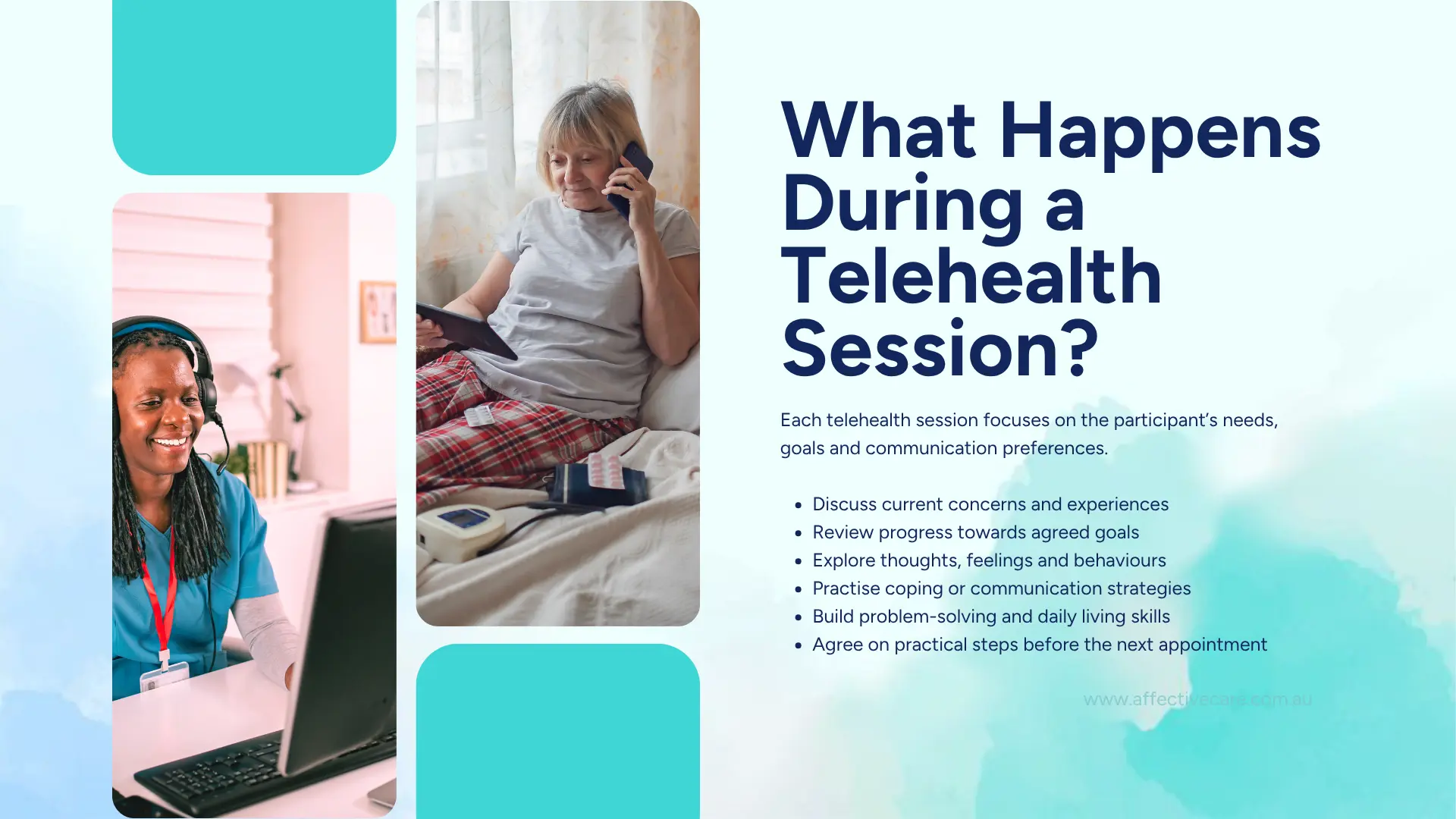
What Happens During a Telehealth Psychology Appointment?
A telehealth psychology appointment is usually similar in purpose to an in-person psychology session, but it takes place through secure technology.
There is no single structure that applies to every person. Sessions should reflect the participant’s age, communication needs, disability, goals and preferences.
A typical session may include:
- Checking how the participant has been feeling
- Discussing recent experiences
- Reviewing progress towards agreed goals
- Exploring thoughts, feelings or behaviours
- Identifying barriers affecting daily life
- Practising emotional regulation strategies
- Developing communication or social skills
- Working on problem-solving and decision-making
- Discussing routines at home, work or in the community
- Planning actions before the next appointment
Some participants prefer to speak for most of the session. Others may use:
- Visual prompts
- Written messages
- Communication devices
- Drawings
- Worksheets
- Games
- Short activities
- Support from a trusted person
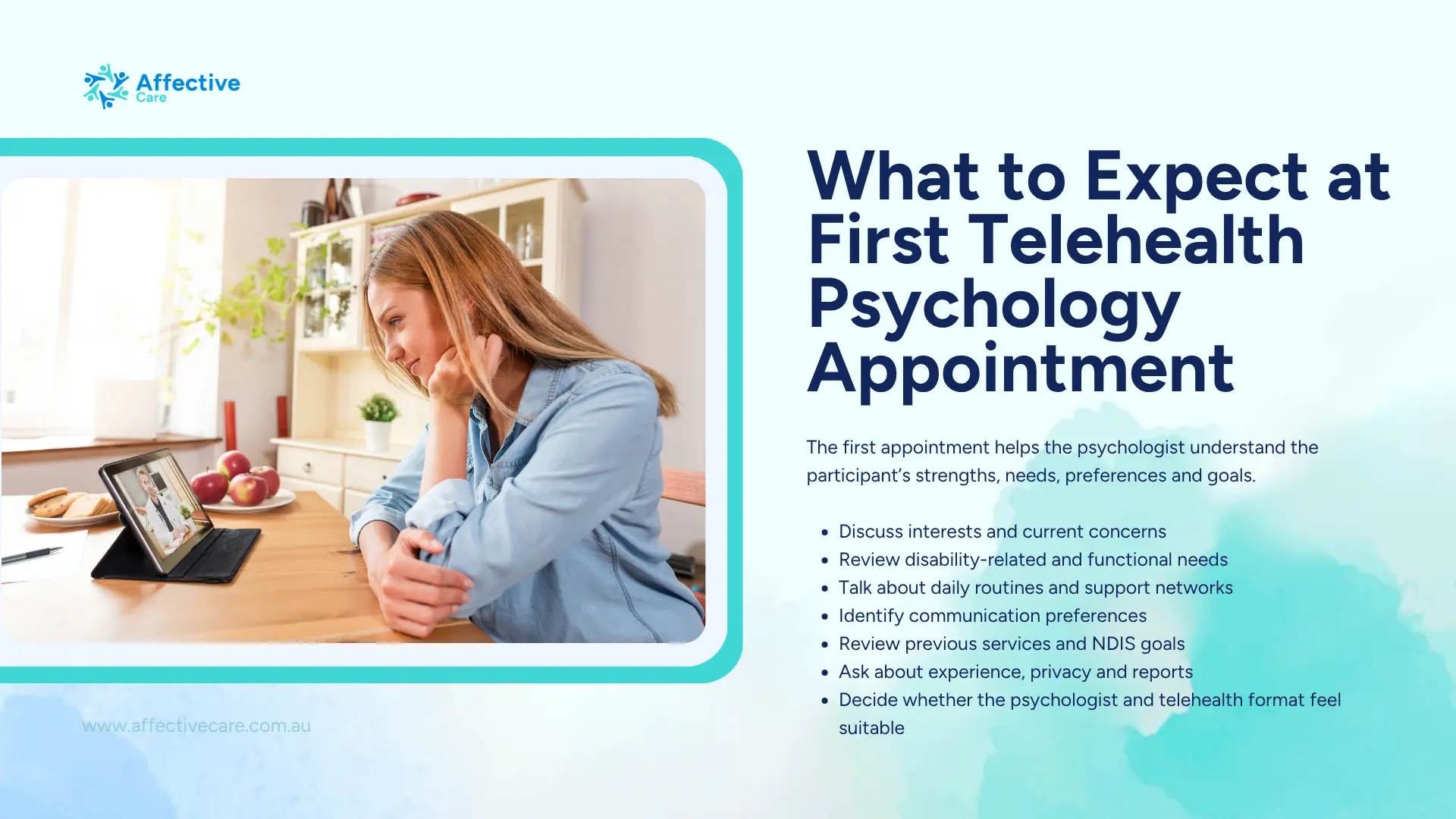
What to Expect at the First Telehealth Psychology Appointment
The first appointment often focuses on understanding the participant rather than immediately beginning a detailed intervention.
The psychologist may ask about:
- The participant’s strengths and interests
- Their current concerns
- Their disability and functional needs
- Daily routines
- Communication preferences
- Relationships and support networks
- Previous services
- Current NDIS goals
- What the participant would like to change
- What a positive outcome would look like
The participant may also ask questions about the psychologist’s experience and approach.
Useful questions include:
- Have you supported people with similar needs?
- How will the sessions relate to my goals?
- How often do you recommend appointments?
- Can a family member or support worker attend?
- How will progress be reviewed?
- Do you provide reports?
- What happens if telehealth is not suitable for me?
- How do you protect my privacy?
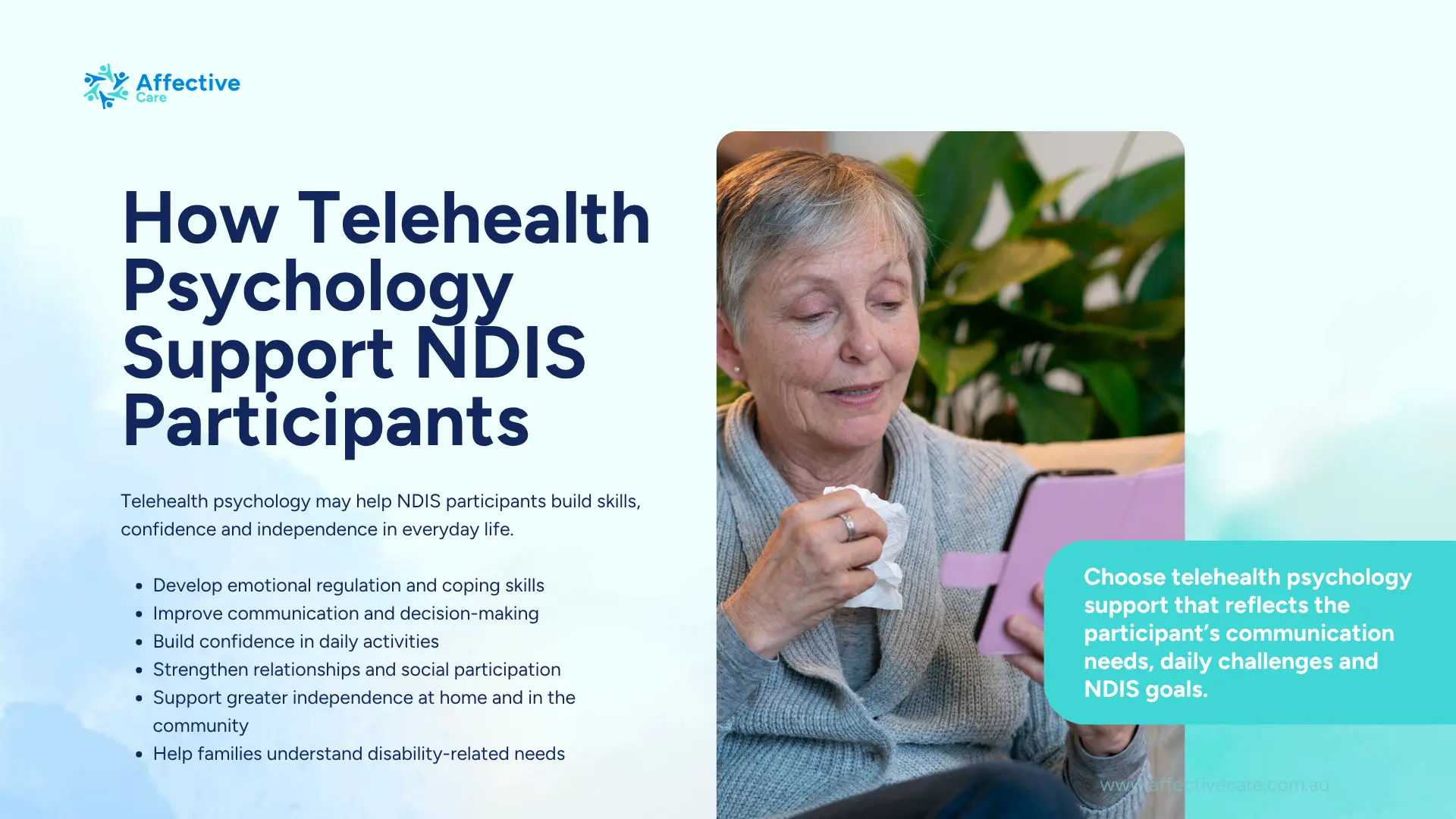
How Telehealth Psychology May Support NDIS Participants
Telehealth psychology for NDIS participants should generally focus on disability-related needs, everyday functioning, skills and independence.
NDIS therapy supports are intended to help participants build or maintain skills and independence in everyday life.
These supports may relate to communication, interpersonal interactions, decision-making, personal care, community living, education or work participation.
Depending on the participant’s needs and approved plan, NDIS telehealth psychology may support goals such as:
- Developing emotional regulation skills
- Improving communication
- Building confidence in everyday activities
- Strengthening decision-making skills
- Improving social inclusion and community participation
- Developing coping strategies
- Understanding disability-related emotions and behaviours
- Adjusting to changes in functional capacity
- Increasing independence at home
- Building skills for relationships
- Participating more confidently in the community
- Supporting parents or carers to understand disability-related needs
For example, a participant may work with a psychologist to develop strategies for managing emotions during changes in routine.
Another participant may focus on building confidence when communicating with support workers or joining community activities.
NDIS-funded psychology should be connected to the participant’s disability-related support needs and goals. It is not automatically available for every mental health concern.

Can the NDIS Fund Telehealth Psychology?
The NDIS may fund telehealth psychology when the support meets applicable NDIS requirements and is included within the participant’s available funding.
Whether a service can be funded may depend on:
- The participant’s approved plan
- The type of funding available
- Whether psychology is an NDIS support
- How the service relates to the participant’s disability
- Whether it supports the participant’s goals
- Whether it helps build or maintain functional capacity
- Whether the service offers value for money
- Whether another service system is responsible for providing the support
The NDIS publishes lists explaining what can and cannot generally be purchased with NDIS funding.
Participants should confirm that a proposed psychology service is an appropriate use of their plan before beginning.
NDIS therapy services are commonly associated with capacity-building outcomes because they are intended to build skills and independence.
However, the wording and structure of individual plans can vary.
Participants can check their funding with:
- Their plan manager
- Their support coordinator
- Their my NDIS contact
- The psychology provider
- The NDIA
If you plan to use NDIS funding for online sessions, read our guide to telehealth psychology under the NDIS for a clearer understanding of funding and eligibility considerations.
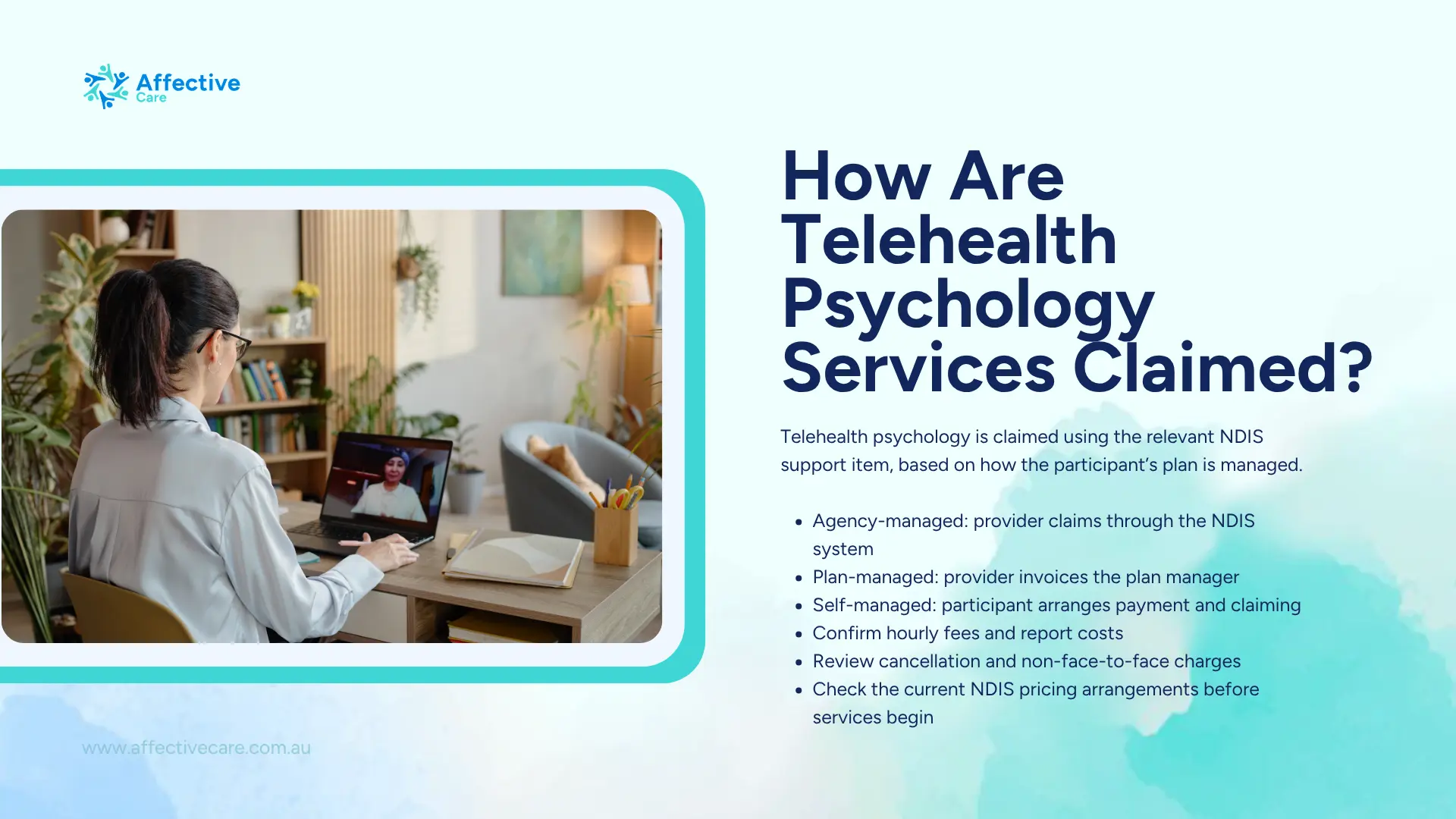
How Are Telehealth Psychology Services Claimed Through the NDIS?
Telehealth is a method of delivering a support rather than a separate support category.
Under NDIS pricing arrangement guidance, telehealth claims are generally submitted using the relevant support item and the applicable telehealth claim type.
The current support catalogue should be checked because it identifies available support items, prices and permitted claim types.
The way payment is handled may depend on how the participant’s plan is managed.
|
Plan management type |
Typical payment process |
|
Agency managed |
The provider generally claims through the NDIS payment system |
|
Plan managed |
The provider generally sends an invoice to the participant’s plan manager |
|
Self-managed |
The participant generally pays or arranges payment and claims according to NDIS requirements |
Participants should confirm:
- The hourly fee
- Whether the fee is within applicable pricing requirements
- Whether reports are charged separately
- The cancellation policy
- Whether non-face-to-face work may be charged
- Whether the service agreement covers telehealth
- Which support item will be used
The NDIS pricing schedule and support catalogue may change, so current documents should be reviewed before services are claimed.
The 2026–27 NDIS pricing schedule became effective on 1 July 2026.
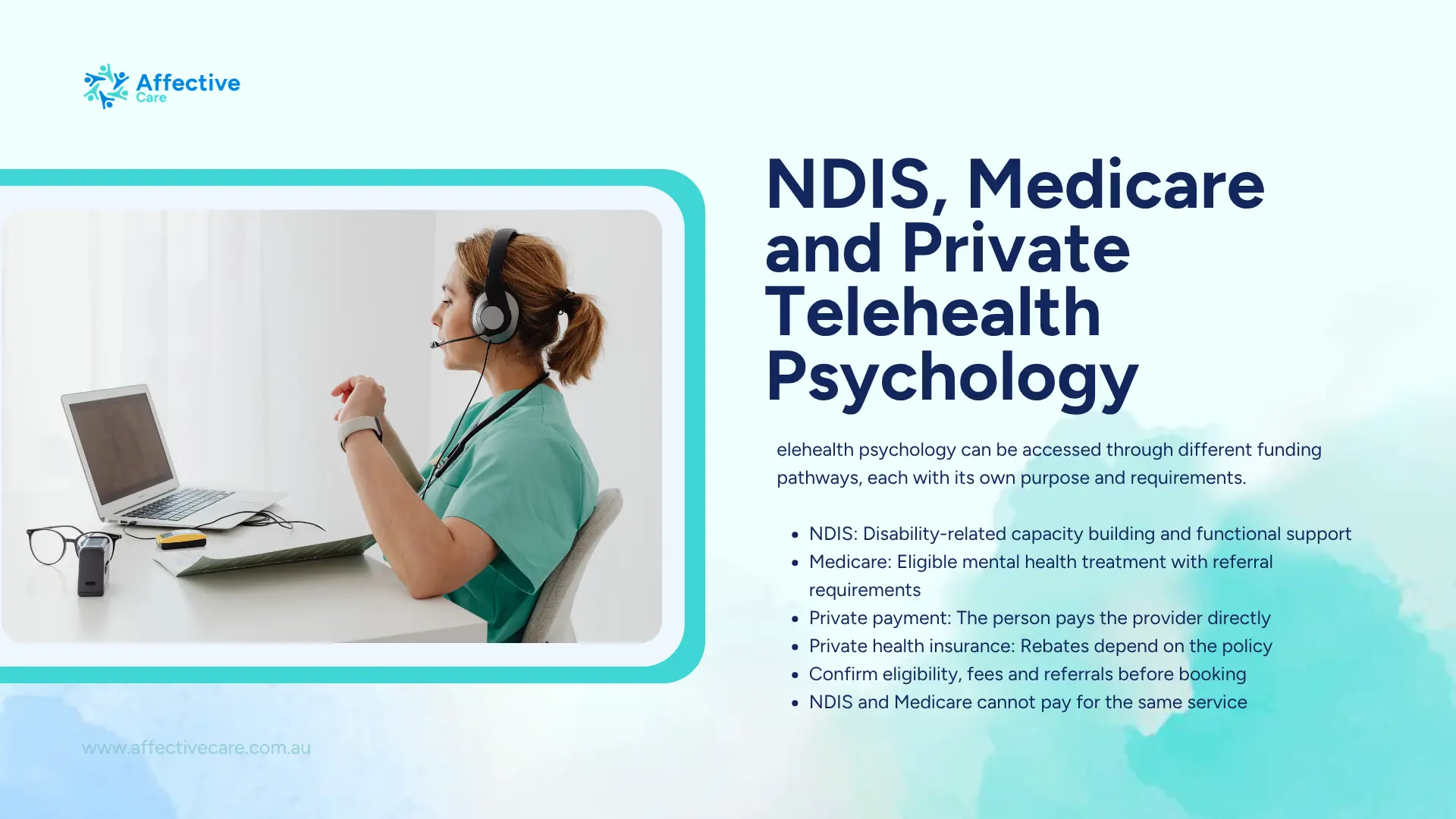
NDIS, Medicare and Private Telehealth Psychology
NDIS, Medicare and private payment are separate ways of accessing psychology.
|
Funding pathway |
Main purpose |
Referral requirements |
Important consideration |
|
NDIS |
Disability-related capacity building and functional support |
A GP referral is not generally the standard NDIS requirement |
The service must be an appropriate use of the participant’s NDIS funding |
|
Medicare |
Eligible mental health treatment through programs such as Better Access |
A referral and treatment plan may be required |
Medicare eligibility and MBS rules apply |
|
Private payment |
Services paid directly by the person |
Usually determined by the provider |
The person is responsible for the fee |
|
Private health insurance |
Eligible services covered under a policy |
Depends on the insurer and policy |
Rebates and waiting periods vary |
The Better Access initiative provides Medicare benefits for eligible mental health treatment services, including certain psychology services delivered through telehealth.
It is separate from the NDIS and has its own eligibility, referral and claiming requirements.
The NDIS and Medicare should not both be used to pay for the same service.
Participants should ask the provider which funding pathway is being used before the appointment.
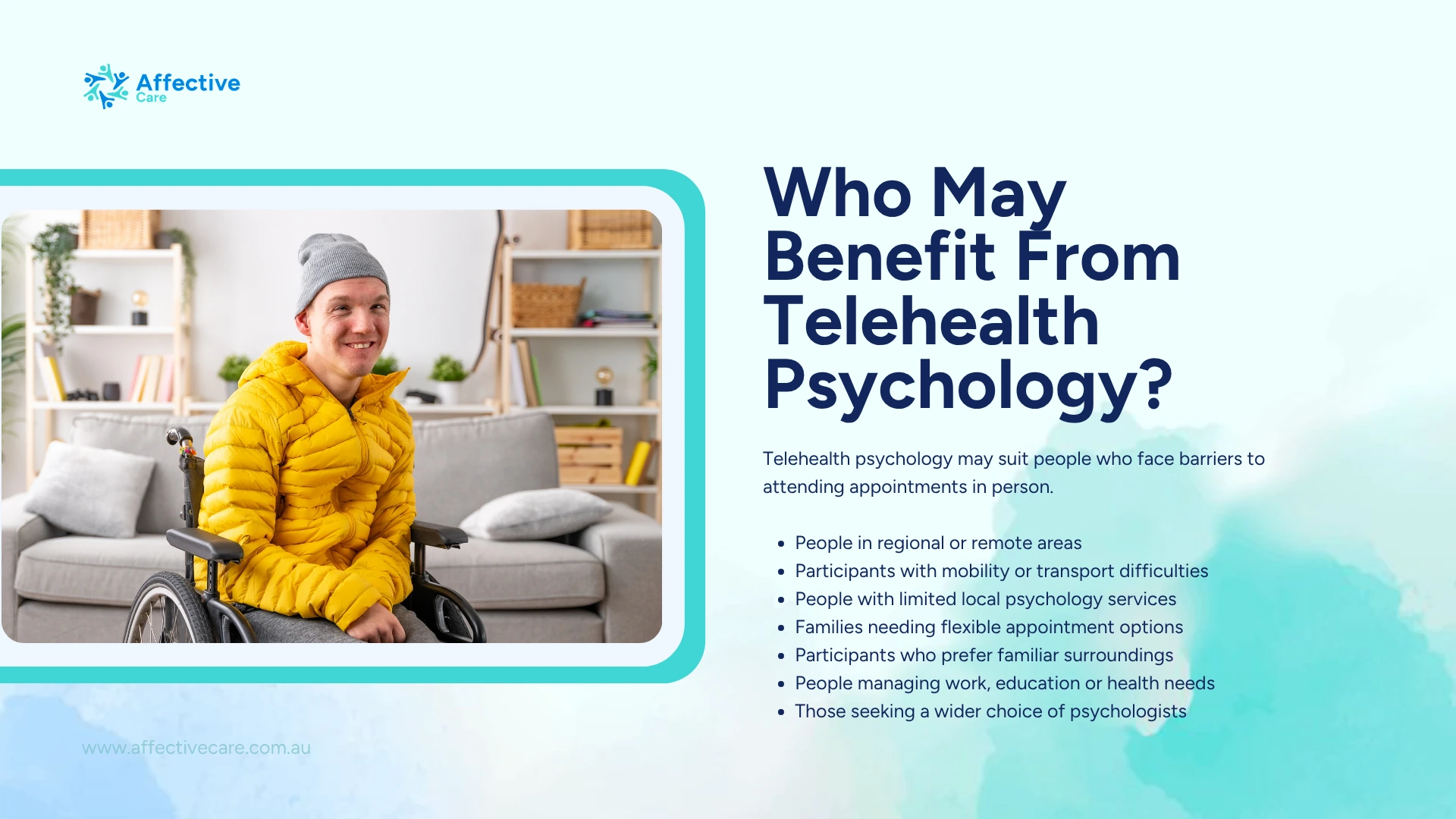
Who May Benefit From Telehealth Psychology?
Telehealth psychology may provide a practical option for people who experience barriers to attending a clinic.
It may benefit:
- People living in regional or remote areas
- Participants with limited local psychology services
- People with mobility limitations
- Participants who experience difficulty using public transport
- People who prefer receiving support in a familiar environment
- Participants who experience travel-related stress
- Families managing several appointments
- People with health conditions that make travel difficult
- Participants who move between locations
- People seeking greater flexibility around work or education
- Participants who require a wider choice of psychologists
For some people, being at home may make it easier to communicate openly and use familiar communication tools.
However, telehealth psychology should not be chosen only because it is convenient. It also needs to be safe, accessible and clinically appropriate.
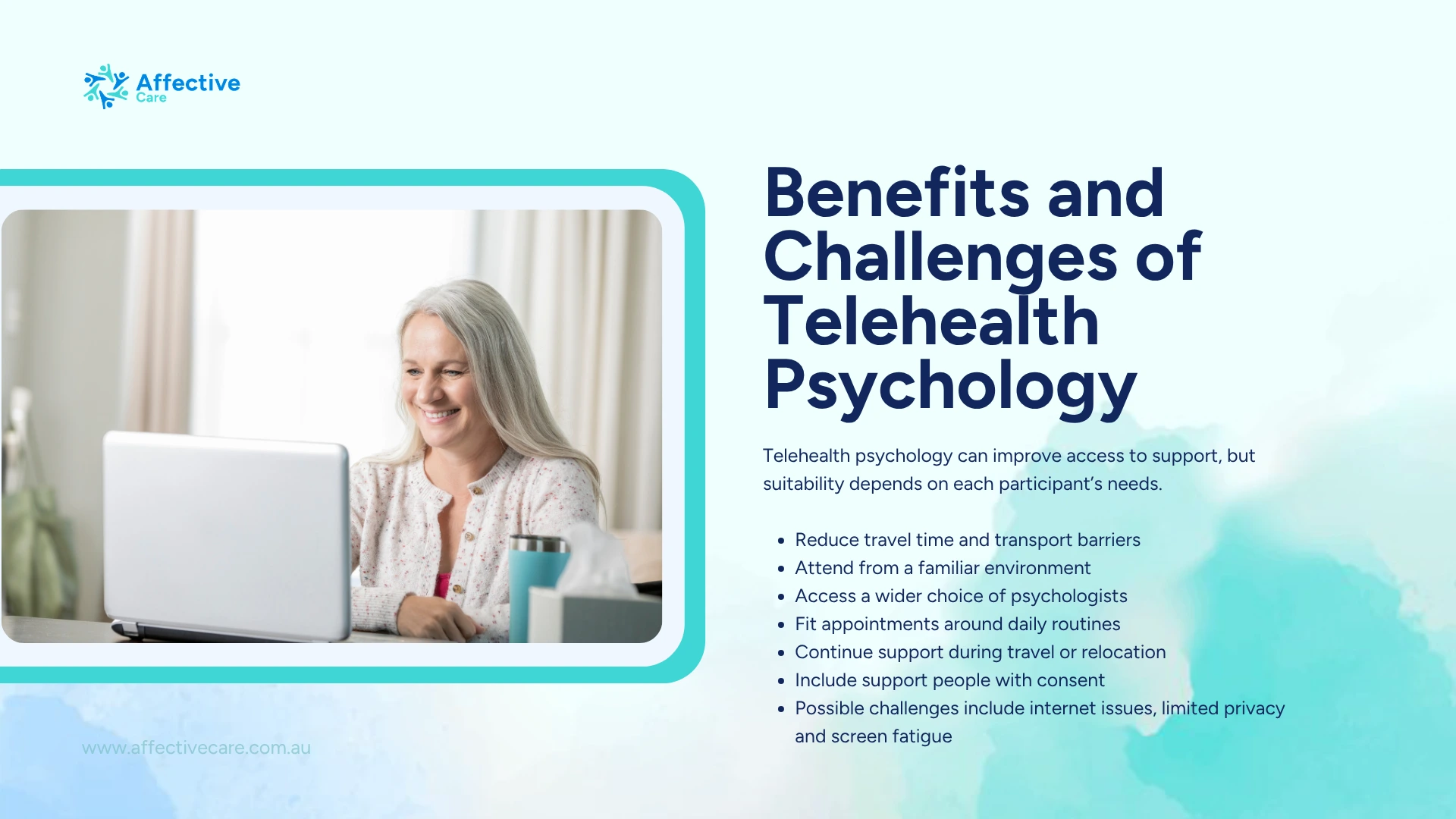
Benefits of Telehealth Psychology
The benefits of telehealth psychology may differ between participants.
Reduced Travel
Online psychology can reduce the time and effort involved in travelling to a clinic.
This may be particularly helpful for participants who:
- Live far from services
- Have mobility limitations
- Depend on support workers for transport
- Experience fatigue
- Have several appointments each week
Access From a Familiar Environment
Some participants feel more comfortable speaking from home.
A familiar environment may help a person:
- Feel more relaxed
- Use their usual communication tools
- Access sensory items
- Take breaks when needed
- Include a trusted support person
- Practise strategies in the setting where they are used
Greater Choice of Providers
Telehealth psychology services Australia-wide may give participants access to providers outside their immediate area.
This can be helpful when a person is looking for a psychologist with experience in:
- Disability support
- Autism
- Psychosocial disability
- Emotional regulation
- Family support
- Communication differences
- Particular cultural or language needs
Flexible Appointment Options
A telehealth psychology appointment may be easier to arrange around:
- Work
- Education
- Support-worker rosters
- Family responsibilities
- Other allied health appointments
- Transport availability
Continuity of Support
Telehealth may help maintain continuity when a participant:
- Relocates
- Travels
- Temporarily cannot attend a clinic
- Moves between family homes
- Lives in an area with limited services
Easier Support-Team Involvement
With the participant’s consent, family members, carers or support professionals may be able to join from different locations.
Their involvement may help with:
- Sharing relevant observations
- Understanding recommended strategies
- Supporting consistent routines
- Reviewing goals
- Coordinating services
Possible Challenges of Telehealth Psychology
Telehealth psychology also has limitations.
Possible challenges include:
- Unstable internet
- Limited privacy
- Difficulty using technology
- Screen fatigue
- Background noise
- Hearing or visual barriers
- Difficulty remaining engaged
- Limited ability to observe some behaviours
- Reduced access to physical resources
- Communication delays during video calls
A participant should tell the provider about any barriers before the first appointment.
Many difficulties can be addressed through reasonable adjustments, including:
- Shorter sessions
- More frequent breaks
- Written instructions
- Visual resources
- Captioning
- A support person
- Telephone backup
- Slower pacing
- Alternative communication methods
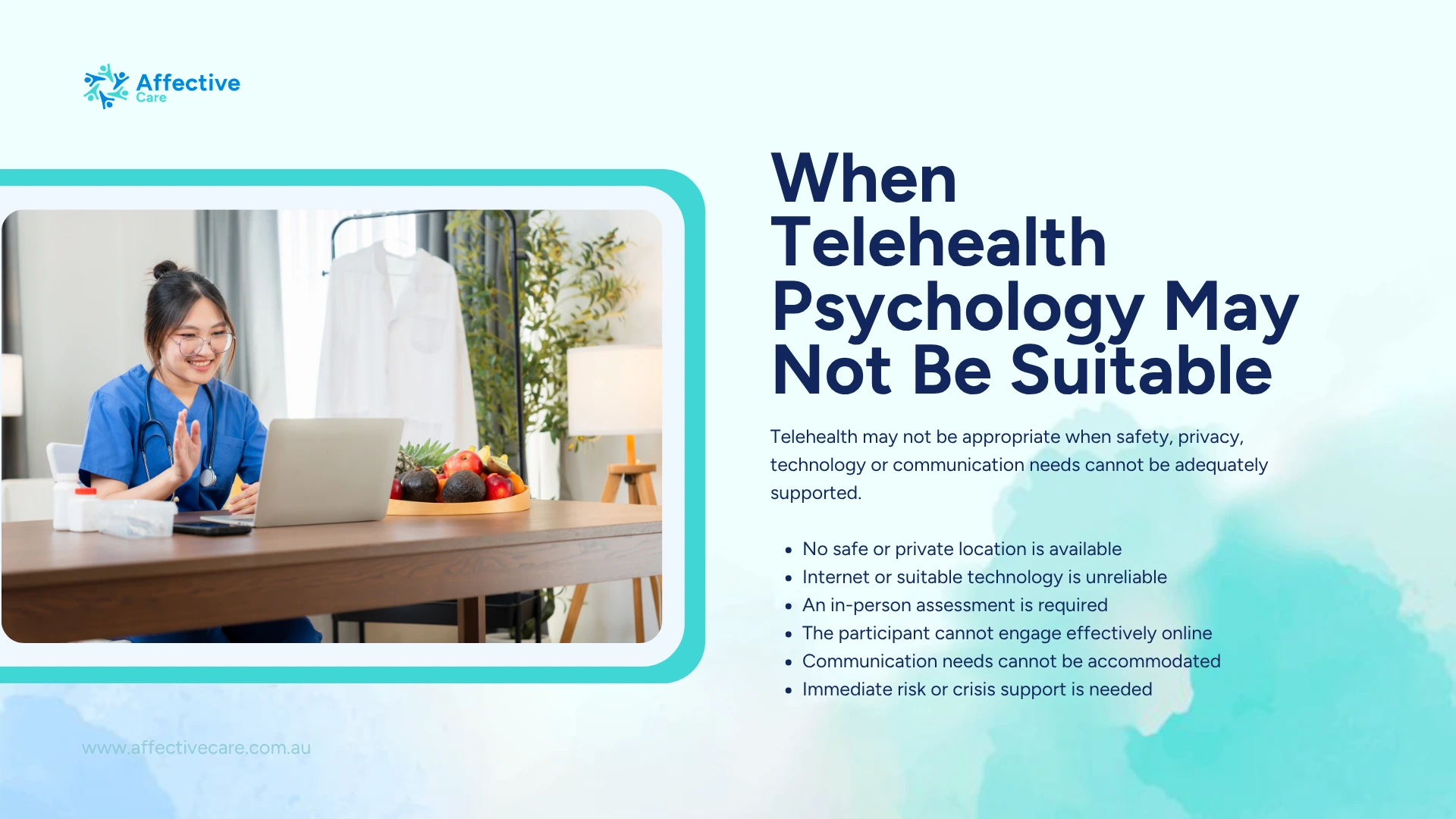
When Telehealth Psychology May Not Be Suitable
Telehealth may not be appropriate when:
- The participant does not have a safe or private location
- Reliable technology is unavailable
- An in-person assessment is required
- The participant cannot engage meaningfully through the available format
- Immediate risk requires urgent face-to-face support
- The person requires emergency or crisis intervention
- Communication needs cannot be adequately supported online
- The psychologist cannot safely provide the required service remotely
Telehealth psychology is not an emergency service.
Telehealth can work well for many people, but it is not always the best option.
Our telehealth psychology compared with face-to-face therapy guide explains where each format may offer advantages and what to consider before choosing.
A person who needs urgent help should contact the appropriate emergency, crisis or health service rather than waiting for a routine telehealth appointment.
The psychologist should discuss alternatives when online support is not suitable.
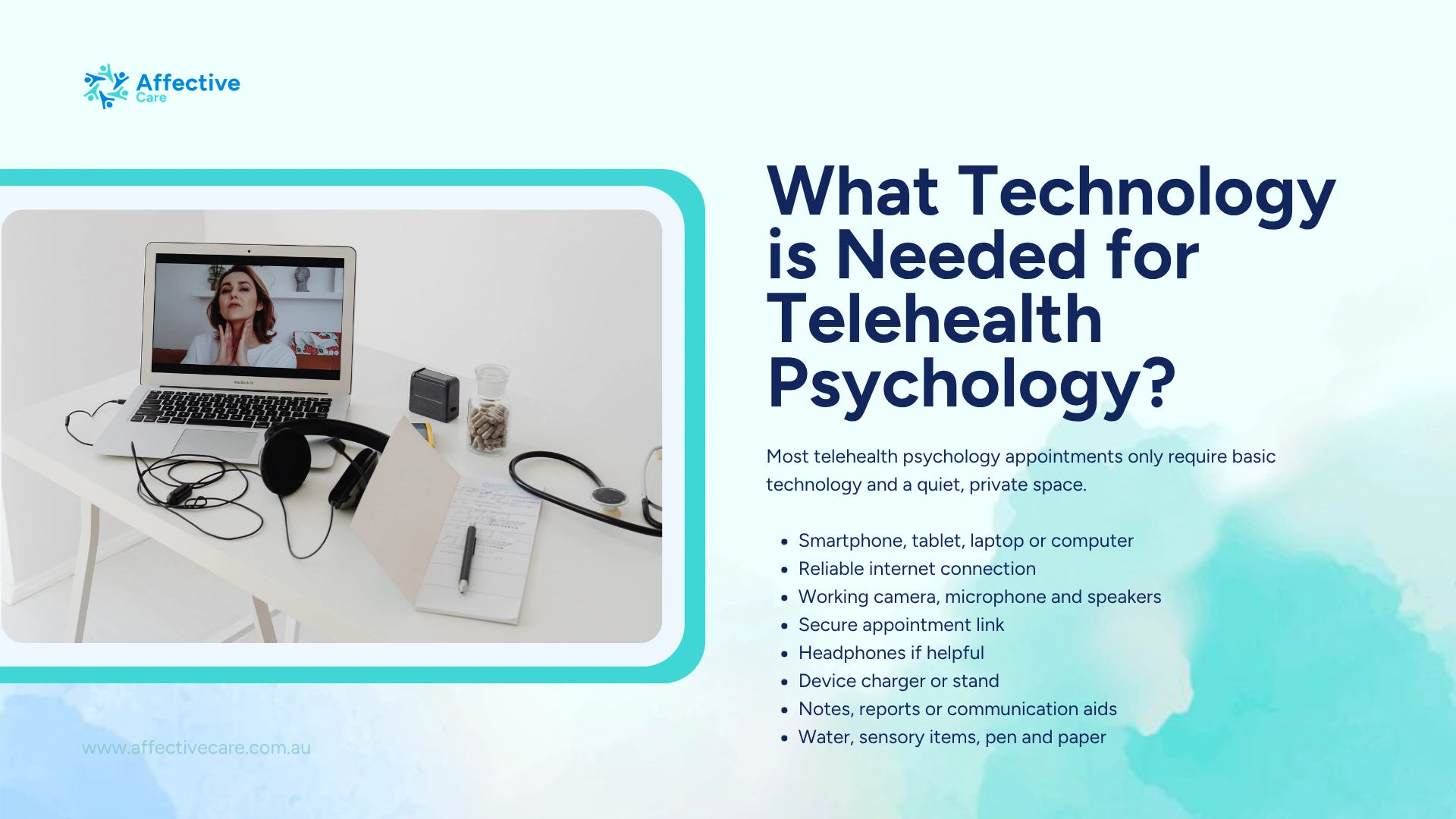
What Technology is Needed for Telehealth Psychology?
Most telehealth psychology appointments require only basic technology.
Essential items
- A smartphone, tablet, laptop or desktop computer
- A working camera
- A microphone and speakers
- A reliable internet connection
- A secure appointment link
- A private or quiet location
Helpful items
- Headphones
- A device charger
- A stand for the phone or tablet
- Water
- Notes or questions
- Communication aids
- Relevant reports
- Sensory items
- Pen and paper
Participants do not need advanced computer skills. The provider should offer clear instructions for joining the appointment.
How to Prepare for a Telehealth Psychology Session
Preparing in advance can make your online psychology appointment easier, more private and more comfortable.
Before the appointment, test your camera, microphone and internet connection.
Make sure your device is charged, open the appointment link and choose a quiet, private room where you are less likely to be interrupted.
Let other people in the home know that you need privacy and reduce any background noise where possible.
It may also help to gather relevant documents, review your NDIS goals and write down any questions or concerns you would like to discuss.
Keep any communication aids nearby and save the provider’s phone number in case you experience technical difficulties.
Around five minutes before the session, close unnecessary applications, place your device on a stable surface and adjust the lighting so your face can be seen clearly.
Turn off distracting notifications, keep some water nearby and use headphones if they help you hear more clearly or maintain privacy.
You can then join the virtual waiting room and wait for the psychologist to begin the session.
During the appointment, tell the psychologist immediately if you cannot hear or see them clearly.
You can ask for information to be repeated, explain when a question is unclear or request a break whenever needed.
You should also feel comfortable using your preferred communication method and letting the psychologist know if another person enters the room.
There is no need to make your space look perfect. The priority is having a private, comfortable environment where you can communicate openly.
Moreover, when timely support is important, it may also help to learn how same-day psychology appointments may be arranged, subject to psychologist availability and individual suitability.
Privacy, Consent and Confidentiality
Privacy is an important part of how online psychology works.
Before telehealth psychology begins, the provider should explain:
- How information is collected
- How records are stored
- Who may access the records
- When information may be shared
- The limits of confidentiality
- What happens if the video call disconnects
- Whether the platform records sessions
- How consent can be changed or withdrawn
Participants can also take steps to protect their privacy by:
- Using a private room
- Wearing headphones
- Avoiding public Wi-Fi where possible
- Not sharing appointment links
- Closing other applications
- Logging out of shared devices
- Asking others not to interrupt
- Using a privacy screen if needed
Participants should know who is present on both sides of the call.
A session should not be recorded unless there is a lawful and clearly explained reason, appropriate consent and suitable privacy arrangements.
Can a Family Member or Support Person Attend?
A family member, carer, support worker or interpreter may attend when:
- The participant agrees
- Their presence supports communication or participation
- The psychologist considers their involvement appropriate
- Privacy responsibilities are understood
A support person may help by:
- Assisting with technology
- Helping the participant communicate
- Providing relevant background information
- Supporting emotional regulation
- Helping practise strategies after the appointment
However, the participant should still have opportunities to express their own views.
The psychologist may recommend that the support person attends only part of the session, depending on the participant’s age, consent and goals.
Moreover, NDIS, Medicare and private payment follow different rules, reviewing Medicare rebates and psychology session costs can help people understand their possible funding and payment options.
Telehealth Psychology for Children and Families
Telehealth psychology for children may look different from adult sessions.
Sessions may include:
- Visual activities
- Games
- Story-based exercises
- Emotional identification activities
- Parent consultation
- Routine-building strategies
- Communication practice
- Short movement breaks
- Collaborative family goals
Parents or carers may be asked to help:
- Set up the device
- Prepare activities
- Reduce distractions
- Support the child’s communication
- Practise agreed strategies between appointments
Telehealth may work best when sessions are adjusted to the child’s attention, communication style and sensory needs.
For some children, shorter or more interactive sessions may be more appropriate than a traditional conversation-based appointment.
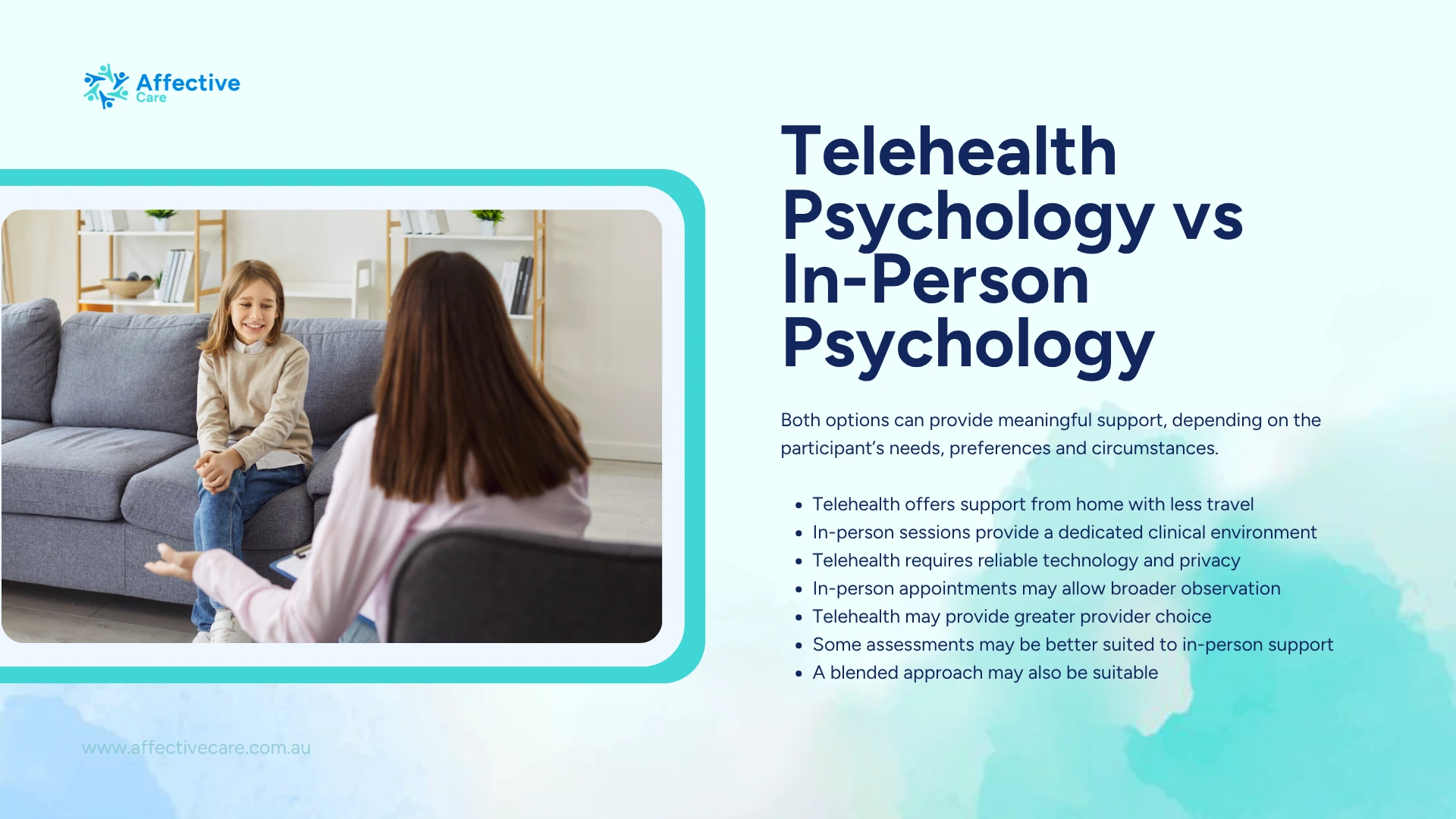
Telehealth Psychology Versus In-Person Psychology
Neither format is automatically better. The most suitable option depends on the participant’s needs.
|
Consideration |
Telehealth psychology |
In-person psychology |
|
Location |
Home or another private setting |
Clinic, home or community setting |
|
Travel |
Usually not required |
May require travel |
|
Technology |
Device and internet needed |
Usually minimal technology needed |
|
Environment |
Familiar environment |
Dedicated professional environment |
|
Provider choice |
May provide access across a wider area |
Usually limited by travel distance |
|
Privacy |
Depends on the participant’s location |
Clinic may provide a private room |
|
Observation |
Some observations may be limited by the camera |
Broader in-person observation may be possible |
|
Resources |
Digital and home-based materials |
Clinic resources may be available |
|
Suitability |
Depends on engagement, safety and technology |
May be better for some assessments and support needs |
Some participants use a blended model, combining telehealth and in-person appointments where available.

How to Choose a Telehealth Psychologist
Choosing a psychologist involves more than checking appointment availability.
Consider asking:
- Are you registered to practise as a psychologist in Australia?
- Do you have experience supporting people living with disability?
- Do you work with NDIS participants?
- How will your support relate to my disability and goals?
- What telehealth platform do you use?
- How do you protect privacy?
- What happens if the connection fails?
- Can you make communication or sensory adjustments?
- Can a support person attend?
- How do you review progress?
- Do you provide reports?
- What are your fees?
- What is your cancellation policy?
- How do you decide whether telehealth is suitable?
A psychologist should explain their service clearly and avoid guaranteeing specific outcomes.
Participants may also check a psychologist’s registration through the relevant Australian practitioner register.
Moreover, before booking, consider the psychologist’s experience, communication approach and understanding of disability by reviewing how to choose the right NDIS online psychologist.
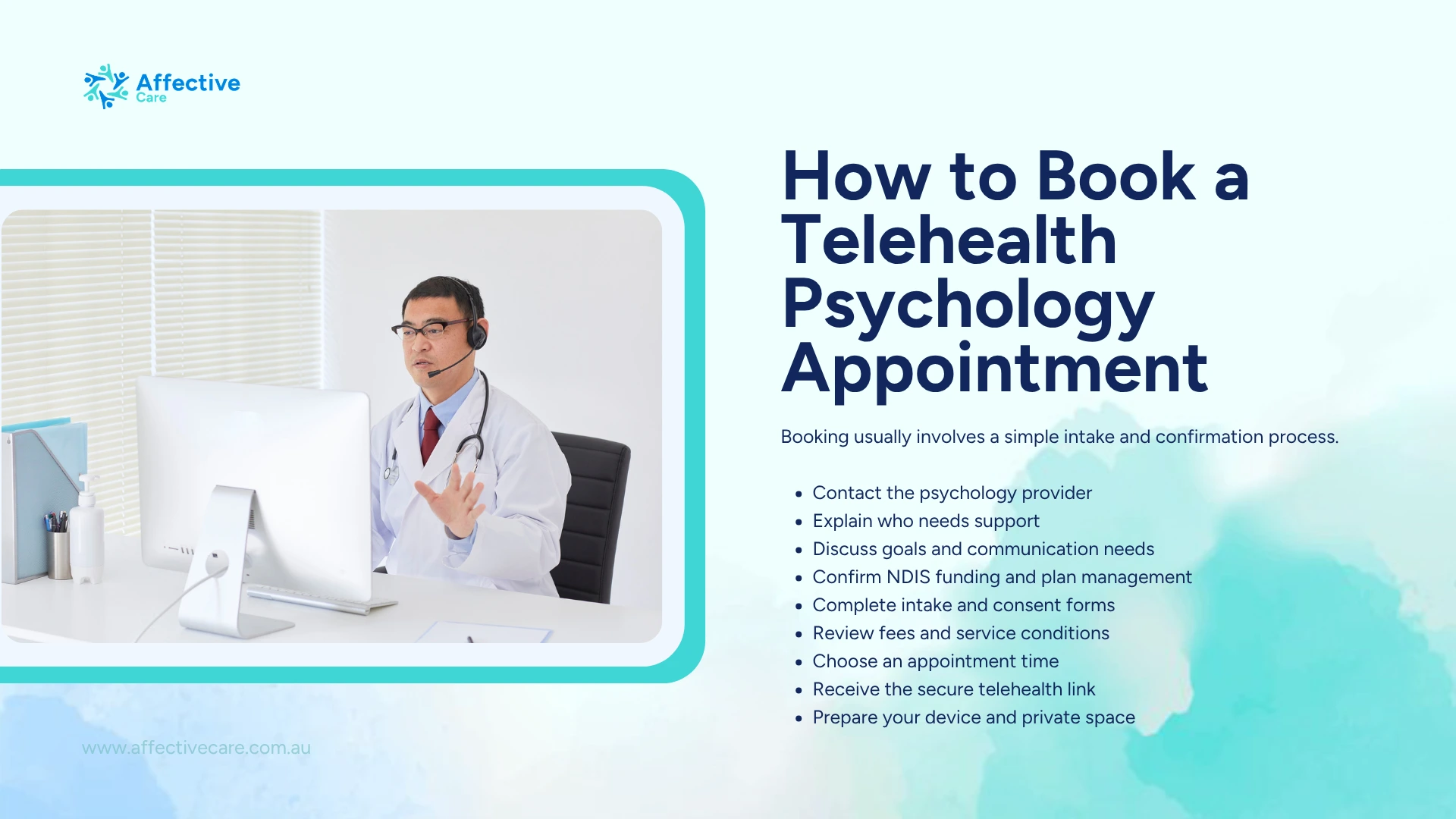
How to Book a Telehealth Psychology Appointment
The booking process is usually straightforward.
- Contact the psychology provider.
- Explain who the support is for.
- Describe the main support needs and goals.
- Confirm whether the provider works with NDIS participants.
- Discuss funding and plan management.
- Complete intake and consent forms.
- Review fees and the service agreement.
- Choose an appointment time.
- Receive the secure telehealth link.
- Prepare your device and private space.
Support coordinators can assist participants to compare providers, gather relevant information and organise appointments, but the participant’s preferences and consent should remain central.
Before choosing an online provider, you may also want to understand whether counselling or psychology under the NDIS is more closely aligned with your goals, assessment needs and preferred type of support.
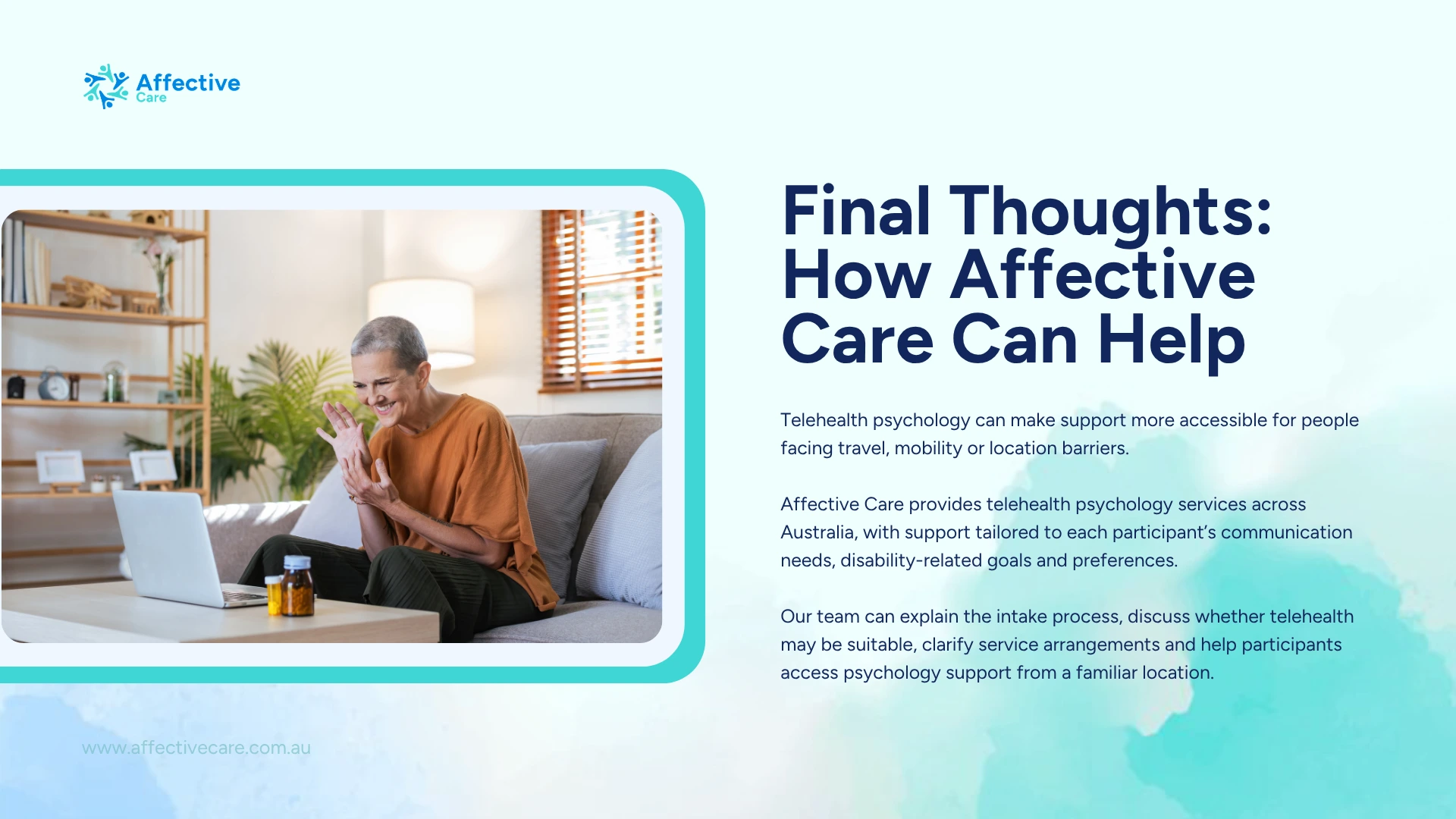
Final Thoughts: How Telehealth Psychology Works
Telehealth psychology can make psychological support more accessible for people who experience distance, mobility, transport or scheduling barriers.
It allows participants to connect with a psychologist through secure technology while remaining in a familiar environment.
Sessions may support emotional regulation, communication, confidence, problem-solving, social participation and greater independence.
For NDIS participants, psychology support must be connected to disability-related needs, functional capacity and plan goals. Funding should always be confirmed before appointments begin.
Understanding how telehealth psychology works can help participants prepare for the process, ask informed questions and decide whether online psychology suits their needs.
Before beginning, confirm:
- Whether telehealth is appropriate
- What the sessions will address
- How fees will be charged
- Which funding pathway will be used
- How privacy will be protected
- How progress will be reviewed
Affective Care provides telehealth psychology services for participants and families across Australia.
Our team works with each person to understand their communication needs, goals and preferences before recommending the next steps.
Speak with Affective Care to learn more about accessing psychology support from home.