


If you’re searching for NDIS price rates for support services, wondering how much NDIS support services cost, or trying to understand NDIS support worker hourly rates, this complete 2026 guide explains everything clearly.
Furthermore, the NDIS sets maximum price limits for supports, but pricing depends on your plan type, service category, location, and the time of support.
Below, we break down the current NDIS pricing arrangements, typical hourly rates, therapy costs, support coordination fees, and key pricing rules.
What Are NDIS Price Rates for Support Services?
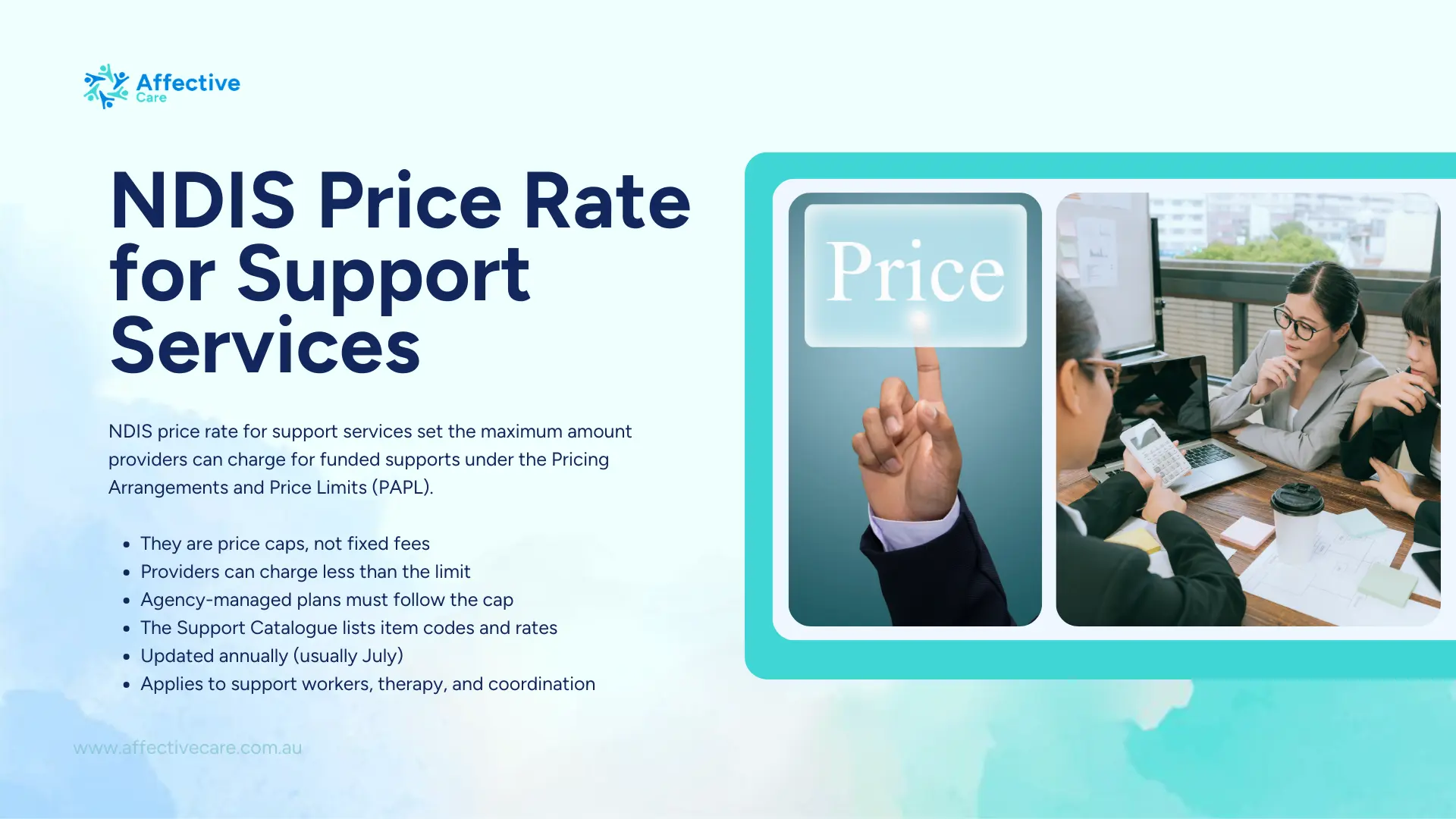
The NDIS Price Guide, formally known as the NDIS Pricing Arrangements and Price Limits (PAPL), outlines the maximum prices that registered providers can charge for NDIS-funded supports across Australia.
When people search for:
- NDIS Price Rates for support services
- NDIS price guide rates NDIS support services cost
- NDIS maximum hourly rates NDIS price limits in Australia
- NDIS support catalogue pricing
They are typically referring to the same official pricing framework that governs how NDIS funding can be used.
The NDIS Price Rates for Support Services ensure transparency and consistency in pricing.
It protects participants by setting clear price limits and helps providers understand the rules around charging for supports.
The Pricing Arrangements document works alongside the NDIS Support Catalogue, which provides detailed information including:
- Individual NDIS support item codes
- Clear descriptions of each funded service
- The applicable hourly, daily, or unit price limit
- Specific conditions (such as travel rules, non-face-to-face support, or reporting limits)
Together, these documents form the official NDIS support services pricing framework, ensuring participants can make informed decisions about how their funding is used.
What Do “Price Limits” Actually Mean?
It’s important to understand that the NDIS sets maximum price caps, not mandatory fixed fees.
This means:
- Providers cannot exceed the price limit for NDIA-managed plans.
- Providers can charge less than the price limit.
- Participants are encouraged to discuss service agreements and ensure value for money.
If you are searching for:
- Can providers charge more than the NDIS price guide?
- NDIS price limits vs actual costs
- How much do NDIS support workers cost?
The answer depends on plan management type (explained further below), but for most agency-managed plans, the price limit acts as a strict ceiling.
Why Does the NDIS Have Price Limits?
Because NDIS is publicly funded, pricing must balance participant choice with responsible use of funding.
The NDIS pricing arrangements are designed to:
- Protect participants from overcharging
- Create national pricing consistency
- Support workforce sustainability
- Ensure funding is used responsibly
Moreover, comparing current service rates with your available budget can reveal potential shortfalls and help you decide how to respond when NDIS funding does not cover your support needs.
How NDIS Pricing Works (Simple Explanation)
When people search “how does NDIS funding work?”, they’re usually trying to understand:
- Why do different supports have different price rates
- Why do therapy costs more than support workers
- How their NDIS budget is divided
- What category do their supports fall under
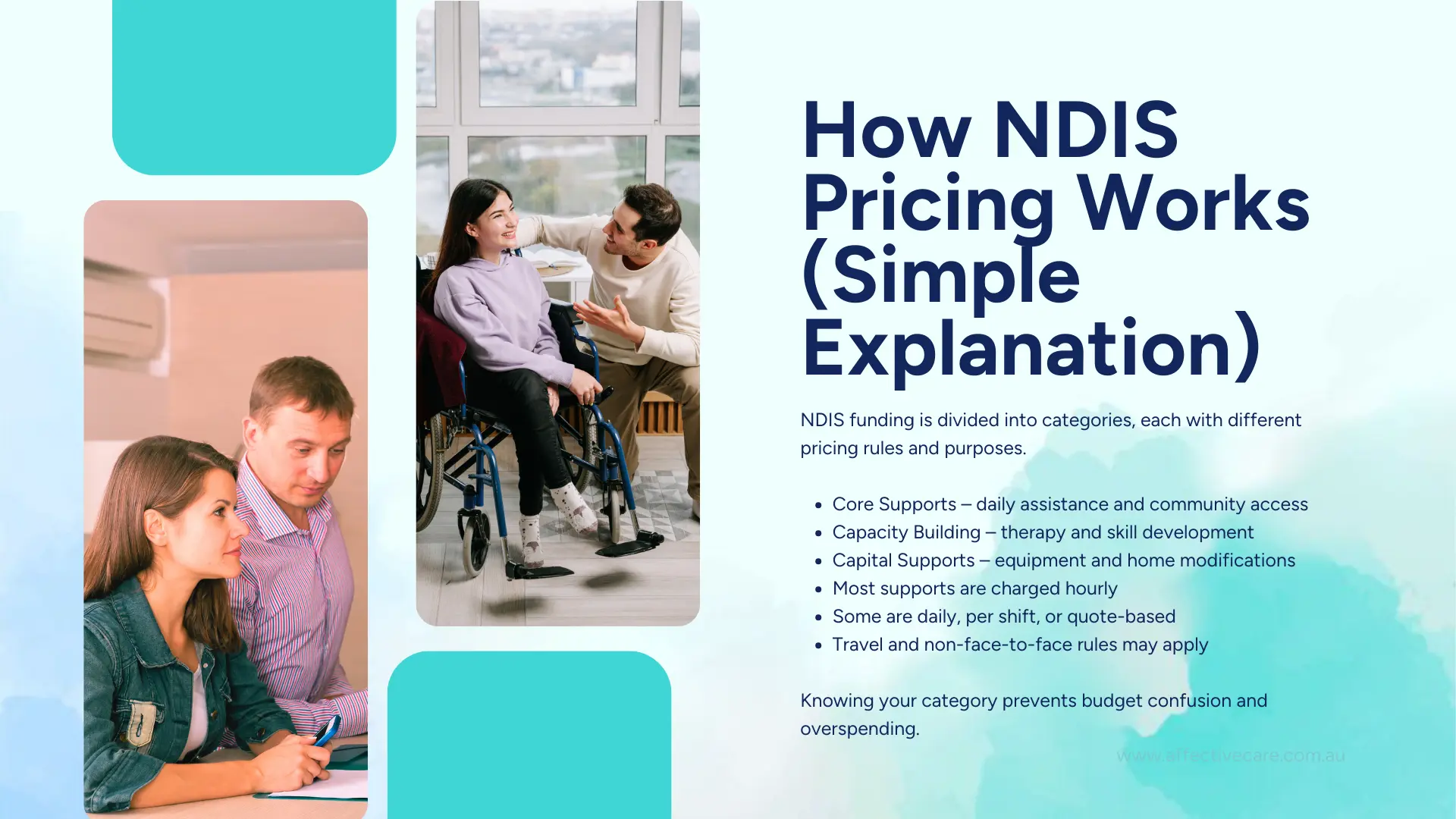
The NDIS does not operate as one single funding pool. Instead, funding is divided into three main support categories, and each category has its own NDIS price guide rates, pricing rules, and funding purpose.
Thus, understanding these categories helps you estimate your NDIS price rates for support services and manage your plan more effectively.
Core Supports
Core Supports help participants with everyday activities and community participation. This is the most flexible category in most NDIS plans.
It typically covers:
- Personal care (showering, dressing, grooming)
- Assistance with daily living
- Household tasks
- Social and community participation
- Transport supports
- Consumables (low-cost assistive items)
This is where most NDIS support worker price rates apply.
Core supports are usually charged at an hourly rate, and the cost depends on:
- Time of day (weekday, evening, weekend, public holiday)
- Level of support required (standard or high-intensity)
- Location (metro, regional, remote)
- Ratio of support (1:1 or group-based)
When people search:
- NDIS support worker hourly price rate
- NDIS personal care price guide
- NDIS core supports pricing
- How much do NDIS support workers cost
They are generally referring to this category. Core funding is often the most flexible part of an NDIS plan, meaning participants may be able to move funds between different types of Core supports if needed.
Why Core Support Rates Vary
The NDIS hourly price rates for support services in Core funding depend on:
- Time of day (weekday, evening, weekend, public holiday)
- Support intensity (standard vs high-intensity)
- Location (metro vs remote)
- Ratio of support (1:1 vs 1:2 or group supports)
Capacity Building Supports
Capacity Building Supports are designed to build independence, improve skills, and support long-term goals.
Unlike Core supports, this funding is usually allocated to specific purposes and is less flexible. This category includes:
- Psychology
- Occupational therapy (OT)
- Speech pathology
- Physiotherapy
- Positive behaviour support
- Support coordination
- Employment-related supports
- Skill development programs
These services fall under what many people search for:
- NDIS therapy price guide
- NDIS psychology rate
- NDIS support coordination price guide
- NDIS capacity building pricing
Capacity Building supports are generally charged:
- Per hour (therapy sessions, support coordination)
- For report writing or assessments (within NDIS rules)
- For non-face-to-face work when appropriate
Therapy services usually have higher NDIS maximum hourly rates than support workers because they require specialised qualifications, professional registration, and clinical expertise.
Capital Supports
Capital Supports cover higher-cost equipment and long-term investments that improve accessibility and independence.
This includes:
- Assistive technology (wheelchairs, communication devices)
- Home modifications
- Vehicle modifications
- Specialist Disability Accommodation (SDA)
Unlike Core and Capacity Building supports, Capital Supports are often:
- Quote-based rather than hourly
- Approved for specific items only
- Less flexible between line items
When people search:
- NDIS assistive technology pricing
- NDIS home modification funding
- NDIS SDA pricing
- NDIS capital supports pricing
They are referring to this category. Capital funding must usually meet the NDIS “reasonable and necessary” criteria and may require formal assessments before approval.
How the Categories Work Together
Each category has:
- Its own NDIS price guide rates
- Its own funding purpose
- Its own pricing rules
- Its own support item codes in the NDIS Support Catalogue
For example:
- You cannot usually use Core funding to pay for therapy.
- You cannot use Capacity Building funding for daily personal care.
- Capital supports are restricted to approved items.
That’s why understanding how NDIS pricing works is essential for:
- Estimating your NDIS price rates for support services
- Planning weekly support hours
- Avoiding overspending in one category
- Making informed service agreements
Simple Example of How It Comes Together
A participant’s plan might include:
- Core Supports: $40,000 (support worker hours)
- Capacity Building: $15,000 (therapy + support coordination)
- Capital Supports: $8,000 (assistive technology)
Each category operates independently under the NDIS pricing arrangements 2025–26, and each service must follow the applicable NDIS maximum hourly rates.
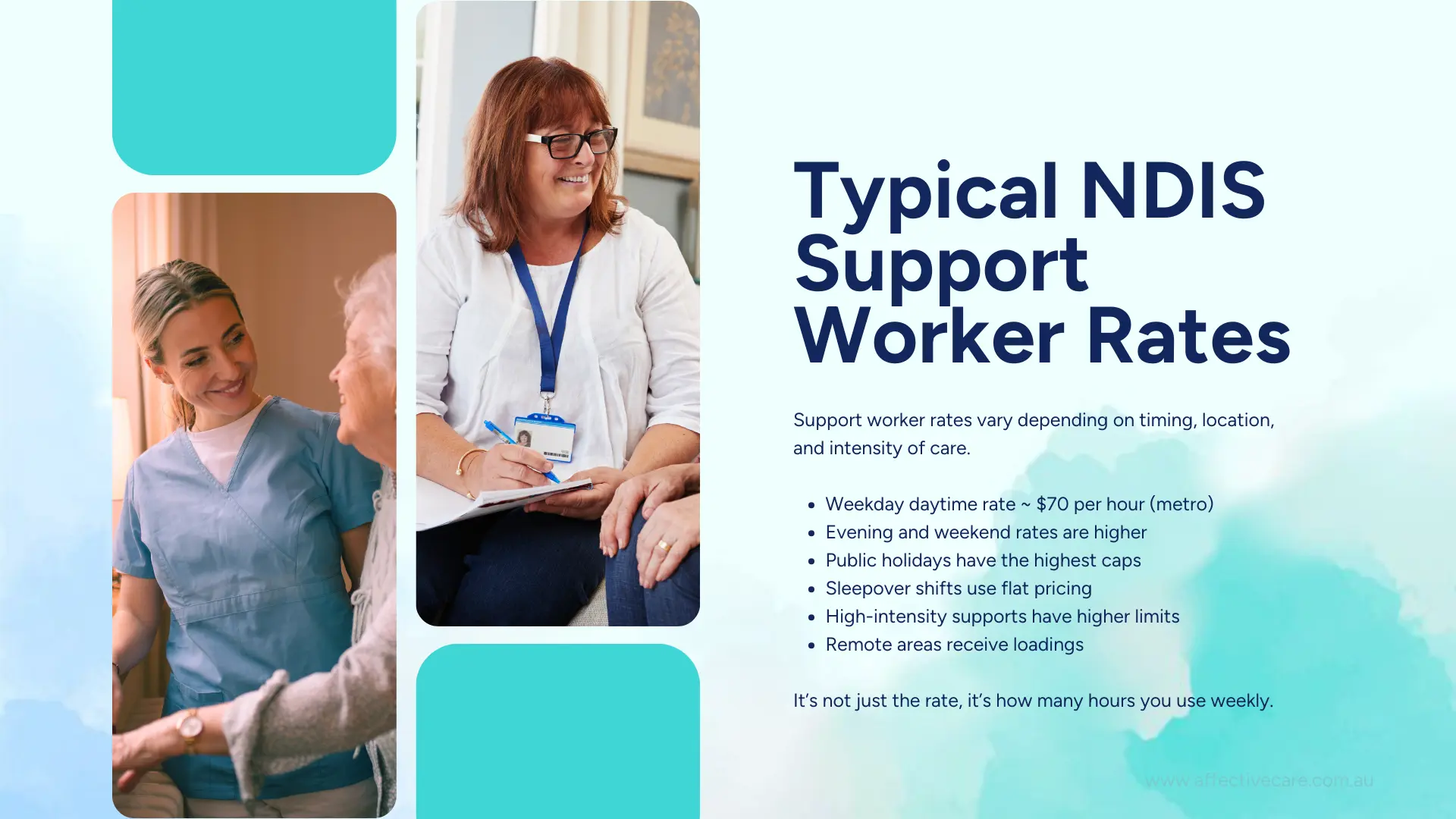
Typical NDIS Support Worker & Therapy Price Rates (2025–26)
One of the most common questions participants and families ask is: “How much do NDIS support services cost?”
The answer depends on the type of support, the time of day it is delivered, the worker’s qualification level, and your location (metro, regional, or remote).
The NDIS does not set fixed fees; instead, it sets maximum price limits under the NDIS Pricing Arrangements and Price Limits (PAPL) 2025-26.
These maximum limits apply to:
- NDIS support worker hourly price rates
- NDIS personal care pricing
- NDIS high-intensity support rates
- NDIS therapy and allied health services
- NDIS support coordination fees
It’s important to understand that these figures represent the highest amount a registered provider can charge for NDIA-managed plans.
Providers may charge less than the price limit, but they cannot exceed it unless the participant is self-managing and negotiates separately.
Because NDIS pricing includes weekday, evening, weekend, public holiday, sleepover, and high-intensity rates, the NDIS price rates for support services per hour can vary significantly.
Below is a simplified summary of the current NDIS price guide rates for 2026, based on the official NDIS Support Catalogue and Pricing Arrangements.
Core Supports: Support Worker Rates
These price rates apply to most NDIS support worker services, including personal care, community access, and assistance with daily living.
| Support period | National recommended maximum |
|---|---|
| Weekday daytime | $73.58 per hour |
| Weekday evening | $81.07 per hour |
| Weekday night | $82.57 per hour |
| Saturday | $103.54 per hour |
| Sunday | $133.50 per hour |
| Public holiday | $163.46 per hour |
| Night-time sleepover | $311.79 per sleepover |
These are standard Disability Support Worker Level 1 national rates from the NDIS Pricing Schedule effective 1 July 2026. Remote and very remote prices are higher.
NDIS Saturday Rate
The standard national NDIS Saturday rate for disability support worker assistance is $103.54 per hour from 1 July 2026.
The applicable rate may differ for high-intensity supports, remote locations, group services or different support item codes.
NDIS Sunday Rate 2026
The standard national NDIS Sunday rate 2026 is $133.50 per hour for common Disability Support Worker Level 1 supports.
Sunday rates are higher than weekday and Saturday rates because they include weekend labour costs within the pricing calculation.
NDIS Evening Rate 2026
The national NDIS evening rate for standard support is $81.07 per hour.
Evening pricing generally applies to eligible weekday supports delivered during the time bands defined by the relevant NDIS pricing rules and support item.
NDIS Sleepover Rate 2026
The standard national NDIS sleepover rate 2026 is $311.79 per sleepover.
A sleepover is generally an inactive overnight support arrangement where a worker is available but is not expected to provide continuous active assistance throughout the night. Remote and very remote sleepover prices are higher.
NDIS Overnight Support Rate
The NDIS overnight support rate depends on whether the support is an inactive sleepover or active overnight assistance.
The standard night-time sleepover price is a flat rate of $311.79, while active overnight support is normally billed hourly using the appropriate weekday night, weekend or public holiday support item.
The standard national weekday night rate is $82.57 per hour, but high-intensity overnight assistance may have a higher price.
NDIS Overnight Rate: Sleepover vs Active Overnight
When comparing the NDIS overnight rate, participants should check whether the service is:
- An inactive sleepover charged as a flat shift
- Active overnight support charged hourly
- High-intensity overnight assistance
- SIL overnight support
- On-call monitoring
Capacity Building Supports: Therapy & Specialist Services
These supports focus on building independence and improving functional capacity.
|
Therapy / Specialist Support |
Maximum Price Limit (Metro – Indicative) |
|
Psychology |
~$230+ per hour |
|
Behaviour Support |
~$230+ per hour |
|
Occupational Therapy |
~$190+ per hour |
|
Physiotherapy |
~$190+ per hour |
|
Speech Pathology |
~$190+ per hour |
|
Dietitian |
~$180+ per hour |
|
Podiatry |
~$180+ per hour |
|
Level 2 Support Coordination |
Hourly rate set under Capacity Building |
|
Level 3 Specialist Support Coordination |
Higher hourly rate |
These rates may include:
- Face-to-face sessions
- Telehealth therapy
- Report writing (within limits)
- Assessment and care planning time
Capital Supports: Equipment & Accommodation
Capital Supports are generally not hourly-based. They are often quote-based or benchmarked under pricing rules.
|
Capital Support Type |
Pricing Structure |
|
Assistive Technology |
Quote-based / benchmarked |
|
Home Modifications |
Assessment + quote required |
|
Specialist Disability Accommodation (SDA) |
Based on SDA pricing framework |
|
Vehicle Modifications |
Quote-based |

NDIS Therapy & Allied Health Rates
Therapy and allied health services under the NDIS are funded through the Capacity Building: Improved Daily Living category.
This category is designed to help participants build skills, increase independence, and improve functional capacity over time.
When people search for the NDIS therapy price guide, they are usually looking for the maximum hourly rates set under the NDIS Pricing Arrangements and Price Limits (PAPL) 2025–26.
These are price caps that providers cannot exceed for NDIA-managed or plan-managed participants.
Therapy funding may cover:
- Face-to-face sessions
- Telehealth appointments
- Functional assessments
- Report writing (within limits)
- Goal planning and progress reviews
Psychology & Behaviour Support
The NDIS psychology rate and NDIS behaviour support pricing are among the highest allied health price limits due to the specialist qualifications required.
Psychology and behaviour support services assist with emotional wellbeing, mental health, functional capacity, and Positive Behaviour Support (PBS) strategies.
These services often include assessment, therapy sessions, behaviour support plans, and collaboration with families or support teams.
Physiotherapy & Occupational Therapy
The NDIS physiotherapy rate and occupational therapy pricing apply to supports aimed at improving mobility, strength, daily living skills, sensory processing, and home safety.
Occupational therapists may also conduct functional capacity assessments and assistive technology recommendations.
Speech Pathology
Speech pathology supports communication, swallowing safety, and social interaction skills.
Funding may include therapy sessions, communication device recommendations, and training for carers.
Dietitian & Podiatry
Dietitians assist with nutrition management linked to disability-related needs, while podiatrists support foot health and mobility.
Both are funded under Capacity Building where aligned with participant goals.
If you are new to the system, our guide to the National Disability Insurance Scheme provides a simple overview of the scheme, who it supports and how participants may use their plans.

NDIS Support Workers Cleaning Price Rate in 2026
The NDIS cleaning rates 2026 help participants understand the recommended maximum prices for disability-related household support delivered from 1 July 2026.
Under the NDIS Cleaning Price Guide 2026, house cleaning and other household activities have a national recommended maximum rate of $60.10 per hour.
The remote rate is $84.14 per hour, while the very remote rate is $90.15 per hour.
These figures are commonly searched as the NDIS house cleaning rates, NDIS rates for cleaning, NDIS cleaning rates per hour, NDIS domestic assistance rate and cleaning NDIS price guide.
They generally apply when cleaning support is related to a participant’s disability and included within the appropriate Core Supports budget.
NDIS Cleaning Rates 2026 Per Hour
| Cleaning support | National rate | Remote rate | Very remote rate |
|---|---|---|---|
| House Cleaning and Other Household Activities | $60.10 per hour | $84.14 per hour | $90.15 per hour |
| Assistance with Personal Domestic Activities | $61.16 per hour | $85.62 per hour | $91.74 per hour |
| House or Yard Maintenance | $59.01 per hour | $82.61 per hour | $88.52 per hour |
The NDIS cleaning rates 2026 per hour are recommended maximum prices rather than a guarantee that every provider will charge the full amount.
Providers should discuss their proposed rates with participants, and participants must agree to pricing changes in their service agreements.
What Can NDIS House Cleaning Include?
Depending on the participant’s disability-related needs and plan, NDIS house cleaning rates may apply to support with:
- Vacuuming and mopping
- Cleaning bathrooms and kitchens
- Dusting and wiping surfaces
- Laundry and changing bed linen
- General household organisation
- Completing domestic activities the participant cannot safely perform independently
The NDIS generally does not fund ordinary living expenses that everyone is expected to pay.
Cleaning must be connected to the participant’s disability-related support needs and included within their approved funding.
NDIS Cleaning Rates for the ACT
The NDIS cleaning rates for the ACT generally use the national rate because Canberra and most ACT locations are not classified as remote or very remote under the NDIS pricing geography framework.
Therefore, the applicable NDIS cleaning rate 2026 for House Cleaning and Other Household Activities in Canberra is generally up to $60.10 per hour, subject to the participant’s plan, service agreement and support requirements.
Participants should still confirm the provider’s actual fee because the NDIS price guide cleaning rates Australia represent recommended maximum prices, and a provider may charge less.
NDIS Gardening Rate 2026
The NDIS gardening rate, listed under House or Yard Maintenance, is $59.01 per hour nationally, $82.61 per hour in remote areas and $88.52 per hour in very remote areas.
Gardening support may include disability-related assistance with mowing, basic yard maintenance, pruning, clearing pathways or completing outdoor tasks the participant cannot safely manage.
It does not automatically cover landscaping, property improvements or general gardening unrelated to disability support needs.

NDIS Support Coordination & Plan Management Pricing (2026–27)
Another highly searched topic for NDIS participants and families is: “What is the NDIS support coordination hourly rate?” “How much do plan managers charge?”
Support Coordination and Plan Management fall under Capacity Building and Plan Management (Financial Administration), which supports the NDIS pricing framework.
They are funded separately from Core supports like personal care and therapy.
The NDIS Pricing Arrangements and Price Limits (PAPL) 2025–26, the updated official document that replaced the old “Price Guide”, sets maximum price limits for all supports that are subject to pricing regulations.
These limits show the most a registered provider can charge for NDIS-funded services.
Support Coordination Pricing
Support Coordination helps participants implement their NDIS plan by:
- Connecting with service providers
- Helping interpret and use plan funds
- Building skills to manage NDIS supports
- Resolving issues with bookings and service delivery
There are three levels of Support Coordination, each with different pricing based on the complexity of support needed.
These supports are claimable against the Capacity Building – Support Coordination line item in your NDIS plan.
Support Coordination Levels:
Level 1: Support Connection
- Entry-level coordination for those new to NDIS or needing minimal help.
- Ideal when you are building confidence using your plan.
Level 2: Coordination of Supports
- Most commonly funded level.
- Focuses on organising services, aligning them to goals, and solving day-to-day issues.
Level 3: Specialist Support Coordination
- For complex or high-risk needs, including clinical or behavioural support environments.
- Requires experienced coordinators with specialist knowledge.
The NDIS price limits for these coordination levels are set in the Support Catalogue and reflected in the official PAPL.
While the exact item rates vary by region and item code, third-party pricing tools based on the Support Catalogue list indicative examples like:
- Level 1: Support Connection – approx. $80.06 per hour (metro rate)
- Level 2: Coordination of Supports – typically higher than level 1
- Level 3: Specialist Support Coordination – higher hourly rate reflective of specialist expertise
Note: NDIS does not publish a consolidated schedule for Support Coordination rates in a simple list on the main overview page, so it’s recommended to check the most recent Support Catalogue for accurate item codes and exact limits.
Support Coordination funding is separate from Core and other Capacity Building supports. It must be included in your plan separately; you won’t be funded for it automatically.
Plan Management Pricing
Plan Managers help participants by handling the financial administration of an NDIS plan. This includes:
- Processing invoices on your behalf
- Paying providers
- Reconciling claims in the NDIS portal
- Helping track your plan expenditure
Plan Management is funded under the Plan Management: Financial Administration Supports category.
Plan Management typically includes:
- Monthly processing fee – an ongoing per-month allowance
- (Until recently) a set-up fee, which was a one-off charge
In the 2025–26 pricing arrangements, the NDIS has discontinued the plan management set-up fee and removed remote/very remote loadings for this service, meaning providers can no longer claim a separate establishment fee in most cases.
The standard ongoing plan management fee published in pricing guides (and widely referenced by plan management providers) is approximately: ~$104.45 per month in metro areas (as the ongoing processing fee).
Participants using plan management do not pay this out of pocket; it is funded from their plan.
This helps participants avoid the administrative burden of processing provider invoices directly.
How These Costs Are Funded
Both Support Coordination and Plan Management costs are funded from your NDIS plan if they are included as line items:
- Support Coordination sits under Capacity Building- Support Coordination
- Plan Management sits under Plan Management- Financial Administration
This means:
- They don’t usually reduce your Core or therapy budgets
- They are separately budgeted amounts within your plan
- They cannot typically be swapped into other funding categories unless discussed at planning or review meetings
The NDIS Pricing Arrangements and Price Limits ensure that these services follow clear price limits and claiming rules for all registered providers.
Understanding how these pricing arrangements work can help you make informed decisions about how much of your plan is allocated to administration vs direct supports and whether you’re getting value from those services.

Do NDIS Price Rates for Support Services Differ by State?
Yes, while the NDIS is a national scheme, NDIS price guide differences by state and region do exist due to geographic classification.
Pricing is not set purely by state borders, but by the NDIS pricing geography framework, which accounts for workforce availability and service delivery costs across Australia.
Modified Monash Model (MMM)
The NDIS uses the Modified Monash Model (MMM) to classify areas based on remoteness and population size. Locations are grouped into categories such as:
- Metropolitan
- Regional
- Rural
- Remote
- Very remote
This system helps determine where higher pricing may apply due to workforce shortages or service access challenges.
Remote and Very Remote Loadings
Under the NDIS remote area pricing structure, providers delivering services in remote and very remote locations may charge higher price limits. These are known as remote loadings.
As a result, the NDIS hourly rates for support services in remote areas are typically higher than metro rates.
Remote loadings recognise:
- Increased travel time
- Higher operational costs
- Limited availability of qualified professionals
- Reduced workforce supply
Why Metro and Regional Rates Differ
Metro areas generally have:
- Larger provider markets
- Greater workforce availability
- Lower travel distances
Regional and remote areas face higher delivery costs, which is why NDIS pricing geography adjustments are applied.
To check exact pricing for your area, refer to the latest NDIS Pricing Arrangements and Support Catalogue, which outlines metro, regional, and remote price limits.

Self-Managed vs Agency-Managed Pricing
How your NDIS plan is managed directly affects how pricing works.
Understanding the difference between self-managed NDIS pricing and agency-managed NDIS pricing is essential when comparing providers and service agreements.
Agency-Managed Plans
If your plan is NDIA-managed (agency-managed):
- Providers must be NDIS registered.
- Providers must follow the official NDIS price limits set out in the Pricing Arrangements and Price Limits (PAPL).
- They cannot charge above the maximum hourly rate.
This means the NDIS price limits vs actual costs are usually the same, the capped rate applies.
Plan-Managed Plans
With plan management:
- Providers do not need to be registered.
- However, pricing limits under the NDIS Pricing Arrangements generally still apply.
- Your plan manager processes invoices and ensures compliance.
Self-Managed Plans
Under self-managed NDIS pricing:
- Participants can engage both registered and non-registered providers.
- Price limits do not strictly apply.
- Rates can be negotiated directly.
However, participants must still demonstrate value for money and keep accurate records.
Choosing the right management type affects flexibility, compliance, and overall service costs.
Private Support Worker Rates
Private support worker rates are not automatically the same as the recommended NDIS support worker prices.
Self-managed participants may have greater flexibility to negotiate with independent or unregistered workers, but the agreed rate should still provide value for money and fit within the participant’s available funding.
Private rates may be influenced by:
- Worker experience and qualifications
- Weekday, evening or weekend delivery
- High-intensity support requirements
- Travel and transport
- Insurance and administration costs
- Whether the worker is employed or self-employed
Participants should confirm the hourly fee, cancellation policy, travel arrangements and responsibilities in writing before services begin.
NDIS Support Worker Insurance Cost
The NDIS support worker insurance cost is generally a provider or independent worker business expense rather than a separate standard NDIS support item charged automatically to the participant.
Insurance expenses may be reflected in the provider’s agreed hourly rate, but providers should not add unexplained insurance fees on top of an invoice.
Independent workers may need insurance such as public liability, professional indemnity or workers compensation, depending on their business structure and the services delivered.
Participants should ask providers to explain all charges clearly before signing a service agreement.
Additional NDIS Pricing Rules You Should Know
Beyond hourly rates, several important NDIS pricing rules affect how services are billed.
Provider Travel Billing
Travel claims depend on location and support type. Under NDIS travel rates, providers may charge:
- Travel time (labour component) within capped limits
- Non-labour travel costs (e.g., per kilometre)
Non-Face-to-Face Supports
NDIS non-face-to-face support pricing allows providers to claim for:
- Report writing
- Care planning
- Case notes
- Phone or email support (when related to goals)
Cancellation Rules
Cancellation charges must be outlined in a service agreement.
Understanding these rules prevents unexpected deductions from your plan and ensures transparency.
The NDIS allows claims for short notice cancellations, typically when:
- A participant cancels within 7 days
- The provider cannot fill the booking
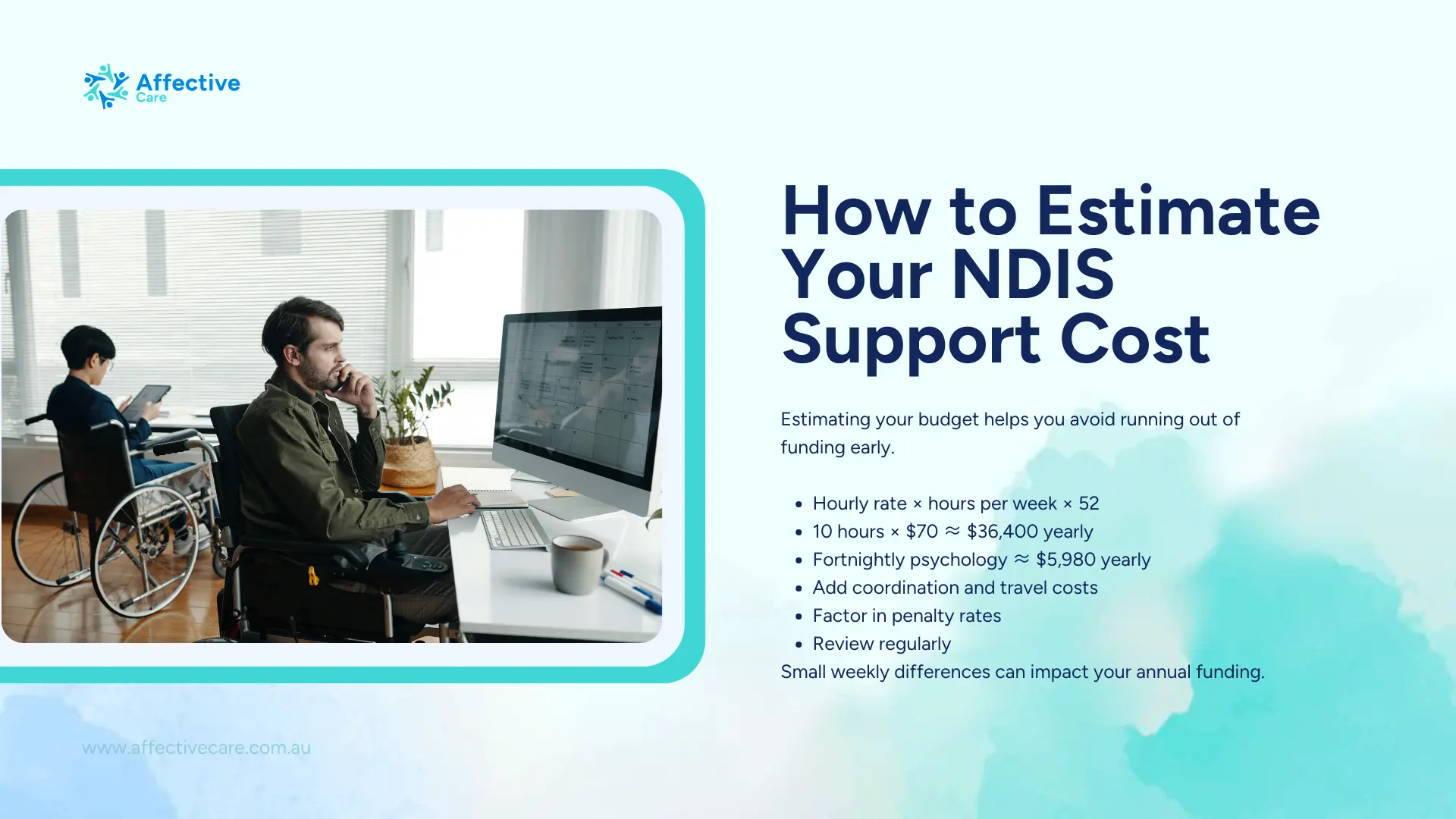
How to Estimate Your NDIS Support Costs
Many participants ask, “How much do NDIS support workers cost per week?” Here’s a simple example.
Example: 10 Hours of Support Per Week
If a weekday support worker rate is approximately $70 per hour:
- 10 hours × $70 = $700 per week
- $700 × 52 weeks = $36,400 per year
Example: Therapy Costs
If psychology sessions cost approximately $230 per hour and you attend fortnightly:
- $230 × 26 sessions = $5,980 per year
Simple Cost Formula
Hourly Rate × Hours Per Week × 52 = Annual Cost
Using an NDIS price calculator or a simple budgeting formula can help you determine whether your funding aligns with your goals.
Therefore, always factor in therapy, travel, and coordination supports when estimating your total NDIS support services cost.
Where to Find the Current NDIS Support Services Price Guide (2025–26)
The official NDIS pricing documents are published by the National Disability Insurance Agency (NDIA).
To access the latest NDIS pricing update 2025–26, visit the official NDIA website and search for:
- NDIS Pricing Arrangements and Price Limits (PAPL)
- NDIS Support Catalogue
- Current pricing announcements
Moreover, many people search for the NDIS Support Services price guide PDF or “NDIS price guide download.”
The correct documents are now listed under Pricing Arrangements and Price Limits, which replaced the old Price Guide terminology.
Always check the official NDIA website for the most up-to-date pricing before signing service agreements or reviewing your plan budget.
These documents outline:
- Maximum hourly price limits
- Remote and regional adjustments
- Travel claim rules
- Cancellation policies
- Support item numbers

Need Help Understanding Your NDIS Funding?
Understanding NDIS Support Services price guide rates (2025–26) is about more than knowing the hourly figures; it’s about knowing how those price limits apply to your individual plan, your goals, and the type of support you actually need.
While the NDIS sets maximum price limits under the Pricing Arrangements and Price Limits (PAPL), the real challenge for many participants and families is translating those numbers into meaningful, practical support.
At Affective Care, we believe NDIS funding should feel clear, transparent and empowering, not confusing.
As a trusted Sydney NDIS provider, we help you understand how Core, Capacity Building, and Capital Supports align, how pricing affects your budget, and how to make informed, confident decisions about your funding.
Moreover, our team focuses on compliance with NDIS pricing rules while ensuring every service aligns with your personal goals and wellbeing.
Whether you need daily supports, psychology and Positive Behaviour Support, or guidance through Support Coordination, we walk beside you with clarity and care.
If you would like help reviewing your plan, understanding your NDIS support services cost, or exploring how to maximise your funding, our team is here to support you.
Empowering Lives With Heart.