There is no single best Telehealth provider in Australia for every person. The right provider depends on the support you need and who will deliver it. Availability, privacy, accessibility and funding also matter. So does whether online delivery suits your individual needs.
Many people look for psychology, counselling, allied health or NDIS-related support. For them, the best Telehealth providers in Australia should explain the service clearly. You should know who will provide it and how appointments work. You should also know what can be delivered online and how progress is reviewed. A good provider will tell you when face-to-face support may suit you better.
Affective Care provides Telehealth psychology across Australia in all states and territories. It also offers Telehealth counselling, Positive Behaviour Support and several allied health and disability supports. In-person services are available across Sydney. Depending on the service, eligible clients can choose online, face-to-face or a mix of both.
This guide focuses on Telehealth for psychology, allied health and NDIS-related support. It does not cover online GP consultations, prescriptions or medical certificates.
What Makes a Good Telehealth Provider?
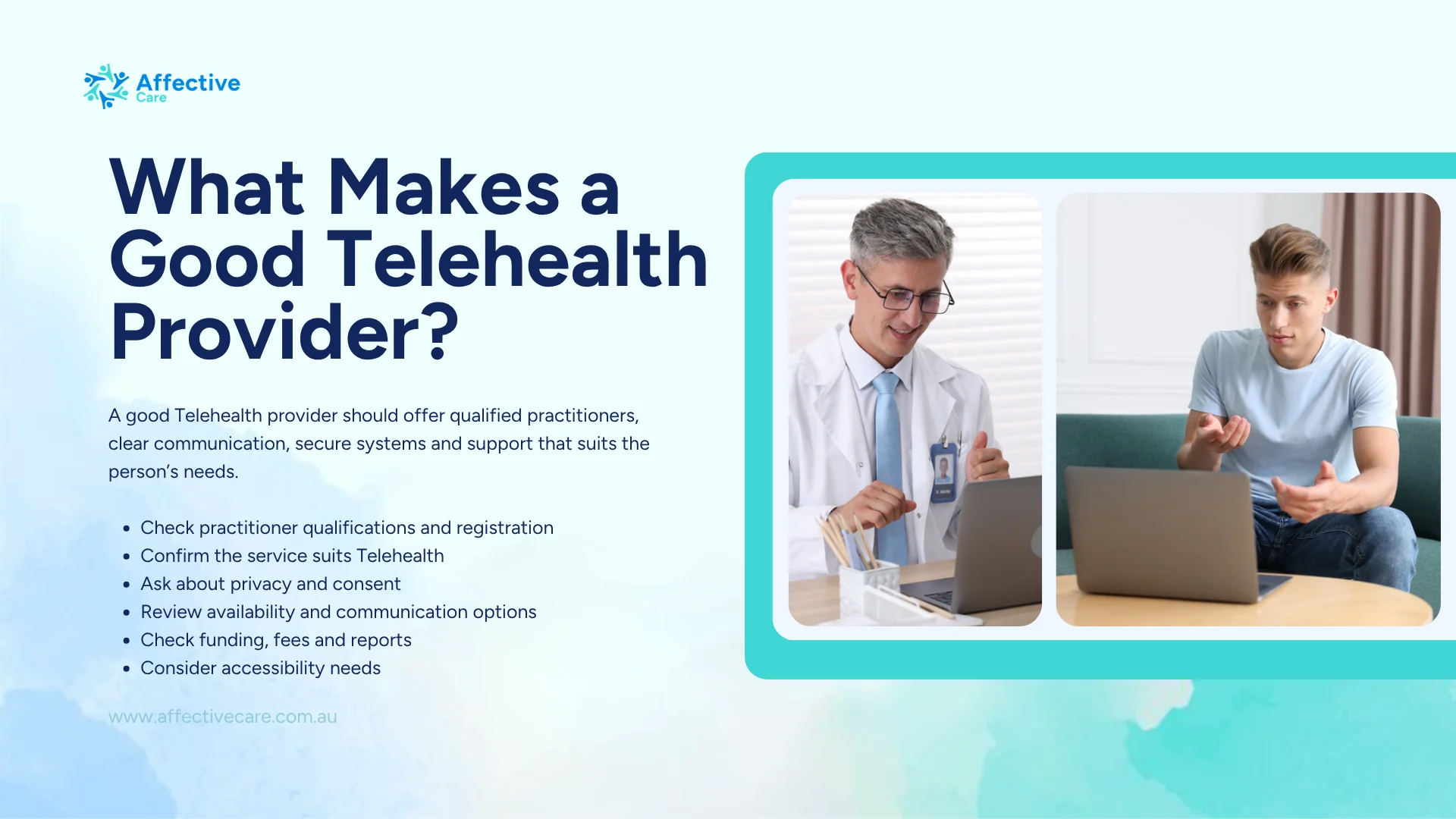
A good Telehealth provider should offer more than convenient video appointments. The service needs to suit the person's needs. It should also be delivered by suitably qualified practitioners.
Start by checking who will actually provide the support. If you are booking psychology, confirm that the psychologist is properly registered. The Psychology Board of Australia sets professional standards for psychologists. Psychologists must practise safely, effectively and within their professional competence. Virtual care does not remove these responsibilities.
Also consider whether the provider understands why you are seeking support. A general online counselling platform may not suit everyone. For example, you may need an NDIS psychological assessment, Positive Behaviour Support, speech pathology or occupational therapy.
Privacy is another important consideration. Good digital mental health care needs clinical governance, secure systems and clear consent. It also needs a suitable model of care. Australia's National Safety and Quality Digital Mental Health Standards cover these areas.
Finally, look at practical factors. These include appointment availability, communication options, funding, reports and reviews. Check whether the provider can work with family members, carers or other professionals when needed.
How to Compare the Best Telehealth Providers in Australia
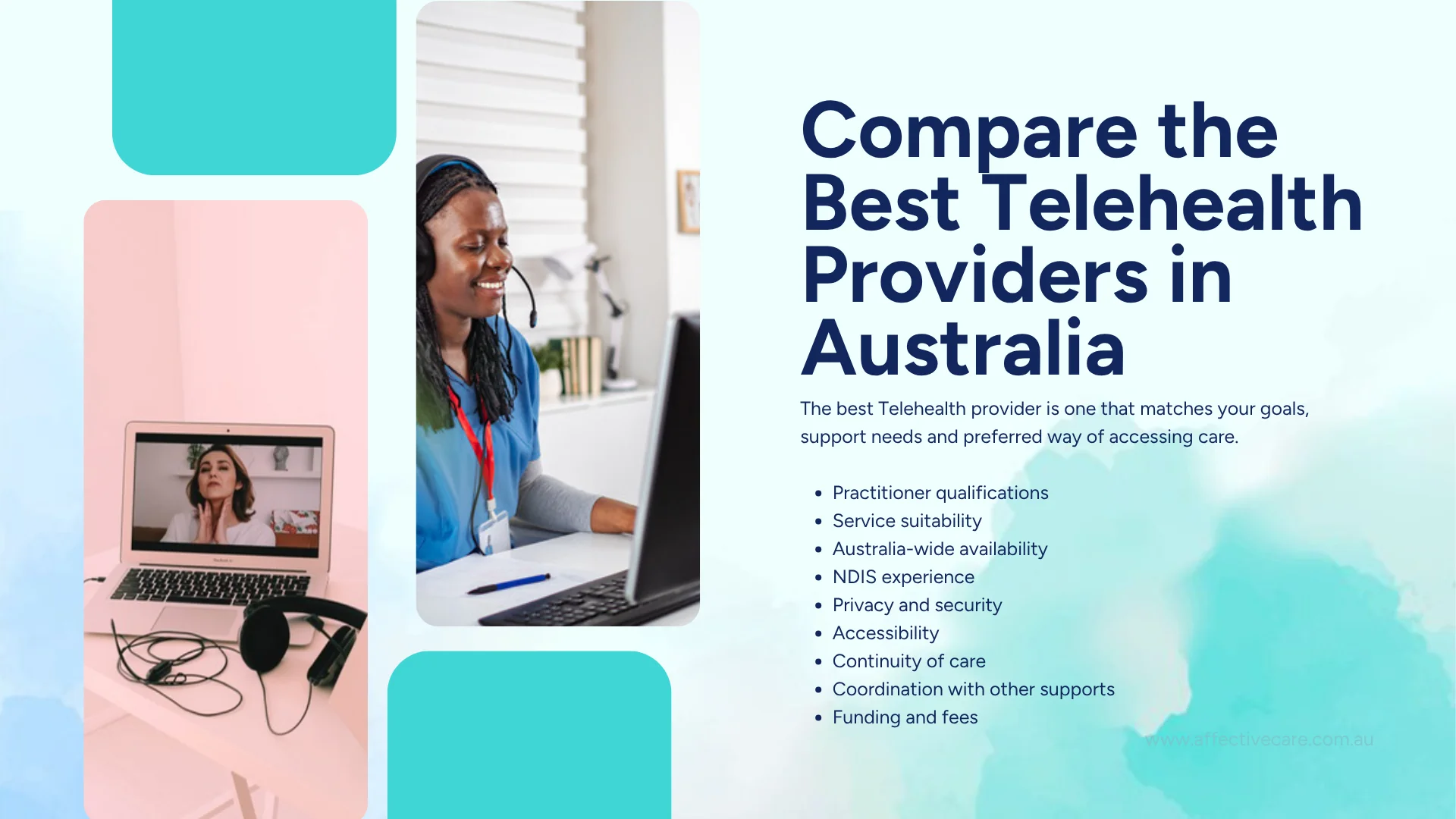
Don't choose a provider just because it appears first in a search result. Compare services on the factors that affect the quality and suitability of your support.
| Area | What to check |
|---|---|
| Practitioner qualifications | Check registration, qualifications and relevant experience. |
| Service suitability | Confirm your therapy, assessment or support can be delivered through Telehealth. |
| Geographic access | Check whether the provider works Australia-wide or only in some states or regions. |
| NDIS experience | Look for experience with disability-related goals, reports and plans. |
| Privacy | Ask about the platform, confidentiality and consent. Ask what happens if the connection fails. |
| Accessibility | Discuss communication, sensory, mobility, language and technology needs before starting. |
| Continuity | Check that ongoing sessions, reviews and consistent practitioners are available. |
| Coordination | Ask whether the practitioner can work with families, carers, Support Coordinators or other clinicians. |
| Funding and fees | Confirm fees, funding, report costs and cancellation policies before you start. |
The best Telehealth provider in Australia for you is one that meets these needs. It should also deliver a service that suits your goals. Our guide on how to choose the right NDIS online psychologist covers the same questions for psychology.
Not Sure Which Telehealth Service You Need?
Tell us about your goals and the support you are looking for. Our team can talk you through your Telehealth options.
What Telehealth Services Are Available in Australia?
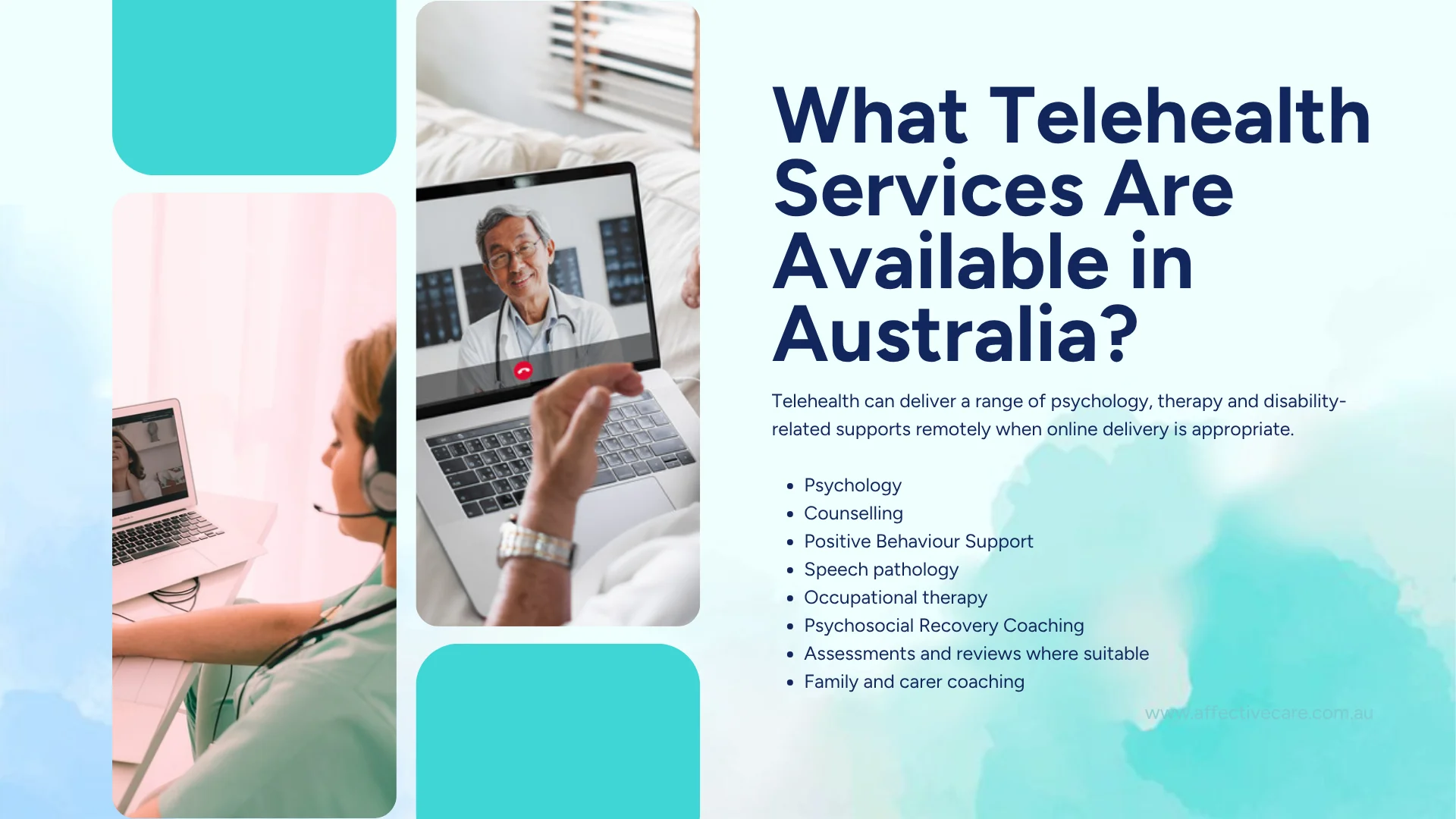
Telehealth is not a single type of therapy. It is a way of delivering different services remotely. This is usually by video, or by phone where appropriate.
Telehealth psychology can include therapy, emotional regulation support, coping strategies and progress reviews. Some assessment components may also be done online when clinically suitable. Affective Care provides Telehealth psychology Australia-wide through registered psychologists. Read more about how Telehealth psychology works.
Telehealth counselling offers confidential support for wellbeing, life changes, relationships and other concerns. Affective Care offers secure video or phone online counselling across Australia.
Telehealth Positive Behaviour Support (PBS) may include behaviour assessment and support planning. It can also include family or carer coaching, support-team training and reviews. Affective Care provides Telehealth Positive Behaviour Support across metropolitan, regional and remote Australia.
Speech therapy online can include communication assessment, therapy, family coaching and AAC-related support. Affective Care provides speech therapy for children, teenagers and adults. Sessions are available at the Campsie clinic and through home and school visits across Sydney. Secure Telehealth is available anywhere in Australia.
Occupational therapy may use Telehealth for suitable assessments, functional discussions and capacity-building strategies. It can also be used for follow-up support. Affective Care offers occupational therapy at its Campsie clinic and through home and school visits across Sydney. Telehealth appointments are also available.
Psychosocial Recovery Coaching may also be delivered online. Affective Care provides psychosocial recovery coaching in person across Sydney. It is also available Australia-wide through secure Telehealth for people living with psychosocial disability.
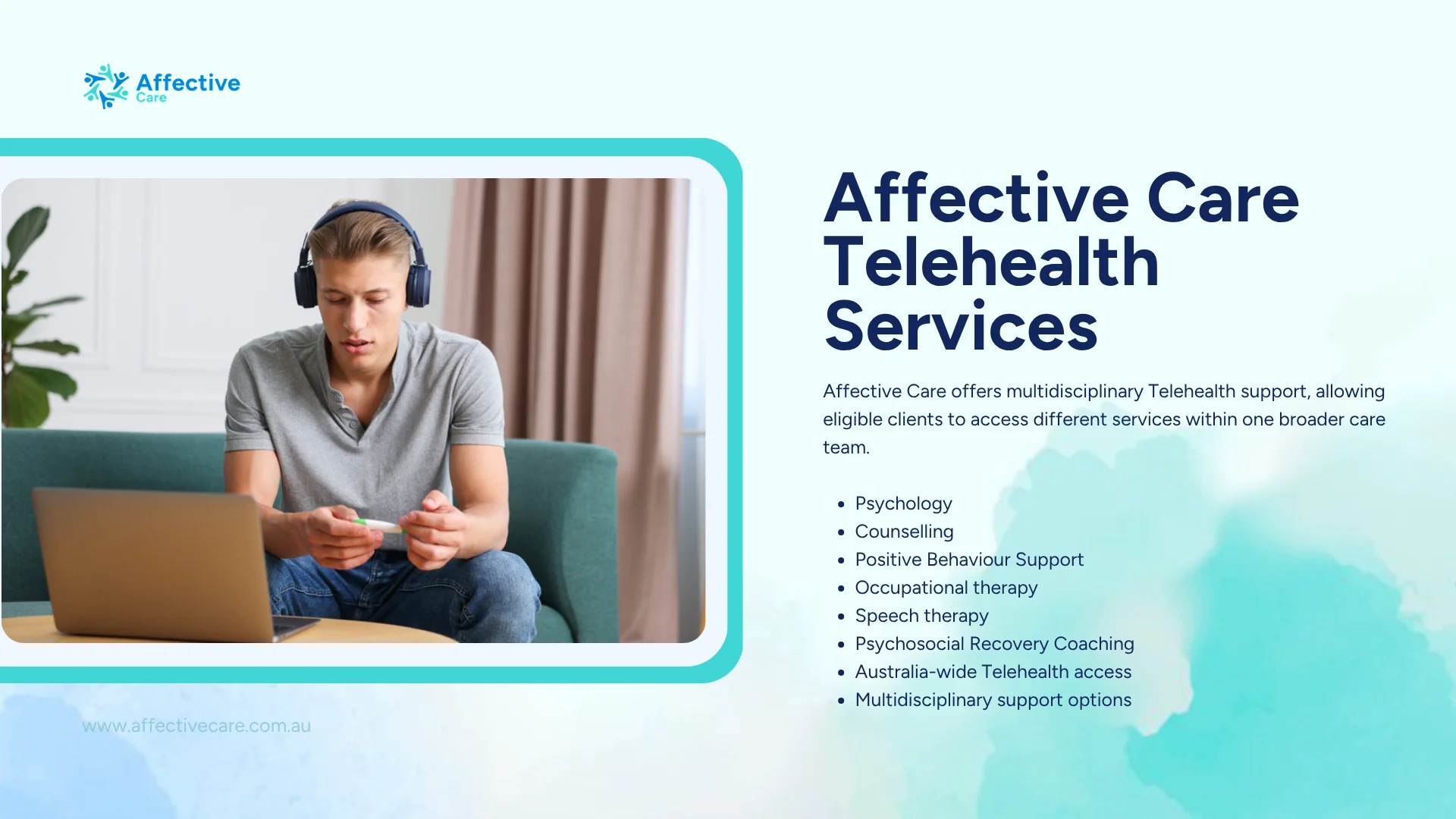
Affective Care Telehealth Services
Affective Care is a psychology-led, multidisciplinary provider. This helps when a participant needs more than one type of support. Psychology, PBS, occupational therapy, speech therapy and recovery coaching can work within one care team. They don't have to operate as separate services.
If you are comparing Telehealth providers in Australia, this may matter if your needs change over time.
For example, a person may begin with psychology. Later, they may need occupational therapy or Positive Behaviour Support. The right combination still depends on individual assessment, goals and funding.
| I'm looking for | Service to explore | Coverage |
|---|---|---|
| Emotional or psychological support | Psychology | Australia-wide Telehealth |
| Someone to talk to | Counselling | Australia-wide Telehealth |
| Daily living and independence | Occupational Therapy | Australia-wide Telehealth where suitable |
| Communication support | Speech Therapy | Australia-wide Telehealth where suitable |
| Behaviours of concern | Positive Behaviour Support | Australia-wide Telehealth |
| Psychosocial recovery goals | Recovery Coaching | Australia-wide Telehealth |
Telehealth also means you are not limited to practitioners in your own suburb. This helps when the right clinical background or disability experience is hard to find locally. It also helps if you need a particular communication approach.
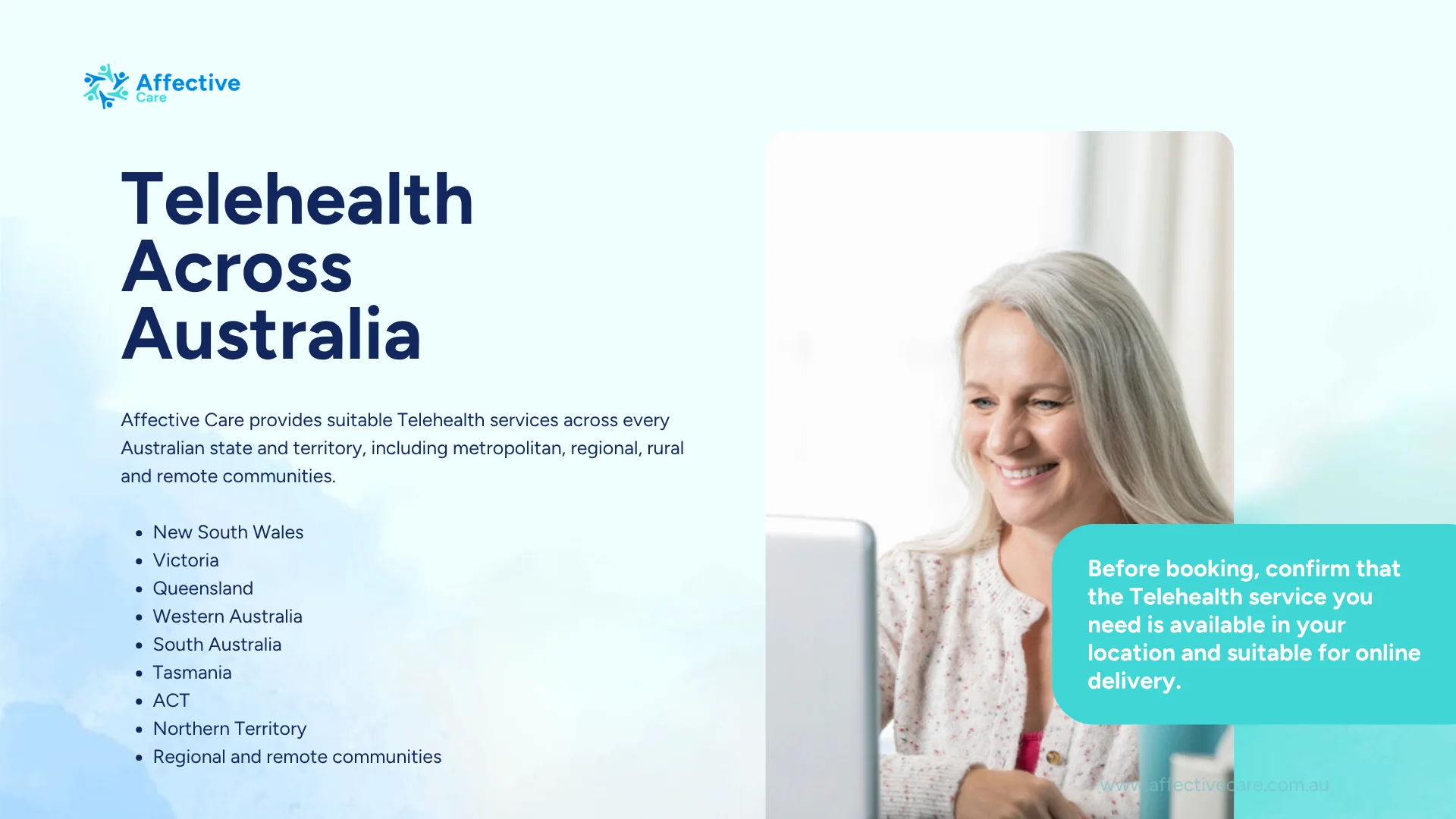
Telehealth Across Australia
Affective Care's Telehealth psychology service covers every state and territory. This includes New South Wales, Victoria, Queensland, Western Australia, South Australia, Tasmania, the ACT and the Northern Territory. Metropolitan, regional, rural and remote locations are all included. Telehealth PBS has the same national coverage.
Someone in Sydney can use the same Telehealth pathway as someone in Melbourne, Brisbane or Perth. The same applies in Adelaide, Canberra and regional communities. The service just needs to be suitable for online delivery. See our overview of Telehealth psychologists in Australia for more detail.
For regional and rural Australians, Telehealth can cut long trips to therapy appointments. It can also widen the choice of practitioners when the right expertise is not available locally. Digital mental health services are recognised nationally as a way to improve access to care. Safety, quality and suitability still need to be considered.
Telehealth Support Wherever You Live
From Sydney and Melbourne to Brisbane, Perth, Adelaide, Canberra and regional areas, our Telehealth services are available Australia-wide.
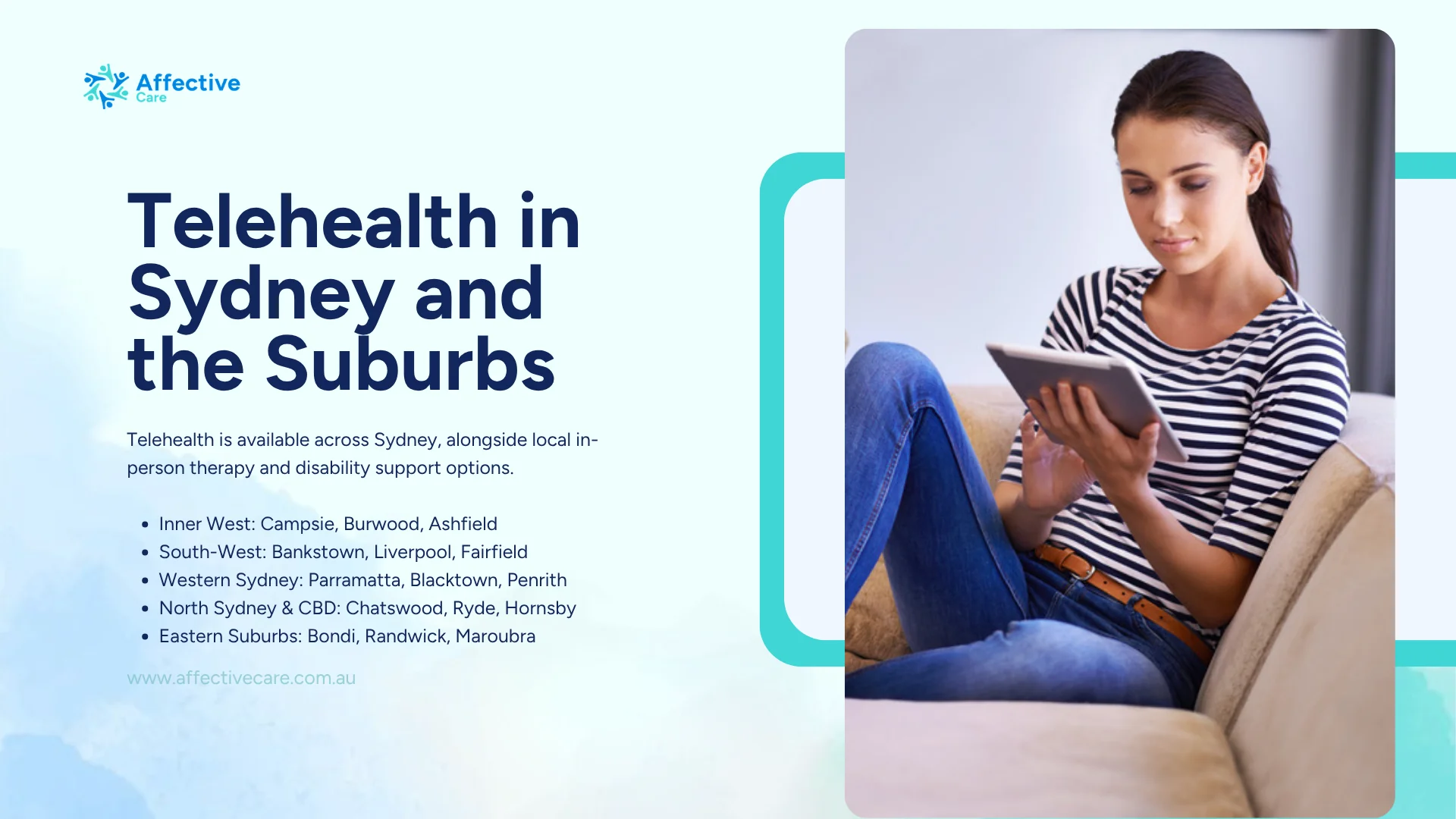
Telehealth in Sydney and the Suburbs Affective Care Supports
Telehealth is available throughout Sydney. You don't need to live near the Campsie clinic to join an online appointment.
Affective Care also provides local in-person disability support services across Sydney. Current Sydney coverage includes:
- Inner West: Campsie, Belmore, Burwood, Ashfield, Marrickville, Strathfield and Canterbury
- South and South-West Sydney: Hurstville, Bankstown, Liverpool, Fairfield and Sutherland
- Western Sydney: Parramatta, Blacktown and Penrith
- North Sydney and the CBD: Sydney CBD, Chatswood, North Sydney, Ryde and Hornsby
- Eastern Suburbs: Bondi, Randwick and Maroubra
Some therapies have their own local arrangements. For example, speech pathology is offered at the Campsie clinic and through home and school visits across Sydney. Telehealth speech pathology is available Australia-wide.
This gives you flexibility. You can use Telehealth for regular sessions. You can then book in-person appointments when direct observation or physical resources are needed.
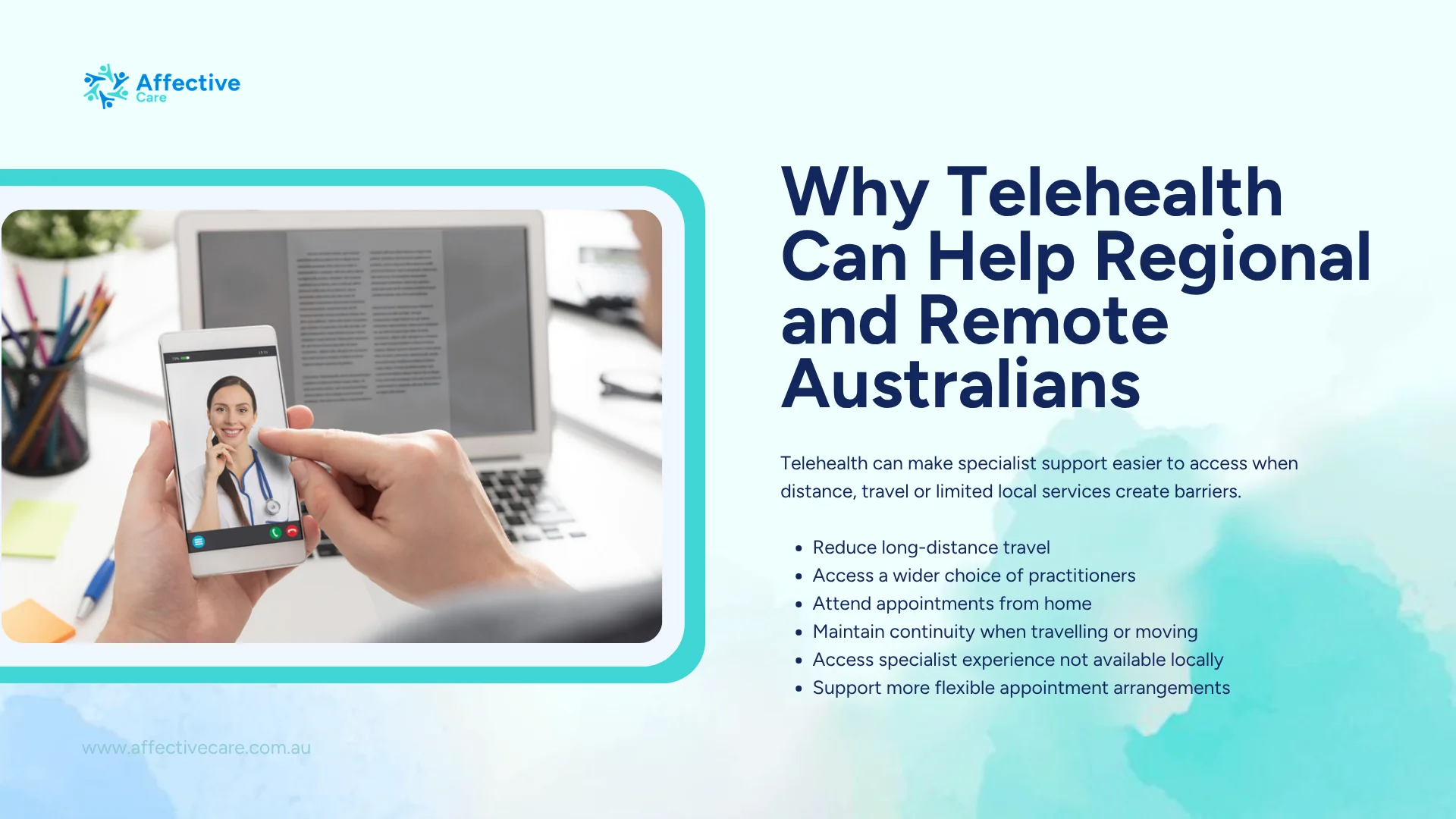
Why Telehealth Can Help Regional and Remote Australians
Distance is one of the clearest reasons to consider Telehealth.
People outside major cities may have local healthcare. But they may still struggle to find the right therapist, psychologist or Behaviour Support Practitioner.
Telehealth can reduce travel time and make regular appointments easier. It also supports continuity if a participant moves, travels or can't get to the clinic for a while.
However, location alone does not decide whether Telehealth is right. The practitioner should still consider the person's communication, privacy, technology and goals. They should also consider the type of therapy or assessment involved.
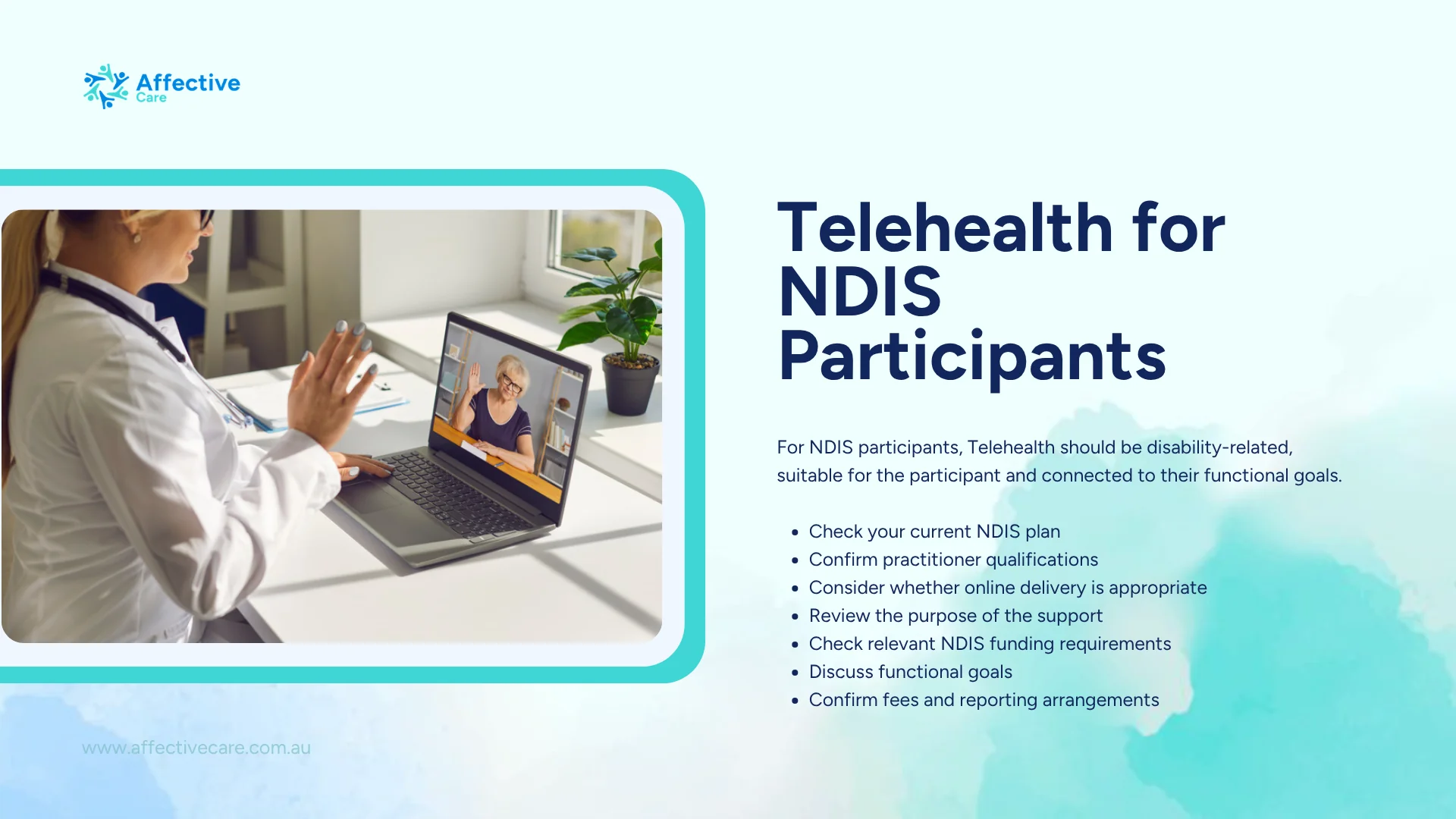
Telehealth for NDIS Participants
For NDIS participants, choosing from the best Telehealth providers in Australia takes more than checking whether a provider accepts NDIS funding.
The key question is whether the support is right for the participant. It should be disability-related and evidence-based. It should also connect to their functional goals.
Current NDIS therapy guidance is dated 27 July 2026. It describes therapy supports as evidence-based supports delivered by allied health professionals. These supports help participants build or keep skills and independence. This can be at home, school, work or in the community. To be included in an NDIS plan, therapy must meet the relevant NDIS funding criteria.
So don't assume Telehealth is funded just because a service can be delivered online. Our guide on whether the NDIS covers Telehealth psychology explains this in more detail.
Before starting a therapy support, a participant should check a few things:
- What their current plan includes
- The purpose of the service
- The practitioner's qualifications
- Whether the support meets NDIS requirements
For more on funding, see psychology under the NDIS.
Affective Care is a registered NDIS provider. We offer a range of NDIS-related therapy and behaviour support services through Telehealth where suitable.
Referring a Participant for Telehealth Support?
Support Coordinators, families and health professionals can refer for psychology, counselling, PBS, occupational therapy, speech therapy or recovery coaching.
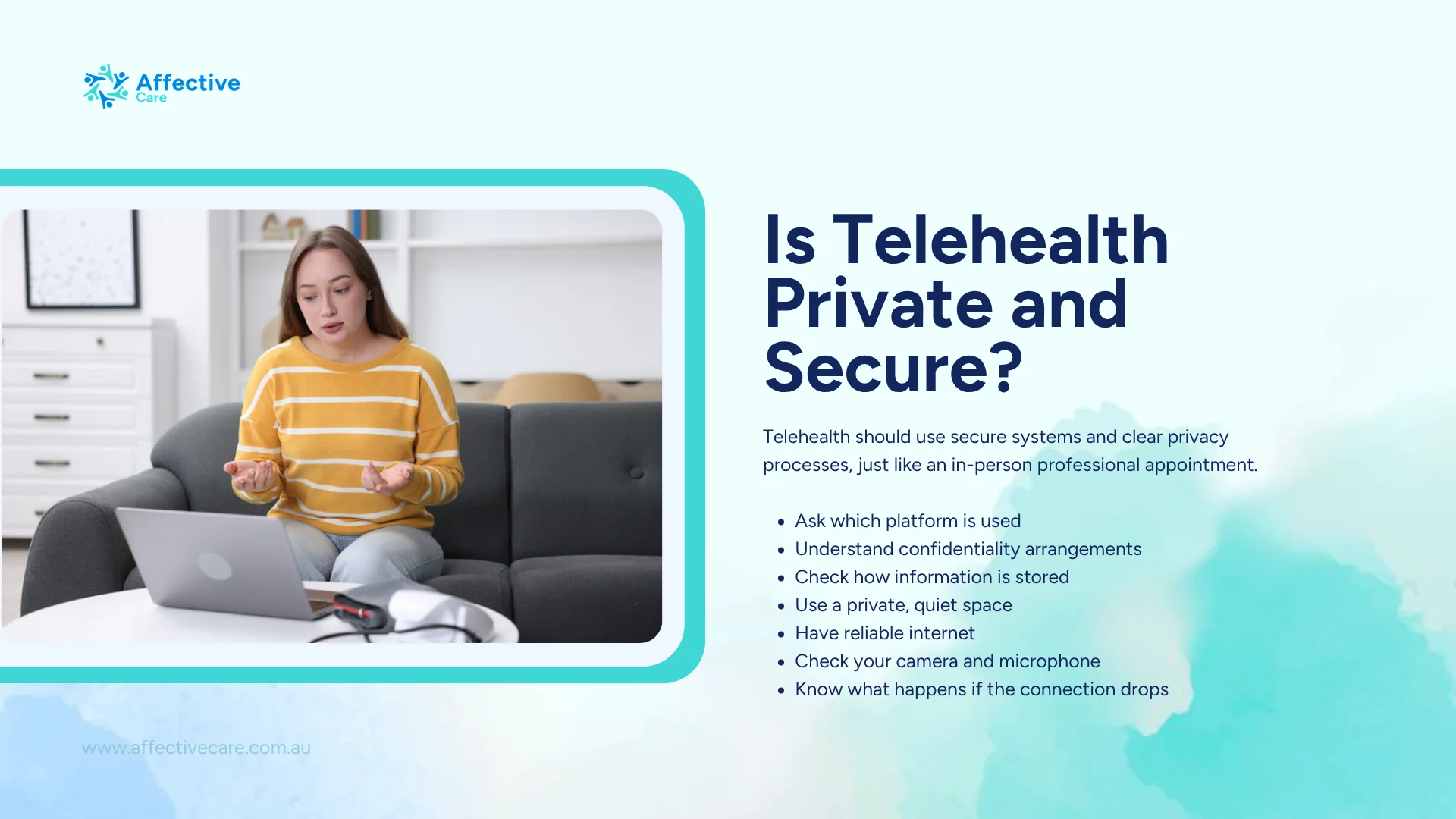
Is Telehealth Private and Secure?
Telehealth should be treated as seriously as an in-person appointment.
The provider should explain which platform is used and how confidentiality works. They should also explain how your information is managed. Ask what happens if the connection drops. Australia's Digital Mental Health Standards treat privacy, security and safe delivery as key parts of good care.
You also need a suitable space. You may need a private room and a reliable internet connection. Your device should have working audio and video. Affective Care recommends a private, quiet space and a phone, tablet or computer with internet access. Our Telehealth-ready checklist can help you prepare.
If you can't get privacy at home, an in-person appointment may be better.
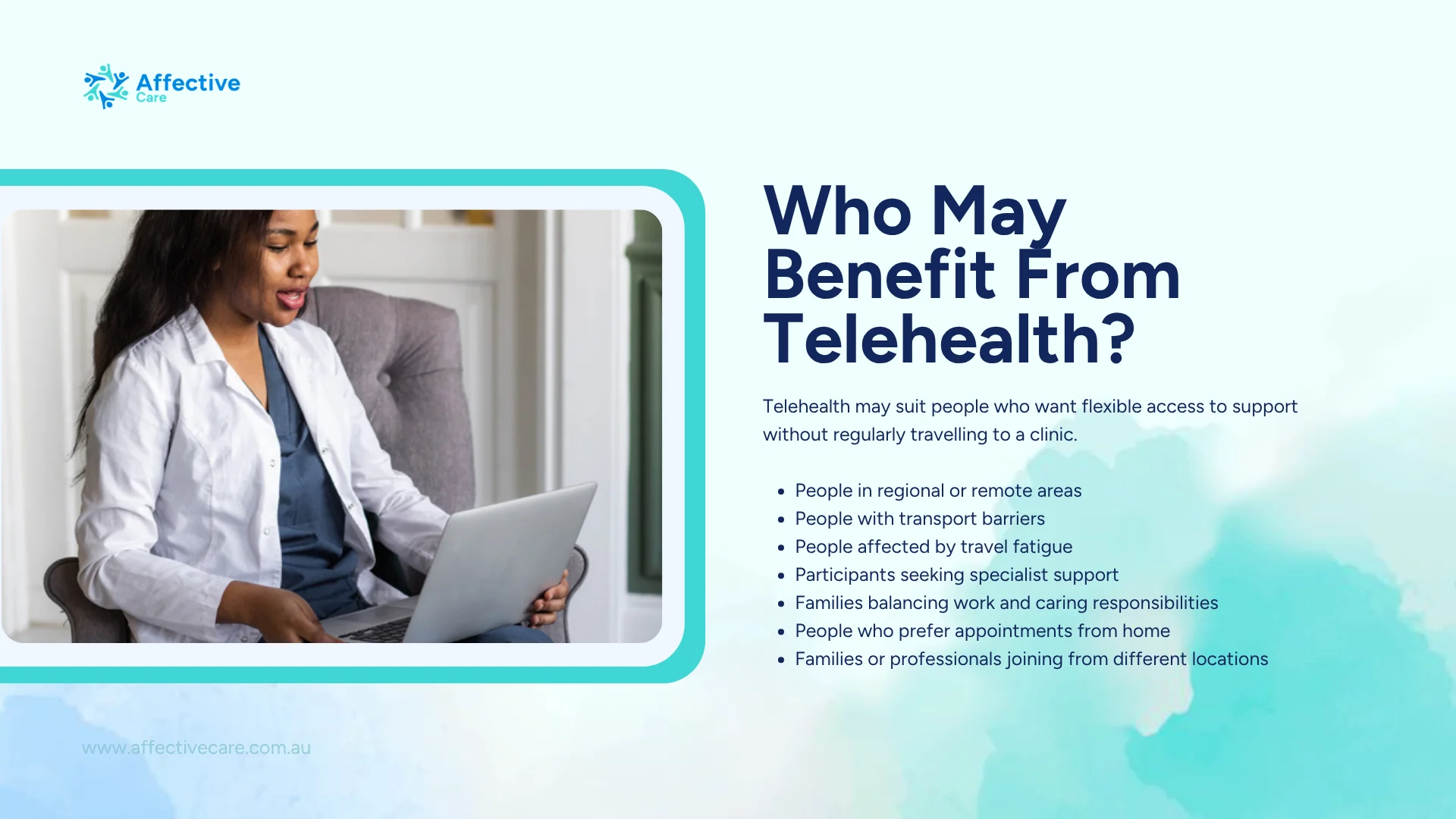
Who May Benefit From Telehealth?
Telehealth may suit people who:
- Live in a regional or remote area
- Have mobility or transport barriers
- Get tired from travelling
- Prefer to talk from home
- Need flexibility around work and family
It may also help NDIS participants who need specialist support that isn't available locally.
Telehealth can also make it easier to involve a family member, carer or other professional. Everyone can join from a different location.
These are possible benefits, not guarantees. Someone who fits all of these descriptions may still prefer face-to-face therapy.
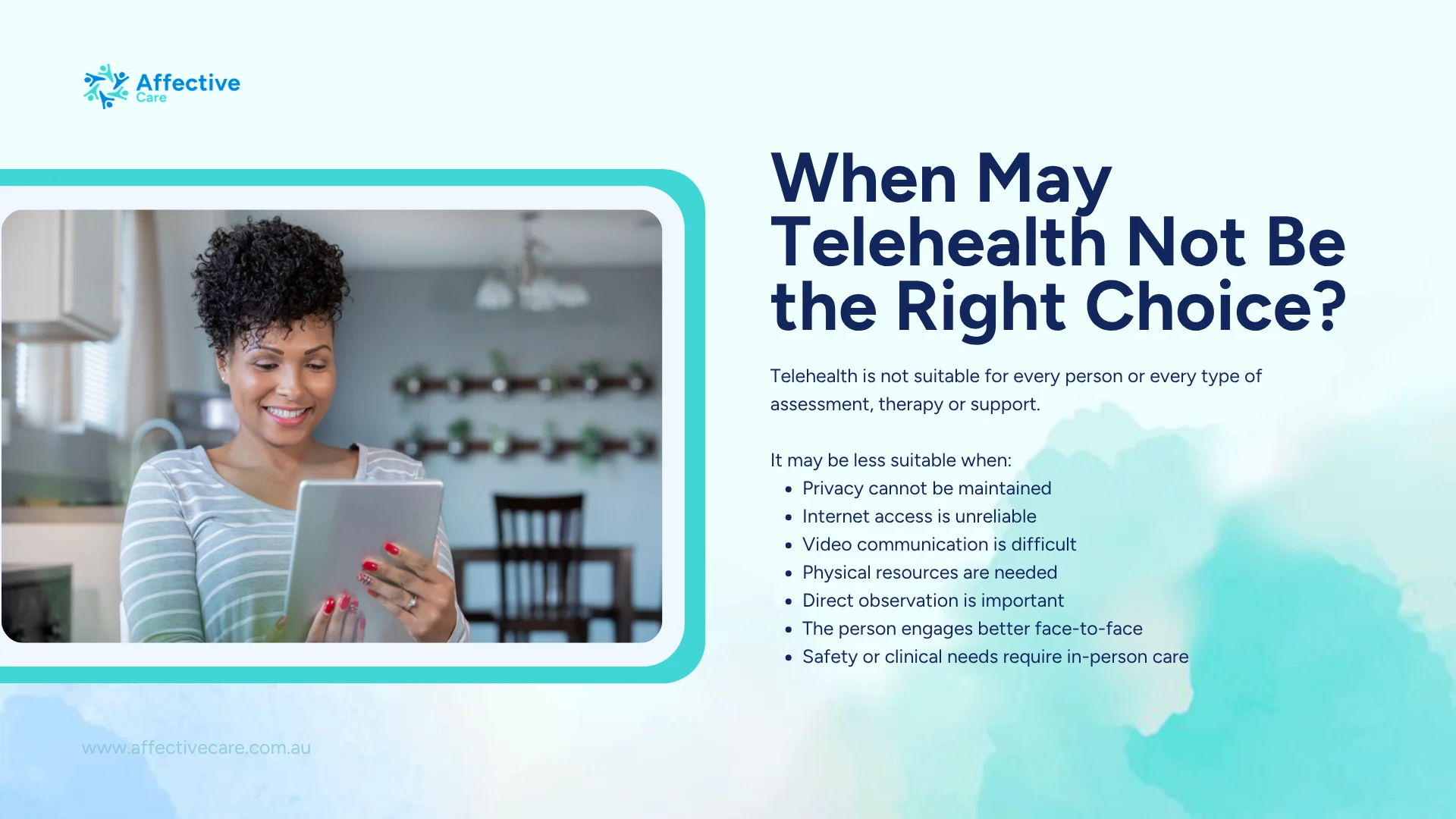
When May Telehealth Not Be the Right Choice?
Telehealth may be less suitable when:
- There is no private space available
- The internet connection is unreliable
- Communicating by video is very difficult
- An assessment needs controlled conditions or physical materials
- The practitioner needs to observe the person directly
Some people simply engage better when they are in the same room as their practitioner.
The goal is not to move every service online. It is to choose the format that supports safe, effective participation.
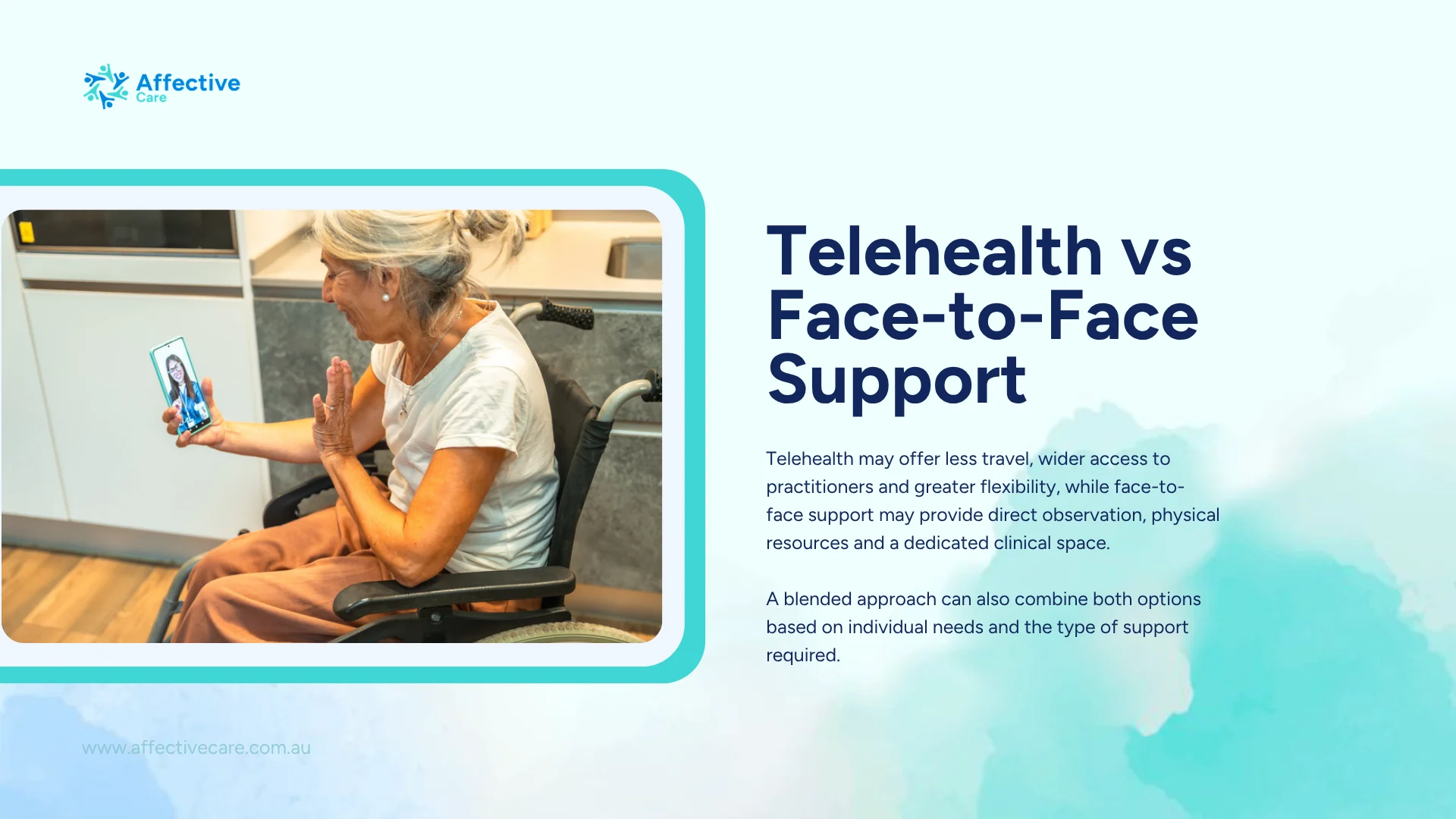
Telehealth vs Face-to-Face Support
Neither Telehealth nor face-to-face care is automatically better.
Telehealth can reduce travel and widen your choice of practitioners. It also lets you attend from a familiar place. Face-to-face appointments offer a dedicated private space and broader observation. They also make physical therapy and assessment resources easier to use.
| Area | Telehealth | In-person |
|---|---|---|
| Travel | Usually unnecessary | Required |
| Location | Australia-wide where offered | Limited by provider area |
| Technology | Required | Minimal |
| Privacy | Requires a suitable private space | Dedicated setting generally available |
| Observation | Limited to camera view | Broader in-person observation |
| Regional access | Strong advantage | May be limited |
| Physical materials | Can be limited | Easier to use |
| Flexibility | High | Depends on clinic and location |
A blended approach can also work well. For example, someone might have regular therapy by Telehealth. They might then visit a clinic for a particular assessment or review.
The best choice depends on the person's goals, communication preferences and accessibility needs. The practitioner's professional judgement also matters. For a closer look, read Telehealth vs face-to-face psychology.
Why Consider Affective Care for Telehealth?
Affective Care combines national Telehealth access with local services across Sydney. Our Telehealth services include psychology, counselling, PBS, speech therapy and psychosocial recovery coaching. Occupational therapy is also available via Telehealth where suitable.
We are psychology-led and multidisciplinary. This can help coordinate care when a participant sees more than one type of practitioner. Our Telehealth psychology service uses AHPRA-registered psychologists. It is available in every Australian state and territory. Learn more about our psychology services and psychology services in Australia.
In Sydney, local options may include clinic, home, school or community-based support. This depends on the service. Elsewhere in Australia, suitable services can be accessed remotely. There is no need to travel to Sydney.
The best starting point is still a one-on-one conversation. It helps work out what support is needed and whether Telehealth is suitable.
Find Telehealth Support That Fits Your Needs
The best Telehealth providers in Australia are not simply the ones with the biggest online presence. The right provider offers the service you need through qualified practitioners. It gives clear information about privacy and funding. Its services are accessible and work for you as an individual.
Affective Care provides Telehealth support across Australia. This includes psychology, counselling, Positive Behaviour Support, speech therapy and psychosocial recovery coaching. Occupational therapy is also available via Telehealth where appropriate. We also provide local therapy and disability services across Sydney. This includes Campsie, the Inner West, South-West, Western and Northern Sydney, and the Eastern Suburbs.
Not sure which service suits you, a family member or a participant you support? Call Affective Care on 1300 615 193 or request a free introductory call.
Find Telehealth Support That Fits Your Needs
Get psychology, counselling, PBS, occupational therapy, speech therapy and recovery coaching through Telehealth across Australia.
Frequently Asked Questions About Telehealth Providers in Australia
What are the best Telehealth providers in Australia?
There is no single provider that is best for everyone. Look for a provider that offers the service you need through qualified practitioners. It should have clear privacy procedures, good availability and transparent fees. Its approach should also suit your communication, accessibility and therapy needs.
How do I choose the best Telehealth provider for my needs?
Start with the service you actually need. Then compare qualifications, experience, privacy, accessibility, availability, funding and coverage. For NDIS support, check that the provider understands functional goals and reporting. They should also be able to work with the participant's support network.
What services can be provided through Telehealth?
Telehealth can deliver psychology, counselling, Positive Behaviour Support, speech therapy, occupational therapy and recovery coaching. This applies when online delivery is suitable. Some assessments, reviews and family or carer coaching can also be done online.
Can I access Telehealth from anywhere in Australia?
Many services operate nationally, but coverage differs between providers. Affective Care provides Telehealth psychology and PBS in NSW, VIC, QLD, WA, SA, TAS, ACT and NT. This includes regional and remote areas.
Does Affective Care provide Telehealth outside Sydney?
Yes. Our Telehealth psychology, counselling, PBS, speech therapy and recovery coaching are available Australia-wide. Our in-person services are mainly delivered across Sydney and nearby areas.
Can NDIS participants use Telehealth?
Yes, for suitable NDIS-related supports. The service must relate to the participant's disability needs. It must also meet NDIS funding criteria and be funded under the participant's plan.
Can I see an online psychologist anywhere in Australia?
Yes, if the provider offers national coverage. Affective Care's Telehealth psychologists are AHPRA-registered. They cover every state and territory, including regional, rural and remote areas, when online delivery is suitable.
Can children use Telehealth?
Yes, when online delivery suits the child's age, communication, attention and goals. The practitioner may involve parents or carers where appropriate. They may recommend face-to-face support if Telehealth is not a good fit.
Is Telehealth private and confidential?
It should be. A provider should use a secure platform with clear rules on confidentiality, consent and data handling. You will also need a private, quiet space. If you can't get privacy at home, an in-person appointment may be better.
What technology do I need?
Video appointments usually need a phone, tablet or computer and a stable internet connection. Your audio and video should work, and you need a private space. Affective Care sends joining details for its secure Telehealth psychology appointments.
Can I combine Telehealth and face-to-face appointments?
Yes, if the provider offers both and it suits your needs. For example, you could have regular online sessions. You could then attend in person for assessments or reviews.
Which Sydney suburbs does Affective Care support?
Telehealth is available across all of Sydney. In-person services cover the Inner West, including Campsie, Burwood and Ashfield. They also cover South-West Sydney, Western Sydney, North Sydney and the CBD, and the Eastern Suburbs.
Information reviewed: August 2026. This article provides general information only. Telehealth suitability, professional advice and NDIS funding depend on your circumstances and current requirements.