
Empower Lives with Heart

SIL Support Ratios Explained: 1:1, 1:2, 1:3 and 2:1

Start your care
journey with someone
who understands.

Table of Contents

JOIN OUR NEWSLETTER & GET FREE UPDATES

Core Essentials

Affective Care Instrument
Affective Care New Branded Post
Affective Care AED
SIL Support Ratios explained

Supported Independent Living ratios can seem technical at first, but they play a central role in determining how support is delivered throughout the day and night.

Understanding these ratios can help participants, families and support coordinators assess whether a Roster of Care genuinely reflects the person’s needs.

If you’ve seen a Roster of Care or a SIL quote, you’ve met the ratios: 1:1, 1:2, 1:3, sometimes 2:1.

They look like maths, but they’re really a description of how support is shared and they’re one of the biggest factors in how Supported Independent Living funding is built.
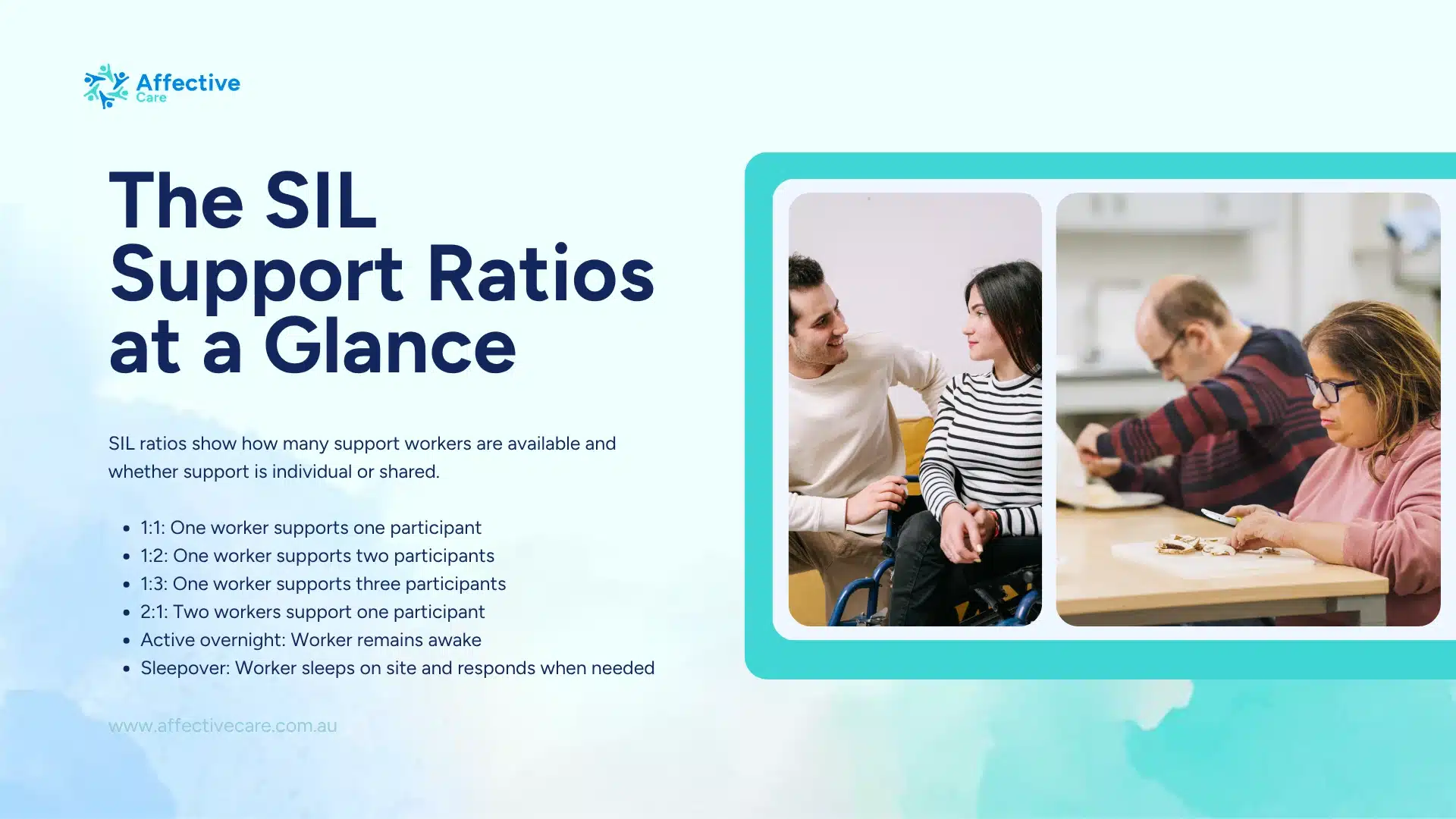
 

The SIL Support Ratios at a glance


The SIL Support Ratios at a Glance

Ratio What it means Typical use
1:1 One support worker, one participant Personal care, community outings, times when individual attention is essential
1:2 One worker shared between two participants Meal times, shared activities in a two-person home
1:3 One worker shared across three participants General daytime supervision and household routines in a shared home
2:1 Two workers, one participant Complex physical transfers or high intensity supports
Overnight: active Worker awake and working through the night Overnight medical or behaviour support needs
Overnight: sleepover Worker sleeps on site, available if needed Safety and reassurance without active overnight care

Most SIL arrangements blend several ratios across a week: shared support for routine parts of the day, individual support where it matters, and the right overnight model for safety.
Ready to Explore Supported Independent Living?
Talk with our team about your support needs, preferred location and the SIL ratios.

Why ratios matter for funding


Why SIL Support Ratios Matter for Your Funding

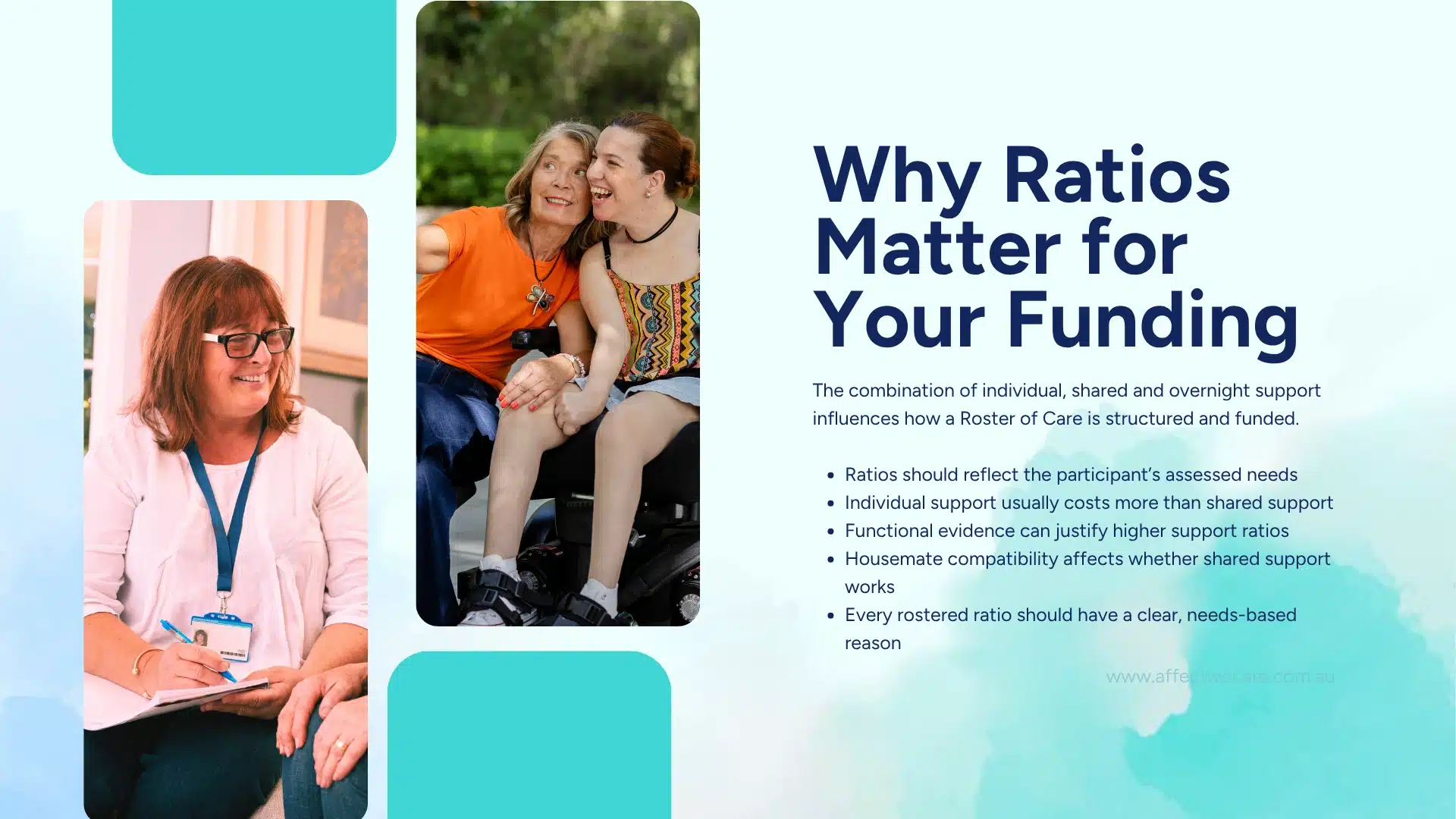
Your Roster of Care,  the weekly support pattern your provider proposes to the NDIA, is essentially a schedule of ratios. Because shared support costs less per person than individual support, the ratio mix largely determines the value of a SIL package.

Two things follow from that:

  1. Ratios should reflect need, not convenience. A participant who genuinely needs 1:1 support for personal care shouldn’t be rostered at 1:3 for those tasks because it’s cheaper — and the functional evidence should make that need undeniable. This is where strong occupational therapy assessments and behaviour support plans earn their keep.
  2. Housemate matching matters enormously. Shared ratios only work when housemates’ routines, needs and personalities are compatible. It’s one of the first things we assess when discussing our homes in Sydney, the Central Coast, Canberra and the Gold Coast.
Refer a Participant for SIL Support
Support coordinators, families and allied health professionals can refer a participant for a personalised SIL suitability discussion.

What a blended week actually look like


What a Blended Week Actually Looks Like

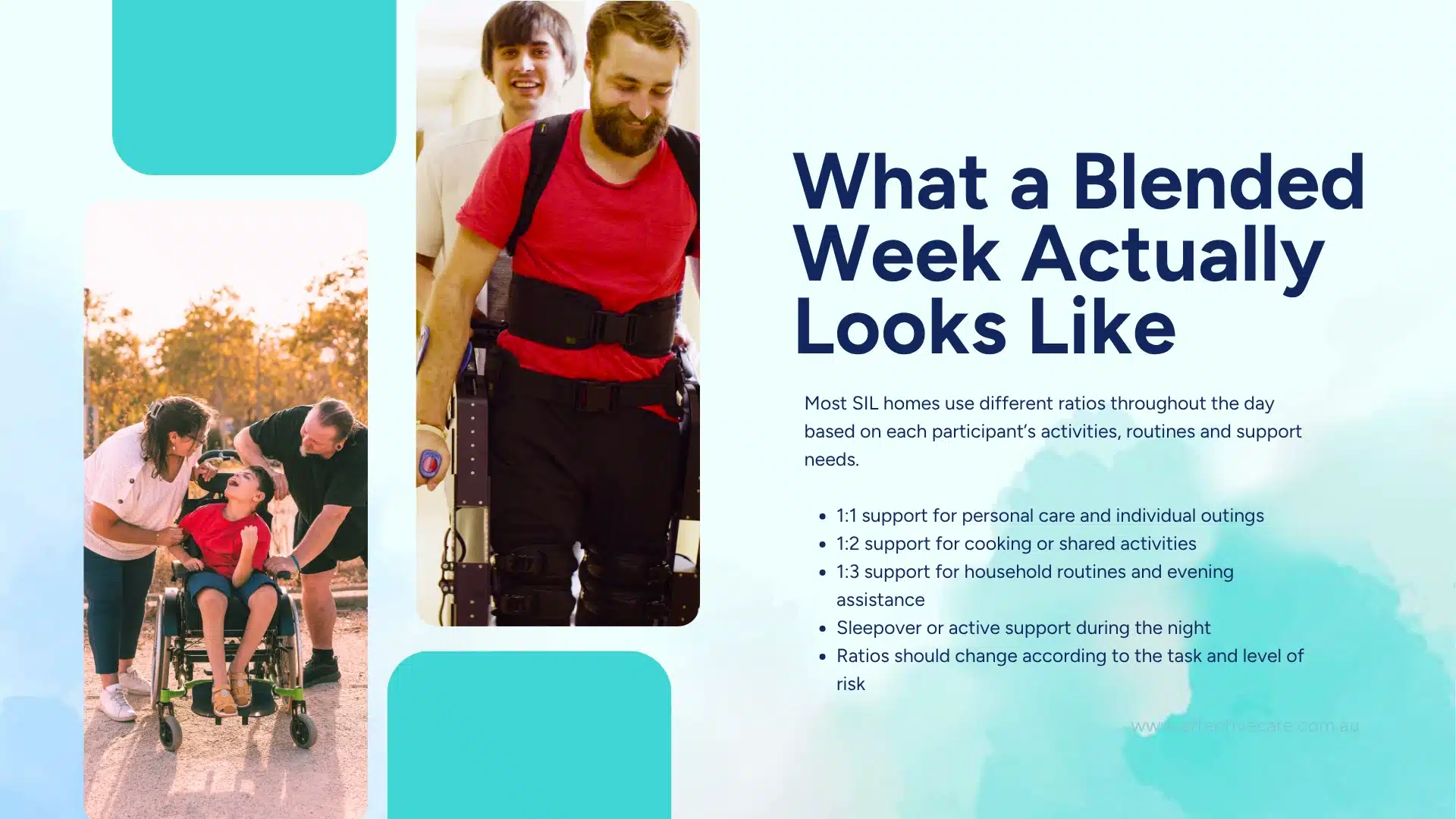
An illustrative weekday in a three-person SIL home shows how ratios weave together:

  • 6:30–9:00am — each resident receives a block of 1:1 support for personal care and breakfast routines, staggered so one worker isn’t stretched across three morning routines at once
  • 9:00am–3:00pm — residents at day programs or community activities; those at home share 1:3 support for household routines and skill-building
  • 3:00–6:00pm — a 1:2 block: two residents cook dinner together with one worker, building kitchen skills; the third has a 1:1 community access outing
  • 6:00–9:00pm1:3 shared support through dinner, downtime and evening routines
  • Overnight — a sleepover worker on site; one resident with epilepsy has documented protocols that would justify active overnight support if night-time needs increased


Same house, five different ratios in one day, each matched to what the moment requires.

When a provider shows you a Roster of Care, this is the picture behind the numbers, and you should be able to ask “why this ratio at this time?” about any line and get a needs-based answer.
Is Supported Independent Living Right for You?
Download our free SIL Readiness Checklist to review support needs.

How sil ratios change over time


How SIL Ratios Change Over Time

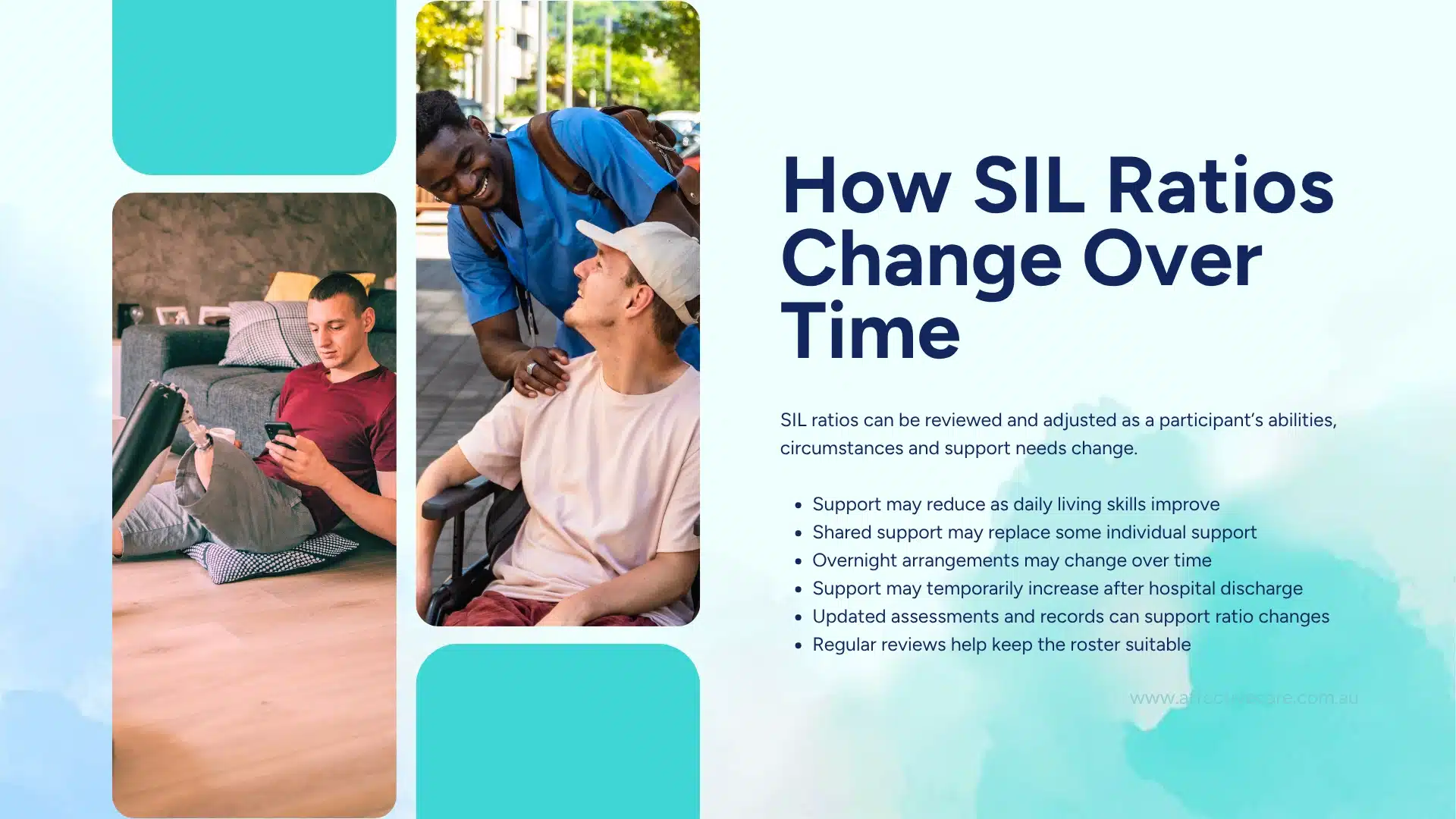
Good SIL support is not static. As participants build skills, support can step down — 1:1 blocks becoming shared support, active nights becoming sleepovers.

That’s the point: SIL is a pathway to independence, not a fixed arrangement. Equally, ratios can step up temporarily after a hospital stay; see our hospital discharge support program or during periods of change.

Ratio reviews are evidence conversations. If your needs have changed, the NDIS Plan Review Evidence Checklist will help you document it.


Have Questions About SIL Ratios?
Contact our team for clear information about Roster of Care ratios, shared supports, overnight assistance and available SIL homes.

Start your care
journey with someone
who understands.

FAQ

Your provider proposes them in the Roster of Care based on assessed need; the NDIA approves the funding. You should always understand and agree with the pattern proposed.

Yes. Living in a shared home doesn't mean every hour is shared; rosters routinely mix 1:1 blocks into shared arrangements.

Active overnight means a worker is awake and providing support through the night; a sleepover worker sleeps on site and assists if something arises. The right model depends on your overnight needs and it materially affects funding.

No — support costs are funded by the NDIS. Your own costs are rent, board, and living expenses; see "Who pays for what in SIL?"

JOIN OUR NEWSLETTER & GET FREE UPDATES

Core Essentials

Affective Care Instrument
Affective Care New Branded Post
Affective Care AED

Why Affective Care?

Trusted Partner in Your Life Journey

Affective Care Why To Choose Us Image

Care with
Heart

Affective Care offers more than services. We bring genuine compassion and empathy to your NDIS and aged care journey, supporting your goals with kindness, respect and personalised care everyday.

Why Choose Us Affective Care BG

Empowering Your Journey

Your goals matter. Affective Care partners with you to build confidence, independence, and joy in your daily life through tailored NDIS and aged care support, always delivered with heart.

Affective Care Why To Choose Us

Support with
Trust

Trust matters in care. That's why our experienced, compassionate team puts your wellbeing first. Delivering reliable, personalised NDIS and aged care support that makes a real difference every day.

Affective Care Why To Choose Us

Together We
Thrive

At Affective Care, we walk beside ypour goals anmd live life ypour way. Our care empowers people living with disability and older Australians to thrive with confidence.

You May Like

Specialist Support Coordination Level 3

Navigating the NDIS can feel demanding at the best of times. When life becomes unstable, unsafe, or overwhelming, that complexity can quickly escalate into crisis.   Many people living with disabilities, and the families who support them, reach a point where standard supports are no longer enough to hold everything together.  Moreover, you might be dealing […]

......
Does the NDIS Cover Telehealth Psychology

It may, when the psychology support relates to a participant’s disability, builds or maintains functional capacity, connects with their NDIS goals and is consistent with the funding available in their plan.  Telehealth is simply a way of delivering psychology support. An online appointment does not automatically become eligible for NDIS funding just because it is delivered by […]

......
Autism level 3 NDIS Funding

A person with Autism Level 3 may qualify for the NDIS when their autism-related impairments are permanent and substantially affect everyday activities such as communication, social interaction, learning, self-care or self-management.  However, an Autism Level 3 diagnosis does not automatically guarantee NDIS access, a particular service or a fixed funding package. The NDIA considers the person’s functional capacity, support needs, goals, […]

......
Telehealth vs face to face psychology

Choosing between Telehealth vs face-to-face psychology depends on therapy goals, communication preferences, accessibility needs, location and clinical circumstances. Telehealth psychology is delivered remotely, usually through secure video or, where appropriate, by telephone. Face-to-face psychology involves attending a clinic or suitable service location and meeting the psychologist in person. Understanding Telehealth vs face-to-face psychology can help […]

......

JOIN OUR NEWSLETTER & GET FREE UPDATES