
For years, NDIS conversations started with a diagnosis. Increasingly, they start with a different question: what can you do, what can’t you do, and what support changes that?
The document that answers it is the functional capacity assessment (FCA) and under the NDIS reforms rolling out through 2026, it’s becoming the most important report in your file.
What is a Functional Capacity Assessment?
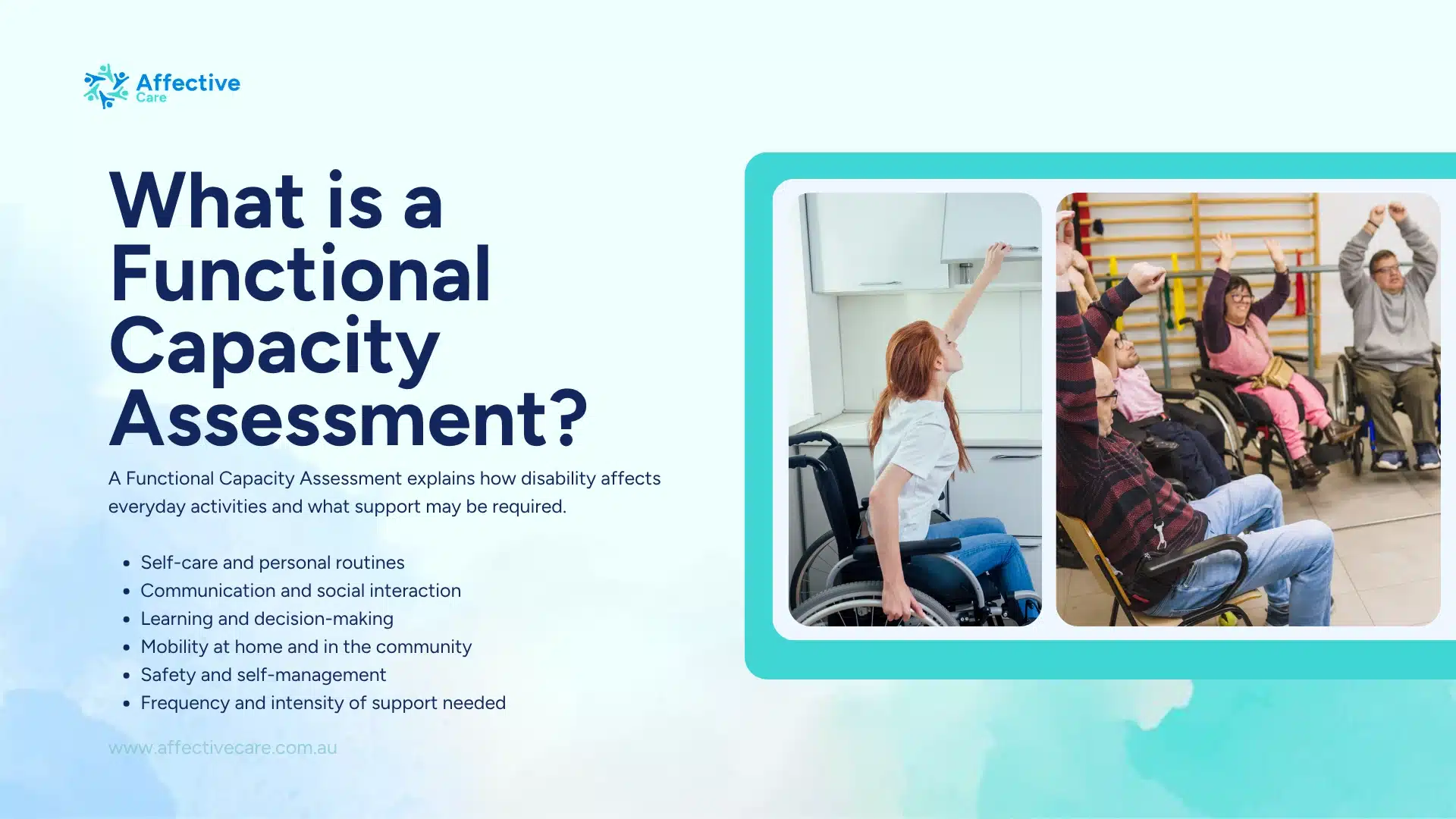
An FCA is a structured assessment, usually conducted by an occupational therapist, that describes a person’s abilities across the domains the NDIS cares about:
- Self-care: Showering, dressing, eating, medication
- Communication: Expressing needs, understanding others
- Social interaction: Relationships, community participation
- Learning: Acquiring and applying skills
- Self-management: Planning, decision-making, money, safety
- Mobility: Moving around the home and community
Crucially, an FCA doesn’t just list difficulties; it describes what support is needed, how often, and what happens without it.
That final piece is what turns an assessment into funding.
Why FCAs are the Centrepiece of the 2026 Reforms
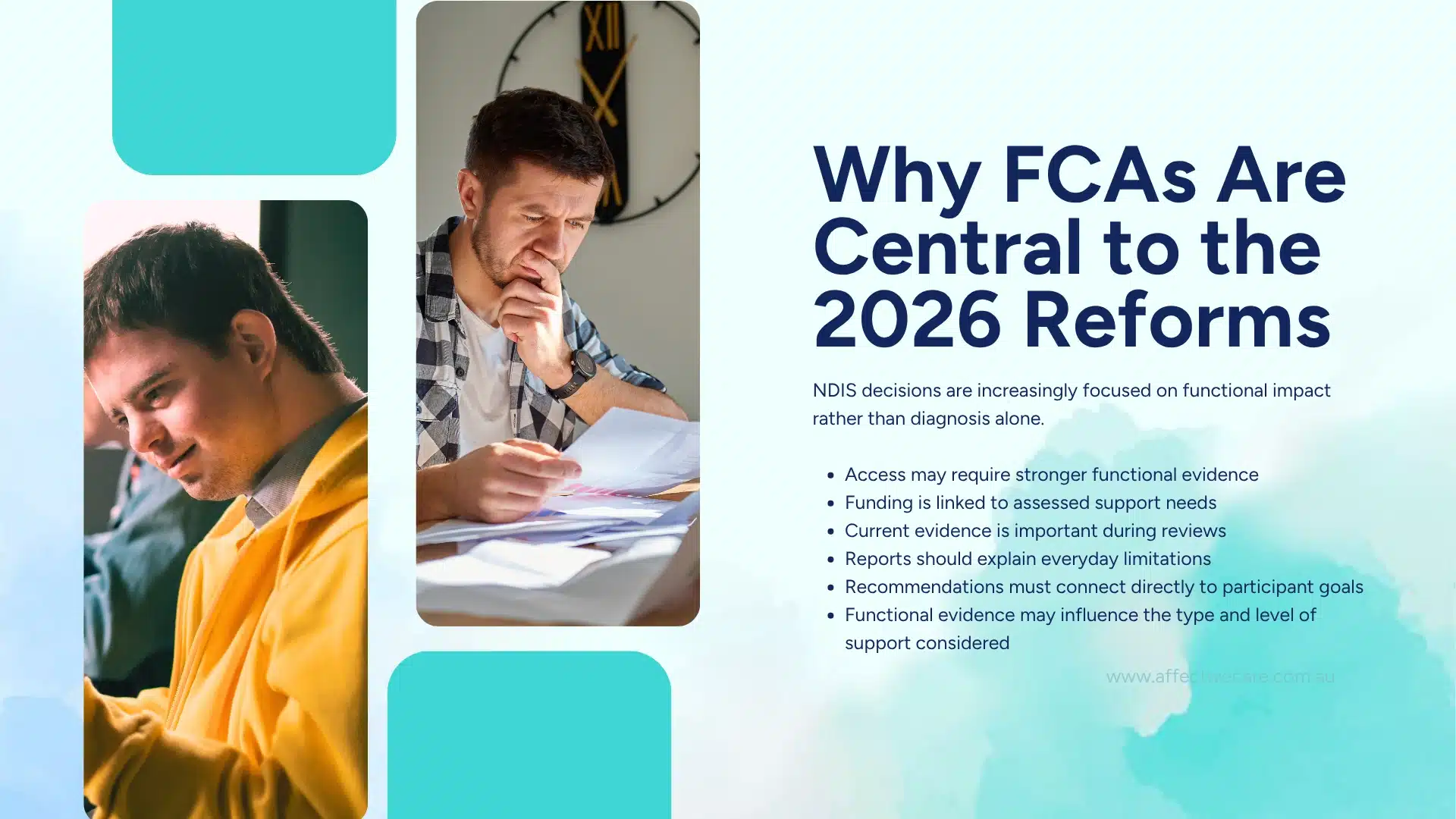
The NDIS is shifting from diagnosis-led eligibility toward functional capacity-based decisions, a change with real consequences:
- Conditions that once fast-tracked access are increasingly assessed on functional evidence (see how this affects autism and ADHD applicants)
- Plan funding levels are more tightly linked to assessed functional need
- Reviews and reassessments lean heavily on current not historical, functional evidence
If you’re following the reform detail, our analysis of the NDIS changes for 2026 covers the broader picture, including the navigator transition.
When You’ll Need an FCA
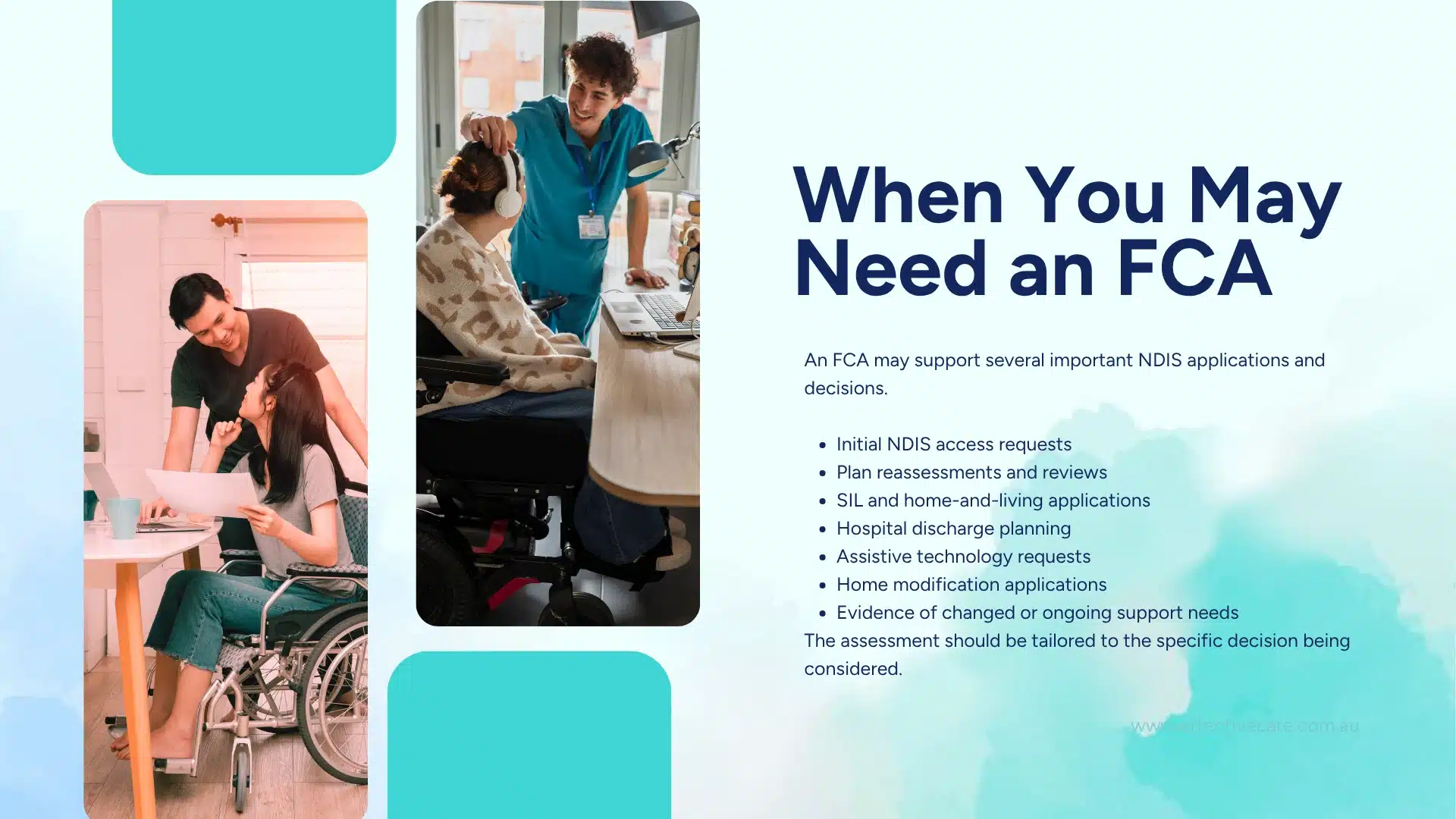
- Access requests; demonstrating you meet the disability requirements
- Plan reviews; evidencing changed or ongoing needs (evidence checklist here)
- SIL and home-and-living requests, the FCA is the cornerstone document
- Hospital discharge planning, establishing post-discharge support needs
- Equipment and home modification requests
Unsure whether you need an FCA or a different report?
The free Which Report Do I Need? guide maps report types to situations, and for the psychological side (cognitive, diagnostic, behavioural), see psychological assessments for the NDIS.
What a Good FCA Involves
- Interview and history: Your goals, routines, and what a typical day really looks like
- Observation in real settings: Home-based assessment shows what clinic rooms can’t
- Standardised tools: Recognised measures that give the NDIA comparable scores
- Input from the people who know: Family, support workers, teachers
- A report written for its audience: Clear functional statements, support recommendations with frequency and intensity, and a direct line from evidence to recommendation
At Affective Care, FCAs can draw on our whole team; OT-led, with psychology, speech and behaviour support input where the picture is complex.
We assess at home across Sydney, in clinic, or via telehealth for suitable components.
Five Ways FCAs Go Wrong
Not all functional capacity assessments are equal, and a weak one can cost more than its fee; it can anchor the NDIA to an inaccurate picture of your needs for a full plan cycle.
The failure modes we see most:
- Clinic-only assessment for home-based needs. A person’s capacity in a quiet clinic room can bear little resemblance to their capacity in a chaotic kitchen at 7:30am. If the decision is about home-and-living supports, the assessment should include the home.
- The “good day” problem. Assessments capture a snapshot; fluctuating conditions need the range documented; best days, worst days, and the pattern between. Say so explicitly to your assessor, and back it with diary evidence.
- Capacity confused with performance. Can the person prepare a meal (with maximum effort, once, while observed) versus does the person reliably prepare meals safely, day after day? Good FCAs assess sustainable, everyday performance and say which one they’re describing.
- Recommendations without dosage. “Would benefit from occupational therapy” funds nothing. “Requires 1:1 support for all personal care tasks, twice daily, approximately 45 minutes per session” is a fundable sentence. Frequency, intensity, duration, every recommendation needs all three.
- The report answers the wrong question. An FCA written for an access request reads differently from one supporting a SIL Roster of Care or an equipment application. Brief your assessor on the decision the report needs to support, a good one will ask before you tell them.
What the Difference Looks Like (Illustrative)
Amal’s first FCA; done in-clinic, generic recommendations, supported a plan that funded a few hours of weekly drop-in support, far short of her actual needs.
Her reassessment was done at home across a morning and an evening visit, quantified every support task her mother had been providing invisibly, and specified support with frequency and intensity attached.
The same person, properly described, received a plan that finally matched her Tuesday-at-7am reality; not her best hour in a clinic.
How to Prepare (and Get Your Money’s Worth)
- Keep a two-week diary of support provided who helped, with what, for how long. Real data beats recollection. (The NDIS Record Keeping Guide has templates.)
- Don’t perform. The assessment needs your ordinary days, not your best ones. Underplaying needs is the most common way families accidentally undermine their own funding.
- Bring the paper trail, previous reports, plans, school or medical letters.
- Be clear on the purpose, an FCA for a SIL request is framed differently from one for an access request. Tell your assessor what decision the report needs to support.