


Understanding NDIS behaviour support and psychology can be important when a participant needs support with behaviour, emotional wellbeing, mental health, or everyday coping skills.
Many NDIS participants, families, and carers want clear information about what these supports involve, how they are funded, and whether both can be included in the same plan.
This guide explains NDIS behaviour support and psychology in a simple, practical way.
It covers what positive behaviour support NDIS services involve, what NDIS psychology services may include, how a behaviour support plan NDIS works, and how psychology therapy can complement behaviour support in the right circumstances.
If you are preparing for a plan meeting, reviewing current supports, or exploring what services may suit your goals, this article will help you better understand your options.
It is designed to give participants and carers clear guidance on NDIS behaviour support and psychology, including how these supports differ, how they work together, and what to consider when requesting funding.
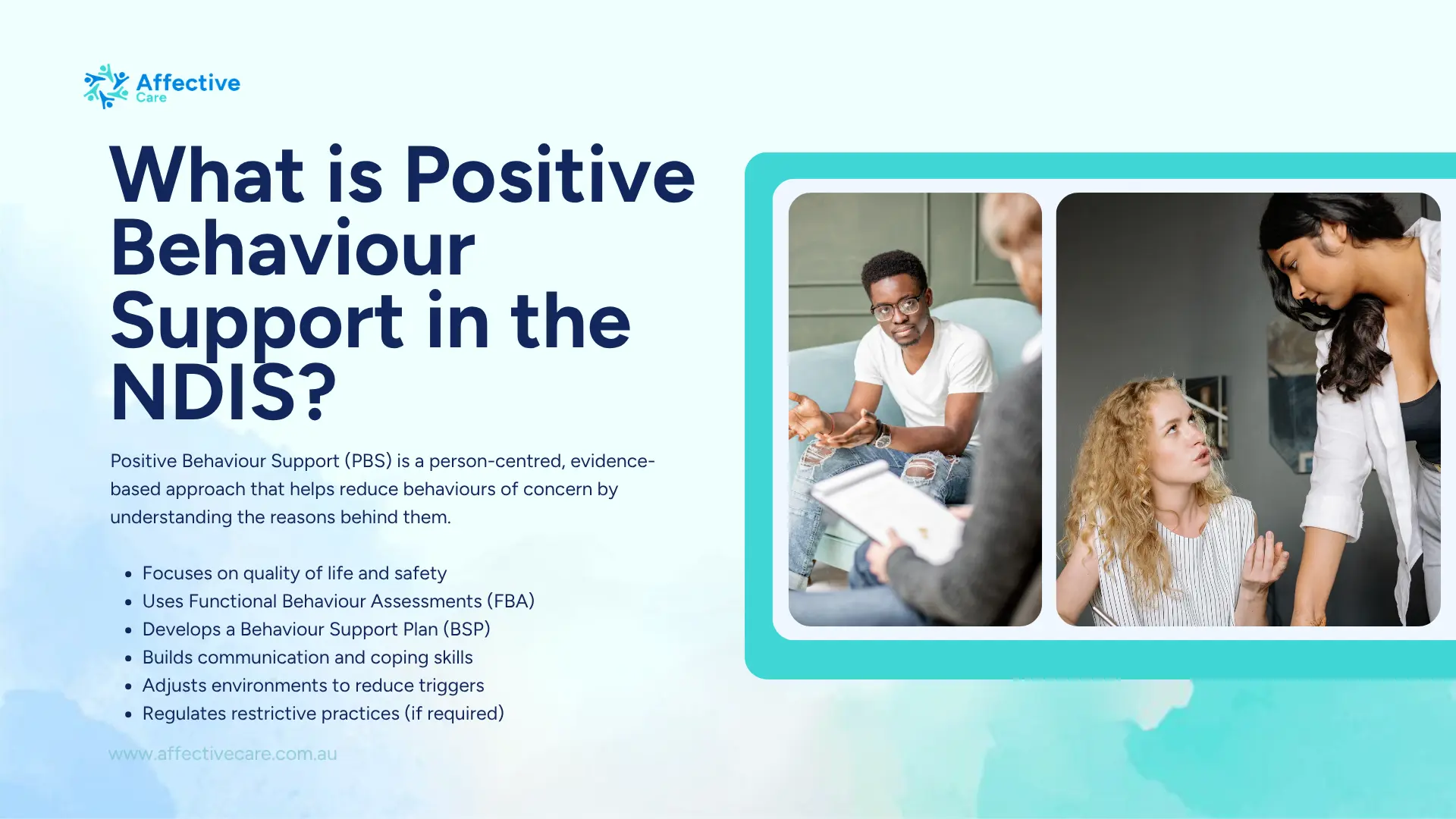
What is Positive Behaviour Support in the NDIS?
Positive Behaviour Support (PBS) in the NDIS is an evidence-based, person-centred therapeutic support for people living with disability who experience behaviours of concern.
Under the NDIS, behaviour support focuses on understanding the reasons behind behaviour, improving quality of life, reducing risk, and helping the person build safer and more effective ways to communicate and cope.
Rather than trying to simply “stop” a behaviour, Positive Behaviour Support Planning services aim to understand what the behaviour may be communicating and what supports may be needed around the person.
This can include teaching new skills, making changes to the environment, and giving clear guidance to families, carers, and support workers so support is more consistent and effective.
The goals of NDIS behaviour support often include:
- Understanding the reason behind the behaviour
- Improving quality of life
- Reducing risk and harm
- Building communication and coping skills
- Strengthening environmental and team-based supports
A qualified NDIS behaviour support practitioner carries out a behaviour support assessment, which may include a Functional Behaviour Assessment (FBA) to explore patterns, triggers, unmet needs, and environmental factors.
This assessment helps inform a behaviour support plan NDIS participants can use as part of their broader support approach.
The NDIS Commission also sets expectations for behaviour support assessments and behaviour support plans.
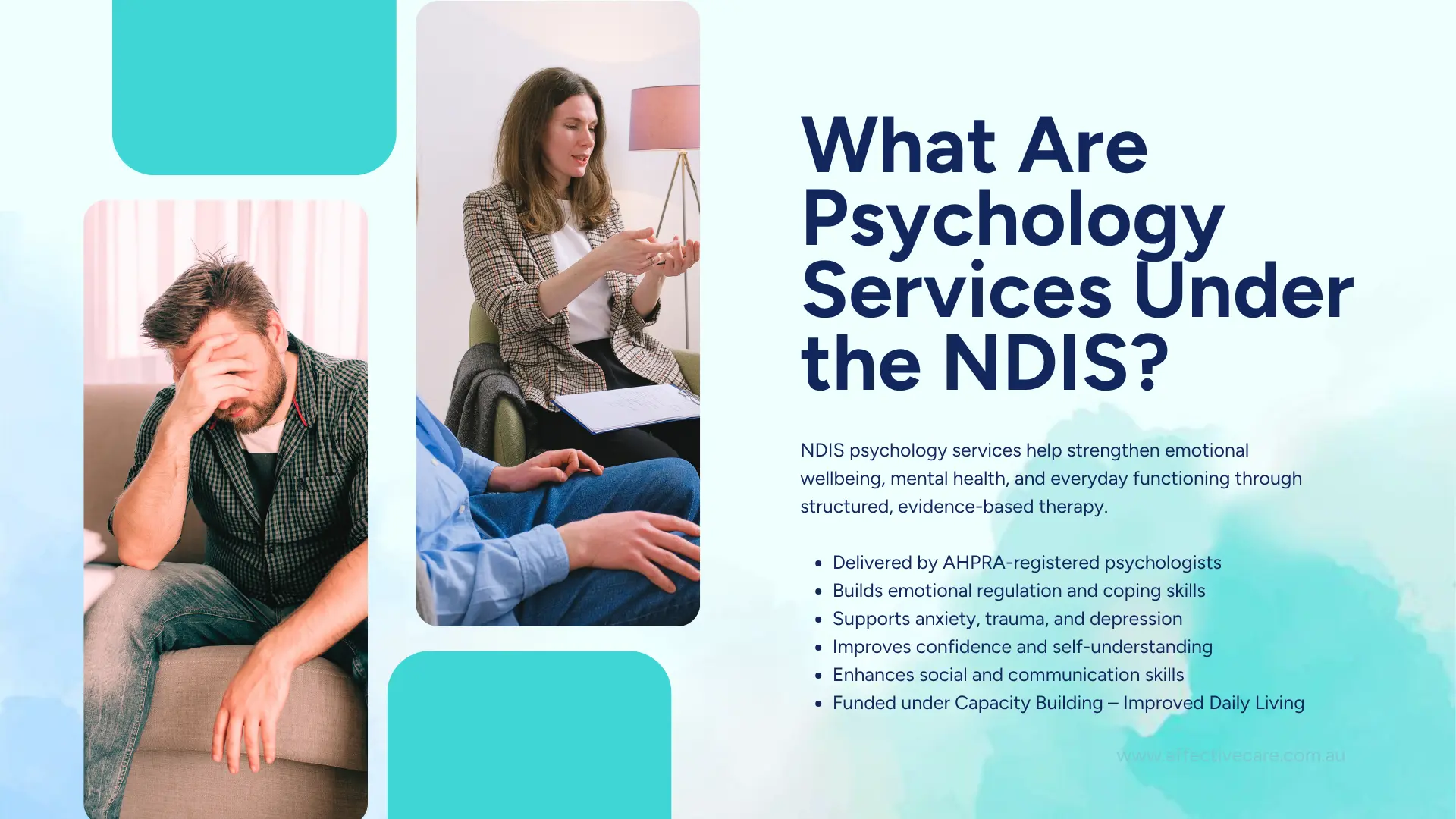
What Are Psychology Services Under the NDIS?
NDIS psychology services support people living with disabilities to strengthen emotional wellbeing, improve mental health, and build practical coping skills that enhance everyday functioning.
These services are delivered by a registered psychologist (AHPRA registered) and are tailored to the participant’s goals, functional needs, and lived experience.
Psychology under the NDIS is not simply “talking about feelings.”
It is structured, evidence-based therapy designed to improve a person’s capacity to participate in daily life, relationships, education, employment, and community activities.
A psychologist may support participants to:
- Develop emotional regulation skills
- Build resilience and healthy coping strategies
- Address trauma, anxiety, depression, or stress
- Strengthen social understanding and communication
- Improve self-confidence and identity
- Reduce overwhelm linked to life transitions
- Support neurodivergent individuals with executive functioning or emotional insight
Psychology therapy is typically funded under Capacity Building – Improved Daily Living in an NDIS plan.
The focus is on building long-term skills rather than providing crisis-only intervention.
Sessions may involve direct therapy, assessment, goal setting, strategy development, and collaboration with families or support teams where appropriate.
Unlike Positive Behaviour Support in Sydney, which examines behaviours in context and develops structured behaviour support plans, psychology explores the internal experiences that influence behaviour.
This includes thoughts, emotions, beliefs, past experiences, and nervous system responses.
For example, a participant experiencing frequent shutdowns may benefit from both supports: PBS to adjust environmental triggers, and psychology to address anxiety patterns or trauma responses contributing to distress.
Ultimately, NDIS psychology services aim to increase independence, emotional safety, and quality of life by equipping participants with tools they can use beyond the therapy room.
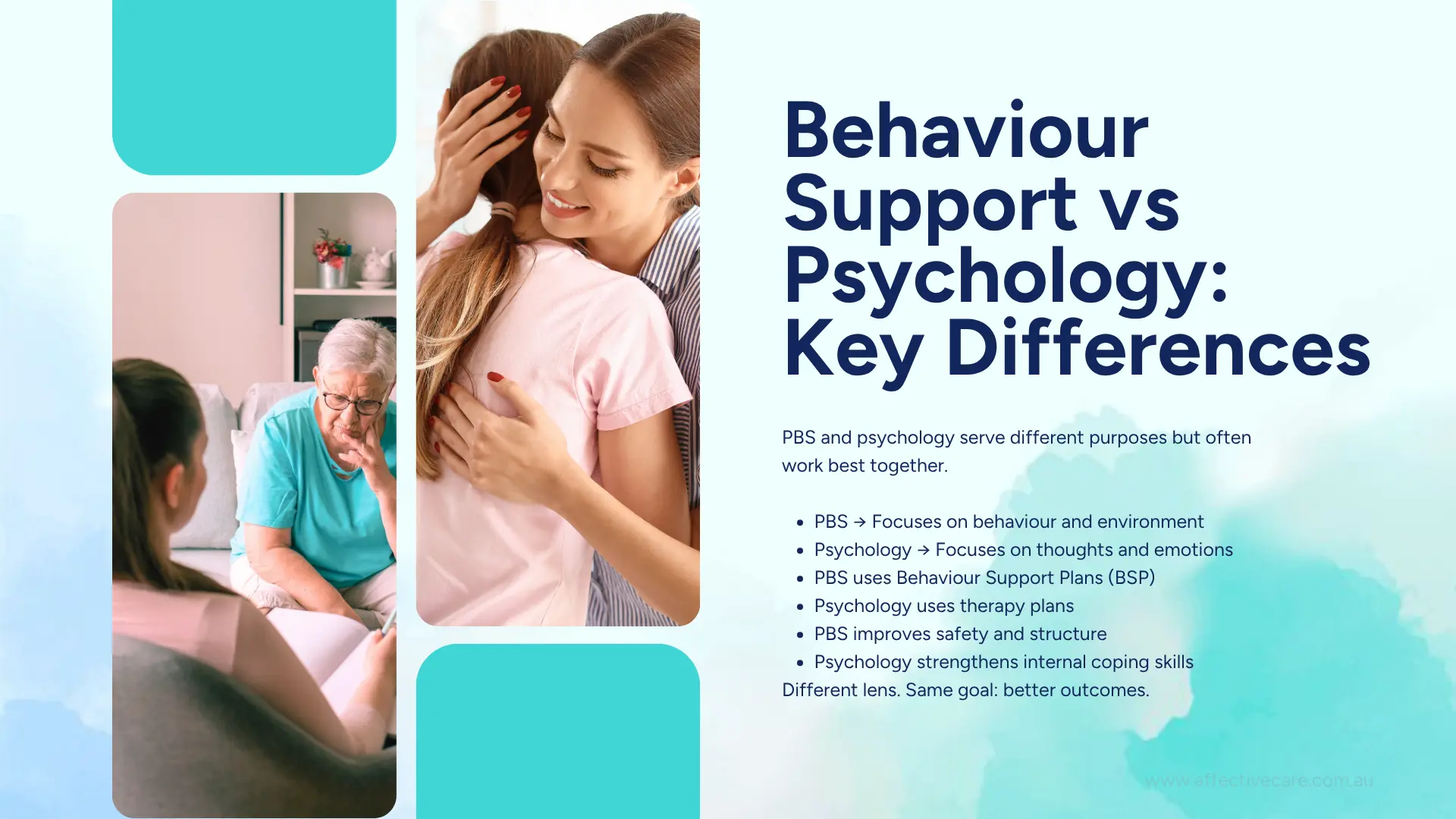
Behaviour Support Vs Psychology: Key Differences
Many NDIS participants, families, and carers across Australia ask the same question: are Positive Behaviour Support (PBS) and NDIS psychology services the same?
While both may be funded through NDIS Capacity Building supports, they are not the same service. Instead, they have different roles and often work best together.
In simple terms, positive behaviour support NDIS services focus on understanding observable behaviours, environmental triggers, and support strategies that improve safety, participation, and quality of life.
NDIS psychology services, on the other hand, focus more on a person’s thoughts, emotions, mental health, and coping patterns that may be affecting daily functioning.
This is why understanding NDIS behaviour support and psychology is so important.
Choosing the right support, or the right combination of supports, can make a meaningful difference to a participant’s wellbeing, independence, and long-term progress.
If psychology is the more appropriate support, the next decision may be how sessions are delivered.
Our guide to face-to-face vs telehealth psychology explains what to consider when choosing between clinic-based and online appointments.
Quick Comparison: Behaviour Support vs Psychology
|
Area |
Positive Behaviour Support (PBS) |
Psychology Services |
|
Primary Focus |
Observable behaviours and environmental triggers |
Thoughts, emotions, and mental processes |
|
Main Goal |
Reduce behaviours of concern and improve safety and participation |
Improve emotional wellbeing, resilience, and coping skills |
|
Assessment Type |
Functional Behaviour Assessment (FBA) |
Psychological assessment and formulation |
|
Key Document |
Behaviour Support Plan (BSP) |
Therapy plan or intervention plan |
|
When Recommended |
When behaviours affect safety, relationships, or everyday participation |
When anxiety, trauma, mood, stress, or emotional distress affect daily life |
|
Approach |
Environmental strategies, skill building, carer guidance, team-based support |
Therapy sessions, emotional support, cognitive strategies, and mental health interventions |
|
Restrictive Practices |
Aims to reduce and eliminate restrictive practices where relevant |
Does not authorise restrictive practices |
Positive Behaviour Support Focuses on Behaviour in Context
Positive behaviour support NDIS services look at what is happening around the person, not just the behaviour itself.
A behaviour support practitioner explores possible triggers, unmet needs, communication barriers, sensory factors, routines, and environmental stressors.
This process often leads to a behaviour support plan NDIS participants can use to guide safer, more consistent support.
PBS is often recommended when behaviours of concern are affecting safety, daily routines, relationships, community access, or quality of life.
The goal is not punishment or control. The goal is to understand the reasons behind behaviour and put better support in place.
Psychology Focuses on Emotional Wellbeing and Internal Experiences
NDIS psychology services focus more on what is happening internally for the participant. This can include thoughts, emotions, beliefs, trauma responses, anxiety, depression, self-esteem, stress, and emotional regulation difficulties.
A psychologist works with the participant to build practical skills that improve emotional wellbeing and everyday functioning.
For many people, psychology therapy NDIS supports may help with emotional regulation, resilience, coping strategies, confidence, relationships, life transitions, and self-understanding.
This can be especially helpful when emotional distress, trauma, or mental health challenges are affecting participation at home, in education, at work, or in the community.
When Both Supports May be Helpful
In many situations, participants benefit from both NDIS behaviour support and psychology. These supports are different, but they can be highly complementary.
For example, a participant experiencing aggressive outbursts, shutdowns, or high distress may receive positive behaviour support NDIS services to identify triggers, adjust the environment, and develop structured response strategies.
At the same time, NDIS psychology services may help the participant build anxiety management skills, process trauma, improve emotional insight, and strengthen coping tools.
This combined approach can be especially helpful when both external factors and internal emotional experiences influence a participant’s behaviour.
Why the Difference Matters in an NDIS Plan
Understanding the difference between Behaviour support vs psychology NDIS services can help participants and carers ask for the right supports during planning meetings and plan reviews.
Behaviour support is generally used when behaviours of concern require structured assessment, planning, and team guidance.
Psychology is often used when the participant needs therapeutic support to improve emotional wellbeing, mental health, and daily coping capacity.
Rather than seeing them as one or the other, it is often more helpful to view them as two supports that may work side by side within a person-centred NDIS plan.
Together, NDIS behaviour support and psychology can provide a more holistic approach that improves safety, emotional wellbeing, participation, and long-term outcomes for people living with disability in Australia.
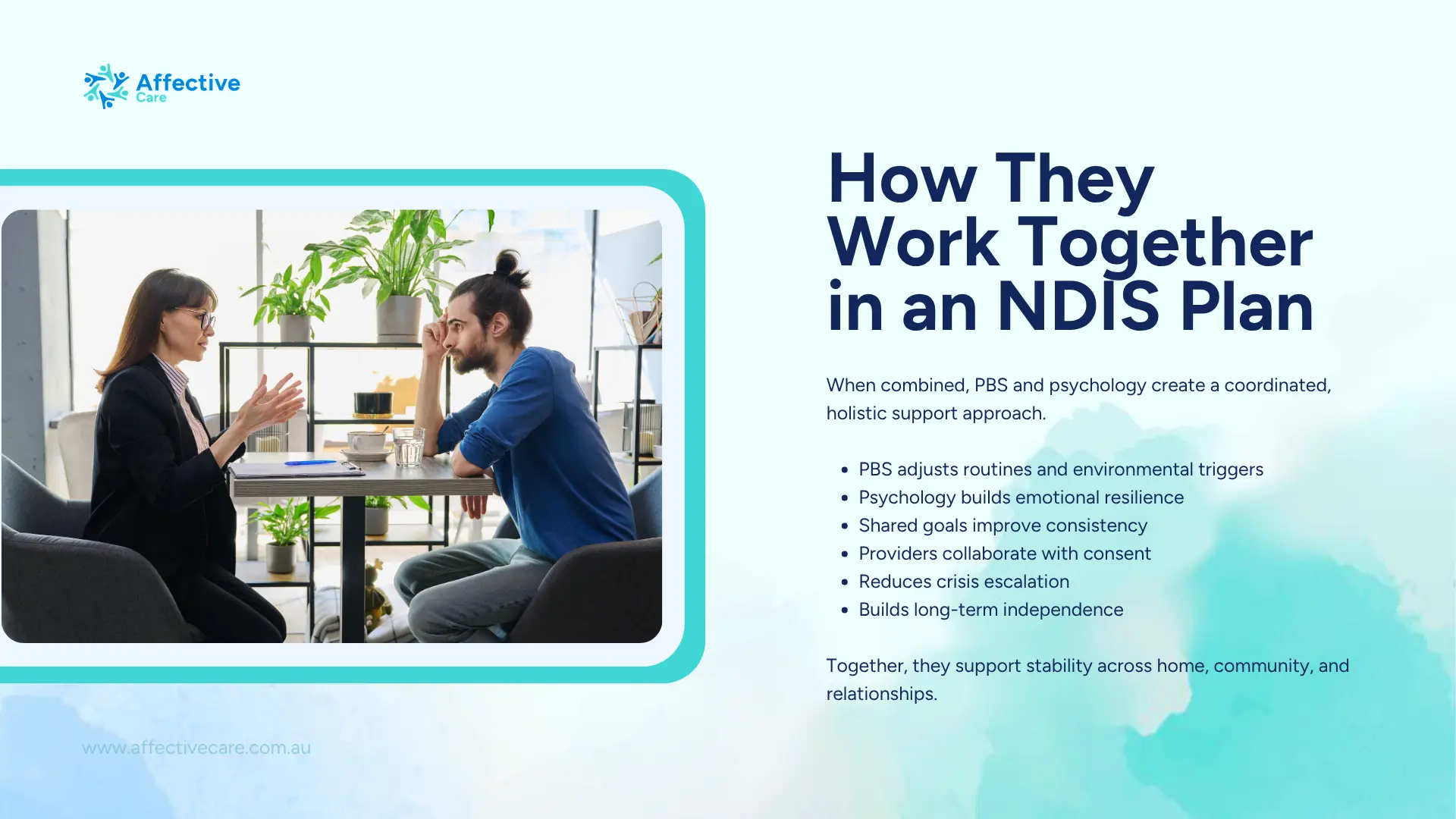
How They Work Together in an NDIS Plan
When Positive Behaviour Support (PBS) and psychology services are included in the same NDIS plan, they often play complementary roles within a broader, person-centred framework.
Rather than duplicating each other, they address different layers of need: behavioural, emotional, environmental, and relational.
Complementary Roles in Holistic Support
A behaviour support practitioner focuses on understanding behaviours of concern in context. They assess triggers, environmental factors, communication needs, and support responses.
Their goal is to improve quality of life, reduce risk, and build practical skills through a Behaviour Support Plan (BSP).
A psychologist, on the other hand, works with the participant to explore internal experiences such as anxiety, trauma, emotional regulation challenges, or self-esteem difficulties.
Therapy sessions may build coping strategies, emotional awareness, and resilience.
Together, PBS may adjust the environment and support systems, while psychology strengthens the person’s internal capacity to manage stress and emotions.
Real-World Example of Joint Planning
For example, a young adult experiencing emotional outbursts at home may receive:
- PBS support to identify triggers, modify routines, and train support workers in de-escalation strategies.
- Psychology therapy to build emotional regulation skills, process underlying anxiety, and develop coping tools.
Both professionals may collaborate with consent to ensure goals align and strategies are consistent across home, community, and therapy settings.
Benefits of Multidisciplinary Support
When coordinated well, multidisciplinary support under the NDIS can improve stability, confidence, and everyday participation for NDIS participants across Australia.
A team approach that includes NDIS Positive behaviour therapy and psychology can create more consistent, person-centred support across different settings.
The benefits of multidisciplinary NDIS support may include:
- Greater consistency across services
- Reduced crisis escalation
- Improved communication between providers
- Stronger long-term skill development
- Better outcomes for participants and families
- More tailored support aligned with the participant’s goals
- Improved emotional wellbeing and daily functioning
When positive behaviour support NDIS services and NDIS psychology services work together, participants can receive both practical strategies and therapeutic support.
This can help build safer routines, stronger coping skills, and more meaningful progress over time.
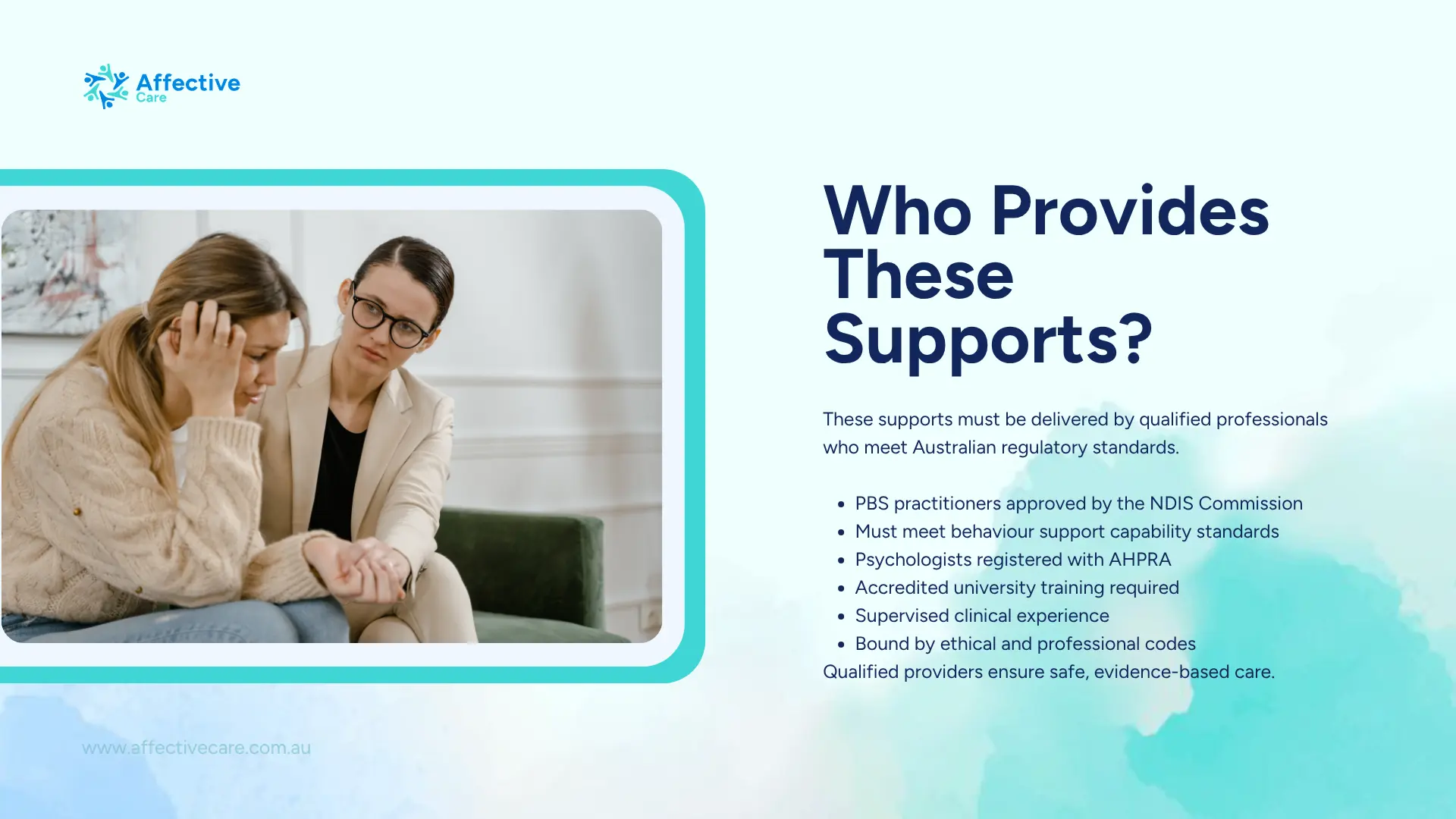
Who Provides These Supports?
Positive Behaviour Support (PBS) and psychology services under the NDIS must be delivered by appropriately qualified professionals who meet regulatory and professional standards in Australia.
Understanding who can provide these supports helps participants make informed and safe choices.
NDIS Registration & Commission Requirements
Providers delivering behaviour support must comply with the NDIS Quality and Safeguards Commission requirements.
Registered providers are required to meet the NDIS Practice Standards, including strict rules around behaviour support and the regulation of restrictive practices.
Behaviour support practitioners must be considered suitable by the NDIS Commission, meeting capability requirements in areas such as functional behaviour assessment, behaviour support planning, risk assessment, and reducing restrictive practices.
Practitioners are assessed at different levels (Core, Proficient, Advanced, Specialist) based on qualifications and experience.
Positive Behaviour Support Practitioner Requirements
PBS practitioners typically have qualifications in psychology, social work, occupational therapy, behaviour analysis, or related human services fields. They must demonstrate skills in:
- Functional Behaviour Assessments (FBA
- Developing Behaviour Support Plans (BSP)
- Safeguarding and risk management
- Evidence-based, person-centred practice
Psychologist Registration (AHPRA)
Psychology services must be delivered by a registered psychologist with AHPRA (Australian Health Practitioner Regulation Agency).
This ensures the practitioner has completed accredited university training, supervised practice, and meets national competency standards.
Psychologists may hold general registration or additional endorsements (such as clinical psychology).
They provide assessment, diagnosis (where appropriate), and therapeutic intervention within their scope of practice, guided by ethical and professional standards.
Choosing qualified providers ensures supports are safe, evidence-based, and aligned with NDIS requirements.
Funding and NDIS Plan Categories
Understanding where NDIS behaviour support and psychology sit within an NDIS plan is important when preparing for planning meetings, reviews, and funding discussions in Australia.
In most cases, both supports sit within Capacity Building budgets because they are designed to build long-term skills, improve everyday functioning, and increase independence.
The NDIS describes Capacity Building supports as funding that helps participants build skills and independence, while therapy supports must be evidence-based and delivered by qualified allied health professionals.
Where are These Supports Funded?
|
Support Type |
NDIS Budget Category |
What It Covers |
|
Positive Behaviour Support (PBS) |
Capacity Building – Improved Relationships |
Functional Behaviour Assessments (FBA), behaviour support plan NDIS development, staff guidance, strategies to reduce behaviours of concern, and oversight relating to regulated restrictive practices |
|
Psychology Services |
Capacity Building – Improved Daily Living |
Psychological assessment, therapy, emotional regulation support, trauma-informed support, coping strategies, and skill-building interventions |
Under current Australian NDIS settings, positive behaviour support NDIS services focus on improving quality of life, understanding the reasons behind behaviour, and reducing or eliminating restrictive practices.
NDIS psychology services support participants to build capacity, strengthen functioning, and improve participation in everyday life.
Core vs Capacity Building: What is the Difference?
Capacity Building funding is designed to help participants develop skills, improve independence, and build long-term capability.
Core Supports, by contrast, usually relate more to day-to-day assistance and practical support needs.
Because NDIS behaviour support and psychology are therapeutic and capacity-building supports, they are generally funded under Capacity Building categories rather than Core Supports.
Tips for Requesting Funding in your NDIS Plan
When asking for NDIS behaviour support and psychology, it helps to:
- Link the support to clear NDIS goals, such as emotional regulation, safety, independence, or community participation
- Provide professional evidence, such as psychology reports, occupational therapy reports, or behaviour support assessments
- Explain the functional impact on daily life, not just the diagnosis
- Be specific about how the support will build capacity, reduce risk, and improve participation over time
How to Request Behaviour Support and Psychology in Your NDIS Plan
Requesting NDIS behaviour support and psychology services starts with preparation.
Going into your planning meeting or plan review with clear information and documented evidence can make a significant difference.
Prepare Clear Evidence
The NDIS funds supports based on functional impact, not diagnosis alone. Before your meeting, gather relevant documentation such as:
- Functional Capacity Assessments (e.g., Occupational Therapist reports)
- Psychology assessments or progress reports
- Behaviour support assessments or incident reports
- Risk assessments outlining safety concerns
- School, employer, or service provider feedback
Reports should clearly explain how the person’s disability affects daily life, relationships, emotional wellbeing, and community participation and how behaviour support or psychology will build capacity.
Be Clear About Your Goals
The clearer the goal, the easier it is to justify funding under Capacity Building – Improved Relationships (for behaviour support) or Improved Daily Living (for psychology).
During your meeting, link your request to specific plan goals. For example:
- “I want to improve emotional regulation and reduce anxiety.”
- “We need support to reduce behaviours of concern and improve safety at home.”
Involve Your Support Coordinator
A NDIS Support Coordinator can play an important role when you are requesting NDIS behaviour support and psychology in your plan.
Choosing the right provider matters, and our guide on how to choose an NDIS Support Coordinator explains what to look for, what questions to ask, and how to find support that matches your goals.
They can help you organise the right information, make your request clearer, and ensure your evidence connects back to your goals and daily support needs.
A Support Coordinator can:
- Help interpret existing reports and recommendations
- Identify gaps in evidence before a planning meeting or review
- Draft goal wording that links clearly to function, safety, and independence
- Assist with submitting additional documentation
- Help explain why the support is reasonable and necessary
- Coordinate communication between providers, families, and the NDIA
- Make sure your request reflects the impact on everyday life, not just the diagnosis
This can be especially helpful when you are requesting both positive behaviour support NDIS services and NDIS psychology services, as each support may need different evidence and goal wording.
Real Stories: Behaviour Support and Psychology in Action
Case Example 1: Reducing Behaviours of Concern
“James” (name changed) was experiencing escalating behaviours at home linked to anxiety and difficulty with change.
A Positive Behaviour Support practitioner completed a Functional Behaviour Assessment and introduced structured routines and consistent response strategies.
At the same time, a psychologist worked with James on emotional regulation and coping skills.
Outcome: Incidents reduced, anxiety became more manageable, and the family felt more confident responding to challenges.
Addressing both behaviour and emotional triggers led to safer, more stable support.
Case Example 2: Supporting Emotional Wellbeing
“Sarah” (name changed) was withdrawing socially and experiencing distress following trauma.
Psychology sessions focused on trauma-informed therapy and resilience-building, while PBS supported her team to adjust environmental triggers and reduce pressure points.
Outcome: Emotional safety improved, behaviours reduced, and community participation gradually increased.
Key Insight: When behaviour support and psychology work together, they create a coordinated, person-centred pathway toward stability and independence.
The Right Support, at the Right Time
Understanding the difference between NDIS Behaviour Support and Psychology helps participants and families make informed, confident decisions about the supports included in their plan.
While Positive Behaviour Support focuses on reducing behaviours of concern and improving safety and quality of life, psychology services address emotional wellbeing, mental health, and internal coping processes.
When these supports work together, they create a stronger, more holistic pathway toward independence, stability, and participation in everyday life.
At Affective Care, we provide emotionally-centred behaviour support and psychology services tailored to each person’s goals, strengths, and circumstances.
Our team works collaboratively with participants, families, and support coordinators to ensure supports are evidence-based, aligned with NDIS requirements, and focused on long-term outcomes.
If you’re unsure what your plan should include or how to request the right supports, we’re here to help.
Reach out to our team for a supportive conversation about your NDIS plan and the next steps that feel right for you.