


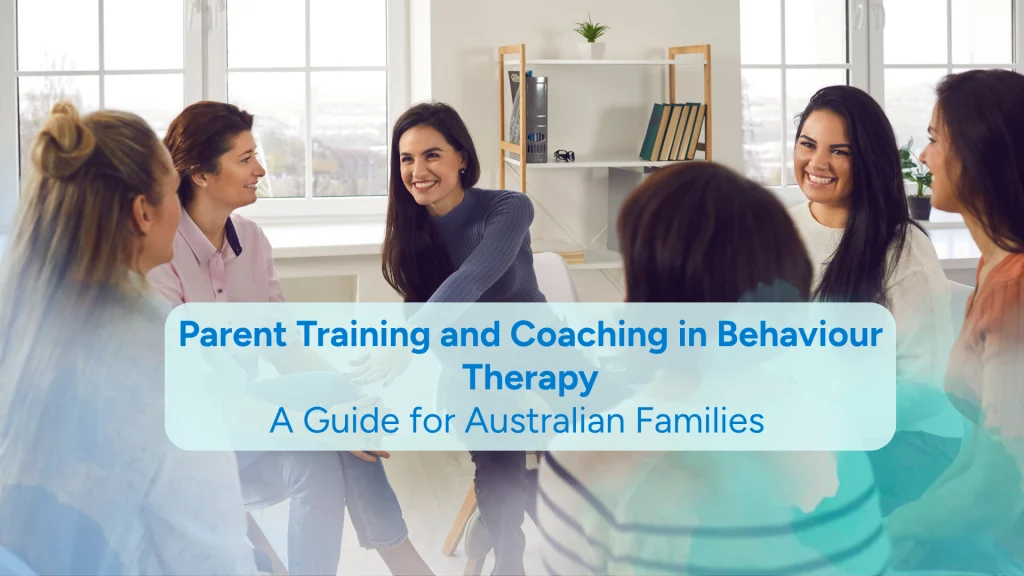
Supporting a child who displays challenging behaviours can feel emotional, tiring, and deeply personal.
Many parents and carers try different strategies at home, often wondering whether they are doing “enough” or responding in the right way.
Parent training behaviour therapy offers a practical, evidence-based way to support children and families.
Instead of focusing only on the child, this approach helps parents and carers build the skills, confidence, and consistency needed to encourage positive behaviour at home, school, and in everyday routines.
Through parent coaching in behaviour therapy, families learn simple and structured strategies to respond to challenging behaviours, support emotional regulation, strengthen communication, and create calmer daily routines.
These strategies are often used for children living with autism, ADHD, ODD, developmental delays, and other behavioural or emotional support needs.
Parent training may include well-researched programs such as Parent Management Training (PMT), Triple P, and RUBI parent coaching.
These approaches focus on practical tools such as positive reinforcement, clear expectations, routines, co-regulation, and consistent responses that support long-term behaviour change.
For many Australian families, NDIS parent training funding may be available through Capacity Building supports, including Improved Daily Living or Improved Relationships, depending on the child’s goals and plan.
This can make behaviour therapy for parents more accessible for families seeking structured support.
This guide explains what parent training and coaching in behaviour therapy involves, why it can help with challenging behaviours, how it may fit within the NDIS, and what families can expect from coaching sessions.
It is designed to help parents and carers make informed, confident decisions about support for their child and family.
What is Parent Training in Behaviour Therapy?
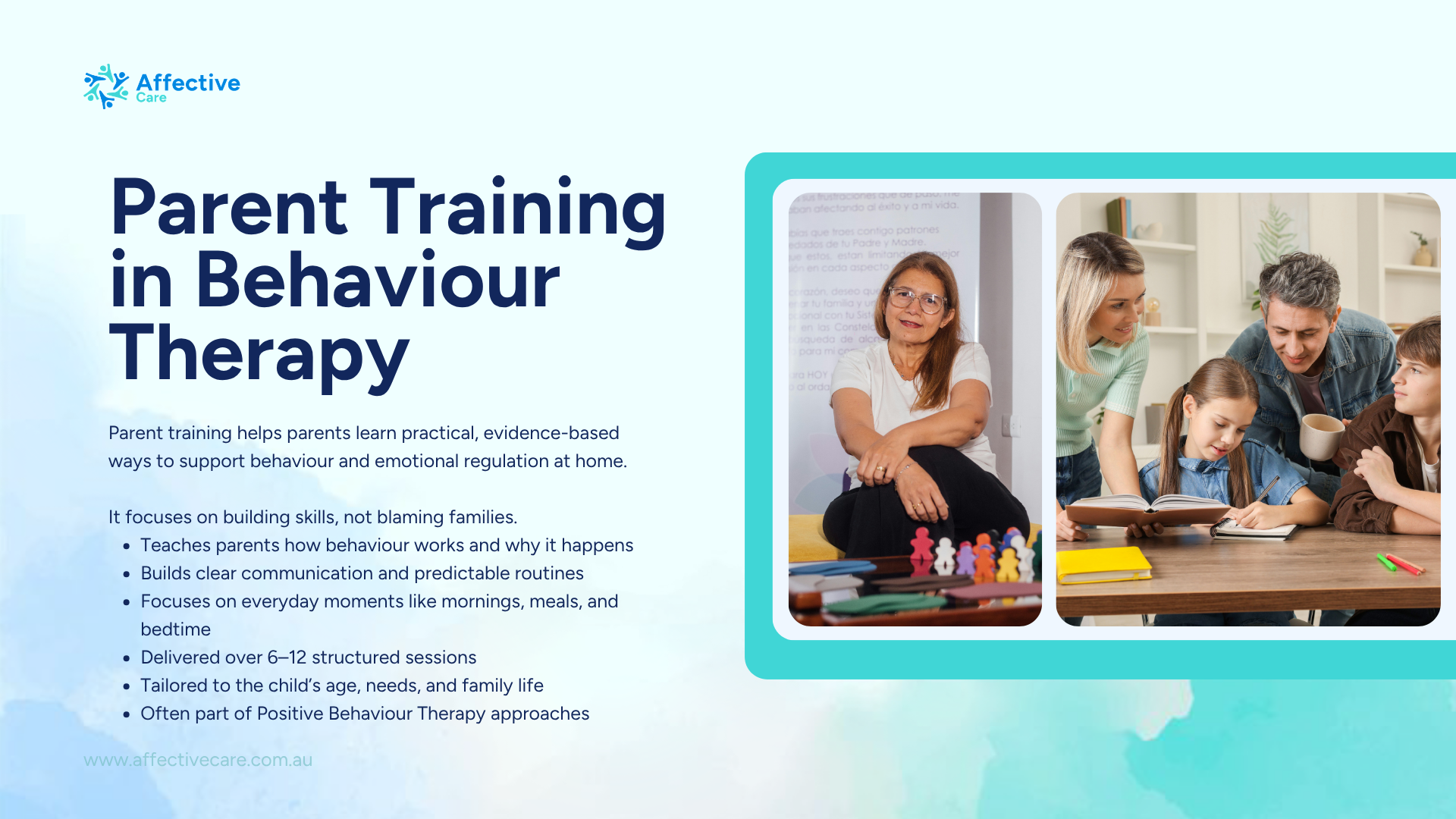
Parent training in behaviour therapy (also called parent management training) is a structured, evidence-based approach that teaches parents practical skills to support positive behaviour and reduce challenging behaviours in everyday life.
It is often delivered as part of Positive Behaviour Therapy, focusing on understanding behaviour, strengthening communication, and building supportive home environments that reduce distress over time.
Rather than relying on punishment or reactive strategies, parent training focuses on understanding behaviour, strengthening communication, and creating predictable, supportive environments.
Most parent training programs:
- Are delivered over 6–12 sessions
- Include goal-setting, guided practice, and feedback
- Focus on everyday routines such as mornings, meals, transitions, and bedtime
- Are tailored to the child’s developmental stage and family context
Common evidence-based programs used in Australia include:
- Triple P (Positive Parenting Program)
- Parent Management Training (PMT)
- RUBI Parent Training (often used with autistic children)
Parent training is commonly used to support children living with autism, ADHD, Oppositional Defiant Disorder (ODD), emotional regulation challenges, and developmental delays.
Importantly, parent training does not blame parents or assume they are doing something wrong.
Instead, it recognises that behaviour is shaped by communication, environment, stress, and unmet needs, and that parents are powerful agents of change when they are supported with the right knowledge, tools, and guidance.
Importantly, parent training does not blame parents. It recognises that behaviour is shaped by communication, environment, and unmet needs and that parents are powerful agents of change when given the right tools.
Moreover, if your child is living with autism, you may also find our guide on Positive Behaviour Therapy for Autism under the NDIS helpful for understanding how behaviour therapy can support communication, emotional regulation, and daily routines.
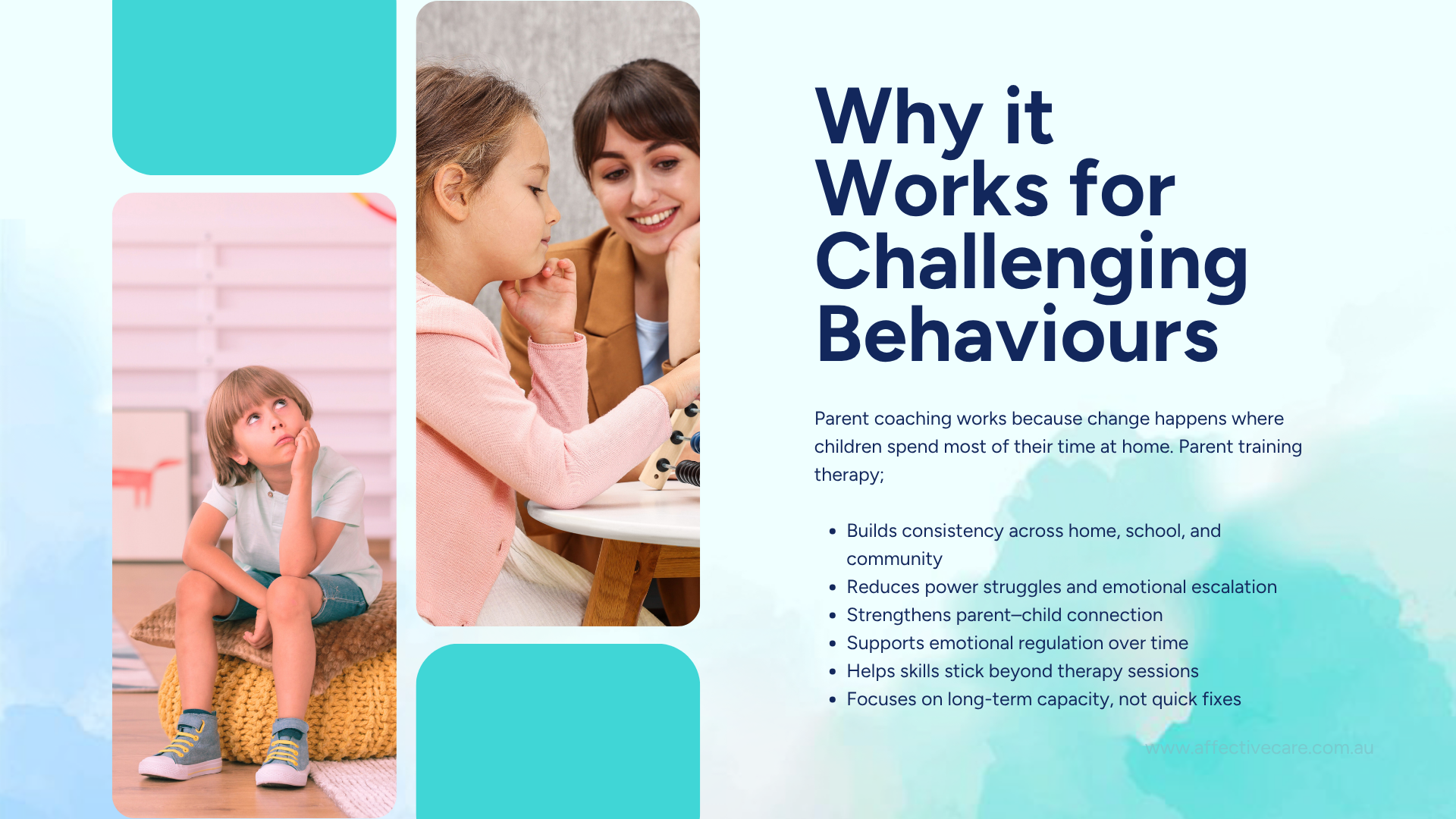
Why Parent Coaching Works for Challenging Behaviours
Parent coaching for challenging behaviours works because it shifts the focus from “fixing” the child to building the skills, confidence, and consistency of the people supporting them every day.
In behaviour therapy for parents, families learn practical strategies they can use at home, in routines, and across everyday situations.
When parents and carers feel supported, children may experience:
- Reduced emotional distress
- Fewer behavioural escalations
- Improved communication and connection
- Better emotional regulation
- More predictable daily routines
One reason parent training behaviour therapy can be effective is that it focuses on real-life practice, not just strategies discussed in a therapy room.
Parents learn how to respond calmly, set clear expectations, use positive reinforcement, and support their child before behaviour escalates.
Key benefits of parent coaching in behaviour therapy include:
- Consistency across environments: Strategies are used daily at home, school, and in the community
- Fewer power struggles: Parents learn proactive responses instead of reacting during stressful moments
- Stronger relationships: Positive connection increases, rather than focusing only on rules or consequences
- Skill generalisation: Children practise new skills in the places where they matter most
- Long-term capacity building: Families gain tools they can keep using over time
For Australian families, NDIS parent coaching funding may be available when the support links to the child’s goals and functional needs.
Parent coaching may sit under Capacity Building – Improved Daily Living or Capacity Building – Improved Relationships, especially when Positive Behaviour Support in Sydney is involved.
Parent training helps families move from constant firefighting to calmer, more consistent, and more predictable daily life.
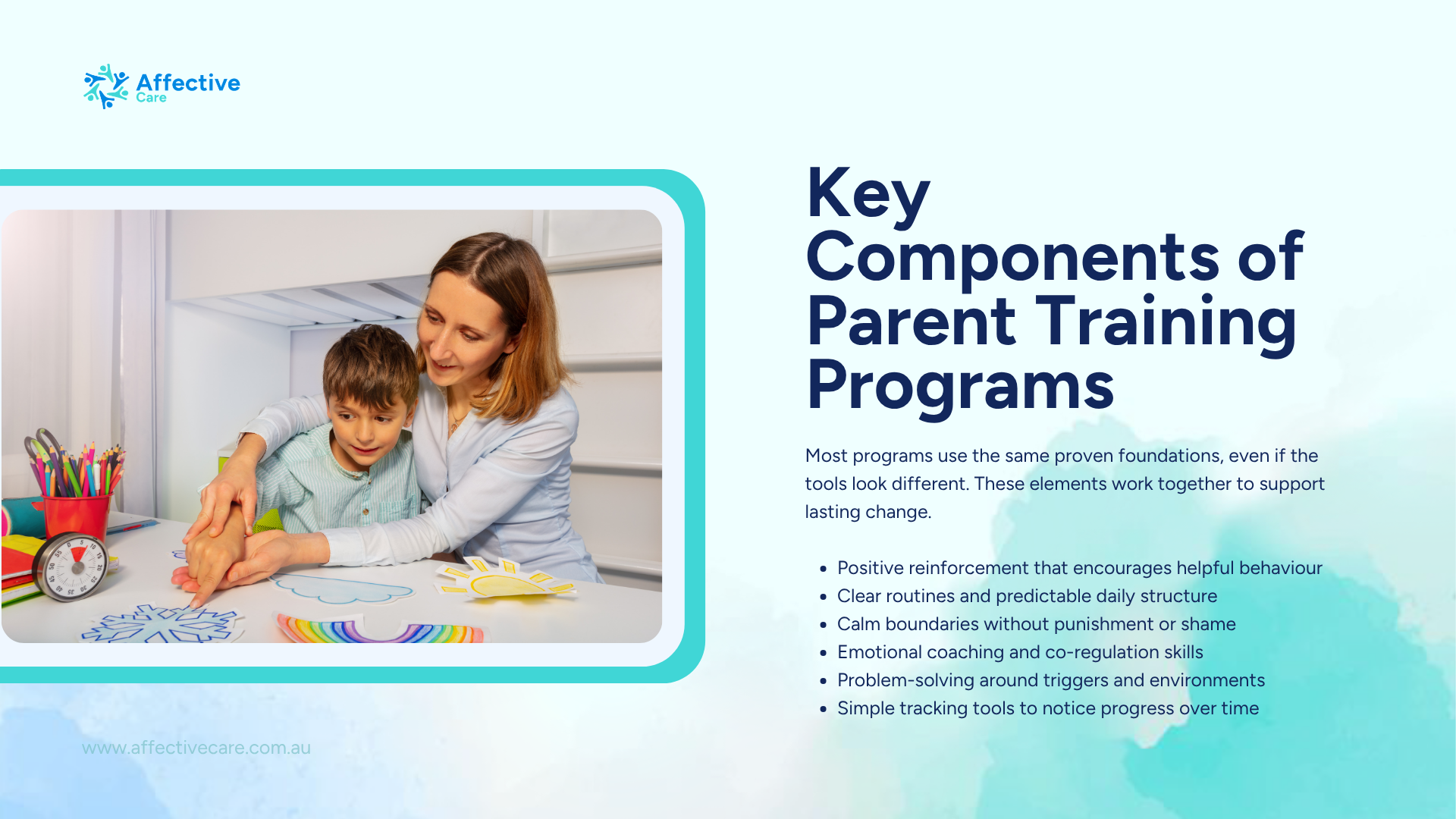
Key Components of Parent Training Programs
Most parent training behaviour therapy programs are built around a small number of evidence-based components that work together to support lasting change.
While different programs may use slightly different language or tools, the core foundations remain consistent across effective approaches.
Positive Reinforcement
Positive reinforcement helps children understand which behaviours are helpful and encourages those behaviours to happen more often. Parent training supports parents to:
- Notice and acknowledge specific, positive behaviours as they happen
- Use praise and rewards intentionally, rather than constantly
- Reinforce effort, progress, and attempts, not just “perfect” behaviour
This shifts the focus away from what a child is doing wrong and toward what they are learning to do well.
Example:
Instead of a general “Good job,” a parent might say, “I noticed how you waited your turn even though it was hard that really helped.”
Routines and Predictability
Many children experience less distress when their day feels predictable and understandable.
Parent coaching helps families create structure that supports emotional safety by:
- Developing visual schedules or simple routines
- Preparing children for transitions and changes in advance
- Creating consistency around key parts of the day, such as mornings, mealtimes, and bedtime
Effective Discipline (Without Punishment)
Parent training moves away from punishment-based approaches and instead focuses on guidance, learning, and calm boundaries.
The goal is to teach skills and understanding, not to create fear or shame.
Parents are supported to use:
- Logical and age-appropriate consequences that connect to behaviour
- “Time-in” strategies that support connection and regulation rather than isolation
- Calm, consistent follow-through without raised voices or power struggles
Moreover, parent coaching can also help families understand safer responses to challenging situations, including why restrictive practices in NDIS behaviour support should be reduced wherever possible.
Emotional Coaching and Co-Regulation
Challenging behaviours often reflect big feelings that a child cannot yet manage on their own.
Over time, this builds a child’s capacity to recognise and manage their emotions more independently.
Parent training helps parents learn how to:
- Acknowledge and name emotions safely
- Support children to calm their bodies during distress
- Model emotional regulation, especially in stressful moments
Problem-Solving and Skill-Building
Rather than viewing behaviour as “good” or “bad,” parent training encourages curiosity and collaboration. Families are supported to:
- Identify patterns and triggers behind behaviours
Adjust environments, expectations, or communication styles - Track progress using simple tools such as charts, visuals, or apps (including RUBI-based tools where appropriate)
This approach supports gradual, sustainable change that fits into real family life.
Together, these components create a balanced, supportive framework that strengthens parent confidence, improves understanding, and supports meaningful behaviour change that lasts beyond the program itself.
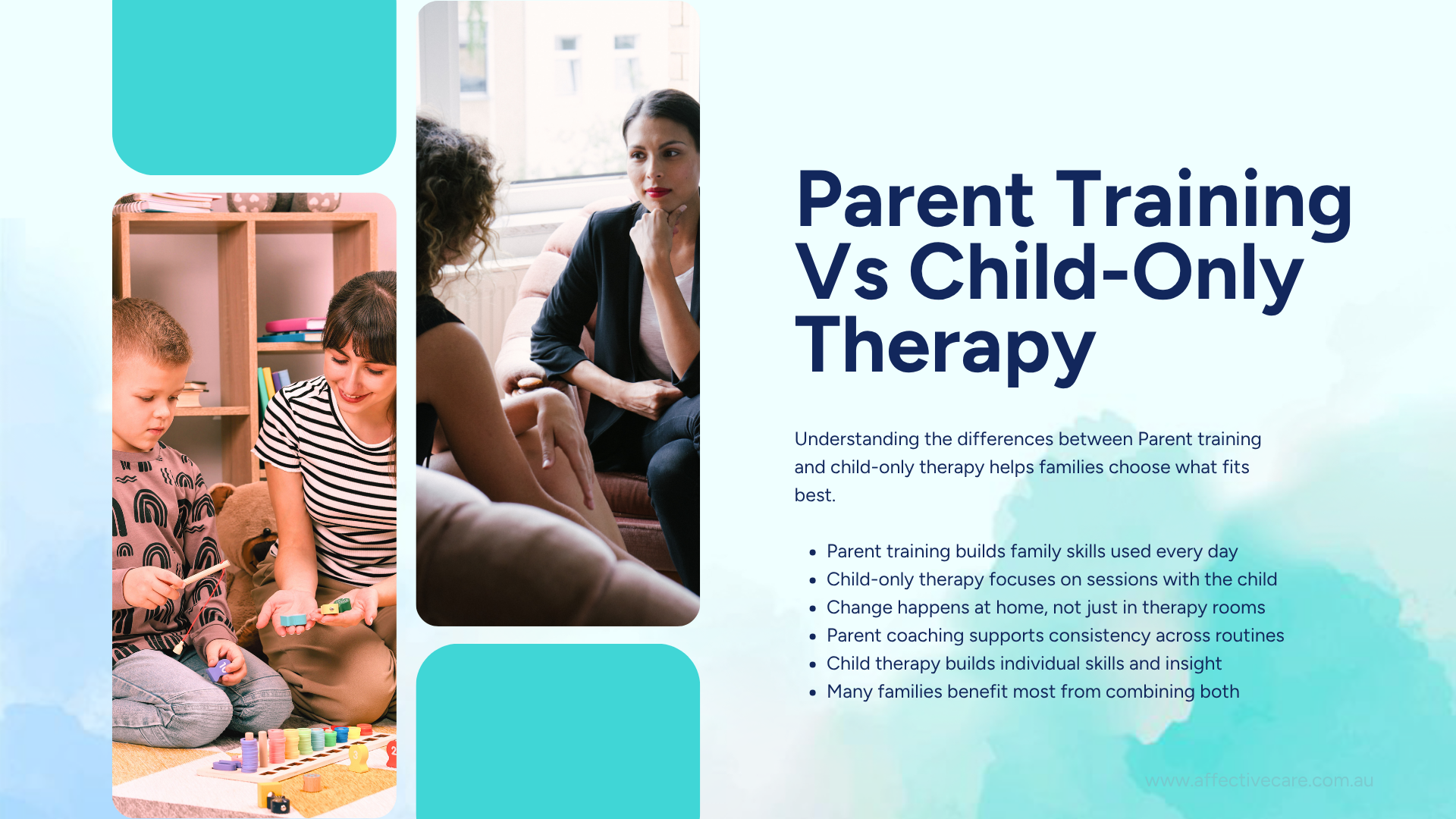
Parent Training vs Child-Only Therapy
When families are exploring behaviour therapy for children, a common question is whether parent training and coaching in behaviour therapy is more effective than child-only therapy.
In practice, both approaches can be valuable, but they support different parts of the child and family’s needs.
Understanding the difference can help parents and carers choose the right support for their child, especially when accessing services through the NDIS.
Parent training behaviour therapy focuses on building skills within the family. Parents and carers learn practical strategies they can use consistently at home, in daily routines, and across real-life situations.
This may include responding calmly to challenging behaviours, supporting emotional regulation, using positive reinforcement, and creating predictable environments that reduce distress over time.
This approach recognises that lasting behaviour change often happens outside the therapy room.
For children living with autism, ADHD, ODD, developmental delays, or ongoing behaviour challenges, everyday interactions at home can become important opportunities to practise new skills and build confidence.
Child-only therapy, on the other hand, involves the child working directly with a therapist during sessions.
These supports may focus on communication, emotional regulation, social skills, coping strategies, or behaviour support, depending on the child’s goals and therapy type.
Child-focused therapy can be highly valuable. However, progress may be slower if strategies are not reinforced consistently at home, school, or in the community.
This is why many families benefit from combining parent coaching in behaviour therapy with child-focused therapeutic support.
Furthermore, for families supporting defiance, emotional outbursts, or ongoing behaviour concerns, our article on Positive Behaviour Therapy and ODD/challenging behaviours explains how evidence-based strategies can reduce distress and build safer routines.
Key Differences Between Parent Training and Child-Only Therapy
|
Aspect |
Parent Training / Coaching |
Child-Only Therapy |
|
Primary focus |
Family skills, parent confidence, and home implementation |
Child-focused therapeutic sessions |
|
Who attends |
Parents and carers, sometimes with child involvement |
Child attends sessions with a therapist |
|
Duration |
Often 6–12 weeks, with ongoing skill use at home |
Varies depending on therapy type and child needs |
|
Where change happens |
Daily routines, home life, school, and community settings |
Therapy sessions and structured practice |
|
Common strategies |
Positive reinforcement, routines, emotional regulation support, consistent responses |
Communication skills, coping tools, emotional regulation, social skills |
|
NDIS funding fit |
Capacity Building, such as Improved Daily Living or Improved Relationships |
Therapeutic Supports, depending on the child’s NDIS plan |
|
Best outcomes |
Strong when combined with child-focused therapy |
Enhanced when family strategies are reinforced at home |
Both approaches are valid. The right choice depends on the child’s goals, family capacity, support needs, and how services are funded through the NDIS.
For many Australian families, the strongest outcomes come from a combined approach.
Parent training and coaching gives families practical tools to use every day, while child-only therapy supports the child’s individual skill development.
Together, they can create more consistent support, calmer routines, and stronger long-term progress.
NDIS Funding for Parent Training and Coaching
Parent training and coaching can be funded through the NDIS when it is considered reasonable and necessary to support a child’s disability-related needs and the wellbeing of their family.
The NDIS recognises that families and carers play a central role in a child’s development, and that building parent skills can lead to more sustainable, long-term outcomes at home and in the community.
In most cases, parent training and behaviour coaching are funded under Capacity Building supports, rather than Core. Common funding pathways include:
- Capacity Building – Improved Daily Living
This is the most frequent category used for parent training delivered by psychologists, behaviour therapists, or allied health professionals. Funding focuses on building parent skills, emotional regulation strategies, communication, and everyday behaviour support. - Capacity Building – Improved Relationships
Parent coaching may also be funded here when linked to Positive Behaviour Support (PBS) or where behaviour support plans involve family-wide strategies to reduce distress and improve relationships.
Parent training is usually discussed and requested during an NDIS planning meeting or plan review. Clear goals are essential. Helpful goal examples include:
- “Build parent skills to support my child’s emotional regulation”
- “Develop consistent strategies to manage behaviours at home”
- “Improve family routines and communication to reduce distress”
To support funding approval, the NDIA often looks for professional evidence, such as reports from psychologists, behaviour support practitioners, or occupational therapists, explaining why parent coaching is needed and how it links to the child’s disability and plan goals.
As outlined in NDIS guidance for families and carers, supports that strengthen a family’s ability to care, respond, and build skills are viewed as an important part of helping children participate more fully in everyday life.
Parent training is typically delivered by:
- NDIS-registered psychologists
- Behaviour support practitioners
- Allied health professionals with behaviour therapy experience
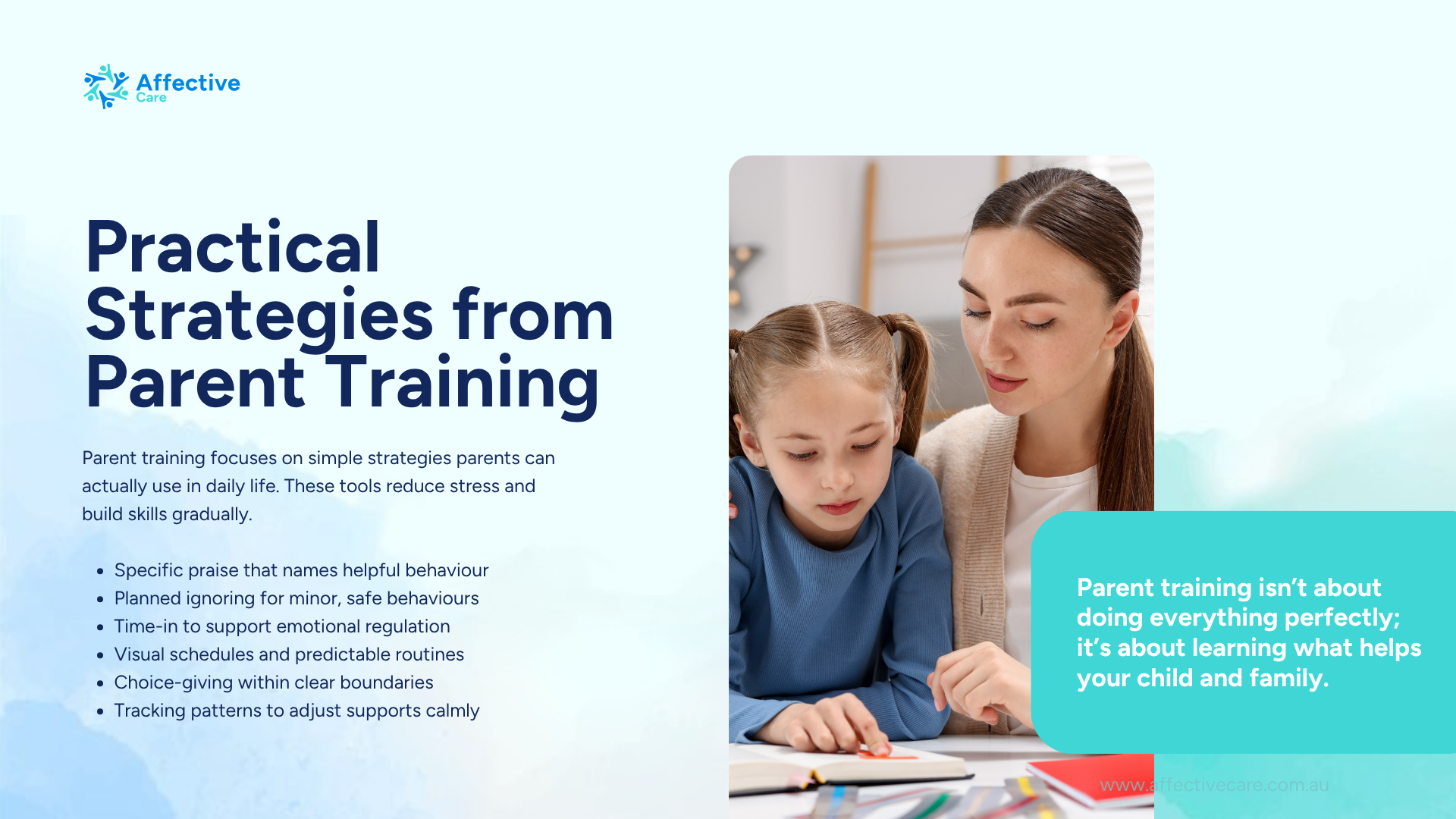
Practical Strategies from Parent Training
Parent training behaviour therapy focuses on practical, everyday strategies that parents and carers can use consistently at home.
These approaches are designed to reduce distress, build skills gradually, and support positive behaviour in ways that feel realistic for family life.
In parent coaching for challenging behaviours, families learn how to respond calmly, create predictable routines, and encourage helpful behaviours before situations escalate.
These strategies can be especially useful for children living with autism, ADHD, ODD, developmental delays, or emotional regulation difficulties.
Key Behaviour Strategies Parents Can Use at Home
Specific Praise and Positive Reinforcement
Parents learn to notice and clearly name helpful behaviours. For example, instead of only saying “good job,” a parent might say, “I noticed how you waited your turn.”
This helps children understand expectations and encourages positive behaviour without relying only on rewards.
Planned Ignoring and Time-In
For minor and safe behaviours, parents may learn to use planned ignoring to reduce attention-seeking patterns.
For bigger emotions, time-in can be used instead of isolation. This means staying nearby, calm, and reassuring while helping the child feel safe and supported.
Clear Routines and Visual Supports
Visual schedules, routine charts, and simple prompts can help reduce uncertainty and support smoother transitions.
These tools are often helpful for children who feel more settled when they know what is coming next.
Choice-Giving Within Boundaries
Offering simple choices can support a child’s sense of control while keeping expectations clear.
For example, “Would you like to put your shoes on first or pack your bag first?” This can reduce resistance while still guiding the child toward the task.
Tracking Progress and Behaviour Patterns
Parents may use charts, notes, or apps, including RUBI parent coaching tools, to track progress over time.
This can help families identify triggers, notice what is working, and adjust strategies with support from their behaviour therapist or parent coach.
These home behaviour strategies for parents are not about perfection. They help families build confidence, respond with more consistency, and create calmer daily routines over time.
Parent training and coaching can be an important part of Positive Behaviour Support planning, helping families understand behaviour and use consistent strategies at home.

What to Expect in Coaching Sessions
Parent coaching sessions are designed to feel supportive, practical, and manageable, not overwhelming. The aim is to build skills gradually, while recognising the realities of family life.
Most programs begin with an initial assessment and goal-setting session, where the practitioner takes time to understand your child’s strengths, challenges, routines, and what you want to change.
Goals are practical and specific, such as reducing morning meltdowns or improving cooperation at mealtimes.
Ongoing sessions are usually weekly and run for 45–60 minutes. During these sessions, you can expect:
- Clear explanations of strategies and why they work
- Demonstrations or role-plays of techniques, such as how to give effective instructions
- Time to reflect on what worked (and what didn’t) at home
- Gentle feedback and adjustments tailored to your family
Between sessions, parents are encouraged to practise strategies at home. This “homework” is realistic and flexible, often focused on one routine at a time.
Progress is reviewed regularly, and strategies are adapted as confidence grows. Some programs may also offer home or telehealth visits to support real-life application.
Choosing a Parent Training Provider
Choosing the right parent training provider is about finding someone who understands your child, your family, and your goals not just someone with the right qualifications.
A good provider should offer practical, evidence-based support that feels realistic for your daily life.
When looking for a parent behaviour coach or behaviour therapy provider, it can help to consider:
- Relevant qualifications, such as a psychologist, behaviour therapist, or behaviour support practitioner
- NDIS registration, if you plan to use NDIS funding
- Experience supporting children living with autism, ADHD, ODD, developmental delays, or emotional regulation needs
- Knowledge of evidence-based programs such as Triple P, Parent Management Training (PMT), or RUBI parent coaching
- A family-centred approach that includes parents and carers in decision-making
Equally important is the relationship fit. A good NDIS parent training provider should feel collaborative, respectful, and easy to talk to.
They should explain strategies in plain language, adapt supports to your family’s culture and routines, and help you feel confident using strategies at home.
Helpful Steps When Choosing a Provider Include
- Reading reviews or asking for trusted recommendations
- Asking whether they offer parent coaching for challenging behaviours
- Checking if they have experience with your child’s specific needs
- Asking how they measure progress over time
- Requesting an initial consultation to see if the approach feels right
For example, one family may choose a provider with strong autism experience who can tailor visual supports, routines, and communication strategies.
Another family may need support with defiance, school-related challenges, emotional regulation, or daily transitions.
The right provider for parent training behaviour therapy is someone who helps you feel supported, respected, and understood.
With the right guidance, families can build practical skills, respond more consistently, and create calmer routines at home.
If your child needs a structured approach to reducing behaviours of concern, our guide on what a Behaviour Support Plan under the NDIS is explains what the plan includes and how it supports safer, more consistent care.
Next Steps to Start Parent Training
Starting parent training behaviour therapy does not have to feel rushed or confusing.
With the right support, the process can be clear, calm, and tailored to your child’s needs, your family routines, and your goals.
A helpful first step is to review your current supports and funding.
Families may access parent training and coaching in behaviour therapy through a GP referral, private therapy pathway, or NDIS Capacity Building funding, depending on the child’s goals and plan.
For children living with autism, ADHD, ODD, developmental delays, or emotional regulation needs, parent coaching may support goals related to behaviour, communication, family wellbeing, emotional regulation, and daily routines.
The next step is speaking with a trusted parent training provider. At Affective Care, we take time to understand your child, your family, and the behaviours or routines that feel most challenging right now.
From there, we help you explore whether parent coaching for challenging behaviours is the right fit.
We support families by:
- Explaining parent training options in plain, supportive language
- Clarifying possible NDIS parent training funding pathways
- Connecting you with experienced, family-centred practitioners
- Helping set practical goals that work in real daily life
- Supporting strategies for calmer routines, emotional regulation, and positive behaviour
You do not need to know exactly what support you need before reaching out.
A calm, no-pressure conversation can help you feel clearer, more supported, and more confident about the next step for your child and family.