


Understanding billable activities in NDIS Support Coordination is important for participants, families, carers, Support Coordinators, Plan Managers and providers.
Support Coordination can be incredibly valuable when it helps a participant understand their NDIS plan, connect with suitable providers, coordinate services and build confidence using their funded supports.
But one of the most common questions people ask is: what can a Support Coordinator actually bill for?
The simple answer is that Support Coordination billing should be connected to the participant’s NDIS plan, goals, support needs and service coordination.
A Support Coordinator should not charge for unrelated business administration, vague tasks, duplicate work or activities that do not provide a clear participant-related benefit.
The NDIS Pricing Arrangements and Price Limits explain how NDIS price controls work, while the NDIS Support Catalogue lists support items, price limits and claim types such as non-face-to-face support and travel where these apply.
Moreover, for a broader overview of participant pathways and support access, you can read our guide to understanding the NDIS in simple terms.
These documents are updated, so participants and providers should always check the current version before relying on pricing or claiming information.
This guide explains what may be billable, what is usually not billable, how invoices should be understood, and what participants can ask before agreeing to Support Coordination services.

What is NDIS Support Coordination?
NDIS Support Coordination helps participants understand and use their NDIS plan.
A Support Coordinator’s role is to help a participant connect with NDIS providers, community services, mainstream services and other government supports in line with the participant’s goals and plan.
The NDIS describes this as helping participants plan, coordinate, establish and maintain their supports.
Support Coordination may include helping a participant:
- Understand what is funded in their NDIS plan
- Identify services that match their goals
- Connect with suitable providers
- Organise service agreements
- Coordinate communication between providers
- Address gaps or risks in supports
- Prepare for plan reassessments
- Build confidence and independence over time
Support Coordination is not the same as general administration. It should be participant-focused and connected to the person’s goals, needs and funded supports.
For example, helping a participant compare therapy providers may be part of Support Coordination.
But completing unrelated internal admin for the provider’s own business would usually not be an appropriate Support Coordination charge.
What Are Billable Activities in NDIS Support Coordination?
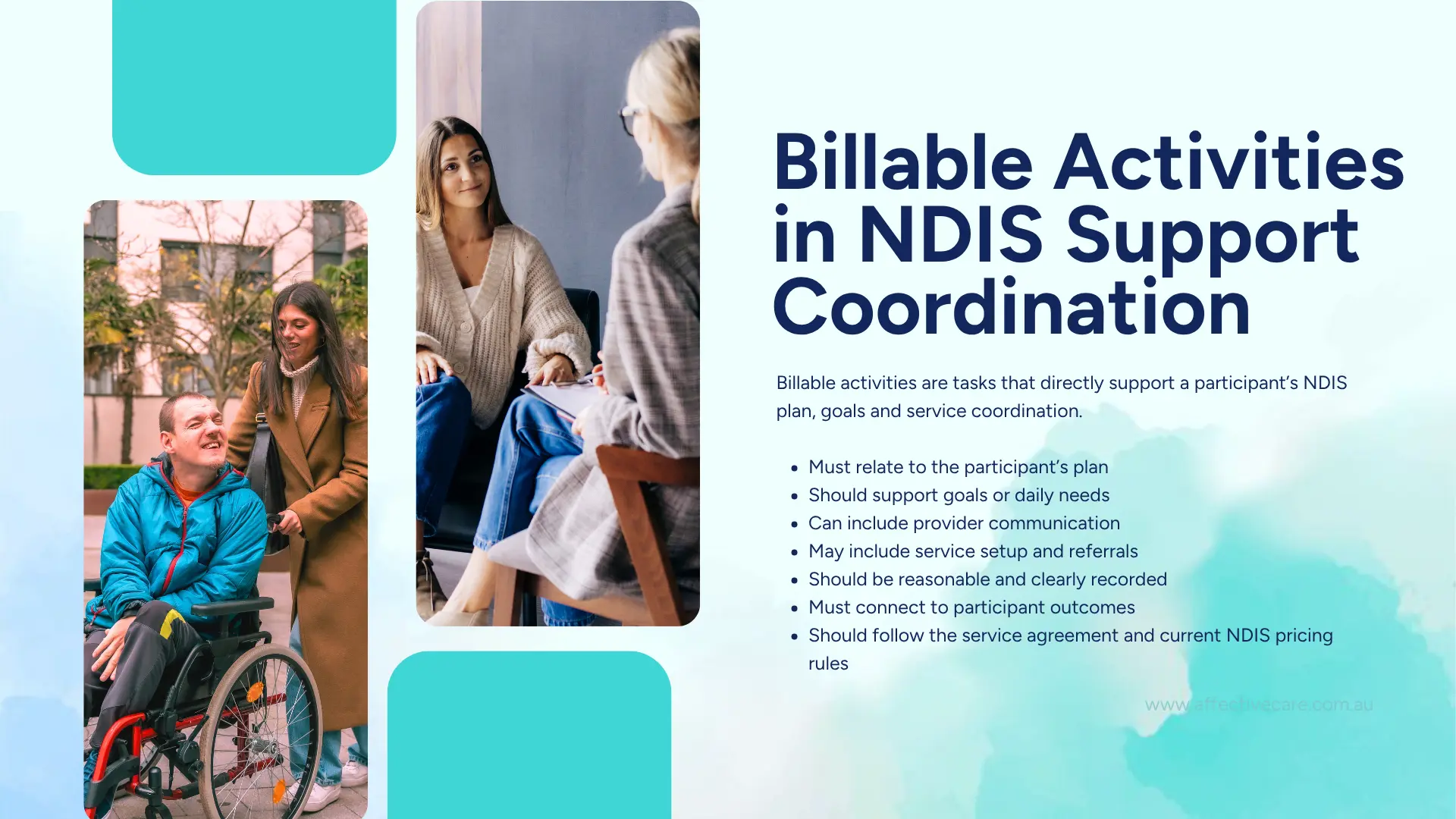
Billable activities in NDIS Support Coordination are tasks that directly relate to helping the participant use their NDIS plan, coordinate supports, connect with services, manage changes and build capacity.
A Support Coordinator may be able to bill for work that is:
- Related to the participant’s NDIS plan
- Connected to their goals or support needs
- Required to coordinate services
- Helping the participant access or maintain supports
- Properly recorded
- Reasonable in time and purpose
- Consistent with the service agreement and current NDIS pricing rules
The NDIS Support Catalogue lists claim types such as non-face-to-face support and travel for applicable support items, and its requirements form part of the NDIS Pricing Arrangements and Price Limits.
Common NDIS Support Coordination billable activities may include:
- Speaking with the participant about their support needs
- Helping the participant understand their plan
- Contacting providers to check availability
- Helping set up new services
- Coordinating meetings with the participant’s support network
- Reviewing service agreements with the participant
- Communicating with Plan Managers or providers
- Helping resolve service delivery issues
- Preparing information for a plan reassessment
- Documenting participant-related coordination work
- Following up on risks, service gaps or urgent changes
The key question is not just “Did the Support Coordinator do work?”
The better question is: Was the work connected to the participant’s NDIS plan and support outcomes?
To understand how support coordination charges may relate to broader service pricing, our guide to NDIS pricing and support costs explains how rates can apply across different support types.

Common Billable Tasks for NDIS Support Coordinators
Helping Participants Understand Their NDIS Plan
One of the most important Support Coordinator tasks is helping participants understand what their NDIS plan means in everyday life.
This may include explaining:
- What support categories are included
- What funding can be used for
- How different budgets work
- What services may support the participant’s goals
- How to make informed choices about providers
This type of work may be billable when it is part of helping the participant implement their plan.
For example, a participant may not know the difference between therapy funding, Core Supports and Capacity Building supports.
A Support Coordinator can help explain these areas in plain language so the participant can make decisions with more confidence.
This is especially useful for people who are new to the NDIS, have recently received a new plan, or have had a change in their circumstances.
Moreover, before you agree to services, take time to learn how to choose an NDIS Support Coordinator so you know what to ask about costs, communication and support expectations.
Finding and Connecting with Suitable Providers
A Support Coordinator may help a participant find services that match their goals, preferences and support needs.
This may include:
- Researching providers
- Contacting providers about availability
- Checking whether services are suitable
- Helping the participant compare options
- Supporting referrals
- Helping organise intake paperwork
- Helping the participant prepare questions for providers
This can be billable when the work is specific to the participant and supports their plan implementation.
Moreover, billing can vary depending on the type of coordination support provided, so it is useful to understand the difference between Coordination of Supports and Specialist Support Coordination.
Coordinating Communication Between Providers
Many participants receive support from more than one provider. A Support Coordinator may help bring information together so the participant’s supports work better as a whole.
This may include communication with:
- Therapists
- Support workers
- Plan Managers
- Accommodation providers
- Behaviour support practitioners
- Support networks
- Schools, hospitals or mainstream services where relevant
- Family members or nominees, where the participant has consented
Provider communication may be billable when it is directly related to the participant’s supports, safety, goals or service coordination.
For example, if a participant’s therapy team and support workers need to communicate about daily routines, behaviour support strategies or safety needs, the Support Coordinator may help coordinate this communication.
Attending Support Meetings
Support Coordinators may attend meetings that are directly related to the participant’s NDIS plan and support needs.
This may include:
- Participant check-ins
- Provider meetings
- Support team meetings
- Plan review preparation meetings
- Service transition meetings
- Risk-related meetings
- Meetings about support gaps or changes
Meetings should have a clear purpose. A meeting may be billable when it helps the participant coordinate supports, make decisions, address risks or improve how services are delivered.
The participant should also understand why the meeting is needed, who is attending, and how it relates to their supports.
Reviewing Service Agreements
A service agreement is a written agreement between a participant and provider.
The NDIS explains that a service agreement describes what supports will be delivered, how they will be delivered, how much they cost, how the provider will be paid and how changes can be made.
A Support Coordinator may help a participant understand a service agreement before they agree to services.
This may include checking:
- What support is being provided
- The hourly rate or price
- Cancellation terms
- Travel charges
- Reporting expectations
- Service responsibilities
- How to make changes
- How to end the agreement
This may be billable when the Support Coordinator is helping the participant make an informed decision about services connected to their NDIS plan.
Moreover, to better understand provider invoices, it may help to read more about how NDIS Support Coordination hours are allocated, used and recorded.
Monitoring Supports and Plan Use
Support Coordination is not only about setting up services at the start of a plan. It can also include checking whether supports are working well.
A Support Coordinator may help review:
- whether services are meeting the participant’s goals
- whether the participant is using their funding appropriately
- whether there are service gaps
- whether risks have changed
- whether support levels need adjustment
- whether the participant needs different providers
For example, if a participant’s support needs increase, the Support Coordinator may help gather information, communicate with providers and support the participant to prepare for a plan reassessment.
This work may be billable where it is connected to the participant’s plan, goals and support needs.
Preparing for Plan Reassessment or Review
Support Coordinators often help participants prepare for NDIS plan reassessments or changes.
This may include:
- Helping gather reports from providers
- Documenting changes in circumstances
- Identifying what supports are working
- Identifying gaps or risks
- Helping the participant prepare information
- Coordinating provider input
- Supporting the participant to explain their needs clearly
This work can be important because plan reassessments often depend on clear information about the participant’s daily support needs, goals, risks and outcomes.
This may be billable when the work is reasonable, participant-specific and connected to the NDIS plan.

Can Support Coordinators Bill for Emails, Phone Calls and Meetings?
Yes, Support Coordinators may be able to bill for emails, phone calls and meetings when the activity is directly related to the participant’s NDIS plan, supports, service coordination, goals or risks.
For example, a Support Coordinator may bill for:
- Emailing a therapy provider to organise an appointment
- Calling a support worker provider about service availability
- Speaking with a Plan Manager about an invoice issue
- Attending a provider meeting about the participant’s support needs
- Following up with a participant after a service concern
- Communicating with a support network about agreed next steps
However, these activities should be clearly recorded. An invoice should not simply say “admin” or “email” without enough detail.
The participant, nominee or Plan Manager should be able to understand what the communication was about and how it related to the participant’s support.
A better invoice description might be:
“Non-face-to-face coordination: emailed occupational therapy provider to confirm service availability and referral steps for participant’s therapy supports.”
This is clearer than:
“Admin — 30 minutes.”
The goal is transparency. Participants should not have to guess what they are being charged for.
If you want more context around plan budgets, our guide on how NDIS funding works explains funding categories, plan management and how supports may be used.
Non-Face-to-Face Support Coordination: What Does It Mean?
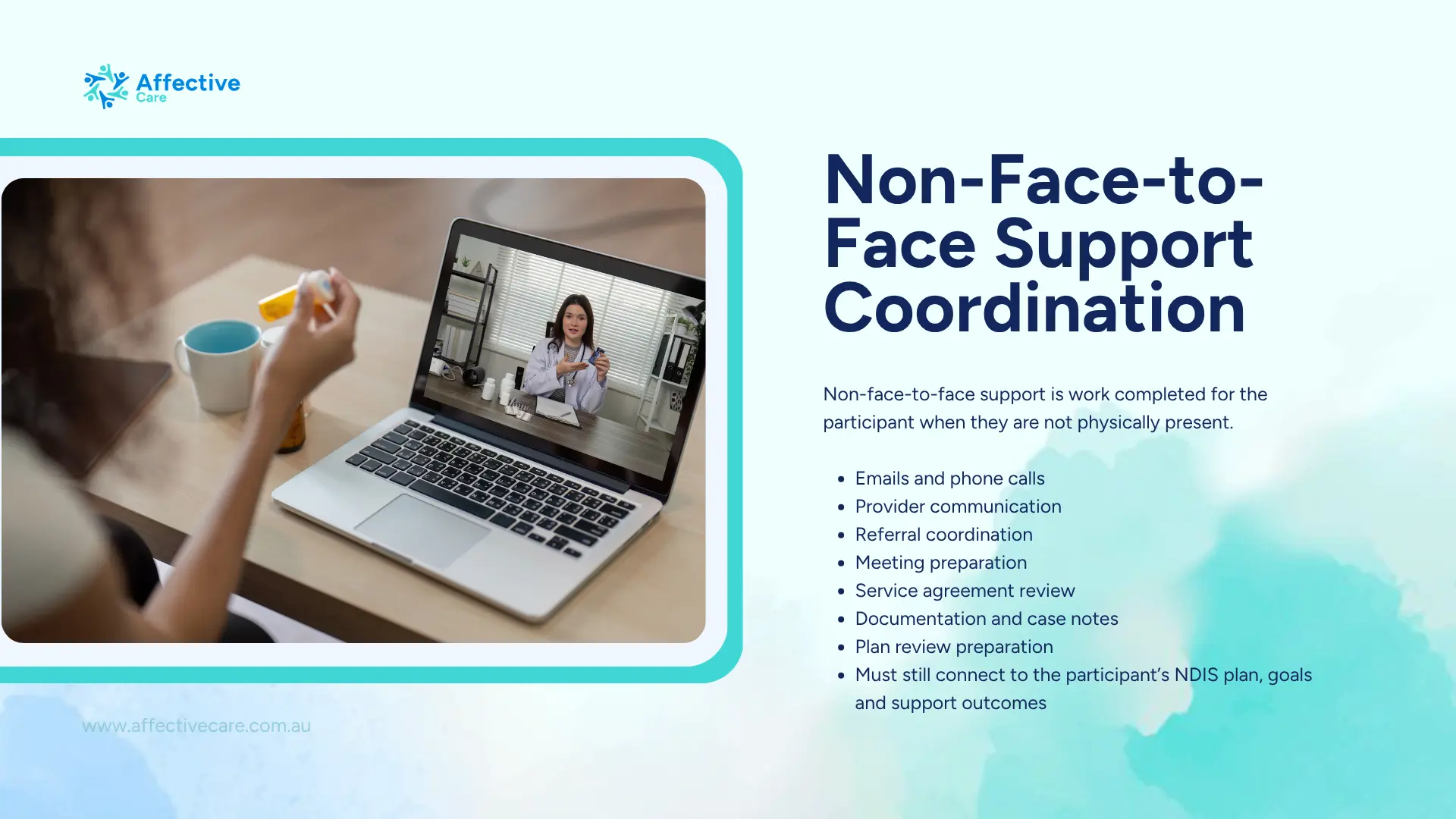
Non-face-to-face Support Coordination means work completed for the participant when they are not physically present, but the task still supports their NDIS plan, goals or service coordination.
| Activity | Description |
|---|---|
| Emails | Sending or responding to participant-related emails about supports, providers, referrals or service updates. |
| Phone calls | Calling providers, Plan Managers, participants or support networks about NDIS-related support needs. |
| Provider communication | Coordinating with therapists, support workers, accommodation providers or other services involved in the participant’s care. |
| Referral coordination | Helping send, follow up or manage referrals to suitable NDIS, community or mainstream services. |
| Documentation | Recording notes, actions, updates or outcomes related to Support Coordination work. |
| Report follow-up | Following up with providers about reports needed for reviews, reassessments or support planning. |
| Service agreement review | Reviewing service agreement details such as supports, costs, terms, responsibilities and changes. |
| Meeting preparation | Preparing notes, questions, documents or updates before participant-related meetings. |
| Plan review preparation | Gathering information and coordinating provider input to support upcoming NDIS plan reviews or reassessments. |
Non-face-to-face work is not automatically wrong or unnecessary. In fact, a large part of Support Coordination may happen through communication, follow-up and provider liaison.
The NDIS Support Catalogue lists what can and cannot be claimed for non-face-to-face support, travel and other claim types, so providers should check whether these claim types apply to the relevant support item.
For participants, the key point is this: non-face-to-face billing should still be connected to your NDIS plan and support outcomes.
It should also be documented clearly enough for you to understand what happened.
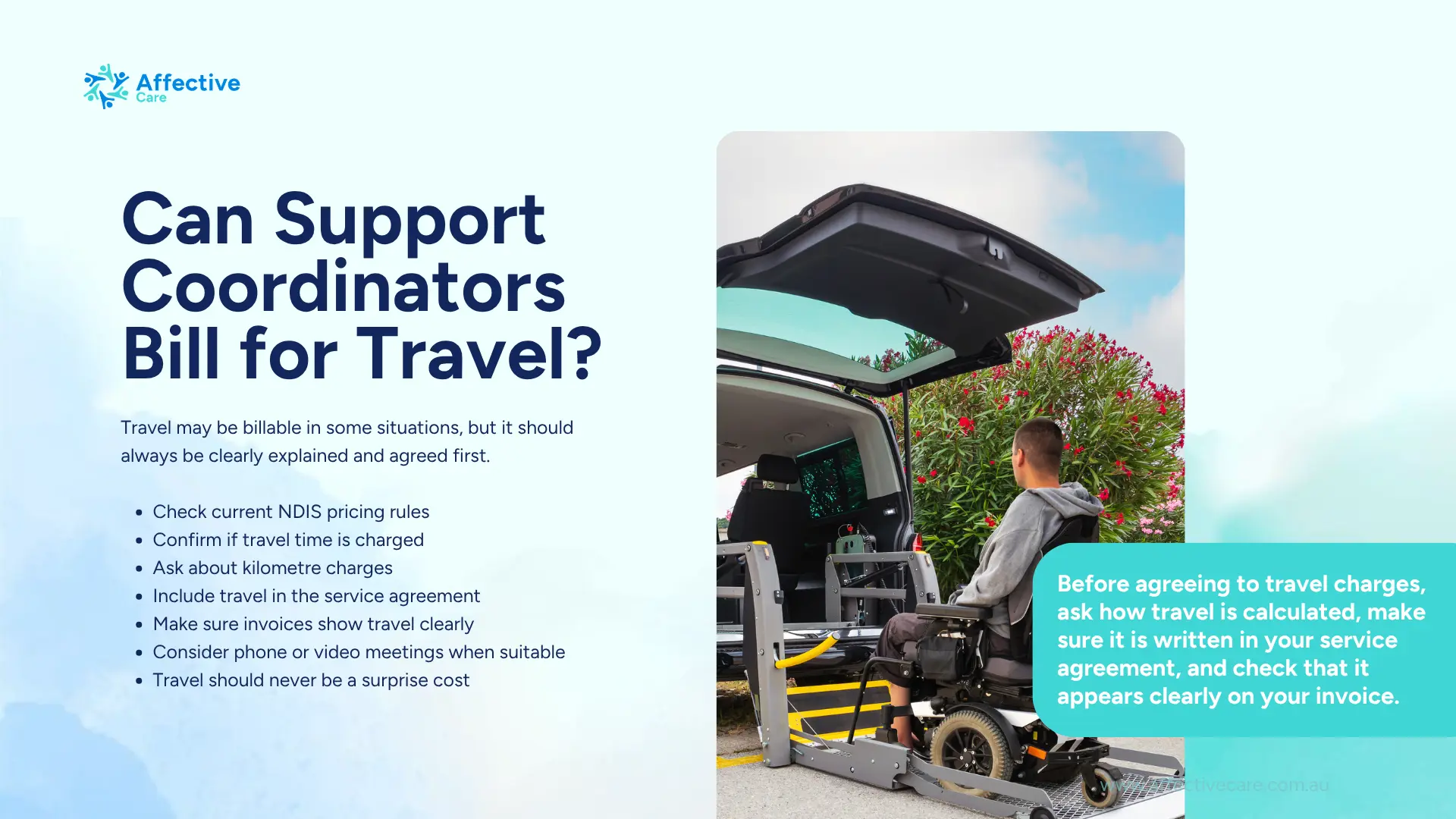
Can Support Coordinators Bill for Travel?
Travel may be claimable in some circumstances, but it depends on the current NDIS Pricing Arrangements, the relevant support item and what has been agreed with the participant.
Participants should ask about travel charges before services begin.
Travel costs should be explained clearly in the service agreement and shown clearly on invoices if they are charged.
The NDIS has noted that pricing and travel claiming rules can affect participant funding, and participants and providers are encouraged to review current pricing information.
Before agreeing to travel-related charges, participants can ask:
- Will travel time be charged?
- Will travel kilometres be charged?
- What rate will be used?
- Is travel included in the service agreement?
- How will travel appear on invoices?
- Can some meetings happen by phone or video instead?
Furthermore, you may also find our guide on NDIS tax considerations helpful for understanding financial responsibilities connected with disability supports and services.
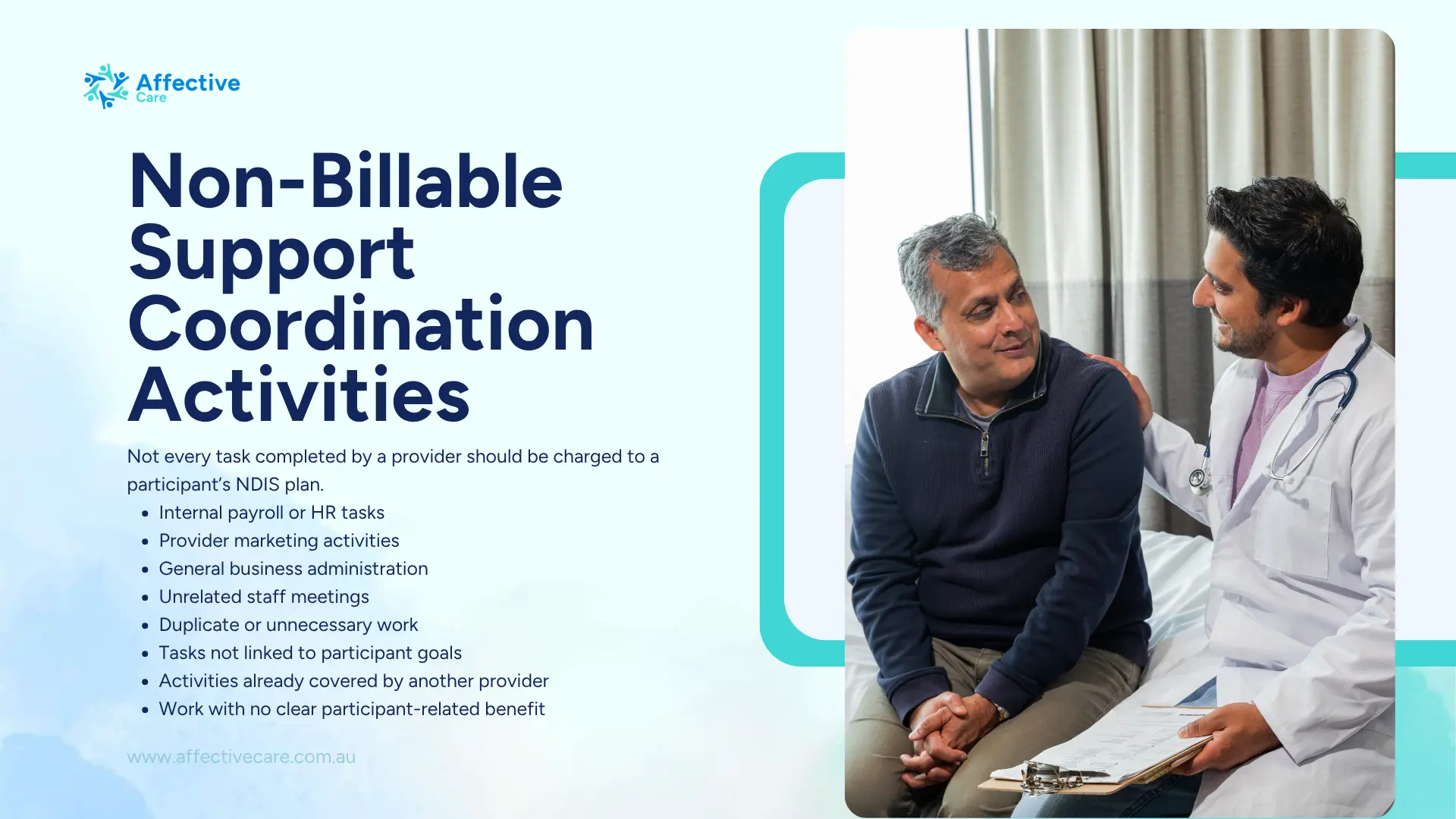
What Support Coordination Activities Are Usually Not Billable?
Not every task a Support Coordinator or provider completes should be charged to a participant’s NDIS plan.
NDIS Support Coordination non-billable activities usually include work that is not directly connected to the participant’s plan, goals or support needs.
General Business Administration
General business administration is usually not appropriate to bill as Support Coordination.
For example, if a provider is updating its internal policies, that should not be billed to a participant as Support Coordination.
This may include:
- Internal payroll
- Staff rostering for the provider’s own business
- Provider marketing
- General staff meetings
- Recruitment activities
- Internal business planning
- General policy writing
- Training that is not specific to the participant’s support needs
Duplicate or Unnecessary Work
Support Coordination billing should be reasonable and purposeful.
Red flags may include:
- Repeated charges for the same task without clear reason
- Excessive communication with no clear participant benefit
- Multiple providers billing for the same coordination activity
- Long time entries for tasks that are not explained
- Unclear or repeated invoice descriptions
Work Not Connected to the Participant’s NDIS Goals
Support Coordination should relate to the participant’s NDIS plan and goals.
Activities are usually not appropriate to bill if they are:
- Unrelated to the participant
- Not linked to plan implementation
- Not connected to support needs
- Not helping coordinate services
- Not supporting capacity building
- Not agreed in the service arrangement
For example, general networking with providers may be part of a Support Coordinator’s business development, but it should not be charged to a participant unless the activity is directly related to that participant’s supports.
Work Already Covered by Another Provider
Some activities may belong to another funded service. For example, therapy providers may be responsible for writing therapy reports, while support worker providers may be responsible for rostering their own staff.
A Support Coordinator can help share information between providers, but should not bill for tasks that clearly belong to another provider unless there is a participant-related reason.
Moreover, if you want more clarity around billing, our guide to NDIS Support Coordinator time management explains how direct and non-face-to-face tasks may use funded hours.
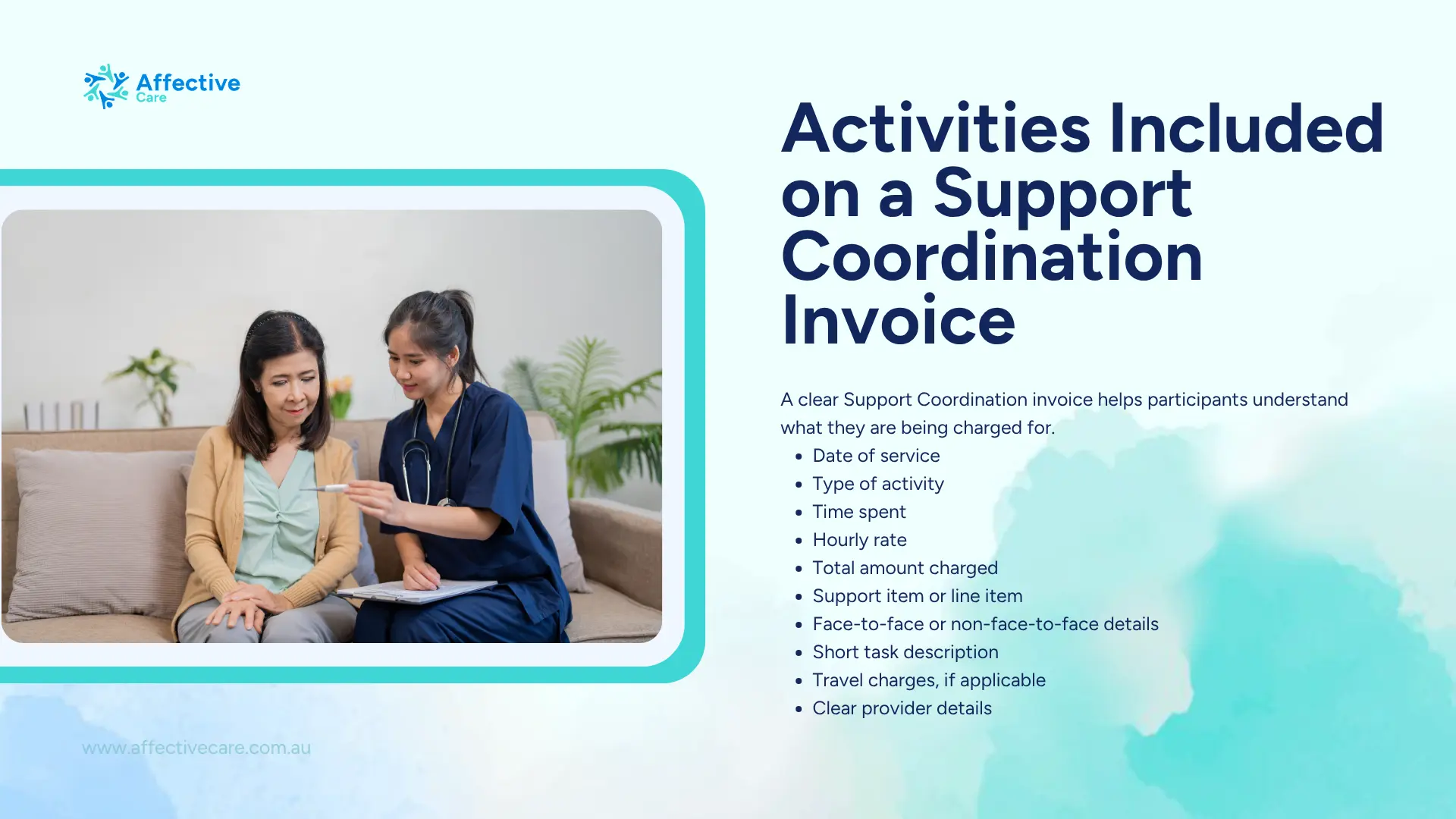
What Should Be Included on a Support Coordination Invoice?
A clear Support Coordination invoice helps participants understand what they are paying for.
A good invoice should include:
- Date of service
- Type of activity
- Time spent
- Hourly rate
- Total amount charged
- Support item or line item where relevant
- Whether the work was face-to-face or non-face-to-face
- A short description of the task
- Travel charges, if applicable
- Provider details
- GST information, if relevant
The NDIS explains that service agreements help participants and providers share expectations about what supports will be delivered and how they will be delivered.
Service agreements can also describe cost, payment and how changes are made.
A Support Coordination invoice should match the services that were agreed. If a participant does not understand an invoice, they can ask the provider for more detail.
A clear invoice description may look like:
“Phone call with speech therapist to confirm referral status and next appointment steps — 20 minutes.”
A vague invoice description may look like:
“Admin — 1 hour.”
Participants should feel comfortable asking for clearer information.
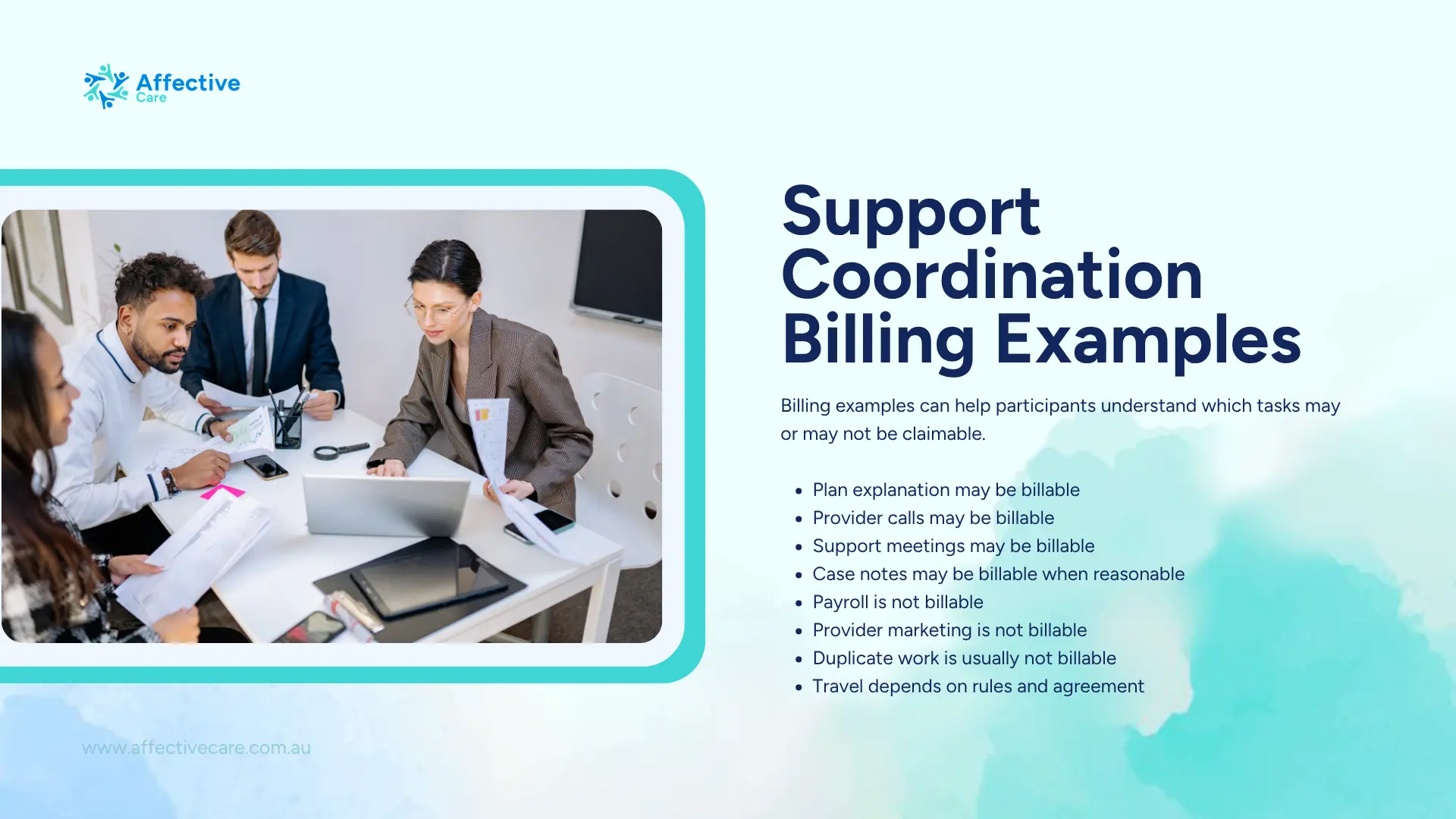
Support Coordination Billing Examples
The table below gives simple examples of activities that may or may not be billable.
These examples are general only and should always be checked against the current NDIS Pricing Arrangements, the participant’s plan and the service agreement.
|
Activity |
Usually billable? |
Why |
|
Helping a participant understand their NDIS plan |
Yes |
Directly supports plan implementation |
|
Calling providers to check therapy availability |
Yes |
Helps connect the participant with supports |
|
Emailing a Plan Manager about a participant invoice issue |
Yes |
Participant-related coordination |
|
Attending a participant support meeting |
Yes |
Supports coordinated service delivery |
|
Reviewing a service agreement with the participant |
Yes |
Helps participant make an informed choice |
|
Writing case notes about participant-related coordination |
May be billable |
Documentation may support transparent service delivery |
|
Provider payroll processing |
No |
Internal business administration |
|
General provider marketing |
No |
Not participant-specific |
|
Internal staff training not related to the participant |
Usually no |
General business activity |
|
Repeating the same task without clear purpose |
Usually no |
May not show reasonable participant benefit |
|
Travel to meet a participant |
Depends |
Must follow current pricing rules and agreement |
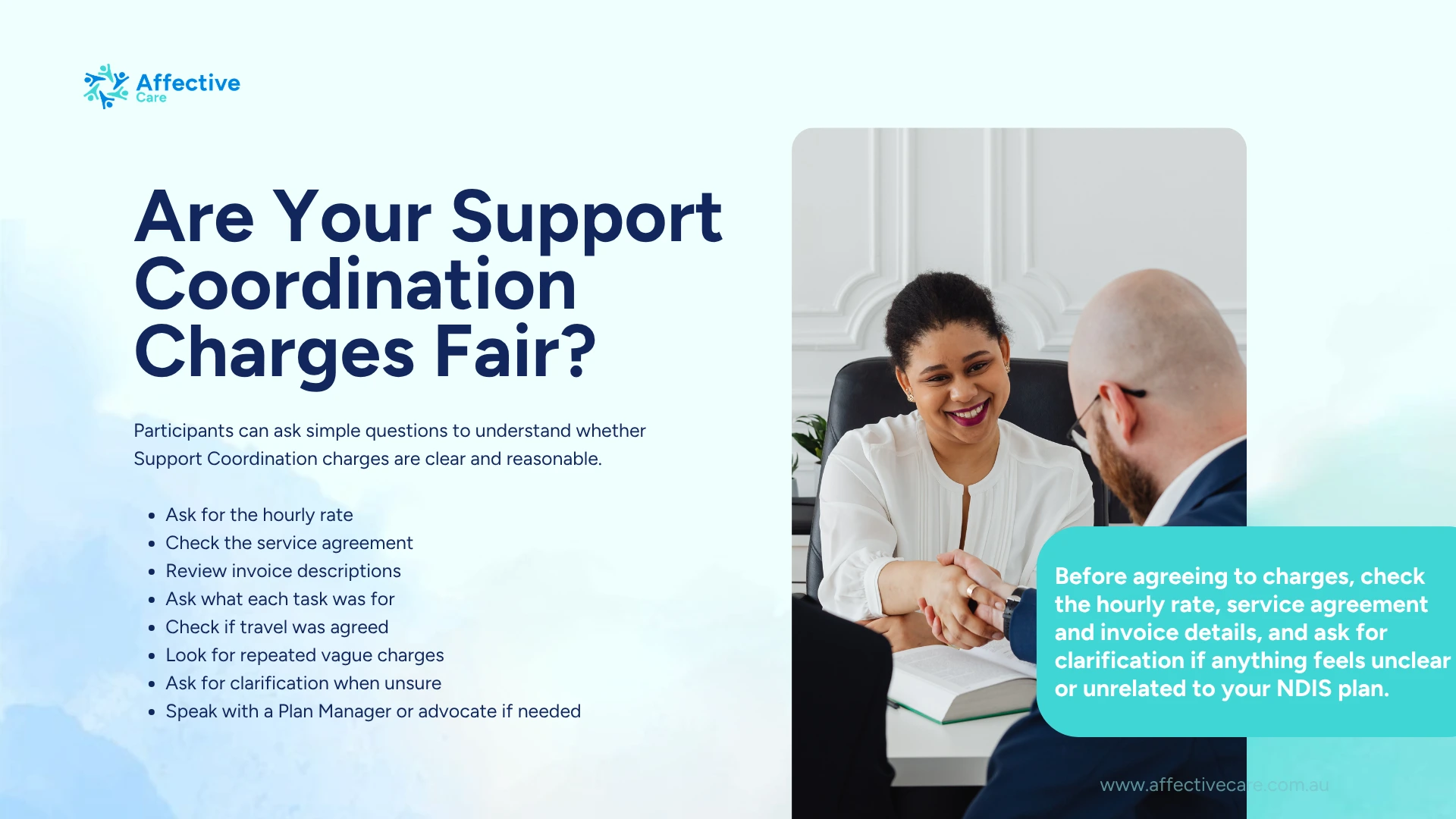
How Participants Can Check If Support Coordination Charges Are Fair
Participants, families and carers can take practical steps to understand Support Coordination charges.
Before services begin, ask:
- What is your NDIS Support Services hourly rate?
- What tasks do you usually bill for?
- Do you bill for emails and phone calls?
- Do you bill for non-face-to-face work?
- Do you charge for travel?
- How will activities appear on invoices?
- How often will invoices be sent?
- How do you record time?
- What happens if I disagree with a charge?
When reviewing invoices, check:
- Is the date correct?
- Is the activity clear?
- Does the charge match the service agreement?
- Does the activity relate to the participant’s plan?
- Is the time charged reasonable?
- Are travel charges clearly explained?
- Are there repeated or vague entries?
The NDIS has a current page on participant rights and responsibilities, including information about consumer rights, protecting an NDIS plan and steps to take when something is wrong.
Participants can also ask their Plan Manager, nominee, advocate or support network for help reviewing invoices.
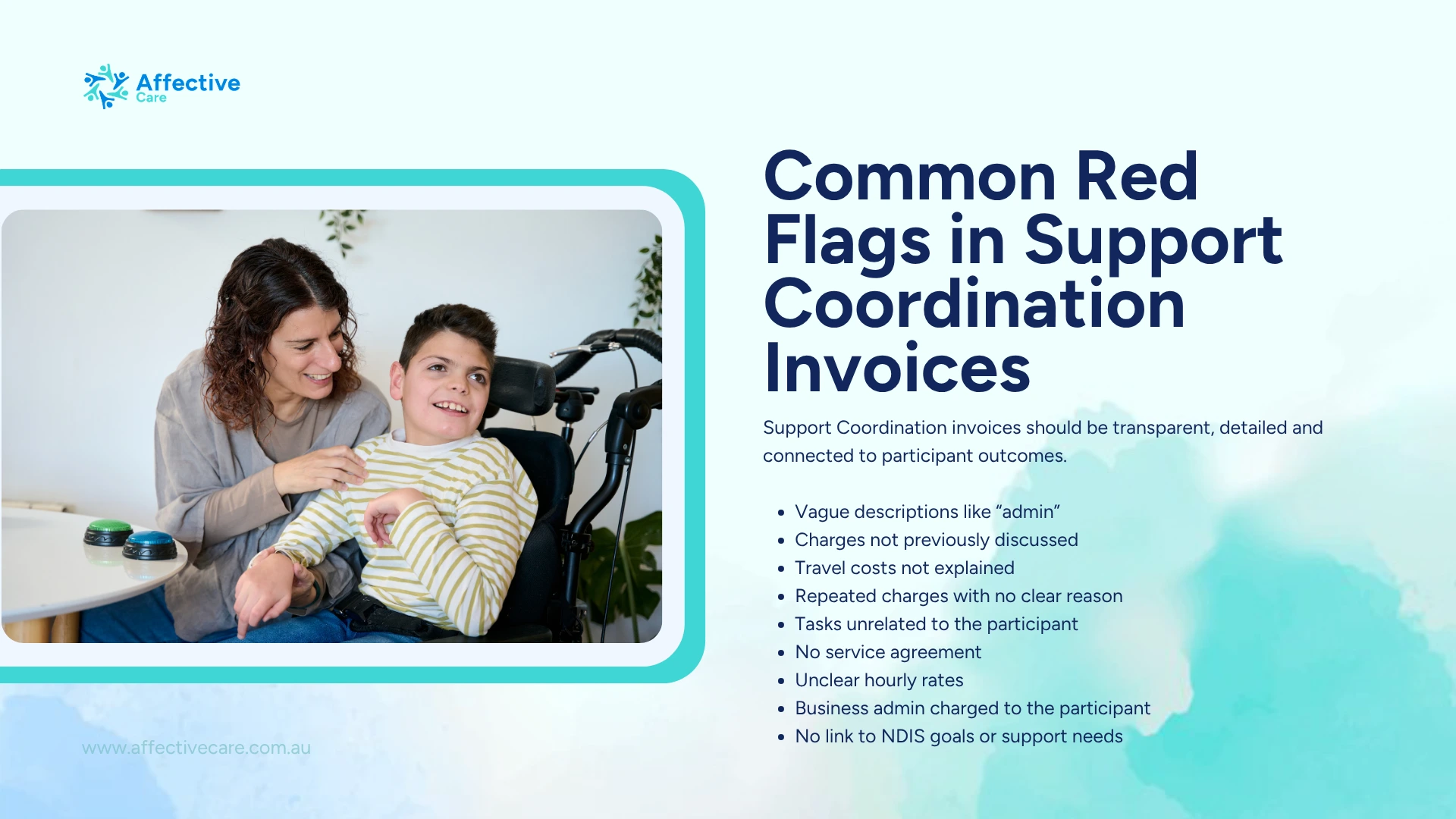
Common Red Flags in Support Coordination Invoices
Support Coordination invoices should be clear, reasonable and connected to participant outcomes.
Common red flags include:
- Vague descriptions such as “admin” with no detail
- Charges the participant did not know about
- Travel charges that were not discussed
- Repeated charges with no clear reason
- Billing for tasks unrelated to the participant
- No service agreement
- Unclear hourly rates
- Charges for provider business administration
- Invoices that do not explain whether work was face-to-face or non-face-to-face
- Charges that do not appear connected to the participant’s NDIS goals
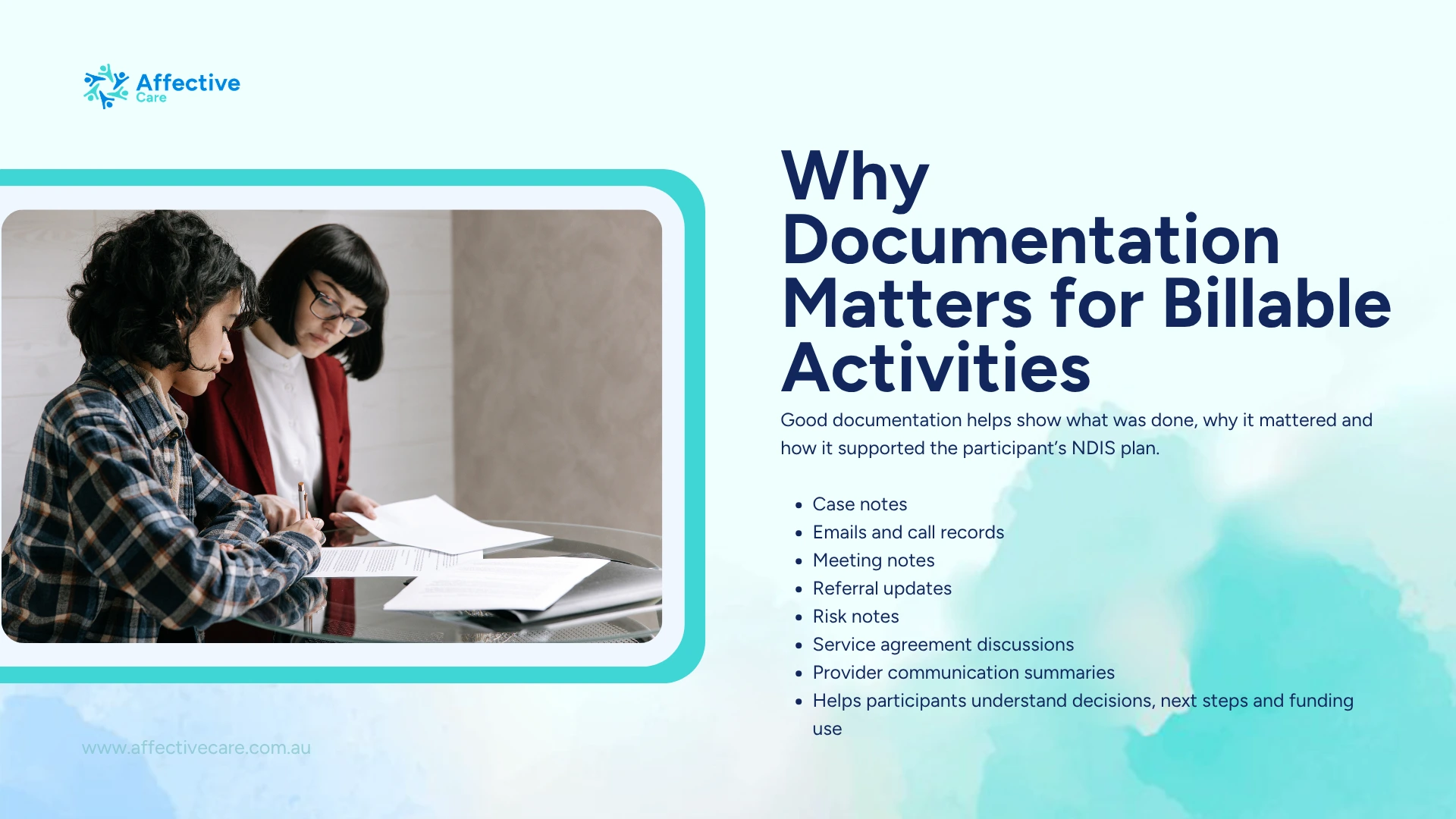
Why Documentation Matters for Billable Support Coordination
Good documentation supports transparency, continuity and accountability in NDIS Support Coordination.
It helps show what work was completed, why it was needed, and how it related to the participant’s NDIS plan, goals or support needs.
Support Coordination records may include:
- Case notes
- Emails
- Call records
- Meeting notes
- Referral updates
- Risk notes
- Plan review preparation notes
- Service agreement discussions
- Provider communication summaries
For providers, clear documentation helps demonstrate that billable activities were participant-related and connected to plan implementation.
For participants, it helps explain what happened, what decisions were made and what the next steps are.
Good documentation should answer:
- What was done?
- Why was it needed?
- Who was contacted?
- How much time was spent?
- How did it relate to the participant’s NDIS plan or goals?
- What outcome or next step came from it?
Support Coordination billing should never feel unclear or hidden.
When records are simple, accurate and transparent, participants can better understand the value of the support they receive and feel more confident about how their NDIS funding is being used.
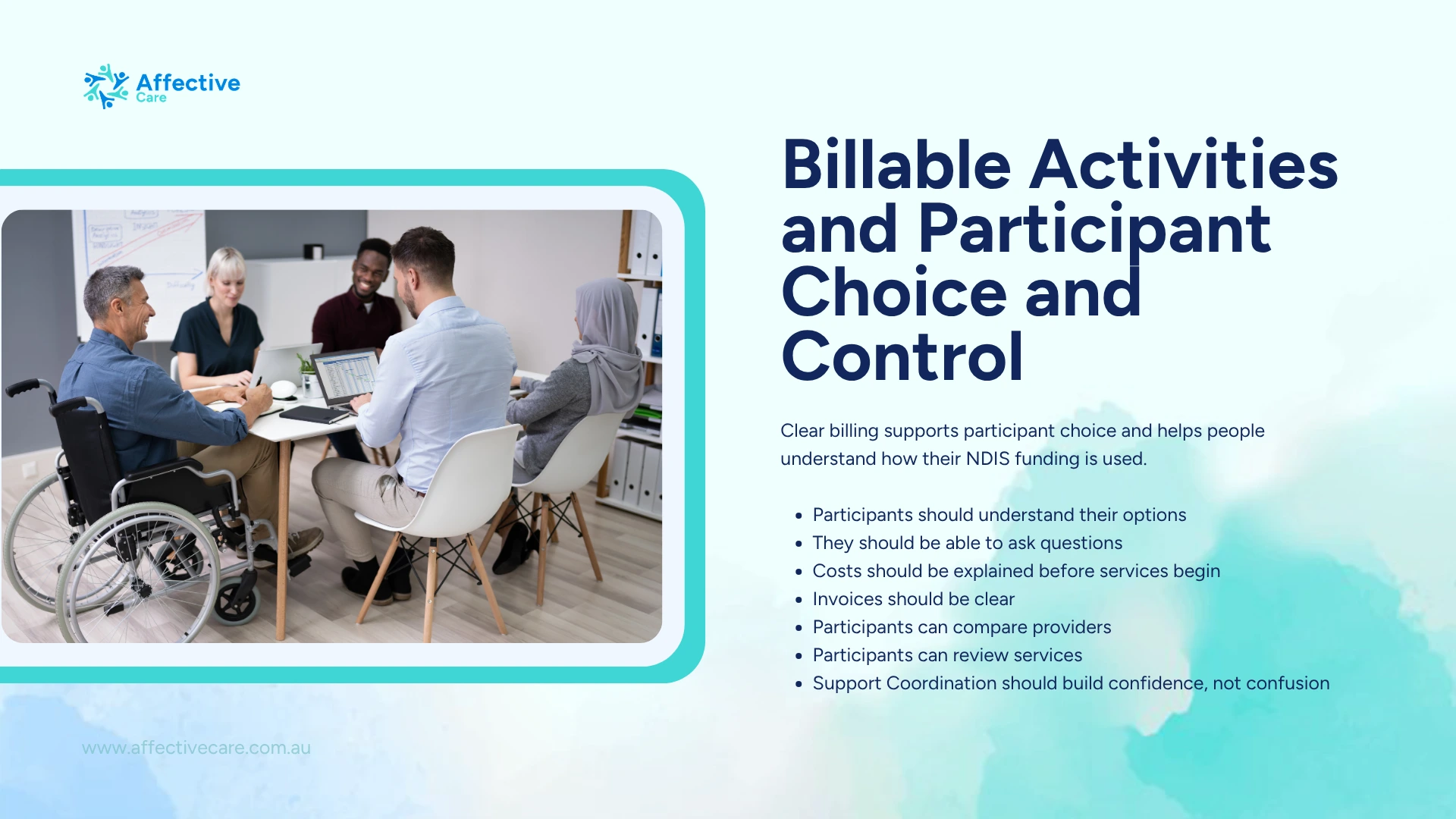
Billable Activities and Participant Choice and Control
Participant choice and control should sit at the centre of Support Coordination.
Clear billing helps participants understand what they are paying for, why a task was completed and how it supports their NDIS plan.
Participants should be supported to:
- Understand their options
- Ask questions
- Compare providers
- Agree to services before they begin
- Understand costs
- Review invoices
- Change providers if needed
Support Coordination billing should never pressure participants into using services they do not want or do not understand.
Instead, it should support informed decision-making and help participants feel more confident using their plan.
When billing is clear, participants can see how their funding is being used and whether the support they receive is helping them work towards their goals.
This also makes it easier to identify concerns, ask for clarification or review service arrangements when something does not feel right.
Good Support Coordination should strengthen participant choice, not reduce it.
The participant should remain involved in decisions about their supports, providers, services and funding wherever possible.

How Affective Care Supports Clear and Participant-First Support Coordination
At Affective Care, Support Coordination is delivered with a calm, respectful and participant-first approach.
Our focus is on helping people understand their NDIS plan, connect with suitable supports and make decisions that feel right for their life.
We support participants and families by helping with:
- Understanding NDIS plan funding
- Connecting with suitable providers
- Organising support arrangements
- Reviewing service options
- Preparing for plan changes
- Identifying support gaps
- Coordinating communication between services
- Supporting choice and control
Our approach is emotionally-centred, which means we listen first, explain options clearly and work alongside participants with care.
Whether you are new to Support Coordination or want clearer guidance around your current supports, Affective Care can help you understand your options in a calm and supportive way.
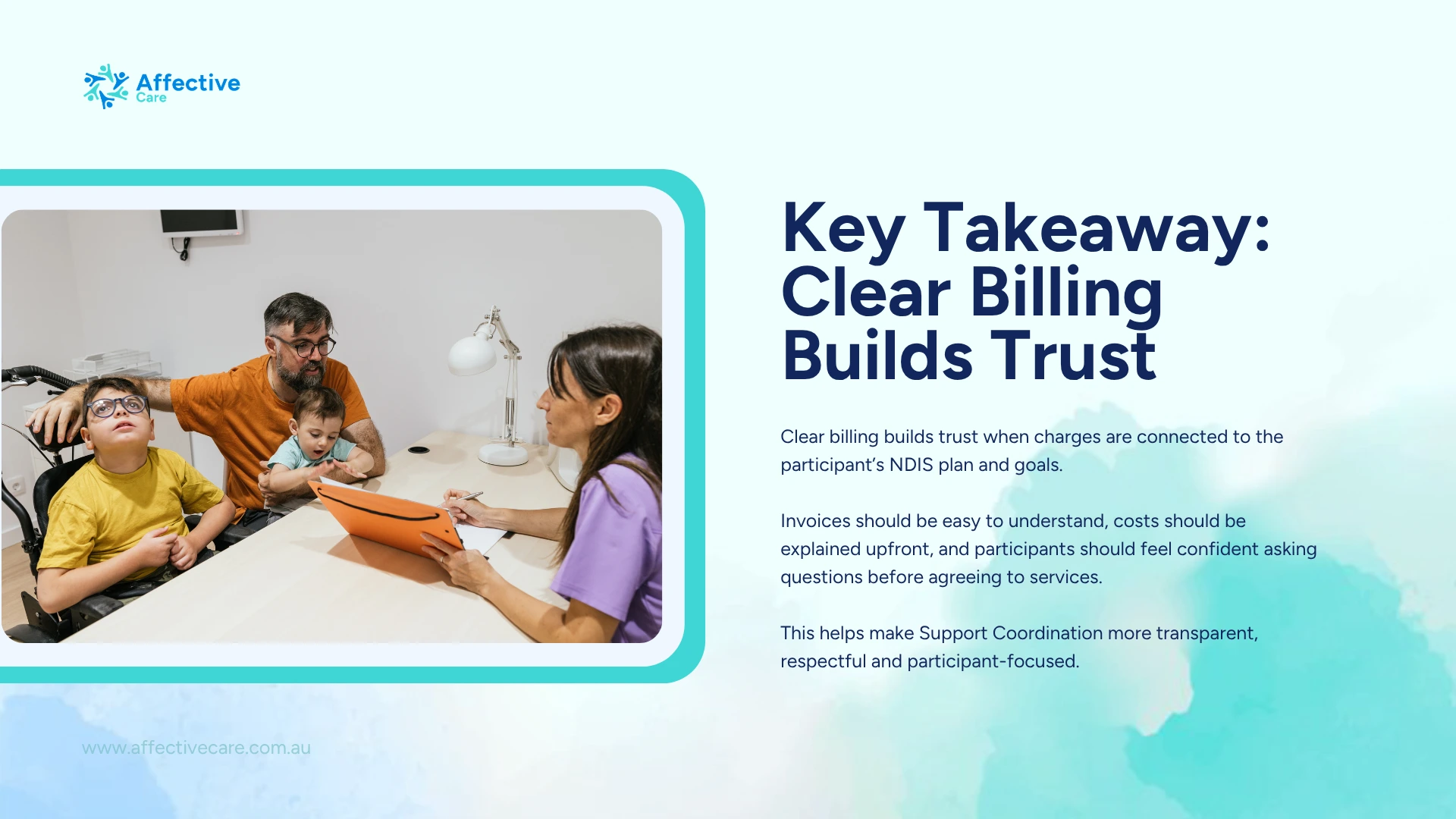
Key Takeaway: Clear Billing Builds Trust
Billable activities in NDIS Support Coordination should be clear, reasonable and connected to the participant’s NDIS plan, goals and support needs.
Support Coordinators may be able to bill for tasks such as plan implementation, provider communication, meetings, service agreement review, non-face-to-face coordination, documentation and plan reassessment preparation.
However, they should not bill participants for unrelated business administration, vague activities, duplicate work or tasks that do not provide a clear participant-related benefit.
Participants have the right to understand what they are being charged for.
A clear service agreement, transparent invoices and open communication can help reduce confusion and build trust between participants and providers.
Before agreeing to services, participants can ask what may be billed, how time is recorded, whether travel is charged and how invoices will be explained.
The best Support Coordination is not just about completing tasks. It is about helping participants feel informed, respected and confident using their NDIS plan.