



Understanding the NDIS Hourly Rate for Support Workers can help participants, families and carers make informed choices about their supports, service agreements and NDIS budgets. ‘
Whether you are arranging help at home, personal care, community access, overnight support or high-intensity support, the hourly rate can change depending on the type of support, time of day, day of the week and location.
The current NDIS pricing source is the NDIS Pricing Arrangements and Price Limits 2025–26.
The NDIA states that these documents help participants and disability support providers understand how price controls for NDIS supports and services work.
The 2025–26 pricing updates came into effect from 1 July 2025, with later updates released in October 2025 and effective from 24 November 2025.
This guide explains the current NDIS hourly rate for support workers, including weekday, weekend, public holiday, sleepover and high-intensity support rates.
It also explains what NDIS price limits mean, how they may affect your Core Supports budget, and what questions to ask before choosing a provider.
NDIS Support Worker Pay Rates by Shift (2026–27)
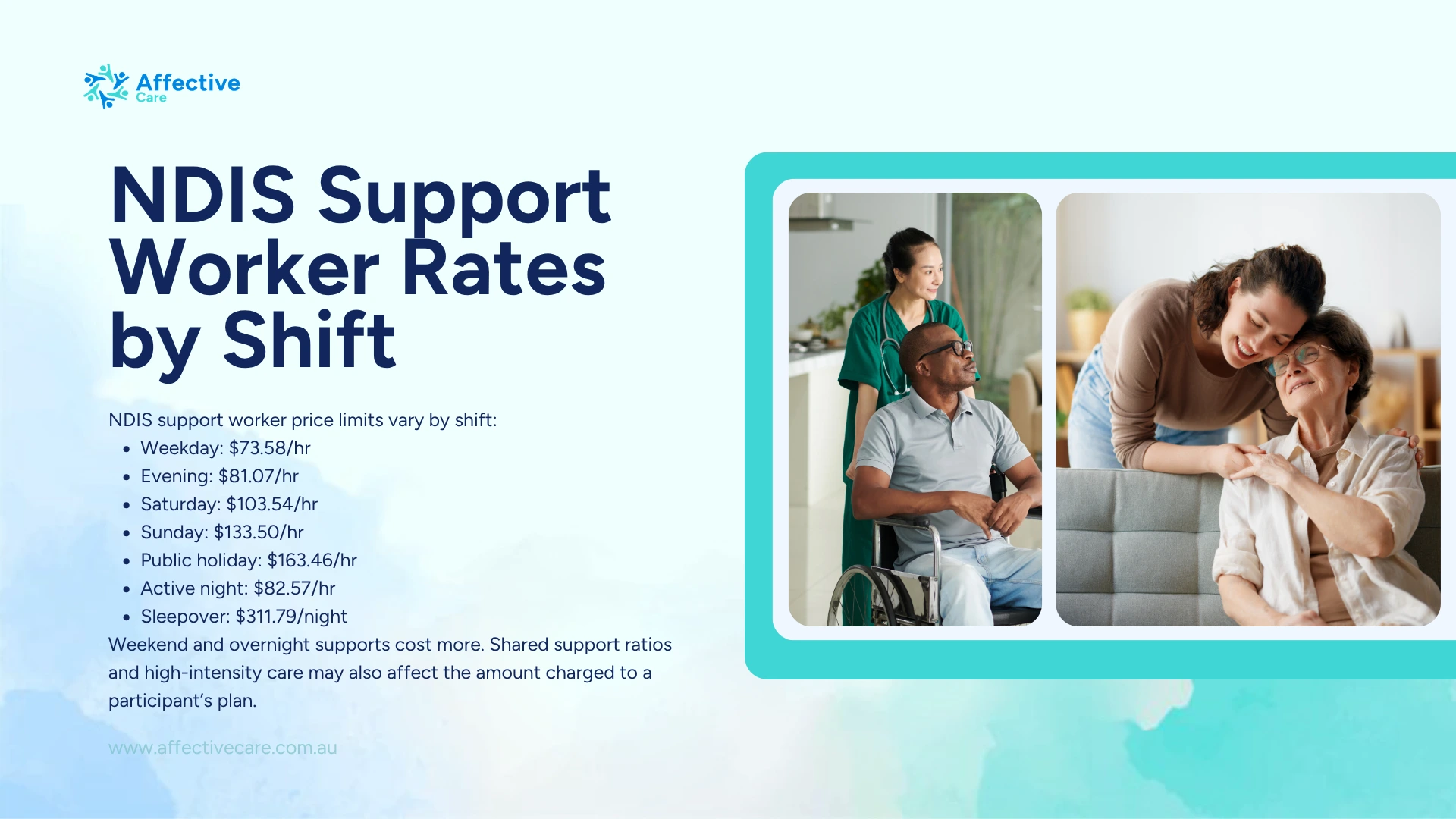
The NDIS hourly rates for support workers change depending on when the support is delivered; weekday, evening, weekend or overnight.
The table below shows the current price limits for standard personal care and daily living support (the most commonly used line items).
These are the maximums providers can charge a plan, set by the NDIA and updated each July.
| Shift type | When it applies | Price limit |
|---|---|---|
| Weekday daytime | Monday–Friday, 6am–8pm | $73.58 per hour |
| Weekday evening | Monday–Friday, after 8pm | $81.07 per hour |
| Saturday | All day Saturday | $103.54 per hour |
| Sunday | All day Sunday | $133.50 per hour |
| Public holiday | Gazetted public holidays | $163.46 per hour |
| Active night shift | Worker awake and providing support overnight | $82.57 per hour |
| Sleepover, non-active | Worker sleeps on site and assists if needed | $311.79 per night |
Source: NDIA Pricing Arrangements and Price Limits 2026–27, national non-remote limits. Remote and very remote loadings apply.
Three things worth understanding about this table:
- The Sunday rate for an NDIS support worker is substantially higher than the weekday rate because price limits track award-based labour costs; the same reason evening and public holiday supports cost a plan more. If your funding is tight, scheduling flexible supports on weekdays stretches it further.
- Active night vs sleepover matters. An active night shift (worker awake all night, e.g. for medical or behaviour support needs) is charged hourly; a sleepover is a flat overnight amount plus any hours the worker is actually woken to assist. The right model depends on assessed overnight need, explained in our guide to SIL support ratios and overnight support.
- NDIS personal care rates use the same shift structure and higher-skill supports such as high intensity daily personal activities have their own, higher limits reflecting the qualifications required.
How support is shared also changes the cost to your plan: 1:1, 1:2 and 1:3 arrangements are priced differently. See support ratios explained, or the full NDIS rates reference for other support categories.
What Are NDIS Support Worker Rates?
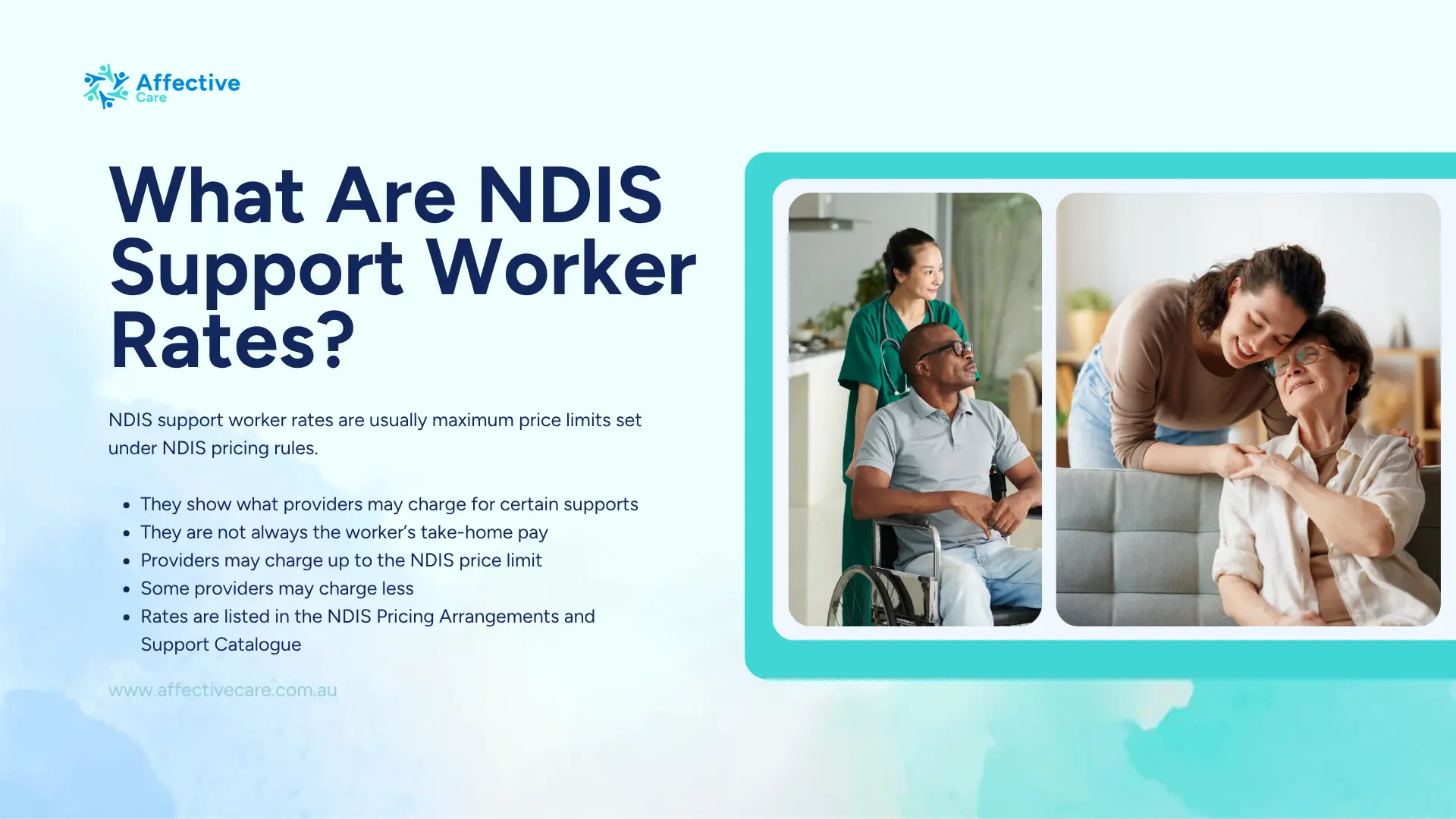
NDIS support worker rates usually refer to the maximum price limits that can be charged for certain support worker services under the NDIS.
These rates are listed in the NDIS Pricing Arrangements and Price Limits and the NDIS Support Catalogue.
The NDIS Support Catalogue provides the current price limits for each support item and shows which claim types may apply, such as provider travel, non-face-to-face supports and other claim conditions.
In simple terms, an NDIS support worker hourly rate is not always the exact amount a worker personally receives as wages.
It is usually the amount a provider may charge to a participant’s NDIS plan for a specific support item.
That provider charge may include worker wages, superannuation, insurance, training, compliance, administration, rostering and service management.
This is important because many people search for NDIS provider hourly rate or NDIS support worker cost per hour expecting it to mean worker pay.
In reality, the NDIS maximum hourly rate is a plan-charging limit, not a wage guide.
Providers may charge up to the NDIS price limit where the support is eligible and the pricing rules apply.
They may also charge less. Participants, nominees and families should always ask for clear pricing before signing a service agreement.
Current NDIS Hourly Rates for Standard Support Workers
One of the most common support worker categories is Assistance with Self-Care Activities – Standard.
This can include support with daily personal activities such as showering, dressing, grooming, eating, personal routines and everyday domestic tasks that a participant is unable to complete independently.
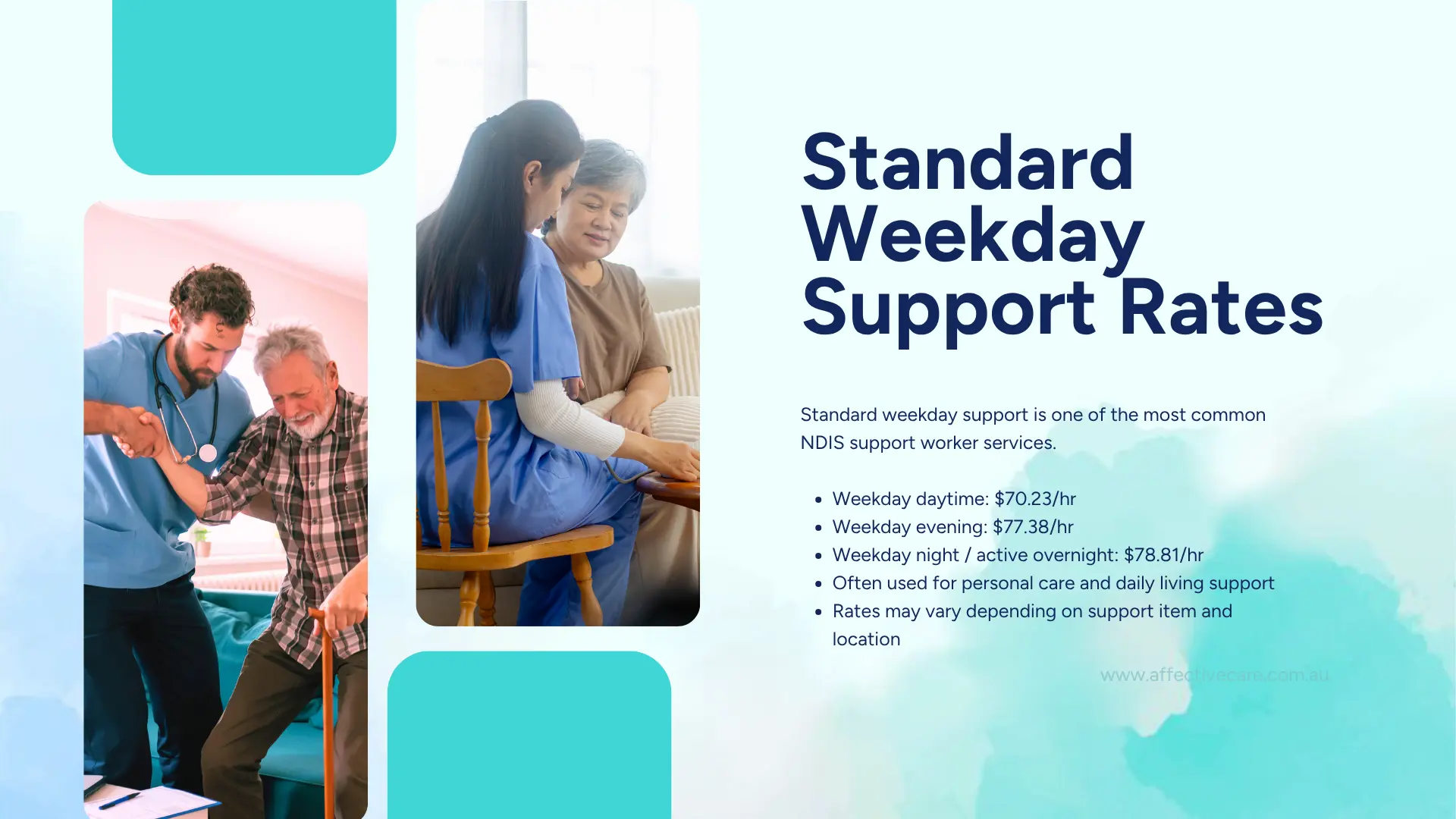
For the 2025–26 period, the standard NDIS weekday daytime support worker rate for Assistance with Self-Care Activities is listed as $70.23 per hour for support item 01_011_0107_1_1.
Standard Weekday Support Worker Rates
|
Support type |
Time / day |
NDIS support item |
Current rate |
|
Assistance with Self-Care Activities – Standard |
Weekday daytime |
01_011_0107_1_1 |
$70.23/hr |
|
Assistance with Self-Care Activities – Standard |
Weekday evening |
01_015_0107_1_1 |
$77.38/hr |
|
Assistance with Self-Care Activities – Standard |
Weekday night / active overnight |
01_002_0107_1_1 |
$78.81/hr |
The weekday daytime rate usually applies from Monday to Friday during standard daytime hours.
For example, Plan Tracker describes the weekday daytime self-care item as support available Monday to Friday between 6 am and 8 pm, including everyday domestic tasks the participant may be unable to do independently, such as eating, grooming and showering.
Evening and night rates are higher because support is being delivered outside standard weekday hours.
If a participant requires active overnight support, the worker is generally awake and actively providing support during the shift.
This is different from a sleepover, where the worker may be present overnight but expected to sleep unless support is required.
Moreover, if you want to understand how hourly support costs are set, our guide to NDIS Price rates for support services explains current weekday, weekend and public holiday price limits.

NDIS Weekend and Public Holiday Support Worker Rates
Weekend and public holiday support worker rates are higher than weekday daytime rates.
This means the same type of support can cost more from a participant’s NDIS plan if it is delivered on a Saturday, Sunday or public holiday.
For participants who need regular support outside standard hours, understanding NDIS support worker weekend rates is important for budgeting.
A plan that covers many weekday hours may be used more quickly if a large portion of support is booked on weekends or public holidays.
Moreover, to understand how support worker rates are set, it can help to review the NDIS Price Guide, which outlines pricing arrangements, hourly rates and claiming rules for different supports.
Standard Weekend and Public Holiday Rates
|
Day |
NDIS support item |
Current rate |
|
Saturday |
01_013_0107_1_1 |
$98.83/hr |
|
Sunday |
01_014_0107_1_1 |
$127.43/hr |
|
Public holiday |
01_012_0107_1_1 |
$156.03/hr |
These NDIS Saturday support worker rate, NDIS Sunday support worker rate and NDIS public holiday support worker rate figures apply to standard Assistance with Self-Care Activities under the relevant support items.
Current third-party support catalogue tools show these rates for the 2025–26 period, aligned with NDIS support item pricing.
Before booking weekend or public holiday support, participants should check whether the higher rate applies and how it will affect their available Core Supports budget.
A good service agreement should clearly explain:
- the hourly rate being charged;
- when weekend or public holiday rates apply;
- whether travel or non-face-to-face costs may be charged;
- how cancellations are handled;
- how invoices will be provided.

NDIS Sleepover and Active Overnight Support Rates
Overnight support can be confusing because there are different types of overnight support worker arrangements.
Two common terms are sleepover support and active overnight support.
A night-time sleepover usually means the support worker is present overnight and available if needed, but they are expected to sleep for part of the shift.
An active overnight usually means the support worker stays awake and provides support during the night.
Sleepover and Active Overnight Rates
|
Support type |
NDIS support item |
Current rate |
|
Night-time sleepover |
01_010_0107_1_1 |
$297.60 each |
|
Active overnight / weekday night self-care |
01_002_0107_1_1 |
$78.81/hr |
The current NDIS Support Catalogue information lists Assistance with Self-Care Activities – Night-Time Sleepover at $297.60, and Assistance with Self-Care Activities – Standard – Weekday Night at $78.81 per hour.
The right option depends on the participant’s support needs.
Participants should ask the provider to explain why a sleepover, active overnight or another arrangement is being recommended.
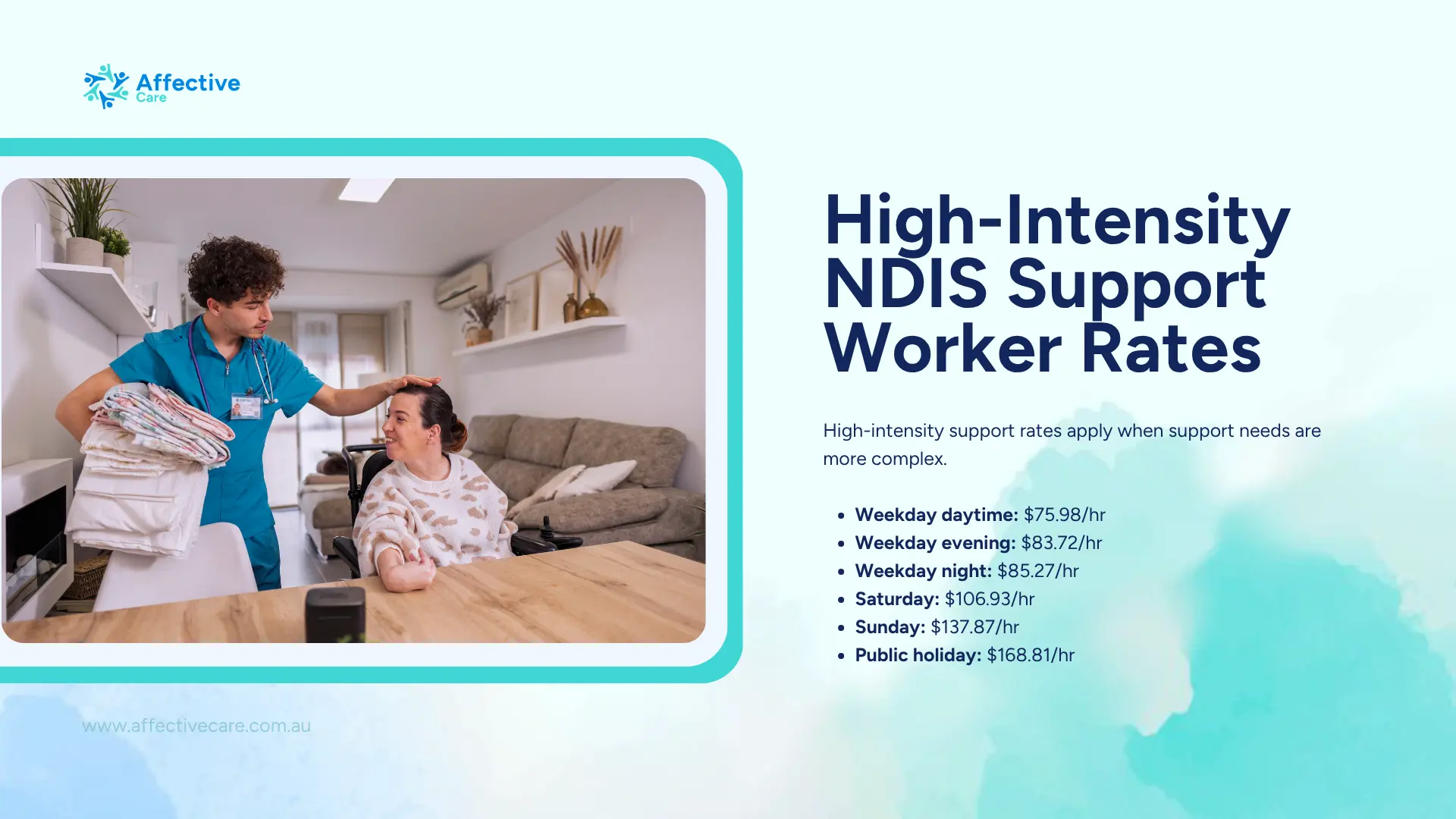
High-Intensity NDIS Support Worker Rates
Some participants need more complex daily personal support. These supports may fall under high-intensity daily personal activities where the worker needs additional skills, training or experience.
NDIS high-intensity support rates are usually higher than standard support worker rates because the support may involve more complex care needs.
High-intensity supports may relate to tasks such as complex personal care or health-related support, depending on the participant’s plan, goals and support needs.
High-Intensity Support Worker Hourly Rates
|
Time / day |
Current high-intensity rate |
|
Weekday daytime |
$75.98/hr |
|
Weekday evening |
$83.72/hr |
|
Weekday night |
$85.27/hr |
|
Saturday |
$106.93/hr |
|
Sunday |
$137.87/hr |
|
Public holiday |
$168.81/hr |
These NDIS high-intensity support worker hourly rates apply to high-intensity daily personal activities under the relevant support items.
Support catalogue tools for the 2025–26 period list these high-intensity price limits separately from standard self-care supports.
Not every participant requires high-intensity support. It should be linked to the participant’s needs, plan and the type of support being delivered.
If a provider proposes high-intensity support rates, participants can ask:
- What makes this support high-intensity?
- What worker training or skills are required?
- Is the support item suitable for my plan?
- How will this be shown on invoices?
- Will the same rate apply for every shift?’
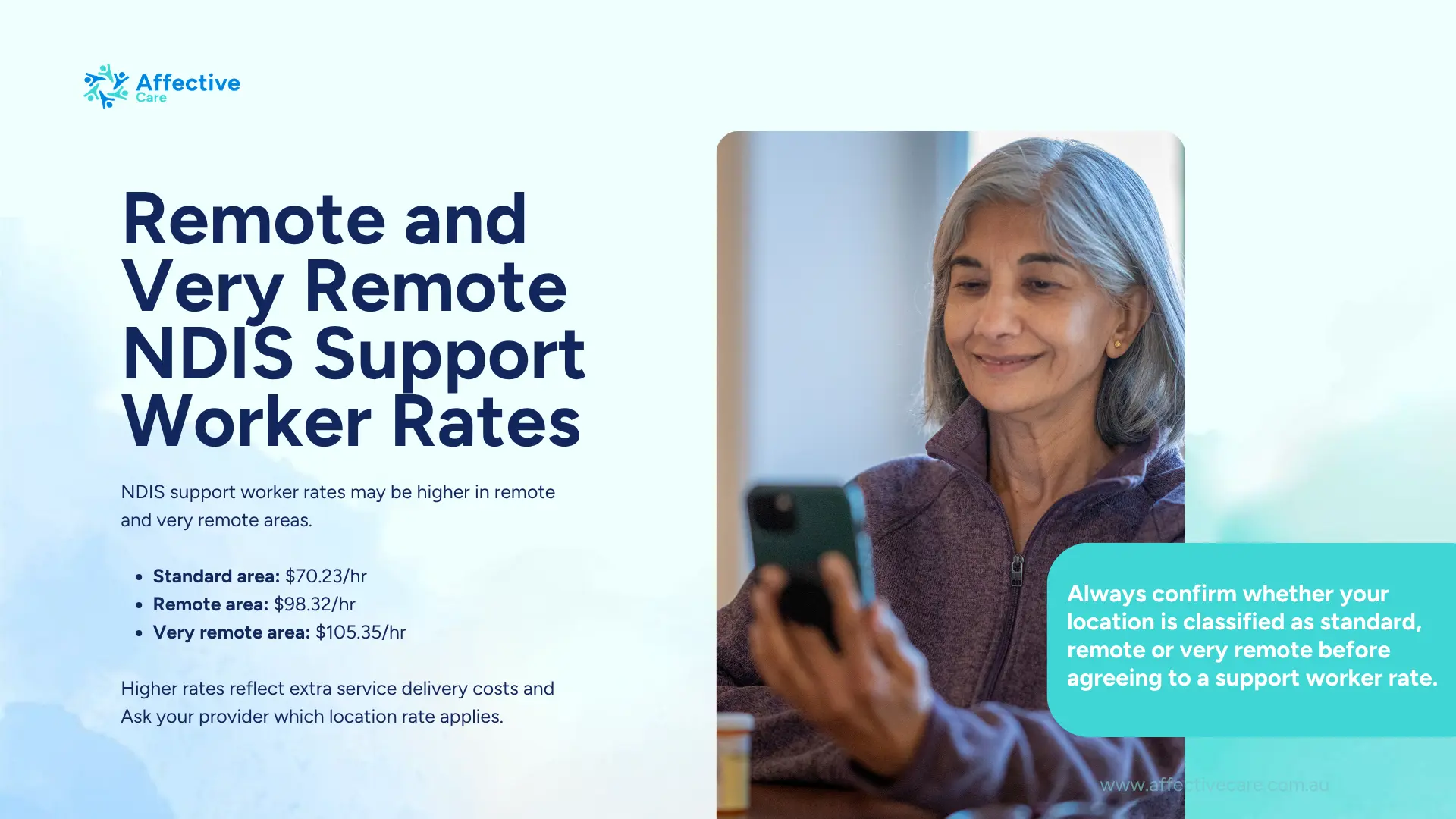
Remote and Very Remote NDIS Support Worker Rates
NDIS support worker rates may be higher in remote and very remote areas.
This reflects the additional cost of delivering services in some locations, including workforce availability, travel, distance and service delivery challenges.
The NDIS Pricing Arrangements and Price Limits 2025–26 include updates related to the Modified Monash Model, with the model updated from 2019 to 2023.
For the standard weekday daytime self-care support item, the 2025–26 rate is commonly listed as:
|
Location type |
Example rate for standard weekday daytime support |
|
Standard area |
$70.23/hr |
|
Remote area |
$98.32/hr |
|
Very remote area |
$105.35/hr |
This means NDIS remote support worker rates and NDIS very remote support worker rates can be significantly higher than standard area rates.
For example, MD Home Care’s pricing tool lists the standard weekday daytime self-care item at $70.23 per hour, with remote and very remote rates shown as $98.32 and $105.35 respectively.
Participants in regional, remote or very remote areas should ask providers which location classification applies and whether any additional travel or non-labour costs may be charged.

Are NDIS Rates the Same as Support Worker Wages?
No. This is one of the most important points to understand.
The NDIS support worker hourly rate is usually the amount a provider may charge a participant’s plan for a support item. It is not necessarily the amount paid directly to the support worker.
A provider’s charge may include:
- Worker wages;
- Superannuation;
- Payroll tax where relevant;
- Workers compensation insurance;
- Public liability insurance;
- Training and supervision;
- Rostering;
- Administration;
- Compliance and quality systems;
- Reporting and documentation;
- Service coordination.
This is why the phrase NDIS support worker rates vs support worker pay is important.
The price charged to a plan and the wage received by a worker are not the same thing.
Support-worker rates can use a significant portion of a plan, particularly when regular assistance is required, so participants may need strategies for managing support-worker costs with limited NDIS funding.
Independent support workers, small providers and larger organisations may also have different pricing models.
Some providers charge the full NDIS price limit, while others may charge below it. Participants can ask for a schedule of fees before services begin.
A transparent provider should be able to explain:
- their standard hourly rate;
- when higher rates apply;
- whether travel is charged;
- how cancellations are charged;
- whether non-face-to-face time is billed;
- how invoices are itemised.
Moreover, if you have questions about payments, invoices or tax-related responsibilities, our guide to NDIS Taxation explains key points participants, families and providers may need to understand.
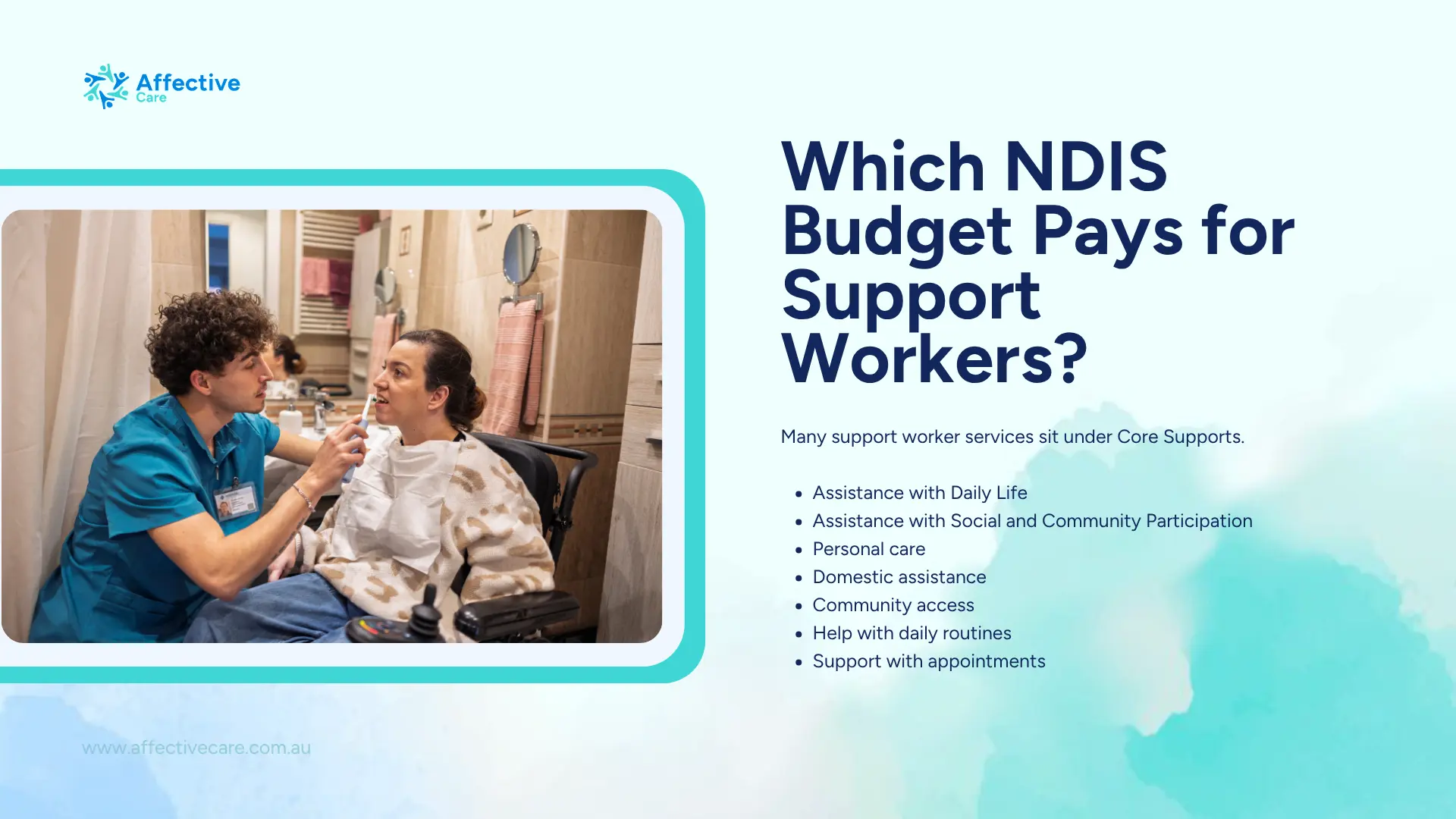
Which NDIS Budget Pays for Support Workers?
Many support worker services are funded through Core Supports, especially under categories such as Assistance with Daily Life and Assistance with Social and Community Participation.
Common support worker services may include:
- personal care;
- help with daily routines;
- domestic assistance;
- meal preparation;
- community access;
- social participation;
- support with appointments;
- help developing daily living skills;
- support in shared living or supported accommodation settings.
The NDIS Pricing Arrangements explain support purposes, support categories and support items used within the Scheme.
Some supports may also be connected to a participant’s goals, plan wording and reasonable and necessary needs.
For that reason, it is best to check the participant’s NDIS plan, funding categories and service agreement before booking supports.
When writing or speaking about NDIS funding, it is better to avoid saying a support is “guaranteed” or automatically “NDIS funded”.
A more accurate phrase is: “This support may be funded under your NDIS plan, depending on your goals, funding and support needs.”
Moreover, if you are new to the system, our guide to the National Disability Insurance Scheme gives a simple overview of what the scheme is, who it supports and how participants may use their plans.
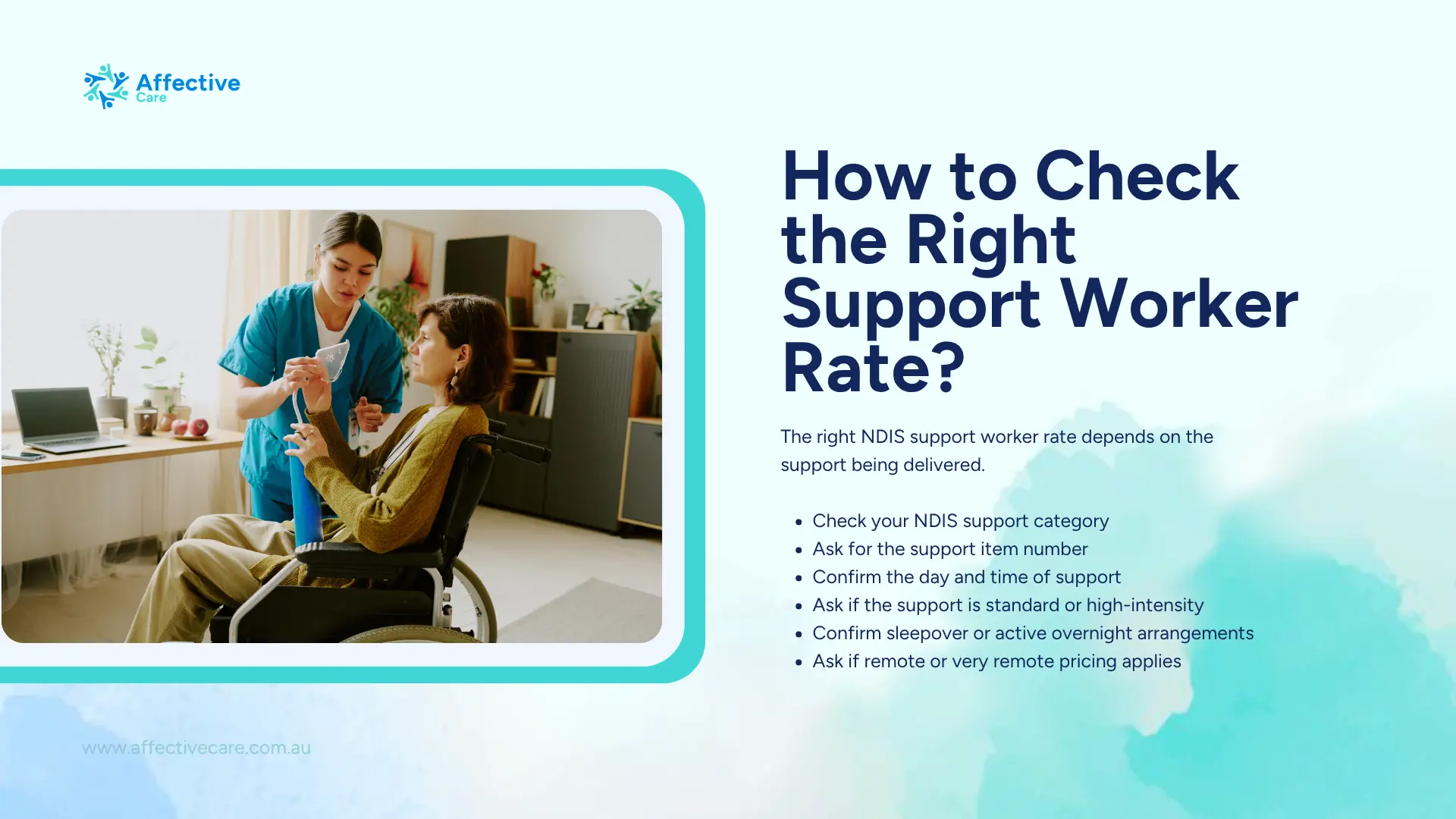
How to Check What NDIS Support Worker Rate Applies
The right NDIS support worker price limit depends on the support item being used.
Two participants may receive support from a support worker, but the rate may differ if the support type, time, location or intensity is different.
To check what rate applies, participants can follow these steps.
- Check the support category in the NDIS plan: Look at whether the support is connected to Core Supports, Assistance with Daily Life, Assistance with Social and Community Participation, or another category.
- Confirm the Support Item: Ask the provider which NDIS support item number they will use. For example, standard weekday daytime self-care support may use 01_011_0107_1_1.
- Check the Day and Time of Support: A weekday daytime rate is different from an evening, night, Saturday, Sunday or public holiday rate.
- Ask whether the support is standard or high-intensity: High-intensity daily personal activities usually have higher price limits than standard support worker services.
- Confirm whether sleepover or active overnight support applies: A sleepover is generally charged differently from active overnight support.
- Check whether remote or very remote loading applies: Participants outside major metropolitan and regional areas may have different price limits.
- Ask for the provider’s fee schedule: The NDIS price limit is the maximum that may apply. The provider’s actual rate should be clearly explained before services begin.
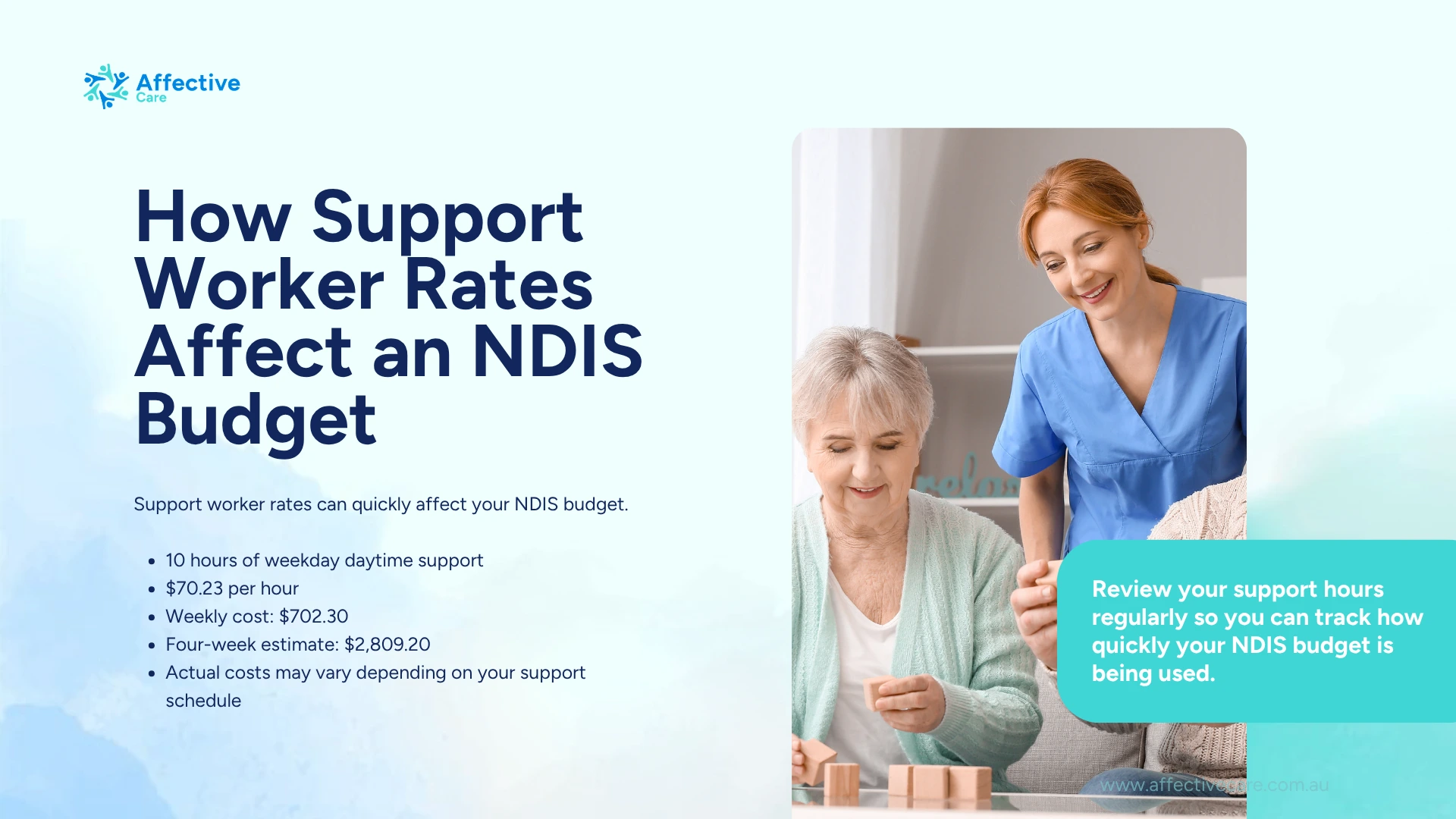
Example: How Support Worker Rates Affect an NDIS Budget
A simple example can show how NDIS hourly rates for support workers affect a participant’s budget.
If a participant receives 10 hours of weekday daytime standard support at $70.23 per hour, the weekly cost would be:
10 hours × $70.23 = $702.30 per week
A four-week estimate would be:
$702.30 × 4 = $2,809.20
This is only an example. Actual costs may change depending on:
- the number of support hours used;
- whether shifts occur on weekends;
- whether public holidays are included;
- whether support is standard or high-intensity;
- whether overnight support is needed;
- whether travel is charged;
- whether the provider charges below the price limit;
- cancellation rules;
- remote or very remote pricing.
This is why participants should review their support schedule regularly.
Small differences in rates can make a big difference over time, especially for participants who use several hours of support each week.
Moreover, Support worker costs are only one part of a plan, so our guide to how NDIS funding works explains how budgets are structured and how supports connect to participant goals and needs.
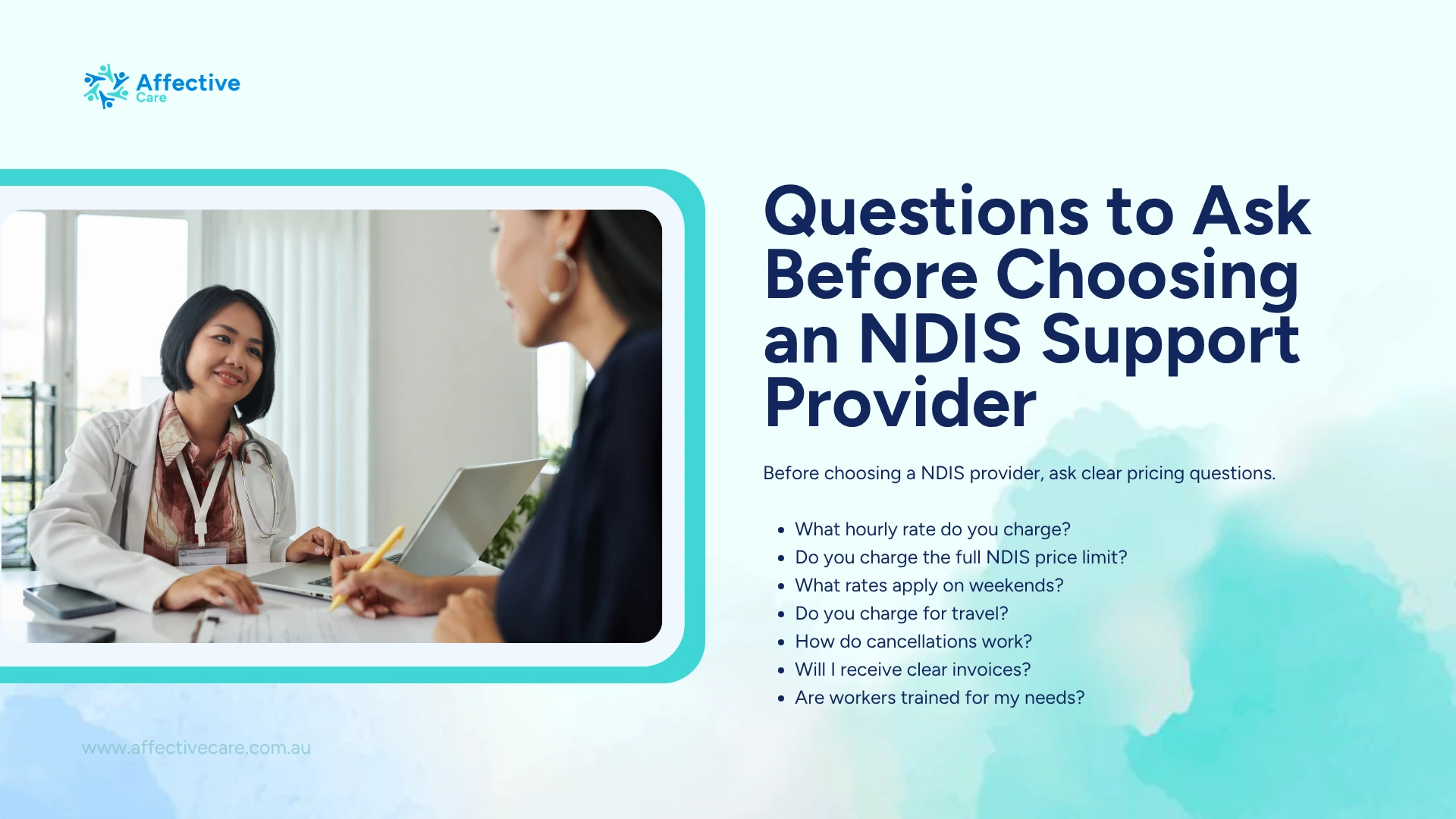
Questions to Ask Before Choosing an NDIS Support Provider
Choosing a support provider is not just about price. Participants should also consider trust, communication, worker matching, safety, reliability and respect for participant choice and control.
Before choosing a provider, ask:
- What hourly rate do you charge for weekday daytime support?
This helps you compare the provider’s rate with the current NDIS support worker rates. - Do you charge the full NDIS price limit?
Some providers do. Others may charge less. - What rates apply for evenings, weekends and public holidays?
This helps you plan ahead if you need support outside standard hours. - Do you charge for travel?
Ask how travel is calculated and how it appears on invoices. - How do cancellations work?
The NDIS Pricing Arrangements include claiming rules, including rules for some short-notice cancellations. - Are your support workers trained for my needs?
This is especially important for high-intensity supports, behaviour support needs, personal care and complex daily routines. - Can I choose support workers who suit my preferences?
Participant choice matters. A good match can support comfort, consistency and trust. - Will I receive clear invoices?
Invoices should show support dates, times, item numbers, hourly rates and total charges. - How do you support participant goals?
Support should be connected to the participant’s daily needs, independence, community participation and NDIS goals. - How do you handle feedback or concerns?
Participants should feel safe to raise questions about workers, billing, communication or service quality.
Moreover, before choosing a provider, it is worth asking what is included in an NDIS provider quote? so you can understand travel, admin and support charges clearly.

How Affective Care Supports NDIS Participants
Affective Care provides emotionally-centred NDIS support for people living with disability.
The focus is on respectful, practical support that recognises each participant’s goals, preferences, routines and emotional wellbeing.
Support may include help with daily living, personal care, community participation, higher support needs, accommodation-related support and other services depending on the participant’s NDIS plan.
Affective Care’s approach is built around trust, emotional intelligence and participant choice. This means support is not only about completing tasks.
It is also about creating a safe, respectful relationship where participants feel heard and supported in daily life.
Participants and families can contact Affective Care to discuss service options, pricing, support needs and how supports may fit with their NDIS plan.
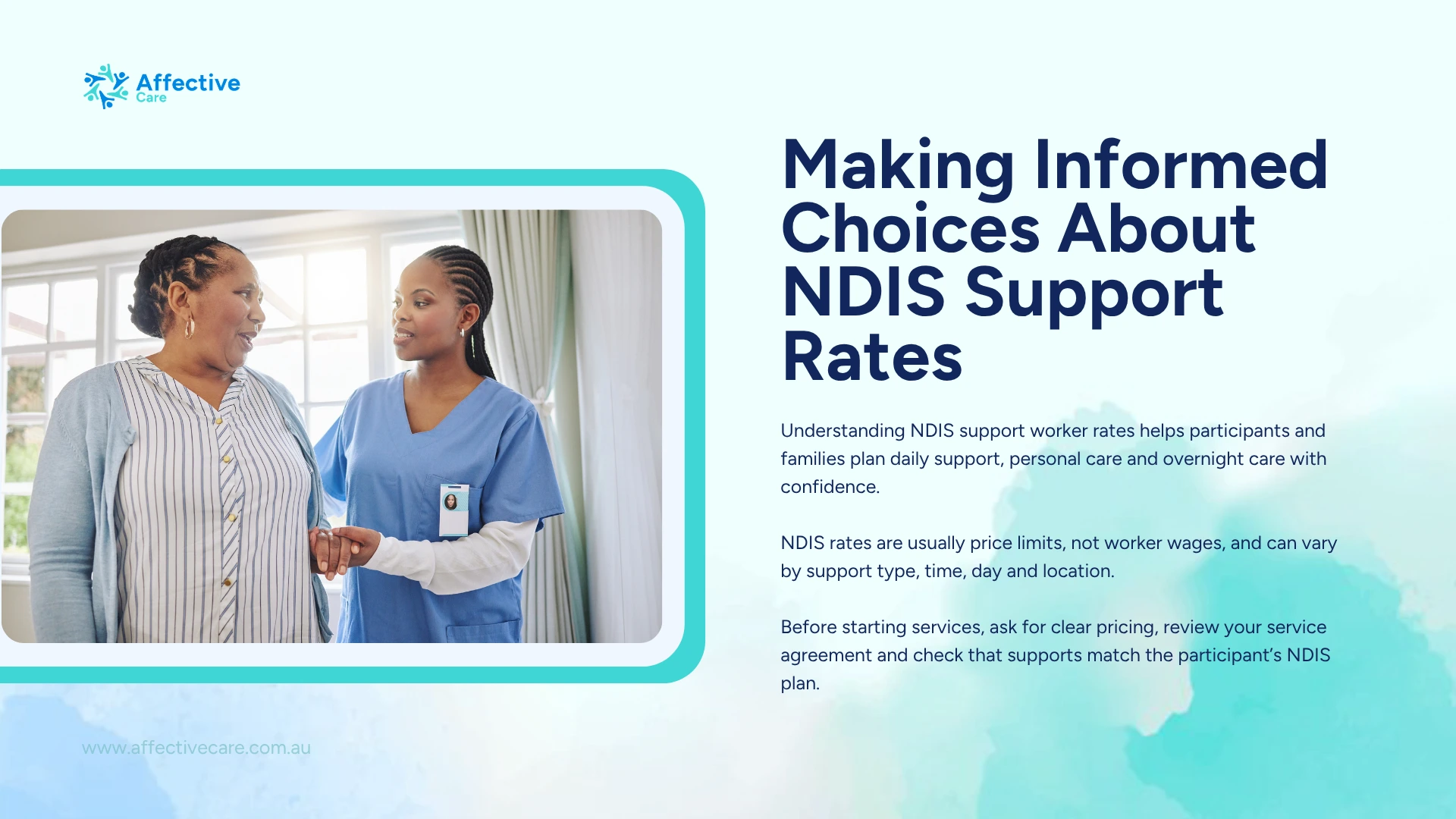
Making Informed Choices About NDIS Support Rates
Understanding NDIS support worker rates helps participants and families make informed choices about daily support, personal care, community access, sleepovers, active overnight support and high-intensity services.
The key point is that NDIS rates are usually price limits, not worker wages. The rate charged to a plan can vary depending on the support item, day, time, location and level of support required.
Before starting services, ask for clear pricing, check the service agreement and make sure the support aligns with the participant’s goals, preferences and NDIS plan.
This helps protect the participant’s budget while supporting safe, consistent and respectful care.