


Why NDIS Price Quotes From Registered Providers Matter
An NDIS price quote from a registered provider is not just a pricing document.
It is a practical tool that helps participants understand what they are agreeing to before services begin.
A good quote can help participants:
- Understand what support is being offered
- See how much the service may cost
- Check whether the support is linked to their goals
- Compare registered providers more fairly
- Identify extra costs such as travel or report writing
- Understand cancellation terms before booking services
- Share clear information with a Plan Manager or Support Coordinator
For many participants and families, an NDIS quote is also one of the first signs of how transparent a provider is.
If a provider explains pricing clearly, answers questions respectfully, and makes the quote easy to understand, it can help build trust from the beginning.
A quote does not need to be complicated. It should be detailed enough to explain the service, but simple enough for the participant or their trusted support person to understand.
If you are new to the system, our guide to NDIS explained gives a simple overview of the scheme, who it supports and how participants may use their plans.
What is an NDIS Quote?
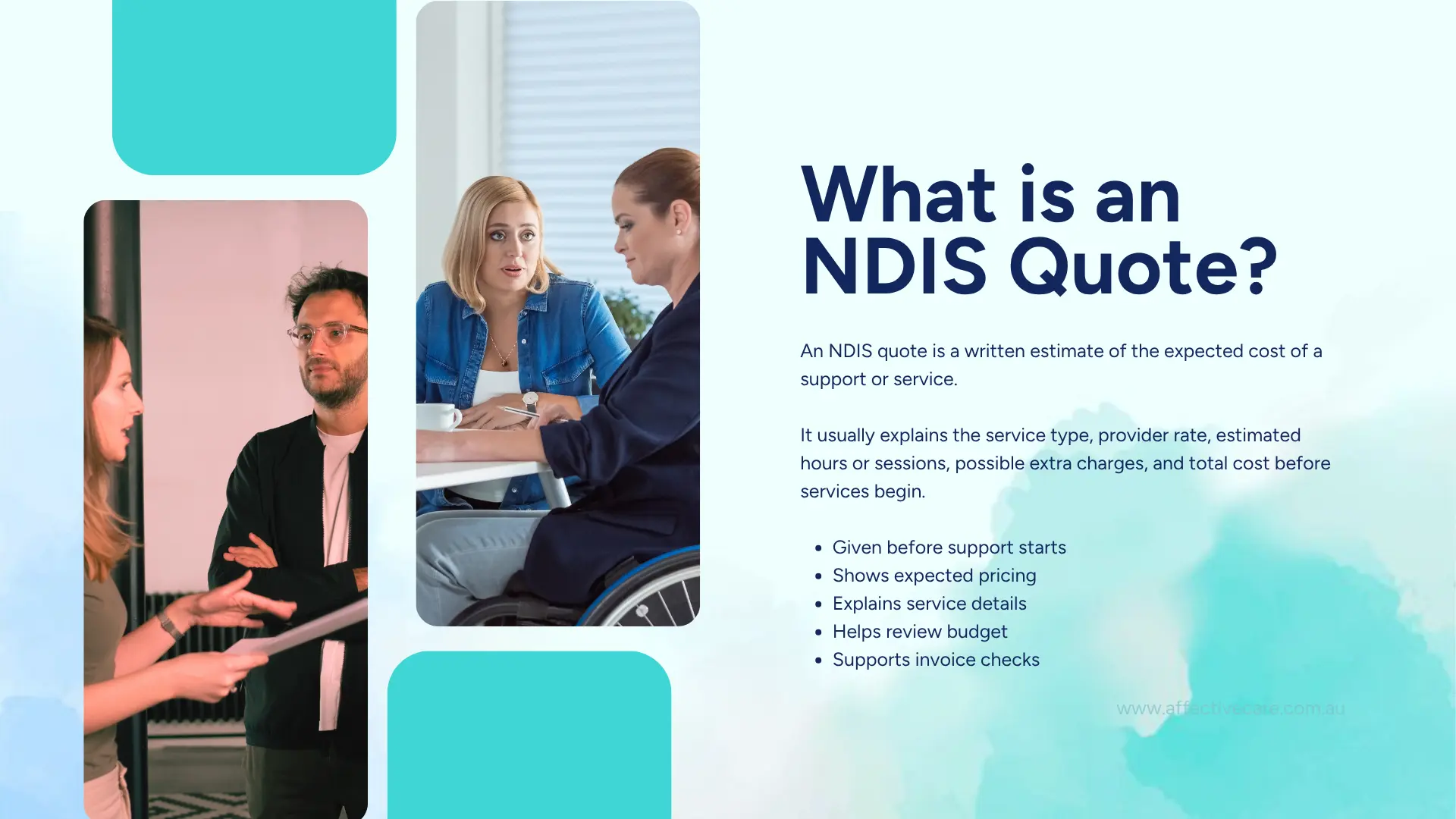
An NDIS quote is a written estimate that explains the expected cost of a support or service before it begins.
It helps participants, families, Support Coordinators, and Plan Managers understand what the provider is offering, how much the service may cost, and what details need to be checked before agreeing.
A clear NDIS quotes usually includes the type of support being provided, the provider’s hourly rate or service fee, the estimated number of hours or sessions, any possible extra charges, and the total estimated cost.
A well-prepared NDIS service quote gives the participant time to review the cost, ask questions, and decide whether the support matches their NDIS plan, goals, and budget.
It can also help a Plan Manager compare future invoices against the agreed quote, making it easier to check that provider charges are clear, consistent, and transparent.
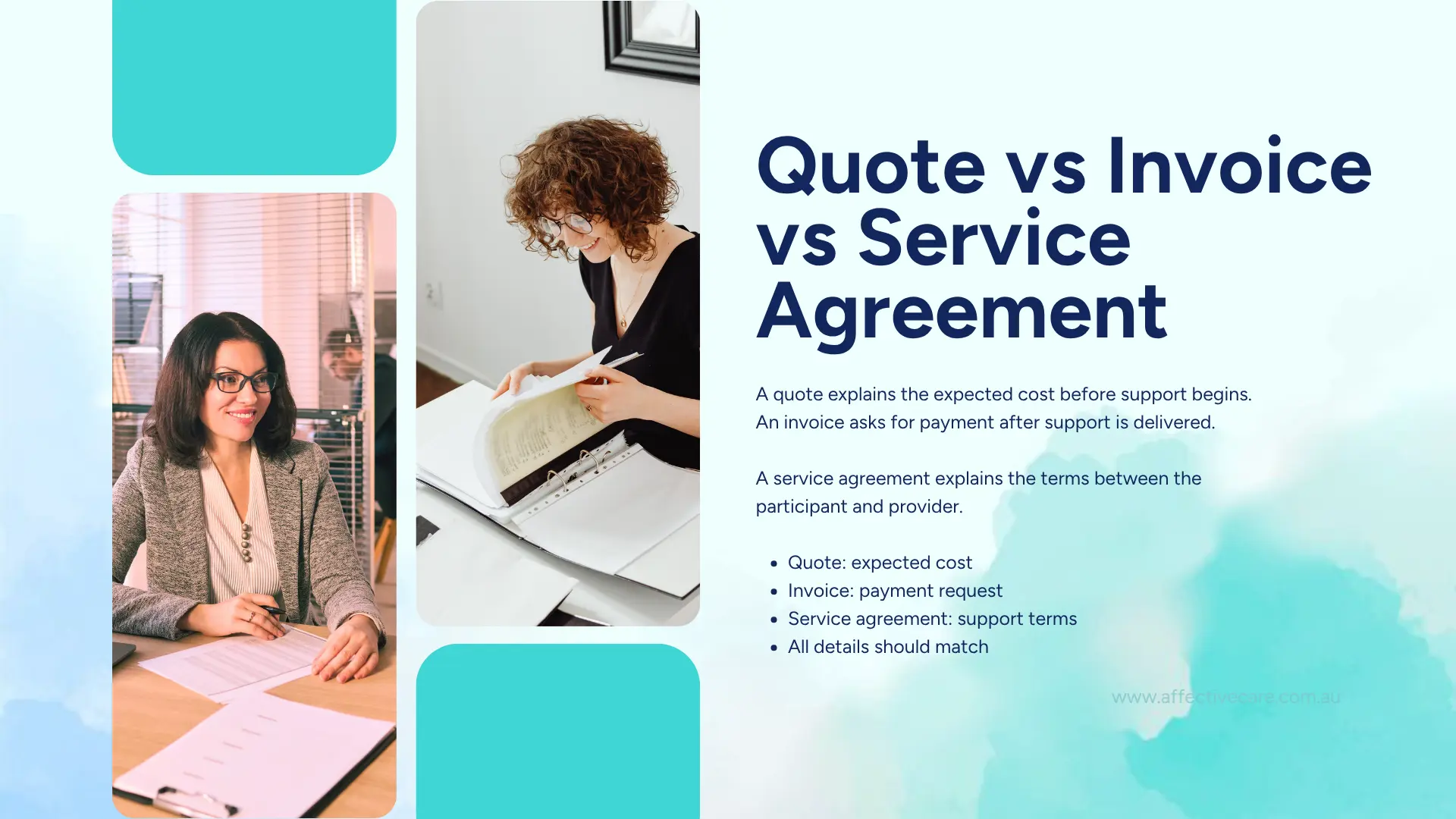
What is the Difference Between a Quote, an Invoice, and a Service Agreement?
A quote, an invoice, and a service agreement are connected, but they each have a different purpose.
Understanding the difference can help participants know what they are agreeing to, what they are being charged for, and what terms apply before and after supports begin.
|
Document |
When it is used |
What it does |
|
Quote |
Before services begin |
Shows the expected cost of the support or service. |
|
Invoice |
After support is delivered |
Requests payment for services or claimable costs. |
|
Service agreement |
Before or during the service relationship |
Explains the agreed terms between the participant and provider. |
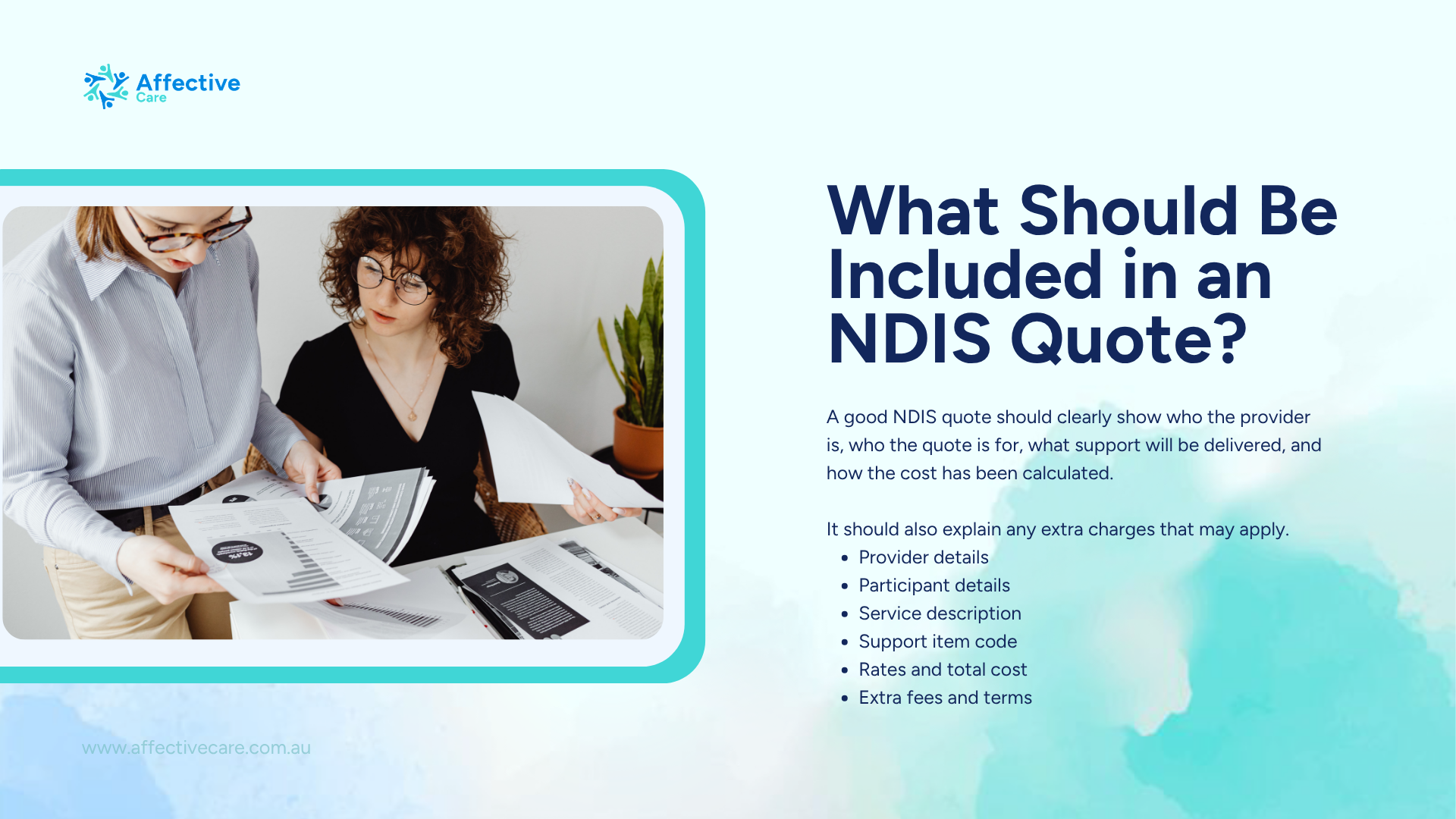
What Should Be Included in an NDIS Quote?
The good NDIS quotes from registered providers should clearly explain who the provider is, what support is being offered, how the cost is calculated, and whether extra charges may apply.
This helps participants, families, Plan Managers, and Support Coordinators review the quote before agreeing to services.
|
Quote section |
What to check |
|
Provider and participant details |
Who is delivering the service and who the quote is for. |
|
Service description |
What support will be provided and how it links to the participant’s goals. |
|
How the support fits within the NDIS plan and claiming process. |
|
|
Rates and quantity |
Hourly rate, session cost, number of hours, or service period. |
|
Extra charges |
Travel, transport, cancellations, reports, non-face-to-face work, or setup costs. |
|
Payment and terms |
GST, invoices, service period, and service agreement conditions. |
A standard quote from a registered NDIS provider should usually include the details below.
The layout may vary depending on the service, but the key information should be clear and easy to find.
Provider Details
The quote should show who is providing the service, including the business name, ABN, contact person, phone number, email, website, and NDIS registration details where relevant.
This helps participants and Plan Managers know who to contact about quotes, invoices, bookings, or service delivery.
Participant Details
The quote should identify who the quote is for. This may include the participant’s name, NDIS number where needed, nominee or representative details, Plan Manager details, and service location.
These details help reduce mistakes and keep the quote connected to the right person and support.
Quote Date and Expiry Date
The quote should include the date it was issued and how long it remains valid.
This matters because provider availability, participant needs, service costs, and NDIS pricing rules can change.
If a quote expires, the provider may need to issue an updated version.
Description of the Support
The quote should clearly explain what service will be delivered. Instead of vague wording like “support services”, it should describe the actual support, such as personal care, daily routines, therapy assessment, community access, or report preparation.
Clear wording helps participants understand what they are agreeing to.
NDIS Support Category
The quote should identify the relevant NDIS support category where possible, such as NDIS Assistance with Daily Life, Improved Daily Living, Improved Relationships, Support Coordination, Core Supports, or Capacity Building Supports.
This helps check whether the service fits within the participant’s plan.
Support Item Code or Line Item
Where applicable, the quote should include the NDIS support item code or line item.
This helps show how the support may be claimed, whether a price limit applies, and whether travel or non-face-to-face work may be relevant.
Hourly Rate or Unit Price
The quote should clearly show how the provider charges. This may be an hourly rate, session rate, daily rate, weekly rate, kilometre rate, item cost, or program fee.
Clear pricing helps participants compare providers and understand future invoices.
Estimated Hours, Sessions, or Quantity
The quote should explain how much support is expected, such as hours per week, sessions per month, appointment length, number of visits, or service period.
This helps participants understand how the total cost has been calculated.
Total Estimated Cost
The quote should show the total estimated cost for the quoted period.
If there are extra charges such as travel, transport, report writing, non-face-to-face time, cancellation fees, or setup costs, these should be listed separately where possible.
If you want a clearer overview of NDIS pricing, support categories, and how costs may apply across different services, explore our full NDIS price 2026 guide.
Travel Charges
If provider travel may be charged, the quote should explain how travel time, kilometres, parking, tolls, or shared travel are handled.
Separating travel from direct support costs makes the quote easier to understand.
Transport and Activity-Based Costs
If transport is part of the service, the NDIS quote from registered providers should explain what transport is included, how it will be provided, and whether any costs are separate.
This is important for community access, appointments, shopping, work, study, or social activities.
Cancellation Terms
The quote or service agreement should explain the provider’s cancellation policy, including notice periods, short notice cancellation rules, possible fees, and how the participant should cancel. These terms should be written clearly.
Non-Face-to-Face Charges
Some supports include work outside direct appointment time, such as planning, writing notes, preparing resources, reviewing documents, reports, or provider communication.
If these may be charged, the quote should explain when and how.
Report Writing and Documentation Costs
If reports, assessments, support letters, progress summaries, or plan review documents are included, the quote should explain what will be prepared, why it is needed, whether it is included in the total, and whether it may be charged separately.
Establishment Fees or Setup Costs
If a setup or establishment fee applies, the quote should explain what it is for, whether it is once-off, how much it costs, and whether it will appear separately on the invoice.
GST Information
The quote should state whether GST is included, excluded, not applicable, or GST-free where relevant.
If this is unclear, participants can ask the provider or Plan Manager for clarification.
Payment Terms
The quote should explain how payment will work, including who receives the invoice, how often invoices are sent, when payment is due, and who to contact about invoice questions.
Service Period
The quote should explain whether it covers one assessment, a therapy block, ongoing support, a short-term program, a SIL roster period, one report, or a trial period.
This helps avoid confusion later.
Staff Qualifications or Support Level
The quote should explain who will deliver the service where relevant, such as a support worker, nurse, therapist, behaviour support practitioner, Support Coordinator, or Specialist Support Coordinator.
This is important when the level of skill affects pricing.
For questions about invoices, payments, GST or financial responsibilities, our guide to NDIS Taxation explains key points participants, families and providers may need to know.
Terms and Conditions
The quote may include basic terms or refer to a service agreement.
These may cover bookings, cancellations, travel, payment, privacy, complaints, service changes, and ending the service.
Participants should ask for a plain-language explanation if needed.

What Different NDIS Quotes May Include
|
Quote type |
Main things to check |
|
Support worker quote |
Rates, shift length, travel, transport, cancellation terms, and support type. |
|
Therapy quote |
Session cost, assessment time, planning, reports, travel, and non-face-to-face work. |
|
Positive Behaviour Support quote |
Assessment, behaviour support plan, staff training, reviews, and reports. |
|
Support Coordination quote |
Hourly rate, estimated hours, provider communication, plan review support, and reporting. |
|
SIL quote |
Roster of care, shared support, individual support, overnight support, and annual cost. |
|
Community access quote |
Session length, transport, activity costs, travel, and cancellation terms. |
|
Personal care quote |
Daily care tasks, shift length, worker numbers, high intensity needs, travel, and rates. |
A support worker quote should explain the everyday assistance provided and how costs may change by time, day, location, or shift length.
A therapy quote should show whether the price covers direct sessions only or also includes notes, resources, reports, or consultation.
Positive Behaviour Support quotes should outline key stages such as assessment, plan development, training, reviews, and documentation.
Support Coordination quotes should show how funded hours may be used based on the participant’s needs.
Overall, NDIS price quotes from registered providers should clearly explain the support type, staffing, transport, activity costs, and any extra charges before services begin.

Plan-Managed, Self-Managed, and Agency-Managed Quotes
The way an NDIS plan is managed can affect how quotes, invoices, and payments are handled.
A participant may be plan-managed, self-managed, agency-managed, or have a mix of these options.
Because of this, the quote should clearly explain what is being charged, how payment will work, and what information is needed before services begin.
|
Plan type |
Who handles payment? |
What the quote should show |
|
Plan-managed |
Plan Manager |
Provider details, ABN, support item codes, rates, invoice process, and extra charges. |
|
Self-managed |
Participant or nominee |
Service details, price breakdown, GST, payment method, invoices, and records to keep. |
|
Agency-managed |
NDIA payment system |
Registered provider details, support item codes, price limits, and claimable costs. |
Can Registered Providers Charge Above NDIS Price Limits?
For supports with an NDIS price limit, registered providers must not charge above the relevant maximum price.
The NDIS price limit is the highest amount that can be charged for a specific support when that limit applies. It is not always the amount a provider must charge.
This means a registered provider may charge the maximum NDIS rate, but they may also agree to charge less.
Participants and providers can discuss pricing before services begin, and the agreed rate should be clearly shown in the NDIS price quote, service agreement, and future invoices.
Some providers may charge close to the maximum rate because of:
- Staffing costs
- Service complexity
- Travel requirements
- Location
- After-hours support
- Specialist skills
- Business operating costs
Other providers may charge a lower rate depending on their service model, availability, or the participant’s needs.
Clear NDIS price quotes from registered providers should show the hourly rate or unit price, support item code, estimated hours or sessions, and total expected cost. Participants should also check whether extra charges are included, such as:
- Provider travel
- Activity-based transport
- Report writing
- Non-face-to-face work
- Cancellation fees
- Establishment fees, where allowed
This is why participants should review the full quote, not just the hourly rate. The quote should explain why the rate applies, what is included, and what the participant will receive for that cost.
To better understand how different support costs are calculated, including hourly rates and service charges, you can read our detailed guide on NDIS Support price guide rates.

What Participants Should Check Before Accepting a Quote
Before accepting an NDIS quote, participants should check that the service, cost, and terms are clear. A quote should not only show the price.
It should explain what support will be delivered, how the provider has calculated the cost, and whether any extra charges may apply once services begin.
Quick Summary
|
What to check |
Why it matters |
|
Service description |
Confirms what support will actually be delivered. |
|
Participant goals |
Shows whether the support matches the participant’s plan, needs, and goals. |
|
Rate and pricing method |
Explains whether the cost is hourly, per session, per day, per kilometre, or per item. |
|
Support item code |
Helps check how the support may be claimed under the NDIS. |
|
Travel charges |
Shows whether travel time, kilometres, parking, tolls, or transport may be charged. |
|
Cancellation terms |
Explains when cancellation fees may apply. |
|
Non-face-to-face charges |
Clarifies whether reports, planning, notes, or provider communication may be charged. |
|
GST and total cost |
Helps the participant understand the full estimated cost. |
|
Service agreement |
Confirms the agreement matches the quote before services start. |

Common Red Flags in an NDIS Quote
An NDIS quotes from registered providers should be clear, transparent, and easy to understand. If it feels vague, rushed, or difficult to compare, it may need closer review before the participant agrees.
A participant should be cautious if the quote includes:
- Only a total cost with no breakdown: The quote should show the rate, hours or sessions, service period, and any extra charges.
- Unclear service descriptions: Broad wording like “support services” or “therapy” may not explain what is actually included.
- Missing support item codes: Where relevant, these codes help show how the support may be claimed.
- Unclear travel charges: Travel time, kilometres, parking, tolls, or transport costs should be explained.
- Unclear cancellation rules: The quote should state notice periods and when fees may apply.
- Unexpected setup fees: Any setup or establishment fee should be explained upfront.
- Unclear GST wording: The quote should state whether GST is included, excluded, not applicable, or GST-free.
- Pressure to sign quickly: Participants should have time to read, ask questions, and compare options.
- Different costs in the service agreement: Any extra fees should be clarified before signing.
- No contact person or expiry date: Participants should know who to ask and how long the quote is valid.
Questions to Ask a Provider Before Accepting a Quote
Asking questions before accepting an NDIS quote is a normal part of choosing a provider.
Participants, families, carers, Support Coordinators, and Plan Managers should feel comfortable asking for clarification before services begin.
A provider should be able to explain the quote in a simple way, including what support is included, how the price was calculated, whether travel or extra charges apply, and what happens if the participant needs to cancel.
These questions help participants compare providers, avoid unexpected costs, and make a more informed decision.
|
Question to ask |
Why it helps |
|
Can you explain this quote in plain language? |
Helps the participant understand the service and cost. |
|
What exactly is included? |
Clarifies what support will be delivered. |
|
Which support item code are you using? |
Helps check how the support may be claimed. |
|
Is this rate within the NDIS price limit? |
Confirms the price is suitable where limits apply. |
|
Does this quote include travel or transport? |
Helps identify extra costs. |
|
Do you charge for reports or non-face-to-face work? |
Clarifies planning, notes, reports, or communication costs. |
|
What happens if I need to cancel? |
Explains whether cancellation fees may apply. |
|
Will invoices match this quote? |
Helps avoid unexpected charges later. |
|
How long is this quote valid? |
Shows how long the price applies. |
|
How do I change or end the agreement? |
Helps the participant understand their options. |
A transparent provider should welcome these questions and answer them clearly before the participant agrees to services.
Simple NDIS Quote Checklist
The clear NDIS quotes from registered providers should help participants understand the service, compare providers, and check costs before agreeing.
It does not need to be complicated, but it should include the key details that affect pricing, support delivery, and payment.
At a minimum, the quote should include provider and participant details, the quote date and expiry date, service description, support category, support item code where relevant, hourly rate or unit price, estimated hours or sessions, and total estimated cost.
Any extra charges, such as travel, transport, cancellation fees, non-face-to-face work, report writing, or GST, should be clearly explained.
Payment terms should also show how invoices will be sent, who receives them, and when payment is due.
If there is a service agreement, participants should check that it matches the quote.
NDIS Quote Checklist Table
|
Quote detail |
What to look for |
|
Provider details |
Business name, ABN, contact person, phone, email, and registration details where relevant. |
|
Participant details |
Participant name, NDIS number where needed, representative details, and service location. |
|
Quote date and expiry |
When the quote was issued and how long it is valid. |
|
Service description |
A clear explanation of what support will be delivered. |
|
Support category |
The NDIS category the support relates to. |
|
Support item code |
The line item used for pricing or claiming, where relevant. |
|
Rate or unit price |
Hourly, session, daily, kilometre, item, or program cost. |
|
Estimated quantity |
Number of hours, sessions, visits, kilometres, or service period. |
|
Total estimated cost |
A clear total based on the rate and quantity. |
|
Extra charges |
Travel, transport, cancellation, report writing, non-face-to-face work, or setup costs. |
|
GST information |
Whether GST is included, excluded, not applicable, or GST-free. |
|
Payment terms |
How invoices are sent, who receives them, and when payment is due. |
|
Service period |
Whether the quote covers one session, a short program, ongoing support, or a plan period. |
|
Terms and conditions |
Booking, cancellation, communication, privacy, complaints, and ending the service. |
This checklist can help participants and families review the quote with more confidence.
It can also support conversations with Plan Managers, Support Coordinators, nominees, or trusted support people before services begin.
Furthermore, when reviewing provider quotes, an NDIS plan implementation checklist can help you check service details, costs, responsibilities and next steps before agreeing.


Understanding Your Quote Before Services Begin
The standard NDIS quotes from a registered providers should be clear, detailed, and easy to understand.
It should explain what support is being delivered, how the cost has been calculated, which support item may apply, and whether extra costs such as travel, cancellation fees, report writing, non-face-to-face time, setup costs, or GST may be relevant.
Participants should not have to guess what they are agreeing to. A good quote supports informed decision-making, helps protect the participant’s budget, and allows everyone to start the service relationship with clear expectations.
Before accepting a quote, participants should take time to review the details carefully.
They can ask questions, compare the quote with their NDIS goals and plan, and seek help from a Plan Manager, Support Coordinator, nominee, family member, or trusted support person if needed.
The best quotes are not only accurate; they are respectful.
They help participants understand their choices, feel confident about the next step, and know what to expect before support begins.